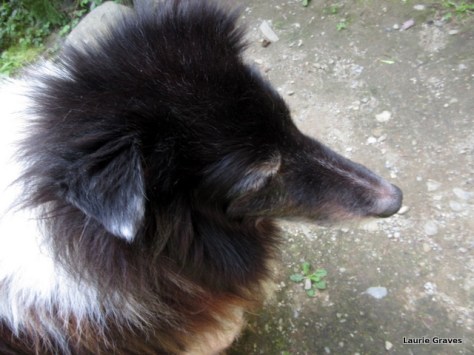
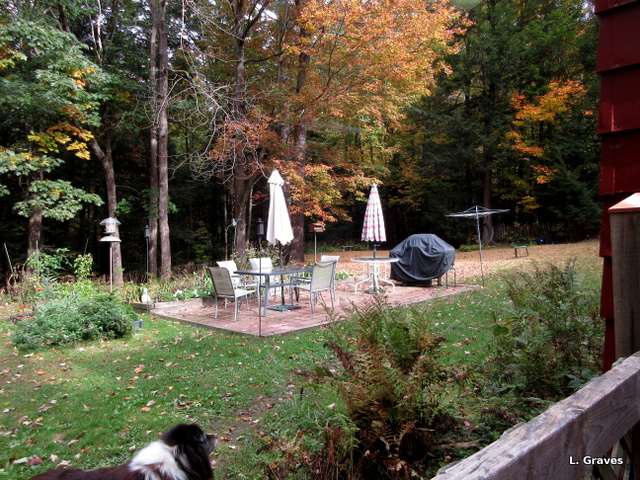
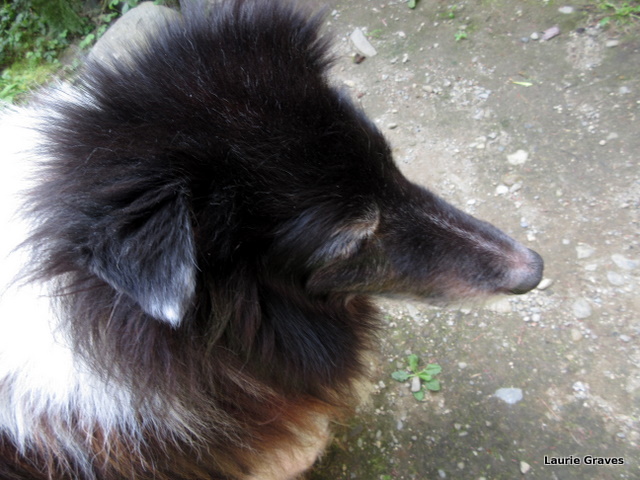
In retrospect, Clif and I could see it had been coming on for months, since spring, at least, and maybe even longer. Our dog Liam just wasn’t himself. After the morning walk, Clif would bring Liam to our fenced-in backyard, where he would take up his favorite spot by the gate. Liam is a Sheltie, and ever since he was a young dog, he knew it was his job to guard the house and us, his herd. From his vantage point by the gate, Liam could keep track of dogs and people going up and down the road, and he was diligent about alerting us when he spotted anything.
Our cellar opens into the backyard, and as soon as the weather is warm enough, say, in late spring, we leave the door open so that Liam can come in and go out as he pleases. After all, along with guarding the house, a dog has to take some time off to beg for treats during lunch. Except Liam wasn’t coming upstairs for lunch to get his usual treats. Instead, he stayed outside all day, coming in only at twilight.
“Maybe he’s got a little doggy senility setting in,” Clif said.
“Maybe,” I replied, and we both felt uneasy.
Then Liam started having a hard time going down the cellar stairs at night for his evening visit to the backyard.
“Maybe he’s got a bit of arthritis setting in,” I said.
“Maybe,” Clif replied.
One day when we were on the patio, we handed Liam a bit of something we were eating—a peanut, a crust of pizza, some chicken—I don’t remember exactly what it was. What I do remember is that Liam didn’t take it, that he just stared straight ahead. Only when we touched his nose with the treat did Liam realize it was there.
Then we knew. Liam was going blind. We did our own simple test to confirm this—we waved our hands in front of his face, and there was little reaction. This was the beginning of July, when he could still go up and down the cellar stairs, albeit slowly.
By mid-July, it was clear the stairs were too much for him. One night, he fell down the entire flight, and I felt such grief that if I had had three wishes, one of them would have been used to restore Liam’s sight so that he could go back to being the nimble, alert dog he had been just six months ago.
We took Liam to Dr. Bryant, our veterinarian, to find out if anything could be done. Unfortunately, there wasn’t. After examining Liam, Dr. Bryant concluded Liam had sclerosis of both corneas, and there was no surgery that could restore his vision.
“My dog has this,” Dr. Bryant said. “Liam will adapt. Just don’t move furniture around.”
Not a problem for us. Unless something new comes in or something old goes out, our rooms stay the way they are.
Liam has adapted, but he went through what can only be called a doggy depression. He lost weight. He slept a lot. He seemed to fold into himself, spending most of his days inside rather than outside. There was no more sitting by the gate to guard the house. In a month’s time, it seemed as though he had aged a year, maybe even two.
We’ve adapted. By the cellar stairs, Clif put a gate that can easily be opened and closed. No more falling down the stairs for the dog! To go out, we take him down the front steps, which has fewer steps. We no longer try to make eye contact. We give him frequent pats on the back to let him know where we are and that we still love him. (Liam, like most Shelties, hates to have his head patted.)
And so it goes. Our sadness has mellowed to resignation, and we do what we can to help our buddy.
It is clear Liam will never be the dog he used to be. How could he? For any dog, losing sight would be a terrible loss. For Shelties, who are so incredibly visual, it is even more of a loss.
However, recently I have noticed that every once in awhile, when Liam is in the yard, he stands still and listens. Yes, he hears someone coming down the road—a person, a dog, maybe both.
And Liam barks to let us know.




 Notes From the Hinterland