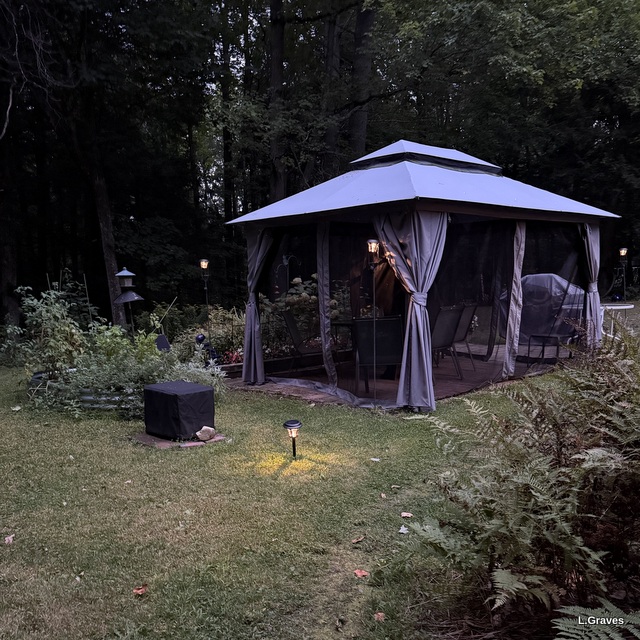
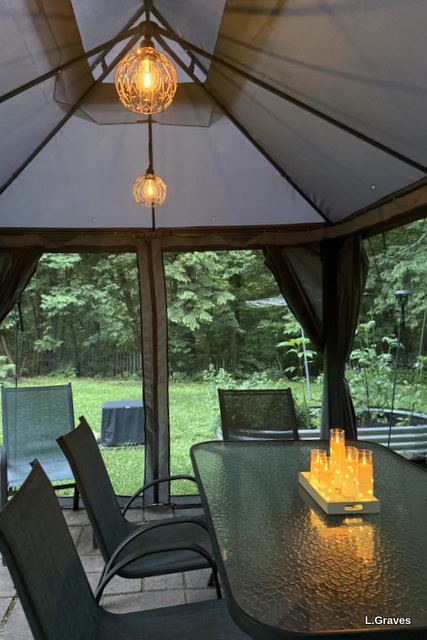
The calendar has flipped to August, high summer in Maine, and right on cue, the crickets have begun singing their sweet, sad song. There is no better place to listen than in our gazebo, which protects us from mosquitoes.
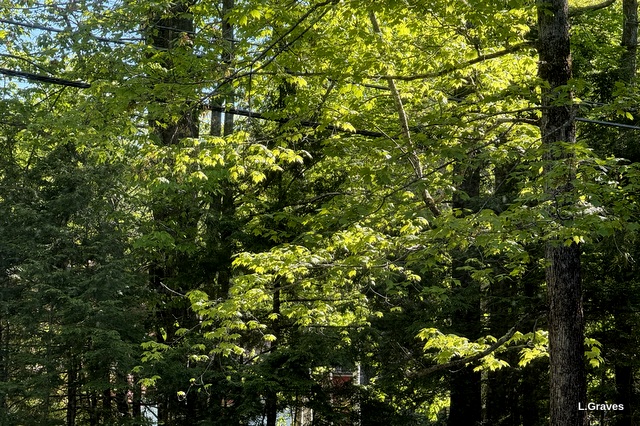
During the day, we are surrounded by green, and it feels as though we are being held by the forest.
But evening is magical, too. On Saturday night, we brought home pizza and stayed in the gazebo until nearly midnight. In Maine, there are not many months where the weather is warm enough for us to do this, and we cherish every opportunity to sit outside without a sweater or jacket.
August in Maine is also the time for tomatoes, and mine have started to ripen.
Did I eat one of those little jewels, straight from the vine? You bet I did. The rest I brought in for lunches during the week.
Clif is making good progress on the house, but the rain today, while much needed, has put a temporary halt on the job. As soon as the weather clears, Clif will be back outside to continue his work.
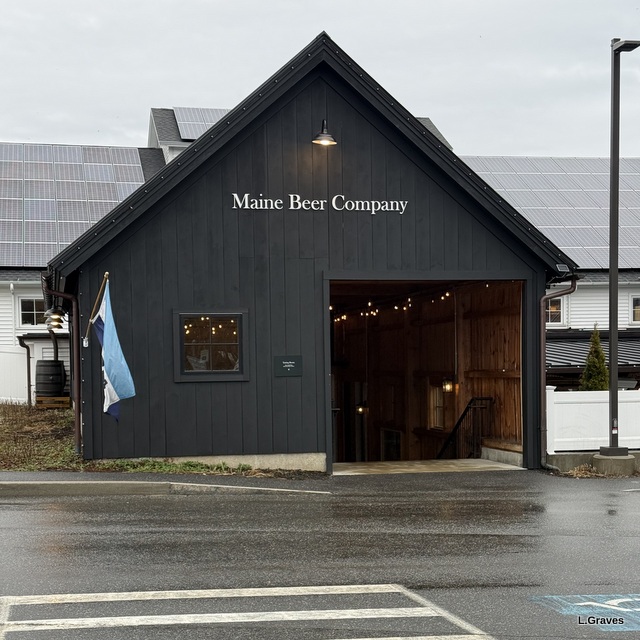
Last night, on Sunday, we met our friends Dawna and Jim at Absolem for drinks and a chat. While we love this old place with its renovated barn turned into a tasting room, we promised Dawna and Jim an invitation to our backyard sometime soon, while the weather is still warm, to enjoy drinks and appetizers. They agreed that this sounded like a great idea.
So welcome, welcome August, the month of warm delights, a slightly melancholy time as we know summer is coming to an end. Each day, dusk comes a little earlier, and the sun rises a little later. But we will cherish every day of this oh-so-lovely month, going outside as often as we can.
I expect many of you have heard of the Irish musician Glen Hansard and perhaps have even seen the bittersweet film Once, which featured his music and singing as well as that of his then-partner Markéta Irglová. This 2007 movie, made for a pittance and directed by John Carney, touched many hearts, including mine.
Less than a week ago, on July 29, Hansard was killed in a motorcycle accident, and the world too soon lost this talented musician. (He was fifty-six.) There has been a huge outpouring of grief from the well known—Bono and Bruce Springsteen—to ordinary fans of this big-hearted musician. According to the BBC, “For the past 15 years, Hansard had organised an annual Christmas Eve busking gig to raise money for homelessness charities.” I have read that, like many musicians, Hansard believed music flowed across cultures, becoming a creative force that unifies us.
Finally, here is a video of “Falling Slowly,” perhaps Once‘s most famous song and one that certainly catches the essence of the movie.
The 29th Maine International Film Festival (MIFF) is over, and Dee, Clif, and I are very slowly making our way back to reality. We saw twenty-seven movies in nine days, and yes, dear blogging friends, that is a lot of movies to see in that amount of time. By the end, my creaky knees and legs were not happy at all, and I’m thinking of cutting back next year.
But there were so many good movies I probably wouldn’t have seen anywhere else. I had planned to post my top five, but instead it will be my top six, and I could easily include ten. Yet again, I am so grateful to have a film festival of this caliber in Waterville, Maine, population 16,000. When I mentioned this to a filmmaker I met, she was astounded that such a small community would be able to host such a terrific film festival.
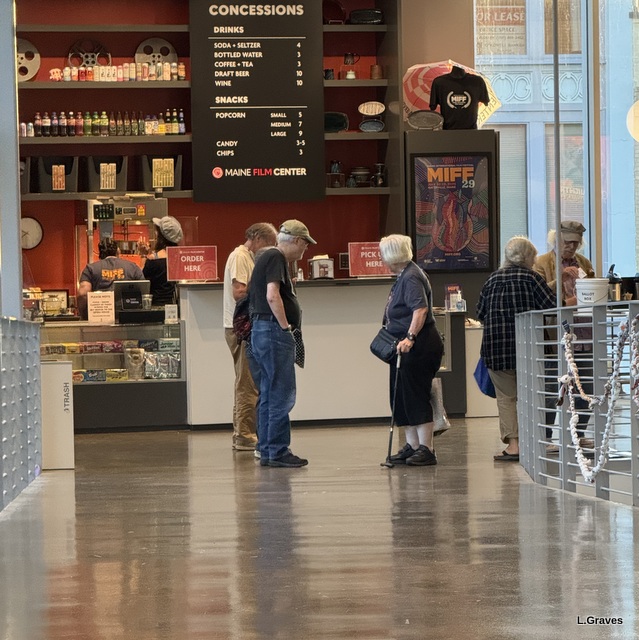
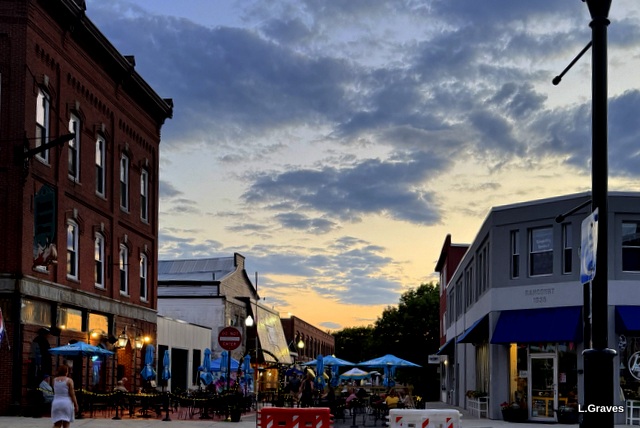
Before I list my favorites from the film festival, here are some scenes from our first day at MIFF 29.
Right from the start, there was popcorn,
and old friends to catch up with.
Drinks after a day of movies,
and a beautiful sky.
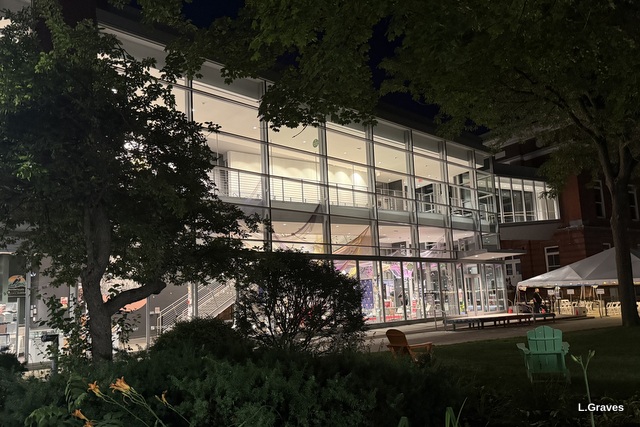
Then, back to the car, with Maine Film Center aglow,
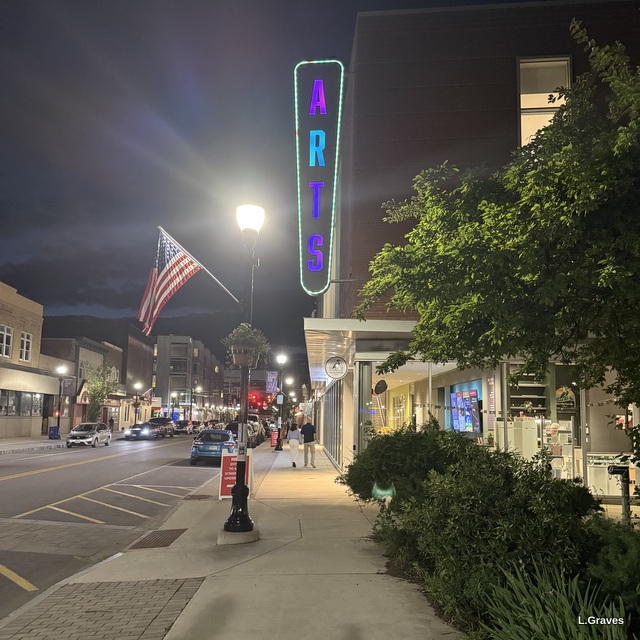
and the Arts sign lighting the way.
Many thanks to the staff and volunteers who make this film festival possible. They illustrate in a beautiful way how art and creativity can thrive even in small communities.
My Top Six Movies, Listed in Alphabetical Order, from MIFF 29
Comparsa
This documentary follows two sisters, Lesli and Lupe, as they help organize a comparsa, a street performance, to honor forty-one girls who died in a fire in a so-called “Safe Home” run by the state. Set in a Guatemalan barrio, the film illustrates how the girls and women in that community are never safe from violence and death. Comparsa also shows how art — astonishing body painting, giant puppets, music — can be used not only to protest injustice but also to heal and build community. Comparsa moved me deeply.
**********************
Hen
Why did the chicken cross the road? To get away from those who want to kill and eat her, humans and animals alike. In György Pálfi’s unique film Hen, the story is told from the hen’s perspective as she escapes an industrial farm, encounters a fox, survives being captured by a dog, and overcomes other misadventures in her quest to lay eggs and raise a family. Clucking all the way, the hen is never anthropomorphized. She is always a hen, at times hapless and at other times clever. This astonishing movie was made using real hens with nary a hint of CGI. (In the ending credits, viewers are also assured that no animals were harmed.) From the jump, my sympathies were with the hen on her perilous journey. It also made me consider whether it is enough to be a vegetarian.
**********************
Mallory’s Ghost
One of the great pleasures of MIFF is that they show films made by young directors who are just starting out. (Three of the films in my top six fit this category.) While Arabella Oz, the writer, director, and lead actor, might have made a few other films, she is clearly young enough to be at the beginning of her career. Mallory’s Ghost is set (and filmed) in Maine in a beautiful old house by the sea. Mallory and her boyfriend Sam have come to visit the enigmatic Lorna, Sam’s former writing professor. Sam hopes to kick-start his writing, and Mallory seems to be along just for the ride. Except she isn’t. She harbors ambitions of her own, and with reminders of Sam’s ex-girlfriend Louise everywhere in the house, Mallory becomes unreasonably jealous of the glamorous, talented ex who seems to be everything she is not. Mallory becomes convinced that Louise’s ghost is haunting her, even though Louise is still very much alive. However, the movie takes an unexpected twist that I will not reveal. The only thing I want to add is that Mallory’s Ghost illustrates that there are different kinds of hauntings, and I found this one to be touching and true. Unfortunately, I couldn’t find a trailer for this movie.
**********************
Still Ohio
Right now, horror is big in this country, and it’s not hard to see why. The United States provides plenty of horrors to inspire artists young and old. Still Ohio, Kaylin Allhouse’s debut feature film, centers on college sophomore Ana, who decides to transfer from Boston College to Tulane University so that she can be with her boyfriend, Doug. We never see Doug. We only hear his unenthusiastic voice when Ana calls him. Nevertheless, Doug arranges Ana’s ride to Tulane with three rowdy friends who are not ideal traveling companions. It doesn’t take Ana long to decide the trip is going to be a long one. As it turns out, the journey becomes longer than Ana could have imagined as the four get caught in a time loop that takes them over and over again to the same creepy gas station, which becomes more and more decrepit each time they stop. It is up to Ana to decide how to break free from the time loop, and in the process, there is a fair amount of blood and mayhem. However, even though I tend to be a squeamish viewer, the violence wasn’t too much for me. Again, unfortunately, I couldn’t find a trailer for this movie.
Union County
This movie features another young writer/director, Adam Meeks, but this movie couldn’t be more different from Mallory’s Ghost and Still Ohio. Union County is grounded in everyday life as it focuses on Cody (beautifully played by Will Poulter) and his journey toward sobriety. My friend Joel noted that Union County felt like a documentary, and I could see his point. The movie features real people dealing with addiction, and some of the scenes take place in what looks like a real courtroom. But this is a narrative film, and the actor Will Poulter holds Union County as he not only struggles with addiction but also with the guilt he feels for introducing his brother Jack to drugs. Union County is a spare, minimalist film that is nevertheless full of emotion. By the end, I was teary-eyed watching a scene where Cody has “a long, dark night of the soul.” Does he emerge victorious? No spoilers here. Watch this gem of a movie and find out for yourself.
**********************
Whispers in the Woods
The last movie really is a documentary, but an unconventional one filled with beauty and a reverence for nature as grand-père, père, and fils take to the woods in France. The père, filmmaker Vincent Munier, records the three-generational journey into the forests of the Vosges. Grand-père Michel, a sort of Jacques Cousteau of the woods, taught his son Vincent how to be patient, how to look and listen and be still. Now, they are teaching Vincent’s son Simon the same lesson. All through the film, I kept thinking what a lucky boy Simon was to have such mentors. In addition, Whispers in the Woods is full of stunning photography and the sounds of the forest’s denizens. The poetic narration is a gentle reminder to love and cherish the wild places on Earth, places that are under threat from not only human development but also from the climate crisis.
**********************
I hope these brief descriptions of six of the twenty-seven movies I saw at the film festival give readers some idea of the variety MIFF offers. In all likelihood, many of these films will not be coming to a cinema near you, but in time most should be available through a streaming service.
It has been hotter than heck lately, by anyone’s standards, I think. With the heat index well over 100, plenty of heat advisories were posted on weather websites. In my heart of hearts, I know this is the new weather pattern for Maine in July, and I have to accept it. But how I long for the old days, when the temperature in July seldom went above 80°F, and the humidity didn’t sap the energy from humans and animals alike. Those days are never coming back, and I feel sorry for the young people who will never experience the glory of a Maine July before the climate crisis hit.
I can only be thankful, then, that we have heat pumps, which not only keep our home pleasantly cool but also act as dehumidifiers. No more clogged salt shakers! Unfortunately, the creatures in the woods do not have this advantage, and I feel so sorry for them. Our dependence on fossil fuels has cast a wide, destructive net that ensnares the innocent.
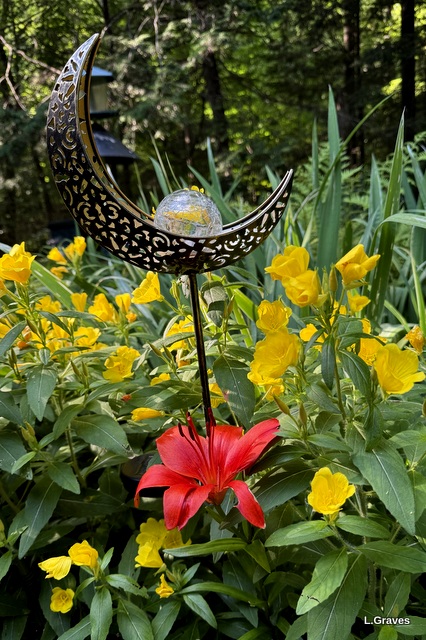
But, a bit of good news. The flowers seem to enjoy the high heat and humidity, and the evening primroses are now in glorious bloom. There is yellow mixed in amongst the green, and for a while, there was even a splash of orange.
We have had different friends over on two separate occasions, and despite the heat, we spent time in the gazebo. (In late afternoon, when the sun no longer shone in our backyard.)
‘Tis one of our favorite places to be, and although I have featured this picture in a previous post, I thought I’d include it again because the lights are so lovely.
We had planned to serve grilled bread, but a little rodent chewed through the gas line on the grill, and Clif wasn’t able to fix it before our friends came over. Next time, there will be grilled bread.
Along with the heat, July in Maine brings the Maine International Film Festival (MIFF), a ten-day extravaganza of movies, many of them foreign. We have full festival passes and are looking forward to seeing movies we might never have heard of if it weren’t for MIFF. Accordingly, I will be taking a blogging break from July 10 to July 20 or so. I’ll keep track of all the movies I see and report back with my top five. (We plan to see about thirty movies during the film festival.)
Television Series: The Other Bennet Sister, adapted by Sarah Quintrell from Janice Hadlow’s novel of the same name
It is a fact universally acknowledged that a good book is usually better than its television adaptation. This is why it is often a mistake to read a book before seeing the series. A series (or a movie) seldom lives up to a reader’s imaginative vision of the story or to the author’s skill in revealing the characters’ inner lives.
Series and movies have their strengths, of course. Acting, dialogue, sound, and cinematography can come together to produce works of art and beauty that can have a profound effect on viewers. But for this reader—a wordy, nerdy woman who has been under the spell of the written word since childhood—books are most always superior to adaptations.
And so it was with The Other Bennet Sister, Janice Hadlow’s sympathetic portrayal of Pride and Prejudice‘s Mary Bennet, the plain and awkward sister plunked among four beautiful sisters. In Pride and Prejudice, Jane Austen’s depiction of Mary Bennet is humorous but unkind, presenting her as a socially inept young woman who always says the wrong thing and can never read the room.
In The Other Bennet Sister, Janice Hadlow allows Mary to have her say, and she skillfully reveals Mary’s inner life—her love of books, her feelings of never fitting in or measuring up to her sisters. Of never being understood. Indeed, of not being loved by her family. I was with Mary all the way, and as she gradually found her footing, I cheered her on. Hadlow charts Mary’s growth in a convincing way. Mary never becomes the belle of the ball, but she does unfold in a way that is lovely to behold and true to Mary’s inner nerdy self.
The series, on the other hand, presents Mary (Ella Bruccoleri) as a clod whose facial expressions are so extreme and odd that, at times, she seems a bit touched. I was not unsympathetic with the character, but as my daughter put it, it was unbelievable that two attractive men would vie for Mary’s attention. In the novel, it was perfectly believable.
In addition, there is a plot change that makes no sense, given the times and the extreme wealth of two of Mary’s sisters. I suppose the change—Mary’s determination to be a tutor—is slipped in to give Mary some agency. This is all well and good, but it is the opposite of the way Mary feels in the book, and in the early 1800s, a family of means would never encourage one of their own to be a tutor.
I did finish the television series, and I didn’t totally dislike it, but the book was so much better.
As is usually the case.
Readers, have any of you both read the book and watched the series? If so, I would love to hear your reactions.
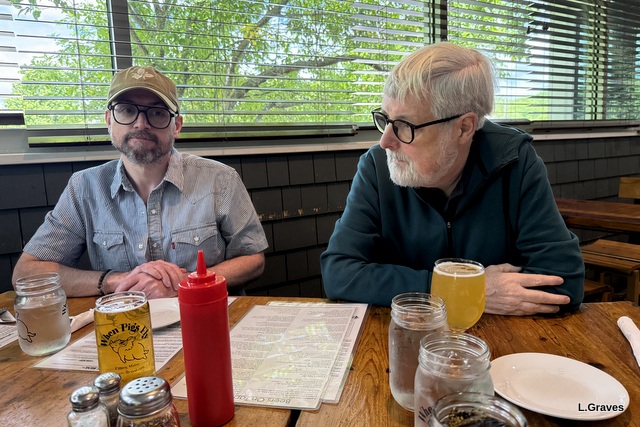
In the United States, last Sunday was Father’s Day. As longtime readers might recall, our philosophy for special days is to celebrate early, celebrate often. Accordingly, on Saturday, we met our daughter Shannon and her husband Mike in southern Maine at When Pigs Fly Pizzeria in Kittery.
Clif and Mike reflected on their beer choices. Did the beer measure up? Yes, it did.
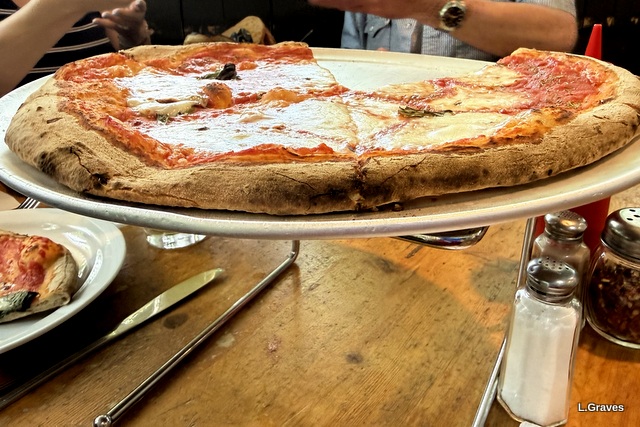
There was pizza.
And for Clif, a tofu bowl with perfectly fried tofu and ever-so-fresh pea pods.
We had a wonderful time eating and chatting. Even though we are homebodies, we so enjoy our southern Maine adventures with Shannon and Mike.
On Sunday, which was actually Father’s Day, did we stick to our usual routine and stay home? We did not. We went to a movie, The Death of Robin Hood, a violent, grim take on the famous outlaw. No merry men cavorting in tights here. This movie is not for the faint of heart, so readers be warned if you decide to see it.
After the movie, we cheered ourselves up with drinks at Margaritas in Augusta.
Duly cheered, we headed home to spend the evening in our gazebo on the patio.
With the addition of lights, our special spot has gone from very sweet to enchanting.
We stayed until dusk came, and the solar lights in our yard blinked on. Despite the grim movie, it was a very happy Father’s Day indeed.
In the United States, last Friday was Juneteenth, a federal holiday. According to Wikipedia, “It is celebrated annually on June 19 to commemorate the end of slavery in the United States. The holiday’s name, first used in the 1890s, is a portmanteau of June and nineteenth, referring to June 19, 1865, the day when Major General Gordon Grangerordered the final enforcement of the Emancipation Proclamation in Texas at the end of the American Civil War.”
In honor of this day, here is one of my favorite songs, “Blackbird,” written by Paul McCartney, who was inspired by the Civil Rights movement in the United States.
In Maine, June is surely one of the sweetest months of the year. Everything is new and green. The days are warm, but not too hot. The nights are cool enough to snuggle under blankets, which I love to do. Right now, as I work at my desk, the window is open, and I can smell the scent of early summer coming from the woods.
Living on the edge of the woods brings many pleasures, but there is a disadvantage in the summer—mainly, mosquitoes. Now, they have their place. Mosquitoes provide essential nutrition for adult birds and their babies, and I would never begrudge food for those fluttering, singing beauties. Unfortunately, we provide food for the mosquitoes, and sitting on our patio in June and July after the sun goes down is no fun at all.
What to do? Douse our yard with pesticides? Yeah, right. As if this family of green beans would ever do such a thing, especially as the mosquitoes in Maine do not spread diseases such as dengue fever, malaria, or yellow fever.
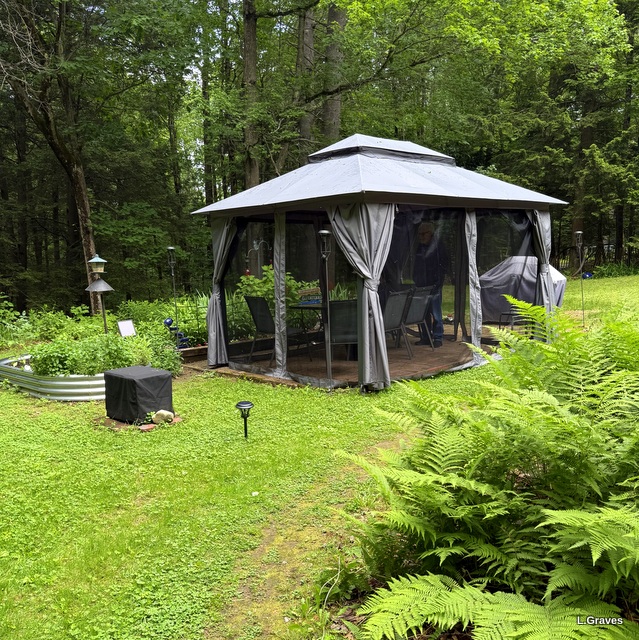
Here, then, is our solution for this year, a Christmas present from our daughter Dee.
The gazebo, roomy and airy, allows us to sit on the patio at any time of day. Occasionally, we thumb our nose at the mosquitoes, who cluster longingly around the screen. Outside. Where they belong.
Last week, we had our friends Dawna and Jim over for wine and appetizers, and eating and talking, we spent hours in the gazebo. Green is still the predominant color, but, as Dawna observed, there are many different shades. So there are, and soon, there will be other colors as well.
Dawna brought cheesecake and made the most delicious strawberry-rhubarb sauce to go with it. I could have some right now.
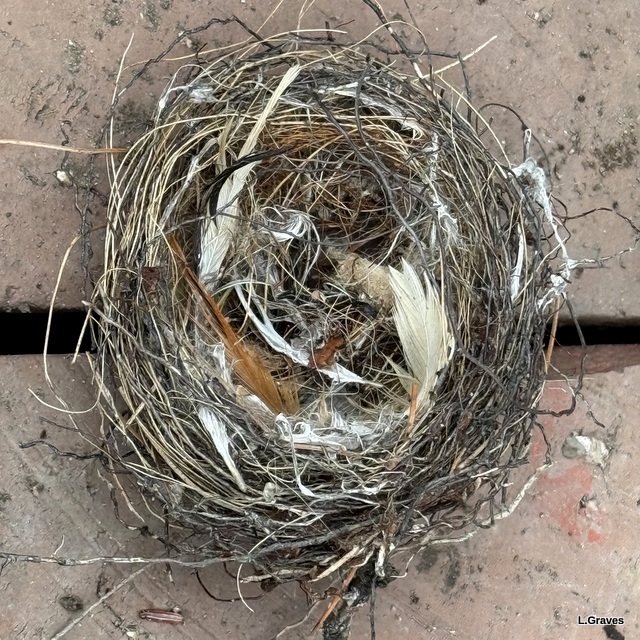
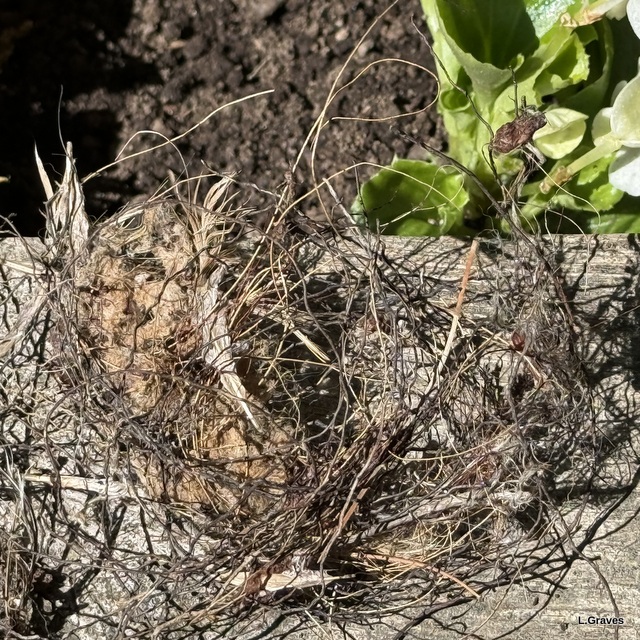
Readers might recall that several posts back, I featured a bird’s nest that had fallen onto the patio. I love the way feathers were woven into the nest.
I left the nest on the patio, and a week or so ago, as Clif was working on the gazebo, he noticed how a bird came to the nest, picked at this and that, and then flew away. The bird returned over and over, until the nest looked like this:
What a great example of recycling! Years ago, my dear friend Barbara Johnson, who has been gone for over twenty years, told me that when we come upon a nest that has blown down from a tree, it is best to leave it there, as birds will reuse the material for a new nest. Barbara, how right you were.
Power Ballad Directed by John Carney With Paul Judd and Nick Jonas
If you like Ireland, music, and character-driven stories, then Power Ballad is the movie for you. Paul Judd plays a wedding musician who yearns for more. Nick Jonas plays a boy-band musician who’s lost his mojo. Their stories come together in a bittersweet way, and the movie’s ending is so generous and kind that it moved me to tears and made me think maybe that there is hope for us as a species. Really, I can’t recommend this movie highly enough.
In Maine, Spring isn’t quite over, but we are edging ever closer to summer.
The view from my living room window shows how the trees are almost in full leaf.
Green, green, green is the predominant color in my yard.
Minerva, our guard cat, watches over the garden.
I always complain that I have one of the worst yards in Winthrop in which to garden. These sweet speckled violets prove my point. Once they were in the bed featured in the picture above. Did they like it there? They did not. Even though the conditions seemed just right in the bed, the violets abandoned ship to take up residency on the lawn.
By the side of our house, we also have traditional violets that look especially fetching alongside the beloved ferns.
I’m still busy with gardening and will be for the next couple of weeks. It looks as though I won’t be able to accomplish all that I set out to do with composting and fertilizing. I am seriously considering letting the leaves stay in the hosta beds for natural composting and fertilizing. After all, to quote my friend Jim, those hostas are as tough as a bag of hammers.
In the United States, Memorial Day was on Monday, May 25. Memorial Day is not only a time to remember loved ones who have passed, but also to honor the service and sacrifice of those who are and were in the armed forces.
Therefore, when we saw that the movie Pressure was playing at our local Regal Cinema on Monday, May 25, we figured this was the perfect day to see it.
Pressure is a movie about the weather. Specifically, what the weather would be like when the Allies planned to invade Normandy on June 5, 1944, also known as D-Day. (I expect most readers are at least familiar with the broad outlines of what happened on D-Day, and that no spoiler warnings are necessary.)
General Dwight D. Eisenhower (Brendan Fraser), an American, commanded the Allied forces, and his concern about the weather was warranted. Bad weather would make landing impossible, thus putting the whole invasion in jeopardy. But postponing the event also had its perils, not the least of which was that crucial information might be leaked to the Germans.

Enter the meteorologists—James Stagg (Andrew Scott), a prickly Scotsman, and Irving Krick (Chris Messina), an overconfident American. (Is there any other kind?) The movie opens seventy-two hours before the planned invasion on June 5. Krick, going by the weather in the past, predicts that the day will be sunny and calm. Stagg, receiving reports of storms approaching Great Britain and France, thinks otherwise.
The decision to attack on June 5 or to postpone the invasion is the central tension of the movie, and Pressure does a terrific job of ratcheting up this conflict. We all know the outcome, yet I was still on the edge of my seat as Stagg and Krick fought about the weather, and Eisenhower had to decide what to do.
Andrew Scott and Chris Messina were perfectly cast as the feuding meteorologists. The stakes couldn’t have been higher, and I was sympathetic with both men. Unfortunately, Brendan Fraser’s volatile performance as Eisenhower was not quite as good. I have read that Eisenhower took pride in being calm and measured, in not having meltdowns under pressure, which must have been considerable in the lead-up to D-Day.
Still, the movie is very much worth seeing, a timely reminder of the courage and wisdom our leaders displayed when the outcome of the war lay in balance.
Once upon a time, we had great leaders who did the right thing. Perhaps, someday, we will have them again.
On a gray, rainy Sunday, Clif, Dee, and I headed south to Portland, the Babylon of Maine, and our biggest city (population: around 68,000). Dee was keen on seeing the movie Exit 8, and as far as we could tell, none of the cinemas in our area would be showing it. Fifty miles one way is a bit of a drive for a movie, but because of the weather, we couldn’t work outside, and our electric vehicle, Bolty, gives us a guilt-free drive. So it seemed like a good day to head south. And as Dee noted, any day is a good day to go to the movies.
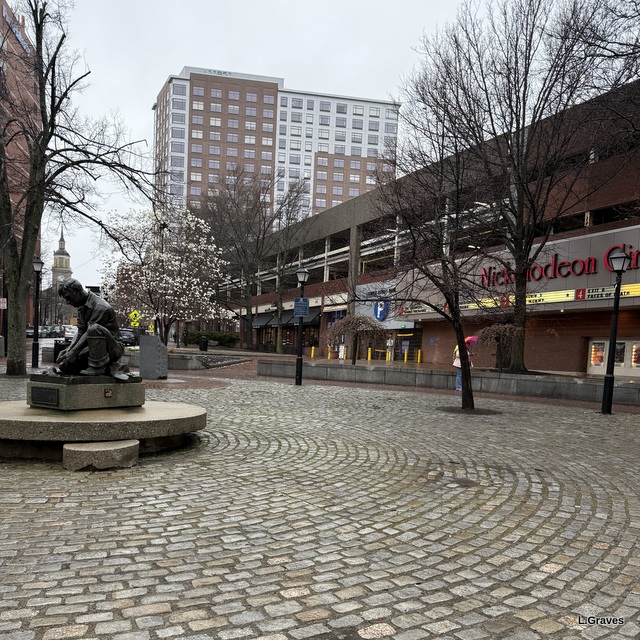
We made it to Portland in good time, and the Parking gods were on our side—there was an empty spot across from the Nicholodeon Cinema, affectionately referred to as “The Nick.” This empty spot really was a gift from the gods, as the parking garage, for some unknown reason, was closed, and there was a big event nearby.
So was it worth driving that far to see Exit 8? It certainly was. Exit 8, directed by Genki Kawamura, was so good that I’ve already put it on my list of best movies for 2026. Billed as a “mystery, psychological, horror film,” Exit 8 is actually light on horror and strong on psychological and mystery. Readers who are squeamish about horror films can go to this movie without fear. Exit 8 is also a surreal film, but it is primarily the psychological journey of Lost Man as he grapples with issues that are holding him back. Think Groundhog Day melded with The Twilight Zone with a dash of Waiting for Godot. Despite these twists, the movie manages to be warm and humane as we follow Lost Man on his journey.
I don’t want to give too much of the plot away, as the delight of this film lies in following Lost Man. Simply put, after receiving an important call from a former girlfriend, Lost Man, on his way to work, gets off the subway and finds himself in a series of white-tiled corridors that lead to Exit 8, his way out. Except Lost Man can’t leave and keeps looping around the bright yet bland corridors. Finally, Lost Man notices a sign with instructions, the most important of which is to turn around whenever he encounters an anomaly. If he doesn’t, Lost Man is back to zero. Literally.
Lost Man makes progress and has setbacks, and I was rooting for him the whole time. The film is moving but never cheesy, a real gem that cost about $1 million to make, which is peanuts nowadays.
Note: The trailer emphasizes the film’s horror elements rather than the humane quest of Lost Man.
For those who don’t live in northern New England, it might seem as though Spring is taking her own sweet time to get here. But for Mainers, things are moving very fast indeed.
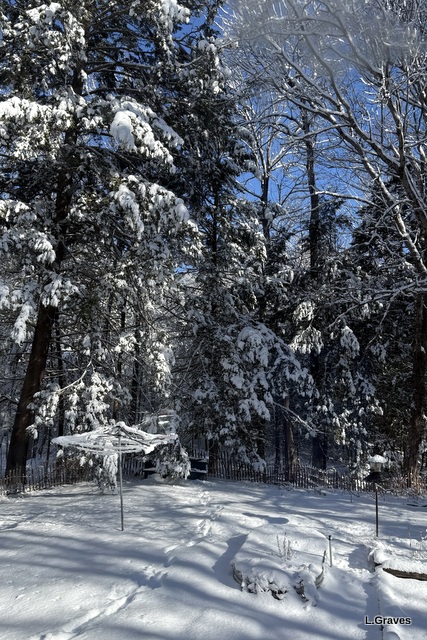
As a visual aid, here is a picture of the backyard last week.
Looks like a winter wonderland, doesn’t it? Except that the picture was taken on March 23, which is officially spring in the northern hemisphere.
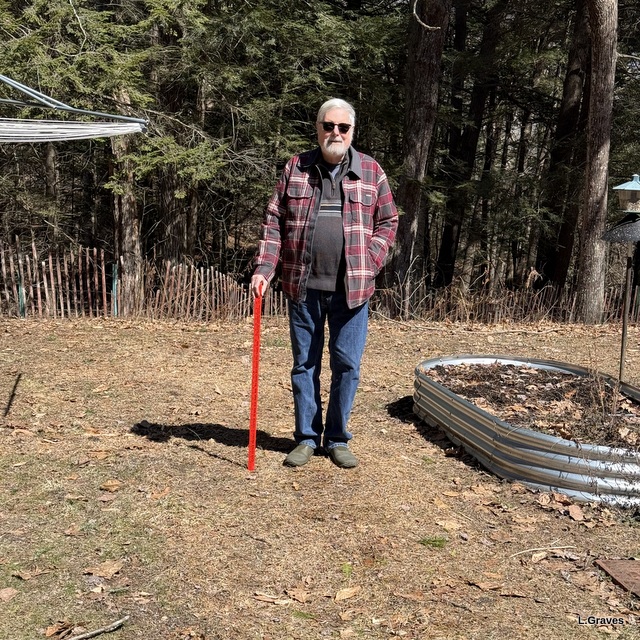
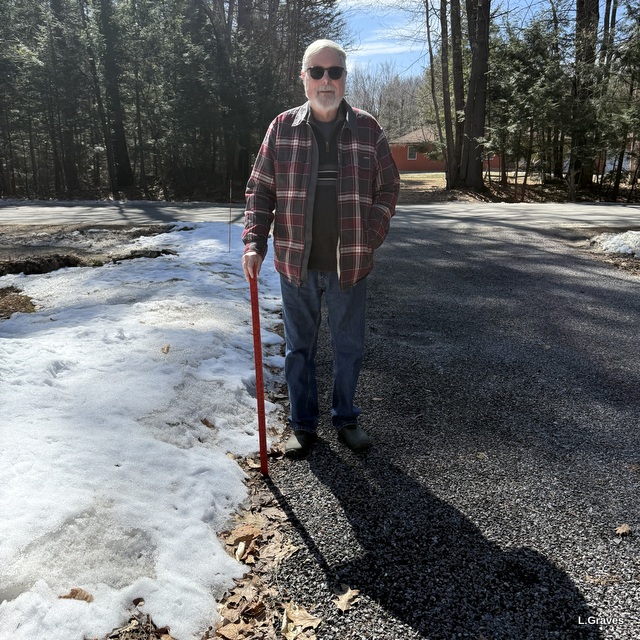
But Spring hasn’t forgotten us after all. Here is the backyard this week, featuring Snow-Gauge Clif.
For this Mainer, that snow melted pretty darned fast.
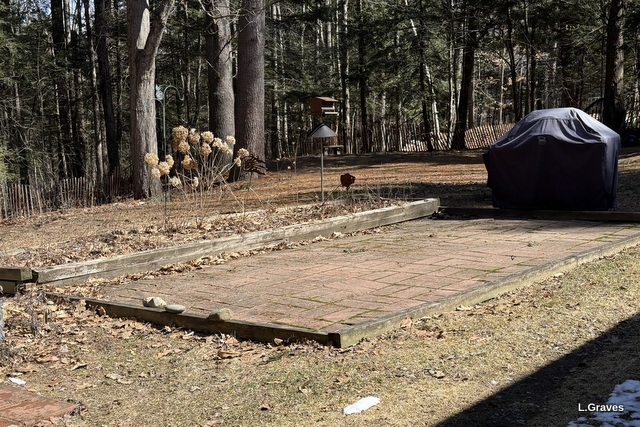
And look! The snow on the patio is completely gone. Time was when we hoped it would be clear by April 22, our daughter Shannon’s birthday. Now, it often melts by the end of March, and somehow, I have a hard time wrapping my head around this. It just doesn’t seem normal, even though this has been the case for several years.
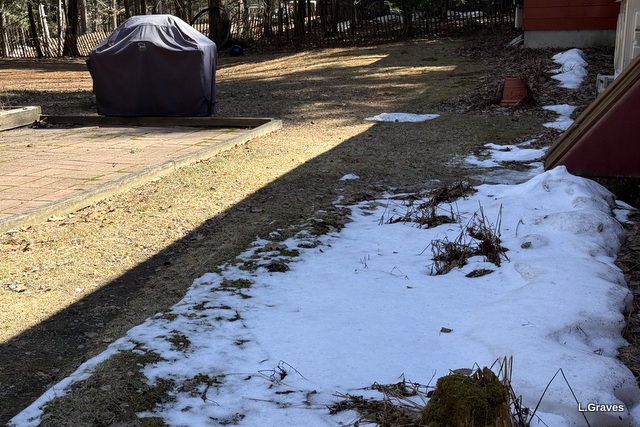
While the backyard is mostly snow-free, there are still patches by the shady side of the house where the ferns grow in the summer.
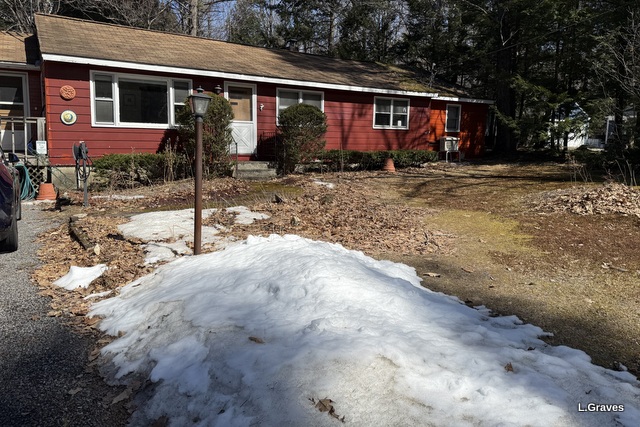
Now to the front yard, where there is more snow.
But even in the front yard, the snow has gone down a lot. Here is a longer view.
When will the snow be gone from the front yard? Hard to say. It all depends on how warm it gets, whether it rains, and—dare I mention it?—whether we get another snowstorm. And yes, Maine sometimes gets April snowstorms, which tend to be wet, heavy, and nasty.
One thing is certain: there is excitement aplenty at our home by the edge of the woods.
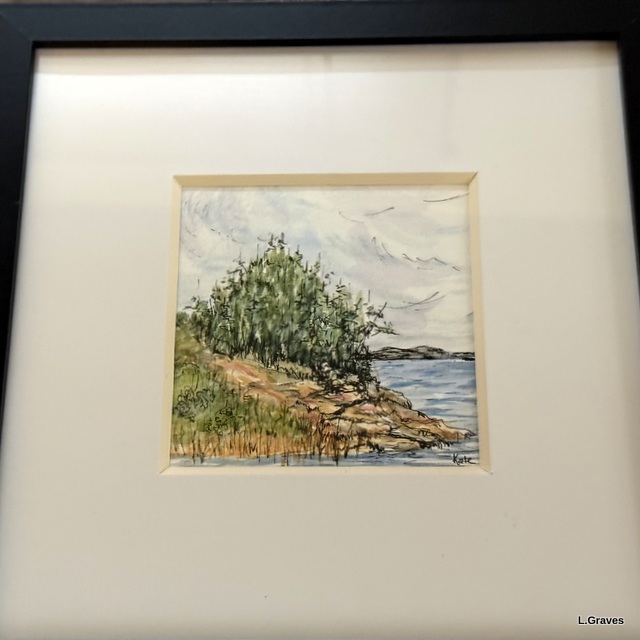
Last week, I featured one of the paintings Dee bought at the Maine Evergreen Hotel in Augusta when we met friends and celebrated our 49th wedding anniversary. Dee bought two paintings, and here is the second one: a delicate pen-and-watercolor by Kate Casparius, quite different from the bold owl. Unfortunately, the camera on my phone doesn’t do this lovely painting justice. But it does give readers a sense of the range of work available at the Evergreen.
This Thursday, we will be meeting friends at the Evergreen, and Dee plans to buy a third painting.
Documentary: Herb and Dorothy, Available on YouTube
Dee is crazy about art and buys a piece whenever she can afford it. So far, although some has spilled out to the rest of the house, there is room on the walls in her room for most of her art.
However, when it comes to buying art, some folks have less restraint than Dee. Enter Herb and Dorothy Vogel, a postal worker and a librarian, whose passion for art exceeded that of most everyday folks. In the 1960s, they decided that they could live on one salary and buy art with the other. And boy did they ever buy art. Their small New York City apartment was crammed full of it to the point where they had to get rid of their sofa to make room for more art.
If you haven’t already seen the documentary about this charming, generous, obsessed couple, do yourself a favor and watch Herb and Dorothy. In a world that is often crabbed and stingy, the Vogels stand out as a shining example of the best of what people can be, even if most of us don’t want to stuff that much art into our homes. Slight spoiler: The Bowdoin College Museum of Art in Maine has been the beneficiary of their generosity.
How things change from one week to another. Last week, it still looked and felt like winter—the air was cold, and the snow sparkled. But Spring has her eyes on us, and yesterday, the temperature shot up to 60°F. Holy cats, it was so warm that I went outside without a jacket.
Now that we have entered this time purgatory in Maine, the snow is no longer lovely and sparkling. Instead, it’s packed down hard, and the snow banks…well, the snowbanks look like this:
But nearly every place has its challenging months—maybe Hawaii doesn’t?—and in Maine, we must suffer through March to get to April, when Spring truly begins.
Still, even in this soggy, dirty time, there are hopeful signs that Spring is just around the corner. The other day, I heard the male cardinal singing his spring song. Such a lovely sound. And the ice on the pathways has started to melt, making walking on them so much easier.
Now to Snow-Gauge Clif.
We have decided that while Clif’s snow gauge might be charming, it is not, ahem, the most accurate way to measure snow. There’s a solid wedge of snow between the top cover and the ground, and the snow gauge can’t break through that wedge. Therefore, the snow gauge will be used as a visual cue rather than as an accurate measurement tool.
In the front yard, the snow hasn’t melted much, but the driveway is much clearer. Progress!
Here he is in the sunnier backyard, where we are seeing some more progress, at least on the pathways.

Rain is in the forecast for this week, and perhaps it will wear some of the snow away in our shady yard. However, March often has a sneaky way of bringing us wet, heavy snowstorms that can knock out power.

So only time will tell! Stay tuned for next week with Snow-Gauge Clif.
Movie: It Was Just an Accident, an Oscar nominee for Best Foreign Film
The 2026 Academy Awards ceremony will be televised next Sunday, March 15. As movie buffs, we are always interested in seeing nominated films, and although we never manage to see them all, we do a pretty good job of seeing most. This week, It Was Just an Accident was on our roster. To borrow from an old saying, better late than never. As it turned out, this Iranian film was my absolute favorite of the year.
Now, I am certainly aware of the significance of my choice. After all, the U.S. is pounding the crap out of Iran, which in turn is pounding the crap out of its neighbors. A horrible, brutal mess with implications that might be with us for a long while.
But I did not choose It Was Just an Accident because of its political significance. Instead, I loved this movie because of the skill of its director, Jafar Panahi—his humanism, his humor, and his wisdom in telling what is essentially a grim story.
A brief synopsis: A man, Eghbal, and his family are driving on a dark road at night. First, he runs over and kills a dog, then his car breaks down. He brings it to a local garage to be fixed. Eghbal has a prosthetic leg, and when one of the mechanics, Vahid, hears it squeak as Eghbal walks, this sets off a chain of events. Vahid is certain he remembers that awful squeak from when he was in an Iranian prison, and that this is the man who tortured him.
Determined to kill Eghbal, Vahid kidnaps him and plans to bury him alive. But when Eghbal insists he is innocent, Vahid begins to have doubts. Knocking Eghbal out, Vahid stuffs him into a large box in his van and sets out to find others who might be able to confirm that this is indeed the right man.
What follows is a darkly comic series of events as Vahid acquires a group of folks who have been tortured by a man with a squeaky prosthetic leg. But is it this man? They were all blindfolded when they were tortured, and no one saw his face.
One of the funniest scenes is when Vahid is approached by security guards who demand a bribe to let him and his cohorts go on their way. The guards are unaware that Eghbal is hidden in the van. When Vahid tells the guards he has no cash, one of them whips out a credit card reader, and all is well.
At the same time, this movie is no spoof, and it addresses serious issues—mercy, guilt, brutality, vengeance, and memory. Each character feels fully rounded rather than a type. Really, I cannot recommend this film enough. It Was Just an Accident is available on Hulu and can also be rented on Prime Video, Apple TV, and YouTube.
On Friday, the sky—to borrow from Simon and Garfunkel—was a hazy shade of winter.
In February in Maine, that can mean only one thing—snow—and snow it did, about five or six inches, which for northern New England is a nice little storm. The snow was not too heavy, and our trusty electric snow-thrower, Snow Joe, easily took care of it.
On Saturday, the skies cleared, and we had one of those beautiful winter days that Maine is known for.
Here is the view of our front yard from our living room window.
A side view from the window in my bedroom.
Kai decided he needed to look out the window, too. Perhaps he needs his own little camera?
Today—Monday, February 23—the sky is again a hazy shade of winter. A nor’easter is blowing up the coast, and this morning my daughter, who lives in Boston, wrote to tell me it is snowing so hard she can’t see the bridge from her window, a bridge that is usually visible.
South of us, in Portland, the nor’easter has hit with blowing snow and low visibility, but in central Maine, it has just begun to snow. The forecast is between four and eight inches. Again, no big deal for us.
For years, I wished we lived closer to the coast. I love the ocean and the sound of waves hitting the shore. The salt air and the cry of gulls. But now that the climate crisis is upon us, I am glad we live inland, where, as a rule, the storms aren’t as bad.
And although we live in a lakes region, not far from the Kennebec River, we live on a hill that keeps us high and dry when we do get storms. No flooding at our home at the edge of the woods. I wish I could write that this was our plan when we bought the house forty-two years ago, but it wasn’t. Instead, it was pure dumb luck. Always grateful when Chance is on our side.
Note: Long-time readers have been asking about Snow-Gauge Clif and when he will be featured on the blog. Well, I have some good news. Snow-Gauge Clif always makes his appearance on the first Monday in March and then on every Monday, usually into April, measuring the snow until it is gone. Next Monday is the first Monday in March. Stay tuned.
One of my blogging friends, Derrick Knight, mentioned in a comment that he can’t go to the movies anymore because he has to sit with his knees bent. I replied that in today’s post, I would show him why, with my creaky knees, I can go to the cinema and sit in comfort.
Here is the reason:
Our cinema has recliners, which I fondly refer to as Baracloungers, and they are oh-so-comfortable, especially for folks like me with creaky knees.
Our cinema, Regal, also offers a pass for $24 a month that lets us see one movie a day. Naturally, we don’t go to that many. We might be true-blue ciniphiles, but we have our limits. Usually, we see one movie a week, maybe two, depending on what’s showing. But even if we only see one, the cost is about $5 a movie, which is a wicked good deal.
Last weekend, we saw the crime thriller How to Make a Killing, a dark comedy about Becket, a young man from a rich family. Although his mother was banished, Becket is in line for a substantial inheritance, but other family members are ahead of him. What to do? Why kill them, of course. And that’s exactly what Beckett, played by the ever-charming Glenn Powell, sets out to do. Naturally, complications ensue along with a nifty plot twist at the end.
I’m only a little ashamed to admit that I enjoyed every minute of this movie, no doubt largely because of Powell’s charm. If you like dark comedy crime movies and shows, such as Burn Before Reading or Ripley, then you will probably like How to Make a Killing.
A blog about nature, home, books, movies, television, food, and rural life.