Yesterday, we had a lashing rain and discovered there was a leak around the chimney. As soon as it dries, Clif, like Santa, will be up on the rooftop, but instead of coming down the chimney, Clif will be patching the leak. (And a good thing, too, because the chimney leads directly to the wood furnace that heats our home.)
But we in central Maine should be grateful. In northern Maine, instead of a lashing rain, they had a wintry mix, a term that chills the heart of any Mainer, as freezing rain is usually part of that mix. However, I haven’t heard of any widespread power outages, so the wintry mix couldn’t have been too bad.
Quiet has returned to the little house in the big woods. Yesterday, Somara and Holly went back home with Shannon. (How thrilled they were to see her!) My cold, finally, is going away. (I’ve had ten not-so-merry days of coughing myself silly.)
Time to roll up the sleeves and start with the Christmas cooking. The new convection oven works like a champ, and I’m ready to make peppermint-frosted shortbread and thumbprint cookies. Homemade ice cream pie. Peanut butter balls and chocolate-covered pretzels. Many of these goodies will be going out to the various elves who make our lives better.
This weekend Shannon and Mike went to North Carolina to look for a place to live—they’re moving the end of December, and how we’ll miss them! Therefore, Clif and I took care of Shannon and Mike’s dogs, Holly and Somara, while they were away.
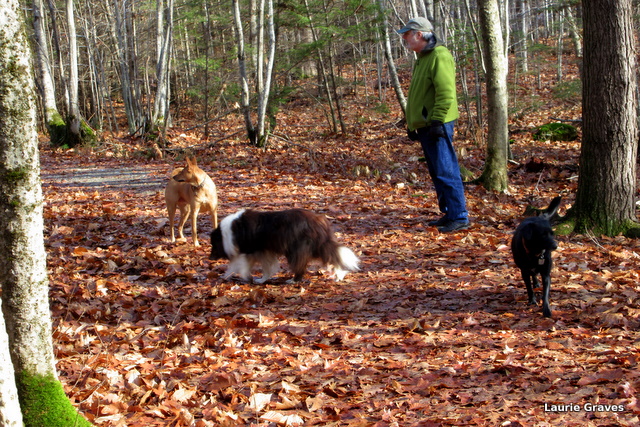
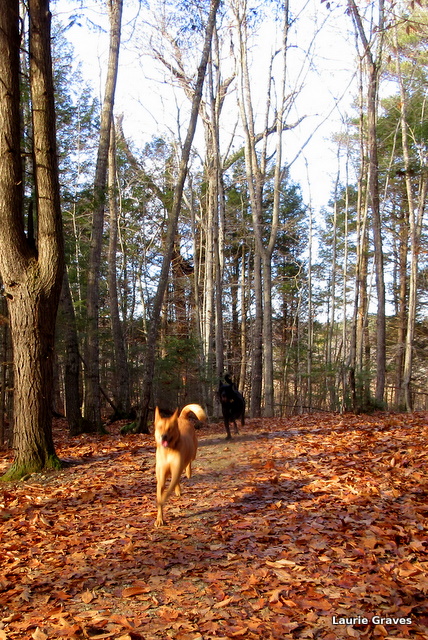
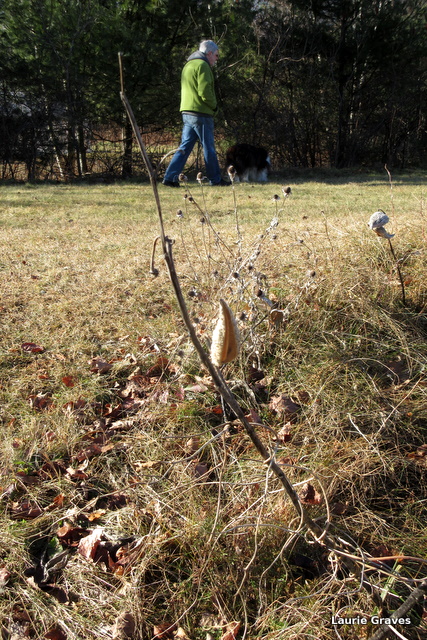
Each day, into the woods we went so the dogs could sniff and run and play. How lucky for us to have such beautiful trails so close by. And, I must admit, even though it is freakishly warm for December in Maine—in the fifties, no less—I was grateful to have bare trails for our doggy romps.
Somara running lickety-split
Clif and the gang
Waiting at attention for treats
More lickety-split
Shannon and Mike aren’t the only ones we’ll miss. We’ll miss those dogs, too.
During this busy time of year, especially when I have a cold—as I do now—I inevitably turn to Miss Read (aka Dora Saint) for some peace, common sense, and just plain fun. I am lucky enough to own Miss Read’s Christmas: Village Christmas and The Christmas Mouse, and how nice it is to just take it from the bookshelf.
What do I like so much about Miss Read? First, there are her depictions of nature. This description of rain is from the first two paragraphs in The Christmas Mouse: “The rain began at noon. At first it fell lightly, making little noise. Only the darkening of the thatched roofs, and the sheen on the damp flagstones made people aware of the rain. It was dismissed as ‘only a mizzle’….But by two o’clock…[t]he wind had swung round to the northwest, and the drizzle had turned to a downpour. It hissed among the dripping trees, pattered upon the cabbages in cottage gardens and drummed the bare soil with pock marks.”
When I read that description, I could feel, hear, and see the rain. Such lovely, evocative writing.
Then, there is what the TheNew Yorker called Miss Read’s “beery sense of humor.” In The Christmas Mouse, the story revolves around three generations—Mrs. Berry, the grandmother; Mary, her widowed daughter; and Frances and Jane, Mary’s two young daughters. It is Christmas Eve, and the children are beside themselves with excitement. (Thank goodness that never changes!) Frances and Jane have just bounded from their bath into their mother’s bedroom.
“‘The water’s all gone. Frances pushed out the plug—‘
‘I never then!’
‘Yes, you did! You know you did! Mum, she wriggled it out with her bottom—”
They began to giggle, eying each other.
‘Let’s go down and frighten [Gran], all bare,” cried Jane.
‘Don’t you dare now!’ said their mother, her voice sharpened by the thought of the [girls’] slippers being wrapped below.”
Finally, there is Miss Read’s great respect for work and home. Here she describes Mrs. Berry and her husband: “Amelia and Stanley were true homemakers….She could make frocks for the children, curtains, and rag rugs as competently as she could make a cottage pie or a round of shortbread….Stanley saw to it that any stonework or woodwork was in good repair. They shared the gardening, and it was Mrs. Berry’s pride that they never needed to buy a vegetable.”
In Maine, I’ve known many a Franco-American and many a Yankee who would fit the description of Amelia and Stanley. And I still do.
Perhaps that’s why Miss Read never grows stale for me. Her observations about human nature, work and home, and the natural world continue to ring as true now, in 2015, as they did when she wrote in the 1960s and 1970s,
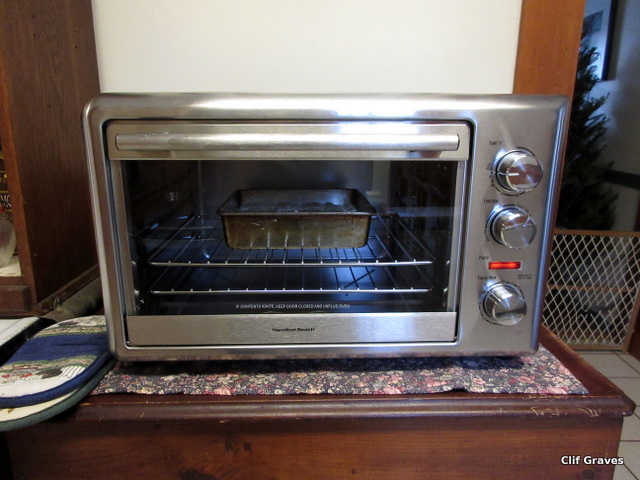
After much deliberation and angst, Clif and I finally made a decision about our new electric range, which has made us so unhappy with its burning ways. After doing a lot of research, we found that it cost less to buy a free-standing convection oven than to return the Whirlpool electric range we just bought and replace it with an electric range with a convection oven. Therefore, we bought a free-standing convection oven—a Hamilton Beach 31103A. It came yesterday, and we were able to rearrange things in the kitchen so that no counter space was lost.
The many comments on this blog were a big help. Thanks to all of you who shared your oven stories. It made us realize two things—new standard electric ovens have a tendency to burn baked goods, and convection ovens do a beautiful job when it comes to baking.
This was reinforced the other night when we had dinner at our friend Mary Jane’s house. There were nine of us in all, and Mary Jane, who is a terrific cook, had us recount the story of our oven woes.
Richard Fortin, our library’s director, was there, and as soon as we had finished telling our sad tale, he said, “The same thing happened to us. We were burning things that we baked. But we have a convection setting in our oven, and as soon as we started baking on that setting, everything came out just fine.”
Then there was the matter of glass top versus coil top. Richard continued, “I once had a stove with a glass top, and I ruined it using cast iron.”
There were protests from some of the other guests, who successfully used cast iron on glass tops without marring the surface. It does seem as though you have to be careful not to slide the cast iron over the glass top. Instead, it has to be lifted up. Richard noted that he wasn’t that careful of a cook, and neither are we. I can easily envision sliding the cast-iron frying pan over the top. For us, coil top is best.
The next day, Richard called and told me that Kenmore has a coil-top electric range with a convection oven, and it is listed for $630. (Clif, in doing stove research, found that Consumer Reports gives Kenmore high ratings.) Dave’s, unfortunately, does not sell Kenmore, but if we had known then what we know now, then we would have gone with the Kenmore.
But as I mentioned above, it was more economical for us to buy the free-standing convection oven—there was a very good deal through Amazon—and we now have two ovens. While the Whirlpool does a terrible job with baked goods, it does a fine job with dishes that require less precision, such as chicken, baked potatoes, and casseroles. It also does a great job broiling. Finally, the free-standing convection oven, which takes a 9x 13 pan, is much more energy efficient than the larger range.
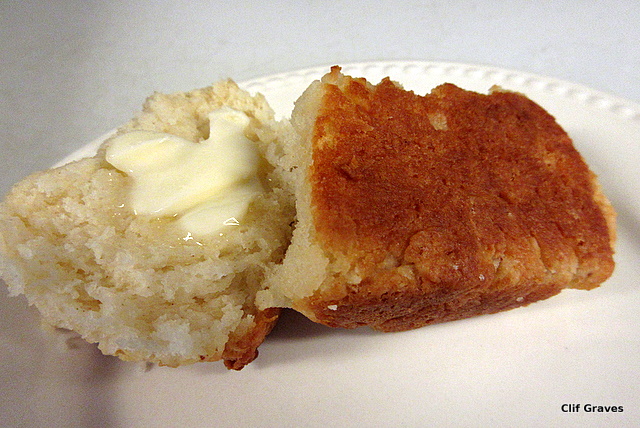
This morning, we tested our new convection oven. I made a batch of biscuits, and success! The biscuits came out exactly as they should, with nicely browned tops. The bottoms were also brown but not crunchy, the way they were when I baked a batch in the Whirpool. Instead, they were soft, just the way biscuits ought to be.
Biscuits baking in the new convection oven
Biscuits the way they should be, brown but not crunchy
Next I will try making gingersnap cookies, which I could not get right in the Whirlpool, no matter how much I fiddled with the time or the temperature. I’ll be sure to report back.
Here is a recap for readers who will be buying a new electric range in the near future. Conventional electric ovens, even the more expensive ones, are not reliable when it comes to baking. Bottoms are burnt and middles aren’t cooked enough. However, many electric ranges—coil top as well as glass top—come with a convection setting, and this is the way to go if you like to bake. Whatever brand you choose, be sure to do some research from a disinterested source such as Consumer Reports. All ranges are not created equal.
Finally, thanks to Shannon for sending us the review of the Hamilton Beach Convection Oven. We ended up buying a larger model, but that review helped steer us in the right direction.
Saturday was quite the day for little Winthrop, population 6,000. There was a craft fair at the grade school—we plan on having a table there next year—various other craft fairs around town, and a pie sale at the library. Lots of people were out and about, and there was definitely a festive air in town.
However, the prime event was the holiday parade, and my plan was to walk with other trustees and various library friends. We always have big bags of candy, which we haul in a little red wagon. I must admit, I love marching down the main street and throwing candy to the children, who scramble eagerly to get the goodies. Line-up was at 2:30, but because of my creaky knees, Clif dropped me off at 3:00 so I wouldn’t have to stand as long. We parked at Rite Aid, and all the floats and organizations seemed to be lined up along the road that went by the store. We looked up and down the line but didn’t see the library’s banner or the crew.
The line-up by Rite Aid
“Never mind,” I said to Clif. “They must be in the line somewhere. I’ll wait here, and you can go down to lower main street and take pictures as we march.”
Clif nodded. “See you later.”
He left, and I found a rock to sit on not too far from the beginning of the parade, where the veterans waited with their flags. I watched the dancing girls in a local dance school as they practiced their dances. Winnie-the-Pooh bounded up and down the road, and the lovely princesses from Frozen waited patiently.
Winnie-the-Pooh and princesses, too
The parade started at 3:30, and it slowly moved forward. I looked for the library banner but didn’t see it. Margy, a friend, stopped to chat, and she hadn’t seen the library’s banner either. When the last of the floats and the marchers had passed, and it was time for the ambulances and fire trucks, I knew that I had missed the library contingency, but how? I had watched everyone pass. Or so I thought.
Well, it seemed I would have to march down the long hill into town, but I would not be part of the parade, and I wouldn’t have any candy to throw. “Penance for my sins,” I thought as I hustled down the hill as fast as my stiff knees would allow.
Seeing the family of some of the children slated to march with the library banner, I stopped and asked, “Has the library crew marched past?”
“Oh, yes!” they assured me. “They were right after the veterans.”
“Son of a biscuit,” I thought, feeling sheepish. “How in the world had I missed them?”
When I got to the bottom of the hill and spotted two of the trustees, Mary Jane and Liz, returning to their car, I found out what had happened.
“We were across the street at the bank,” Mary Jane said, “And we were directed to march right behind the veterans.”
“We’re so sorry you missed us,” Liz said.
Me, too! From where I was sitting, I had not been able to see the bank or the library banner.
Ah, well. Clif got some decent pictures, and after the parade, we went over to Mary Jane’s house where we had her fabulous baked ziti—a recipe from the incomparable America’s Test Kitchen—garlic bread, salad, and good conversation.
Next year, I will be sure to check the bank’s parking lot. (I’ll also bring my cell phone, which I had left in the car.) After all, it would be very hard to miss, two years in a row, marching with the library banner and throwing candy.
One of the things I most enjoy about being outside, either in my yard or in the woods, is how there is always something interesting to see, no matter the time of year. Not only do the changes of the season provide variety, but even the sharpest eye can’t take everything in, which means the same yard or the same trail is never monotonous.
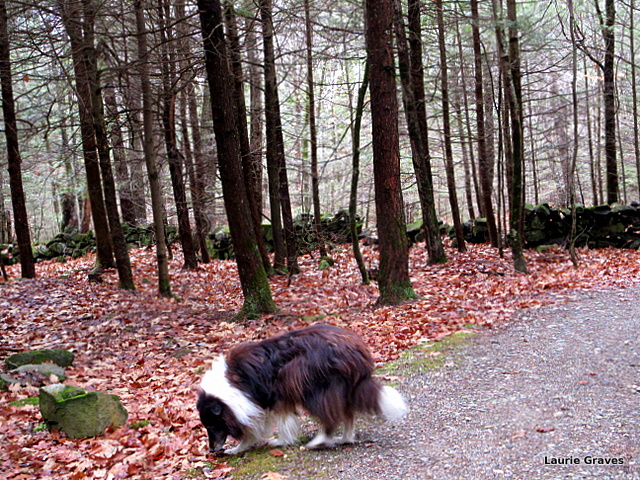
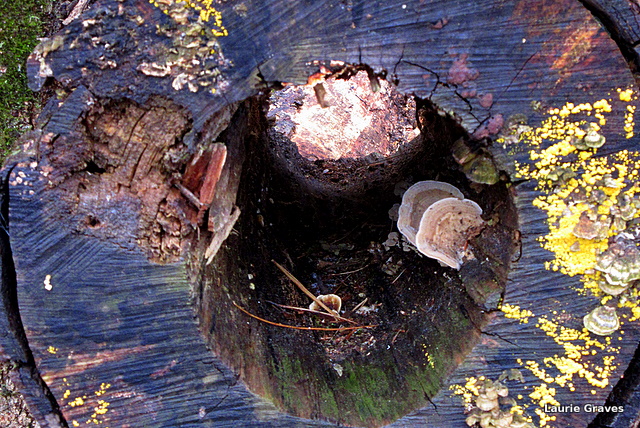
Today, we took Liam for a walk on the trails by the high school. The following pictures are a record of our short journey, where Liam got to sniff as much as he wanted, and I got to take pictures of whatever caught my attention.
“In our latitude we know that each year brings the time when not only the candle but the hearth fire must burn at both ends of the day, symbol not of waste but of warmth and comfort. It is for this time, if we live close to the land, that we lay up the firewood and the fodder. Now we pay for the long days of Summer, pay in the simple currency of daylight. Hour for hour, the accounts are now balanced.”
~Hal Borland, This Hill, This Valley
In Maine, in December, the accounts are certainly balanced when it comes to daylight. By 4:30 p.m., it is fairly dark. By 5:30 p.m., it is as dark as midnight. This is the time of year when we hurry to take the dog for his afternoon walk—no later than 3:00 p.m.
But as Hal Borland points out in his beautifully written This Hill, ThisValley, “[T]he short days provide their own bonus. The snows come, and dusk and dawn are like no other time of the year.”
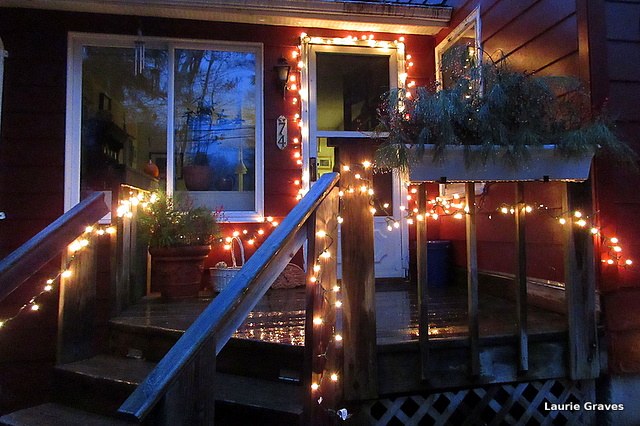
At the little house in the big woods, all is cozy when night falls by late afternoon. The wood furnace is going, and there is no more comfortable heat than wood heat. Although we have back-up, wood is our primary source of heat. It is indeed a lot of work to stack and haul wood, but Clif, who does all of the stacking and hauling, thinks it is more than worthwhile. So do I. Wood heat would not be sustainable everywhere, but in Maine, with its small population of about one million, it is still possible to harvest wood for heating and not destroy the forests.
Around 4:00, we start pulling down the shades. I put on the kettle to boil, and soon we are settled on the couch for tea and snack. Often, I read The New Yorker, and Clif reads on his tablet. The dog nestles beside me, and he hopes he will get an occasional treat. Need I write that Liam is seldom disappointed?
It takes a while for us to get into this comfortable rhythm. At first, when the time changes, and the days are ever so short, we are restless. Night seems too long. But gradually, we ease into the short days and long nights. While we will not be sorry to see spring, with its longer, warmer days, we also appreciate the time to slow down, to read, to take stock.
Well, here it is. The post you’ve all been waiting for—an update on the workings of the oven in my new electric stove. I wish I had good news to report, but I do not.
A week or so ago, two men from Dave’s Appliance came to test the oven. As far as their readings were concerned, nothing was amiss, but they turned down the oven’s electronic setting by ten degrees. In talking with them, we also learned several facts.
First, our complaint is not uncommon, and they have had to go many homes with new electric stoves. One irate customer even produced a burnt loaf of banana bread as proof of her oven’s erratic temperature. Second, new ovens don’t heat the way they once did. In the old days, say the 1990s, the temperature was controlled by a mercury thermostat. We all know that mercury is toxic, but it sure did a good job of regulating an oven’s temperature. Nowadays, ovens use an electronic-based thermostat, and at least in low to mid-priced stoves, these thermostats have huge swings where they overshoot the temperature by a lot and then cool back down. (Hence burnt banana bread and cookies.) To make matters even worse, the oven announces it is up to temperature when in fact it isn’t. The men from Dave’s recommend preheating the oven for twenty minutes.
The final cherry on the sundae is that the men from Dave’s told us that we could spend three times what we spent on our stove and still have the same problem. After they left, Clif did some research online, and the information he found confirmed what we had been told.
Clif turned our oven’s setting down another twenty degrees, and I made a batch of biscuits to test the new settings. Now, I am rather proud of my biscuit-making abilities. Usually, they are light and fluffy through and through. However, with the new oven, even with the lower settings, the bottoms were not burnt, but they were hard and crunchy, not what I want for biscuits.
Yesterday, I spoke with the folks at Dave’s and told them about my oven woes. I was assured that I could return the stove and just pay the difference if we bought a more expensive one. However, because of what we have learned about modern ovens, I am reluctant to do this. We could spend more and still have the same problem.
So here is what we are considering—a large convection toaster oven, one big enough for pies and pizza and even a 9 x 11 pan. My daughter has a toaster oven she swears by, and she sent me a link toBon Appétit’s glowing review of a Hamilton Beach Easy Reach Convection Oven (model #31126). According to Bon Appetit, the Hamilton Beach is not only very affordable—$70—but bakes like a champ. And at the little house in the big woods, we do a lot of baking.
In retrospect, I’m not sure what we would have done if we had known ahead of time about the foibles of low-to-mid-range priced modern electric ovens. Waited until we had enough money for a much more expensive one? Installed a gas stove, which has a more responsive heat? (Unfortunately, we would have to pay a significant fee to have it hooked up, and we have a budget as big as a minute.) Held on to the old one, keeping our fingers crossed that the door didn’t just give out entirely in the middle of a batch of cookies?
Here is a lesson we have definitely learned: The next time we buy an appliance, we will be sure to research the hell out of what we are buying. We will not assume that the new model will be as good as the old model, even though it is from the same manufacturer. (Our old stove was a Whirlpool, our new stove is a Whirlpool, and Clif feels as though we’ve been sucked down a whirlpool.)
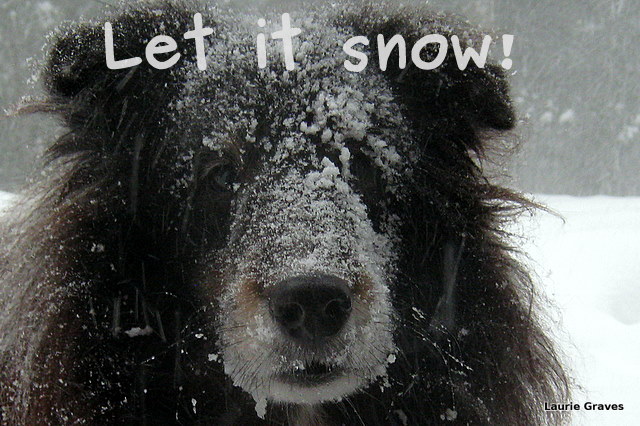
As someone who likes to look at the bright side of things, I’ll start this week with the good. (Tomorrow I’ll write about my ongoing oven woes.) The craft fair, in Mount Vernon, was a success. Lots of people came, and we sold enough cards and calendars to make it very worthwhile for us. Our card of snowy Liam was the hit of the show, and we could have sold double of what we brought.
Many people thought he was a bear, and I had to explain, with a smile, that Liam was a dog, albeit one who loves the snow. I also added that I would never get that close to a bear.
We got lots of positive comments and some very helpful suggestions. Just recently, we have added quotations to some of our pictures, and one woman said, “I love quotes on cards.” Other animal cards, starring family dogs and cats, were also a big hit.
While we will always make cards that feature pictures without words, we have decided to branch out and make cards that have quotations on them. We will also make some that simply have “Happy Birthday” or “Happy Anniversary” on them. We are learning as we go.
Anyway, we were extremely pleased with the results of the Mt. Vernon Craft Fair, and we will be looking for other venues to sell our cards.
A blog about nature, home, books, movies, television, food, and rural life.

 Yesterday, we had a lashing rain and discovered there was a leak around the chimney. As soon as it dries, Clif, like Santa, will be up on the rooftop, but instead of coming down the chimney, Clif will be patching the leak. (And a good thing, too, because the chimney leads directly to the wood furnace that heats our home.)













 Notes From the Hinterland