
This has been a rainy, humid week. While the rain has been much needed, a few dry days would be nice. The house smells like mildew, and I even had to resort to using the clothes dryer. I know from sad experience what clothes smell like when racks are used for wet laundry during rainy, humid weather. Not good!
On the other hand, it has been a good week for going to the movies and to the Colby Museum of Art.
At Railroad Square, we saw two movies: Sorry to Bother You, Boots Riley’s wild, surreal, pointed look at racism and economic injustice in the United States; and Leave No Trace, a sad, beautiful story about an emotionally-wounded veteran and his daughter. If you like character-driven movies, Leave No Trace is a must-see film. In fact, both movies are very much worth seeing.
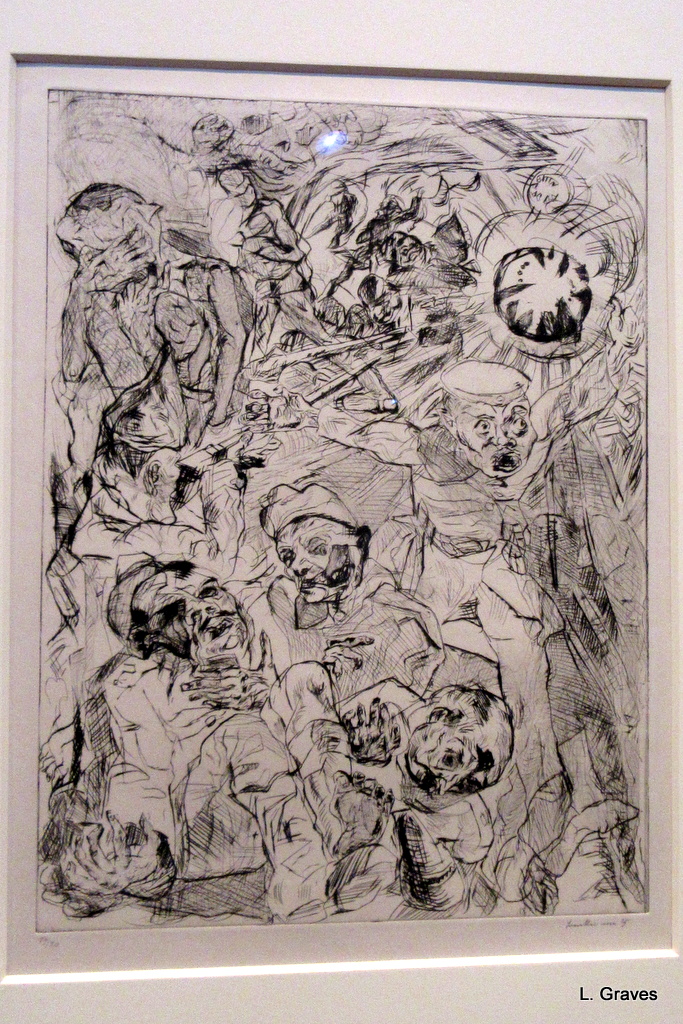
For a small liberal arts college (1,800 students), Colby has an incredible art museum. It is free and open to the public six days a week. Because we live so close—about thirty-five minutes away—we have the luxury of focusing deeply on one exhibit at a time, which is my favorite way to visit an art museum. For this week’s visit, we focused on Self and Society, a collection of German Expressionist Prints.
On its website, MoMA notes that German Expressionism was a “major modernist movement that developed in Germany and Austria during the early decades of the 20th century.” The painters and printmakers—George Grosz and Max Beckmann, to name two—were more interested in portraying emotions rather than the actual physical world. And the emotions they portrayed were usually dark and grim.
Why wouldn’t they be? Many of the artists had fought in World War I and had witnessed firsthand the ugliness and brutality of that war. Not to put too fine a point on it, but the post-war period was not exactly smooth and tranquil either. Then we all know what came next. It seems to me that these Expressionist artists, who would be persecuted during the Nazi regime, had their fingers on the pulse of society. Their art will never go on the cover of chocolate boxes, but art is not obliged to be beautiful.
To be sure, beauty is a part of life, and I appreciate beautiful art as much as the next person. But ugliness is also a part of life, and there are times when that reality is so great that artists have no choice but to face it and portray it.
Here are a couple of photos I took of prints from Self and Society.

In the gallery below Self and Society, we came across this—Cracked Question by Elizabeth Murray, who was not a German Expressionist.

But somehow, after seeing the horrors portrayed in Self and Society, Cracked Question seemed absolutely appropriate.













 Notes From the Hinterland