Category Archives: Books

First Draft of the Cover for Maya and the Book of Everything

Even though it’s still early, today has been a most exciting day for me. I received the first draft of the cover for my YA fantasy, Maya and the Book of Everything. Simply put, the cover is beautiful. I know. All mothers think their children are beautiful, but this cover—a rich blue with a book motif—really and truly is. I even love the font that was chosen.

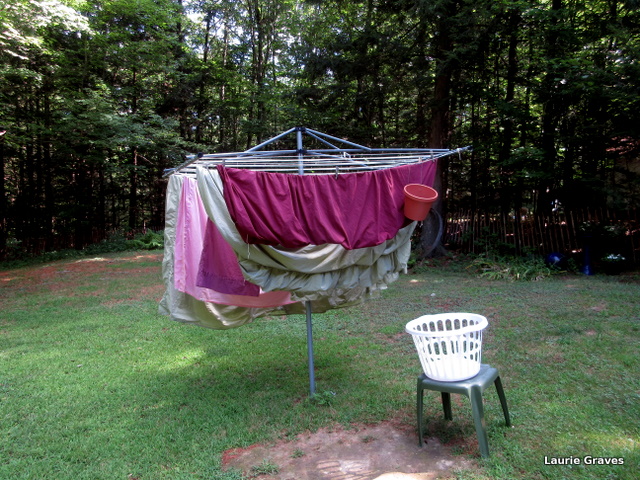
Just seeing the first draft of the cover has put me in a happy state of jitters, and it will be hard to focus on anything else. But, cover or not, the laundry needs to be hung, and we will be going for a bike ride on this fine summer day.

As soon as the cover is finalized, I will post an image of it on this blog. This means, dear readers, that aside from family, you will be the first to see it.

Exciting times, indeed!

IMG_4373
Book cover or not, the laundry must be hung to dry.


An August Visit

IMG_4204

Tomorrow, my daughter Dee will coming from New York to spend a week with us. Is there any better time to visit Maine than August? Some would say September or October, but nothing can beat August for time spent on the patio, where we can drink wine, eat grilled food, listen to the crickets, and watch the birds. Dee looks forward to this, and when she came in July for the Maine International Film Festival, she was sorry that she didn’t get any patio time.

Dee’s visit will be filled with all sorts of simple but fun activities—an appetizer night at a friend’s house; a pizza and movie night here; plays at the Theater at Monmouth, just down the road from us; a couple of movies at the cinema; and most likely a trip to an art museum or two. It will be a lovely interlude from our usual routine. No matter how satisfying a life might be, it is always good to take a break from time to time.

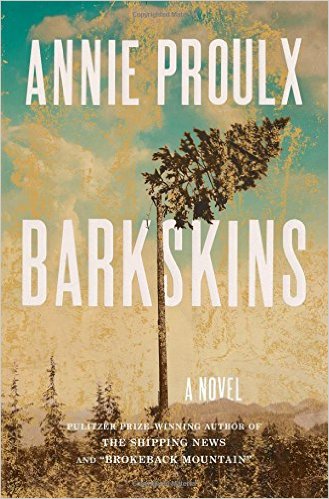
Readers will be happy to know that last night I made my decision about which book to read. The choice was between Barkskins by Annie Proulx and White Trash by Nancy Isenberg. (For more of a description of these two books, see yesterday’s post. ) Jason, from the blog Garden in a City, suggested I go with Barkskins, and I independently came to the same conclusion. I read some of Barkskins last night, and at 12:45 a.m., I reluctantly put the book down so that I could turn off my reading light and go to sleep. Now comes the challenge of finishing the book before it is due in two weeks. At 736 pages, Barkskins certainly qualifies as a tome, but I do feel I am up to the challenge.

I’m not sure how much I’ll be blogging next week. I might post a picture or two, but I expect I won’t be writing much.

I hope all of you have a wonderful week.


Under Book Pressure

No, the title of this post does not refer to my upcoming book, Maya and the Book of Everything. I am right on schedule for that. Instead,  I am referring to two other books, which I recently checked out from our town’s library.

The first is White Trash: The 400-Year Untold History of Class in America by Nancy Isenberg. This title pretty much explains the premise of the book, and as someone who has come from an underclass—I am Franco-American—I am always interested in how class plays out in our supposedly classless society. (Such a foolish premise. Where there are humans, there is always a class hierarchy. )

White trash_

I’ve begun reading White Trash, and it looks as though it’s going to be a very good book. I’ve already begun peppering it with little sticky notes when I find passages that are especially engaging.

The second book is Barkskins by Annie Proulx, and it’s a novel of two Frenchmen who come to New France in the late seventeenth century. Steven, my Franco book buddy,  put this on our must-read list, and knowing there were a lot of holds on Barkskins, I told him I’d see what I could do about getting the book from the library. As luck would have it, Barkskins came far sooner than I expected it would, and now it sits, along with White Trash, on my night stand, two hefty books waiting to be read.

Bark_

And here we come to the crux of the problem. White Trash is 480-pages long, and Barkskins clocks in at a whooping 736 pages. Both are due in two weeks, and for one of those weeks—next week, in fact—my daughter Dee will be visiting from New York.

Now, I am a fast reader, but to read over a thousand pages in two weeks is a bit much, even for me. Amazingly enough, White Trash has lots of holds, over fifty I was told by our library’s director. I guess I’m not the only Maine reader who is interested in class in America. Barkskins also has a lot of holds on it. No surprise there.

This means that renewing either book is out of the question, and.  most likely, I will be able to finish one but not the other. Yesterday, I dipped into White Trash. Today, I will dip into Barkskins. Then, I will have to make a choice.

I wasn’t kidding when I chose this post’s title. Under book pressure, indeed.

Of Blooms and Maya and the Book of Everything

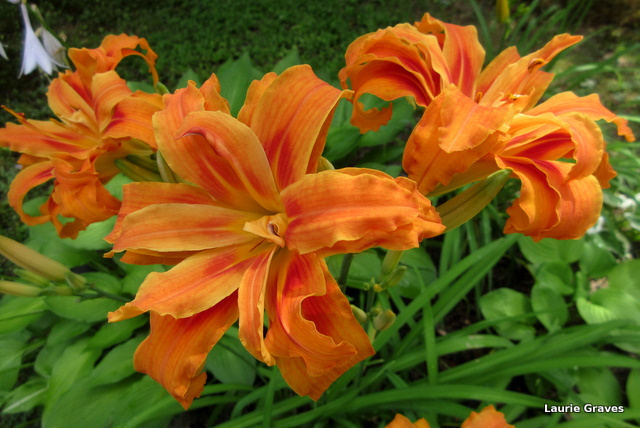
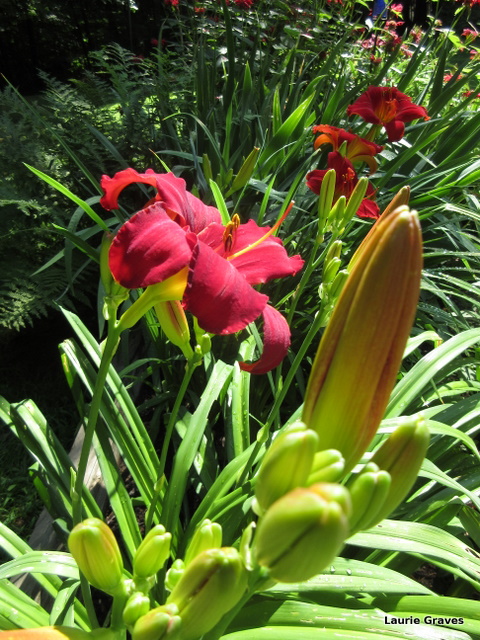
At the little house in the big woods, in mid-July, the gardens went into a slump after the glorious burst at the beginning of the month. But now they’ve gathered themselves again with the bosoming of the daylilies. (Eliza, so sorry you missed them! But flowers will be flowers, and they bloom in their own time.)

IMG_4022

IMG_4051

I am also happy to report that we—Clif and me—are making great progress with my YA fantasy book Maya and the Book of Everything.  All the material for the first part—synopsis, blurbs, and other necessary information—is done and ready to go. Clif is designing an oh-so-lovely author’s website for me. I know. I am lucky to live with a computer geek who also has terrific graphic sensibilities. However, I did have to ask him to remove the flying saucer he put in over the castle. (There are no flying saucers in Maya, but there is indeed a castle.)

I have ideas brewing for a presentation, if I am fortunate enough to be asked.

Busy, busy, busy! But in such a great way.

Soon, I will be sharing the cover.

A Short Leave of Absence to Work on My Novel, Maya and the Book of Everything

IMG_1221Exciting news at the little house in the big woods. Soon I will be publishing a book I’ve been working on for some years. It’s called Maya and the Book of Everything, and here is the tagline: One Girl, One Boy, One Book Against the Forces of Evil.

This October is the projected month for publication, and in the meantime there is much to do to get the book ready.  Therefore, I’m going to be taking a little break from the blog. Oh, I might post a picture from time to time as I do like taking pictures, but I won’t be writing much of anything for the next few weeks.

The book feels a little like my baby, and how gratifying it will be to see it in print.

Stay tuned for an upcoming synopsis of Maya and the Book of Everything. Here is a teaser: Some of the book is set in East Vassalboro and Waterville, Maine, and some of it is set at the mysterious Great Library.


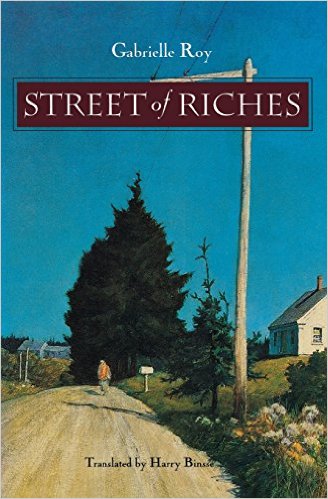
Street of Riches By Gabrielle Roy

Street_A while back, a friend and I formed a little book club, comprising just the  two of us. One year we read Victorian novels, and this year we are reading nineteenth- and twentieth-century French literature—translations because, alas, neither of us reads French well enough to make it through a whole novel.

My friend and I are quite different. He lives in a big city with his husband, and I live in the little house in the big woods. He is the sophisticated city dweller, and I am the country mouse. But we are bound by our love of books, and we recognized this in each other immediately after we met, when we could talk of nothing else except books, books, books. For me, and perhaps for my friend as well, it is the best kind of talk there is.

I would like to think that Gabrielle Roy, the author of Street of Riches, would have been right at home with us. Roy (1909-1983) was a French Canadian writer who was born in Winnipeg, Manitoba. Street of Riches is a collection of interconnected short stories starting when the narrator—Christine—is very young and ending when she goes away to teach school.

The blurb on the back of the book calls the stories “semi-autobiographical,” and it doesn’t take too great a leap to imagine Christine as a stand-in for Gabrielle Roy. The slice-of-life stories are set in Manitoba in the early 1900s, and they chronicle the sadness of Christine’s parents, who are better apart than they are together; her mother’s restlessness; Christine’s childhood illnesses, which earned her the title of “Petite Misère”; the struggle to find her true self; and Christine’s yearning to become a writer.

Roy was a shrewd yet sympathetic writer—my favorite kind of writer—who gives both of Christine’s parents their due. In each story there is piercing clarity and wisdom, written from an adult’s point of view but with great empathy for the young Christine and her family.

Street of Riches is, so far, the best book I’ve read this year, and through interlibrary loan I’ve ordered Roy’s The Road Past Altamont. I’m so grateful that my book buddy suggested Street of Riches for our little book club. I had never heard of Gabrielle Roy, and now she is one of my favorite writers.

I’ll end with a quotation from Street of Riches, from the story “Whooping Cough”:

“Why does one not learn sooner that one is, oneself, one’s best, one’s dearest companion? Why this great fear of solitude, which is merely an intimate commerce with the sole true companion?”

Why, indeed? Written like a true writer.

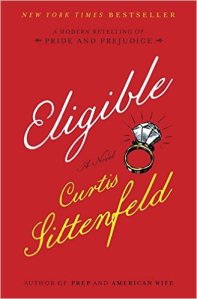
Eligible: A Modern Retelling of Pride and Prejudice

EligibleI am a person who has what might be called “enthusiasms.” In no particular order they include writing, photography, dogs, tea, Shakespeare, flowers, movies, theater, food, and, in particular, Jane Austen. I am such a fool for Jane Austen that I will see or read anything that is remotely connected with her, even though this often dooms me to despair. In particular, I am thinking of the horrible Austenland, a charmless. unfunny movie about a Jane Austen fan who goes to England to re-enact the world of Jane Austen.

Therefore, when on National Public Radio, I heard of Curtis Sittenfeld’s Eligible: A Modern Retelling of Pride and Prejudice, I knew I would have to read it. But would it be a flop on the order of Austenland—how could anything be that bad?—or would it be an engaging retelling of Austen’s most buoyant novel? Readers, I am happy to report that it was the latter rather than the former, and while it doesn’t quite live up to Pride and Prejudice, Eligible is, as the saying goes, a good read.

Eligible is set in Cincinnati, Ohio, where the Bennet family—at least most of them—live in debt in a ramshackle Tudor. Mrs. Bennet is a shopaholic, Mr. Bennet hides in his study, and three of the daughters—Kitty, Mary, and Lydia—sponge off their parents. Liz, a magazine writer, and Jane, a yoga instructor, have flown the nest and live in New York City. However, Mr. Bennet’s bypass surgery brings Liz and Jane back to Cincinnati.

Enter “Chip” Bingley, an emergency room doctor and the recent star of the reality-television show Eligible, where “[o]ver the course of eight weeks…twenty-five single women had lived together in a mansion…and vied for Chip’s heart…” And who should Chip’s best friend be? Why none other than the dark, handsome Fitzwilliam Darcy, a neurosurgeon who went to medical school with Chip.

And so the story begins, and, in general, it follows the contours of Pride and Prejudice. Darcy, in true Darcy fashion, manages to be haughty and insulting at a party, where Liz overhears his disparaging remark about her. This, in turn, gives rise to Liz’s prejudice about Mr. Dacry. Cousin Willie Collins winds up with LIz’s best friend Charlotte, while Mr. Bennet is as funny and detached in Eligible as he was in Pride and Prejudice. And Mrs. Bennet and Lydia? Well, let’s just say that Sittenfeld does an effective job of channelling these two ninnies into the twenty-first century.

There are also some major differences, most of which I’m not going to get into as it would spoil the plot. However, I do want touch on a couple of them. Along with the pairing of Jane and Bingley and Liz and Darcy, one of the book’s major concerns is sex and sexuality, and Sittenfeld explores this in a way that is moving and generous and not in the least gratuitous. Toward the end of the novel, Liz reflects “that if a Cincinnatian could reinvent herself as a New Yorker, if a child who kept a diary and liked to read could ultimately declare she was a professional writer, then why was gender not also mutable and elective?” Why, indeed?

But the biggest difference is that for all of the young women in Eligible, not much is at stake if they don’t wind up with the right partner.  Charlotte is a smart professional woman who does not need a husband to live a good life. The same is true for Liz, and it’s mostly true for Jane. In short, women today have more options—better options, in my opinion—than they did in Jane Austen’s time, where making a good match was the best thing that could happen to a woman. The extremely limited options available to women in the eighteenth and nineteenth century bring a dark note into Pride and Prejudice, and it makes it a deeper story than Eligible is.

Nevertheless, Eligible is very much worth reading.  In the end, I found myself routing for the characters in their own right, as Sittenfeld conceived them rather than as crossovers from Pride and Prejudice.

That, of course, is the mark of a good book.



A Regency Bonbon: Friday’s Child

Friday'sEvery once in a while when, say, the political season just drags me down, and I simply hate the thought of having to choose between the lesser of two evils, I find myself turning to Georgette Heyer and her Regency novels for some relief. For the uninitiated, Georgette Heyer wrote Regency novels, lots of them, from 1932 to 1974, but according to Wikipedia, she also wrote thrillers, detective,  and historical fiction. In fact, Heyer is credited with creating the Regency romance genre, and she is well known for meticulous research and authentic period details. (Officially, the British Regency began in 1811 and lasted until 1820, and Jane Austen’s books were published during this period.)

All right. Let’s clear the air—Georgette Heyer was no Jane Austen, who while writing about love and the upper class, delved into the condition of women and the cruelties of the British aristocracy.  Heyer, while not ignoring the excesses of the upper class, blithely skimmed across them. Simply put, Austen is deeper than Heyer. Also, Heyer’s writing style is not as fine as Jane Austen’s. There, we’ve gotten that out of the way.

But what fun Georgette Heyer’s novels can be, and sometimes, fun is exactly what a person needs. Recently I came across Heyer’s Friday’s Child in my bookcase, and I decided it was exactly the right book to distract me from the political season. And so it was.

Friday’s Child is equal parts romance novel, farce, and screw-ball comedy,  and Heyer whips the reader through the first months of the improbable marriage of the very young Hero Wantage and the self-centered Lord Sheringham (aka Sherry). Hero and Sherry have known each other from childhood, and when Sherry comes upon Hero, a poorly-treated orphan who is down in the dumps because her guardian and cousin is insisting that Hero go to Bath to become a governess, well, Sherry does what any high-minded young male of the Regency era might do—he proposes marriage. (An added inducement is that Sherry won’t come into his large inheritance until he marries.) Hero, who has been in love with Sherry since she was very young, immediately accepts the proposal.  In today’s parlance, it is a win-win situation.

Off to London the pair go, where Hero gets into one “scrape” after another. Hero, who falls into the category of the adorable but naive heroine, must be schooled by Sherry and his friends, well-meaning but imperfect and hilarious teachers. Most of Hero’s mistakes involve making the wrong sorts of friends and going to the wrong sorts of places, thus opening her up to public shame and snubbing. However, on a more serious note, both Hero and Sherry run up huge debts while gambling.

Unlike most romance novels, the central concern of the story isn’t whether the two protagonists will end up together—indeed they are married early in the story. Instead, the plot revolves around Sherry, who must learn not to be so selfish and to fall in love with his sweet but hapless wife. I must admit that as I chortled my way through Friday’s Child, I wasn’t particularly worried about this. With all such novels, the destination is never in doubt. Instead, it is the delightful journey that matters.

Friday’s Child, like all of Heyer’s Regency novels, is a bonbon of a story.  As it is with many rich sweets, one is definitely enough, and it will probably be quite a while before I read another of Heyer’s books. (Richard Russo’s Everybody’s Fool is waiting for me at the library.)

Still what a delight to read a book that made me laugh out loud.  And while Friday’s Child certainly falls into the guilty pleasure category, the New Yorker’s blurb on the back of the book gets it exactly right: “Nimbel, light-hearted…Almost too good to be true.”


The Summer Before the War by Helen Simonson

summerWhen Helen Simonson’s novel The Summer Before the War opens, it’s just another drowsy summer in 1914 in the coastal town of Rye in Sussex, England.  Snout, an unlikely but bright Latin student, is busy poaching rabbits and doing odd jobs to add to his growing pile of coins.  Agatha Kent, one of the pillars of the community, is enjoying the company of her two nephews, practical Hugh Grange, who is studying to be a doctor, and snobbish Daniel Bookham, a poet.  There are parties and teas to attend.

Except it’s not just another quiet summer in Rye. Agatha Kent has done something most unusual. She has persuaded the school board to hire a woman to be the new Latin teacher in the town’s school. Apparently, in England in 1914, men taught Latin, and The Summer Before the War begins with the arrival of Beatrice Nash to assume the position of Latin teacher.

Beatrice Nash is young, attractive, bright, an aspiring writer, progressive, and poor. In short, she is everything a heroine should be, and I was rooting for her right from the start. While Agatha Kent might be Beatrice’s champion, the mayor’s wife, Mrs. Fothergill, is Beatrice’s enemy and, of course, Agatha’s as well. During the course of the summer, Agatha and Mrs. Fothergill will work very hard to outmaneuver each other, with Beatrice often caught between the two women.

Much of the novel deals with Beatrice trying to make her way on her own—her father has recently died—in a town where her status is far from assured. With Agatha as Beatrice’s champion, the way is easier but certainly not easy for this bright, genteel but poor young woman who has never taught before and has much to learn.

For many novels, this would have been enough. As the story progresses, it is clear that Hugh and Beatrice are attracted to each other. Do we want them to get together? Of course we do. But there are complications. Hugh is committed to another woman, not quite engaged but heading in that direction. In the meantime, the repulsive Mr. Poot, the Mayor’s nephew, is angling for Beatrice.

But as the title suggests, this is the summer before the war, the Great War, as it is known, where so many young men lost their lives. Suddenly, the book’s tone takes a turn from pointed yet amusing to very serious. Many of the young men we have come to know in the book go off to war, and Helen Simonson has such a knack for vivid characters that I had a lump in my throat as they left Rye for the killing fields of France.

Readers, I must confess that one night I stayed up until 2 a.m. reading this book. Simonson, a terrific writer, skilfully weaves in many issues in this book that begins as a comedy of manners. Class, gender, poverty, sexuality, ambition, and literature are subjects that are explored in The Summer Before the War. Then, of course, there is war and its terrible toil.

Finally, as is the case with so many British writers, Simonson has a wonderful feel for the natural world, and there are many beautiful descriptions of Rye and the seaside. Indeed, the book opens with “The town of Rye rose from the flat marshes like an island, its tumbled pyramid of red-tiled roofs glowing in the slanting evening light. The high Sussex bluffs were a massive, unbroken line of shadow, from east to west, the fields breathed out the heat of the day, and the sea was a sheet of hammered pewter.”

This fine book will go on my wish list so that I can have it in my home library.

Beatrix Potter: A Life in Nature by Linda Lear

BeatrixA few weeks ago, my friend Cheryl, knowing how much I love England and books about nature, recommended that I read Beatrix Potter: A Life in Nature by Linda Lear. As luck would have it, the book was available in our library, and I checked it out.

When most people think about Beatrix Potter, Peter Rabbit and all the small animals in her other stories come to mind. And how you feel about Beatrix Potter often depends on how much you like charm and fancy. I must admit that I am a sucker for such things. Seldom is anything too fanciful for me, but I do understand how some people might find Potter’s work a little too twee. Those trousers, that hat, the little dress, and on a rabbit, duck, or pig.

However, as Linda Lear makes it clear in her lengthy but absorbing biography of Beatrix Potter, the creator of Peter Rabbit was a multi-talented, extremely bright woman who made herself useful in a time when women of her class were not expected to do much. Peter Rabbit and the other animal tales were but one aspect of this complex woman.

Born in 1866 to parents who were extremely conservative and overprotective—some might say smothering—Potter was nonetheless encouraged to draw, paint, and explore nature on summer trips her family took to England’s Lake District and to Scotland. As a young woman, Potter become fascinated by fungi, and she spent much of her time painting and observing them. Eventually she came up with her own theory of germination and spores. (This was in her pre-Peter Rabbit days.) She submitted a paper “On the Germination of the Spore of Agaricinea” to the Linnean Society in… 1897.”

Lear writes, “The Linnean Society did not reject Potter’s paper because they never seriously considered it….Beatrix was too insignificant a player for the establishment to be concerned with. To have noticed her would only have called more attention to her unwelcome and unproven theories…That they were antagonistic to her as a woman and as an amateur goes without saying, and their bad manners account for the LInnean Society’s official ‘apology’ for the sins of historic sexism a century later.”

And that was that. Except for Beatrix Potter, it wasn’t. Over the years, she had written picture letters to the children of a former Governess, Annie Moore. “Annie Moore suggested that some of {Potter’s]  pictures letters could be made into interesting books for little children….Beatrix was taken by the idea.”

Hence, Peter Rabbit was born, to be followed by Benjamin Bunny, Jemima Puddle-Duck, Jeremy Fisher, and various other characters that would become beloved by generations of children. I don’t think I’m spoiling anything by revealing that Potter’s books sold very, very well. In addition, Potter, who was a brilliant marketer—is there anything this woman couldn’t do?—came up with what we would now call spin-off products: games, dishes, stuffed animals, and various other related items.

Peter Rabbit and Company made Potter an independently rich woman. To add to Potter’s wealth, an aunt died and left a substantial inheritance to her niece. Did Potter then decide to rest and retire in style, say, taking in the sights of Europe or taking a trip around the world?

She did not. Instead Potter continued to write, bought land in the Lake District, got married at age forty-seven, started raising sheep, and bought more land—well over 3,000 acres, which she would later donate to the National Trust so that the land would be preserved after her death.

This review is just a survey of this remarkable woman who was so enormously talented and creative yet did not believe in women’s suffrage. (I certainly have a hard time wrapping my mind around that contradiction.)

Lear’s biography accomplished what a good biography should. It expanded my appreciation of the subject, whom I had taken for granted as a children’s writer, which, in all fairness, would have been enough. Little did I know of Potter’s other accomplishments, this energetic Victorian who blazed through life, turning her attention not only to rabbits and ducks but also to fungi, sheep breeding, and land preservation.