Category Archives: Books

Beatrix Potter: A Life in Nature by Linda Lear

BeatrixA few weeks ago, my friend Cheryl, knowing how much I love England and books about nature, recommended that I read Beatrix Potter: A Life in Nature by Linda Lear. As luck would have it, the book was available in our library, and I checked it out.

When most people think about Beatrix Potter, Peter Rabbit and all the small animals in her other stories come to mind. And how you feel about Beatrix Potter often depends on how much you like charm and fancy. I must admit that I am a sucker for such things. Seldom is anything too fanciful for me, but I do understand how some people might find Potter’s work a little too twee. Those trousers, that hat, the little dress, and on a rabbit, duck, or pig.

However, as Linda Lear makes it clear in her lengthy but absorbing biography of Beatrix Potter, the creator of Peter Rabbit was a multi-talented, extremely bright woman who made herself useful in a time when women of her class were not expected to do much. Peter Rabbit and the other animal tales were but one aspect of this complex woman.

Born in 1866 to parents who were extremely conservative and overprotective—some might say smothering—Potter was nonetheless encouraged to draw, paint, and explore nature on summer trips her family took to England’s Lake District and to Scotland. As a young woman, Potter become fascinated by fungi, and she spent much of her time painting and observing them. Eventually she came up with her own theory of germination and spores. (This was in her pre-Peter Rabbit days.) She submitted a paper “On the Germination of the Spore of Agaricinea” to the Linnean Society in… 1897.”

Lear writes, “The Linnean Society did not reject Potter’s paper because they never seriously considered it….Beatrix was too insignificant a player for the establishment to be concerned with. To have noticed her would only have called more attention to her unwelcome and unproven theories…That they were antagonistic to her as a woman and as an amateur goes without saying, and their bad manners account for the LInnean Society’s official ‘apology’ for the sins of historic sexism a century later.”

And that was that. Except for Beatrix Potter, it wasn’t. Over the years, she had written picture letters to the children of a former Governess, Annie Moore. “Annie Moore suggested that some of {Potter’s]  pictures letters could be made into interesting books for little children….Beatrix was taken by the idea.”

Hence, Peter Rabbit was born, to be followed by Benjamin Bunny, Jemima Puddle-Duck, Jeremy Fisher, and various other characters that would become beloved by generations of children. I don’t think I’m spoiling anything by revealing that Potter’s books sold very, very well. In addition, Potter, who was a brilliant marketer—is there anything this woman couldn’t do?—came up with what we would now call spin-off products: games, dishes, stuffed animals, and various other related items.

Peter Rabbit and Company made Potter an independently rich woman. To add to Potter’s wealth, an aunt died and left a substantial inheritance to her niece. Did Potter then decide to rest and retire in style, say, taking in the sights of Europe or taking a trip around the world?

She did not. Instead Potter continued to write, bought land in the Lake District, got married at age forty-seven, started raising sheep, and bought more land—well over 3,000 acres, which she would later donate to the National Trust so that the land would be preserved after her death.

This review is just a survey of this remarkable woman who was so enormously talented and creative yet did not believe in women’s suffrage. (I certainly have a hard time wrapping my mind around that contradiction.)

Lear’s biography accomplished what a good biography should. It expanded my appreciation of the subject, whom I had taken for granted as a children’s writer, which, in all fairness, would have been enough. Little did I know of Potter’s other accomplishments, this energetic Victorian who blazed through life, turning her attention not only to rabbits and ducks but also to fungi, sheep breeding, and land preservation.

 

If I Had a Bucket List…Shakespeare’s First Folio

As the title of this post indicates, I don’t have a bucket list. I have nothing against them, but a bucket list is not for me. Instead, I prefer to focus on each day, on my various projects, on nature, on family and friends.

However, if I did have a bucket list, then seeing Shakespeare’s First Folio—a book published in 1623 that contains thirty-six of Shakespeare’s plays—would be at the top of my list. It might even be number one. (I fell in love with Shakespeare when I was in seventh grade, and it has been an enduring love.)

Well, lucky me, lucky me—the First Folio is now in Portland, Maine. The Folger Shakespeare Library, which has eighty-two copies of the First Folio—has sponsored a First Folio Tour, where in 2016 this great book will be displayed in all fifty states as well as in Washington, DC, and Puerto Rico. In Maine, the Portland Public Library was chosen as the host site, and as Portland is only a little over an hour from where we live, getting to the First Folio is pretty easy. (How glad I am that I don’t live in northern Maine. I guess I still would have made the pilgrimage.)

Our friends Alice and Joel, who are also fans of Shakespeare, were over last weekend, and as we discussed the First Folio, I wondered if I would cry when I saw it.

Rather than look at me as though I were crazy, they just nodded, and Joel compared the First Folio to the Holy Grail. Or something like that. And how right he was. For those of us who love literature and plays, Shakespeare is at the top, reigning supreme.

Readers, I did not cry when I saw the First Folio on Tuesday. I was in too much awe. An attendant led us into a small darkened room, which, when the doors opened, came the blast of Handel’s Messiah. Just kidding about that last bit. The room was as quiet as an empty church.

IMG_1221

The First Folio, of course, was in a case, and the book was opened to Hamlet’s “To be or not to be” speech. I stayed for some time gazing at this beautiful old book with its gold-edged pages. The First Folio is very modern in its layout and very Elizabethan in its spelling. It looked pretty much the way I thought it would except for the large size and thickness. This was not a book for everyday folks. According to the Portland Public Library’s website, the First Folio “originally sold for one British pound (20 shillings)—about $200 today.” And in The First Folio, Peter Blayney writes that “nothing quite like it had ever been published in folio before….The folio format was usually reserved for works of reference…and for the collected writings of important authors…”

In Elizabethan times, plays were not considered “important” but instead trivial, the mass entertainment of the time “unworthy of serious consideration as literature.” But somehow, two of Shakespeare’s fellow actors thought it worthwhile to publish the First Folio, and to them we must be forever grateful. Without that First Folio, many, if not most, of Shakespeare’s plays might very well have been forgotten and lost.

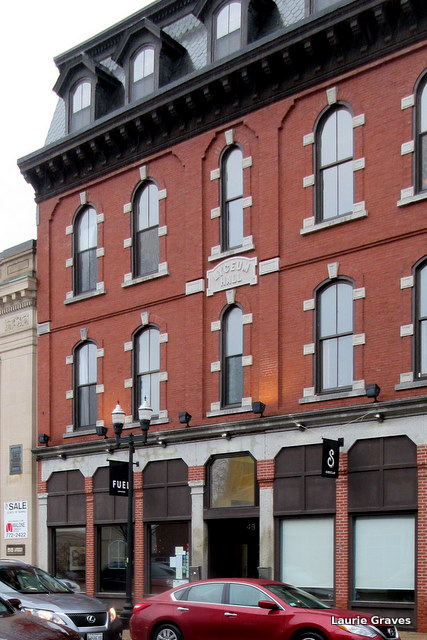
What to do after such an experience? Why, on to Lewiston to Fuel, my favorite restaurant in Maine.

IMG_1227

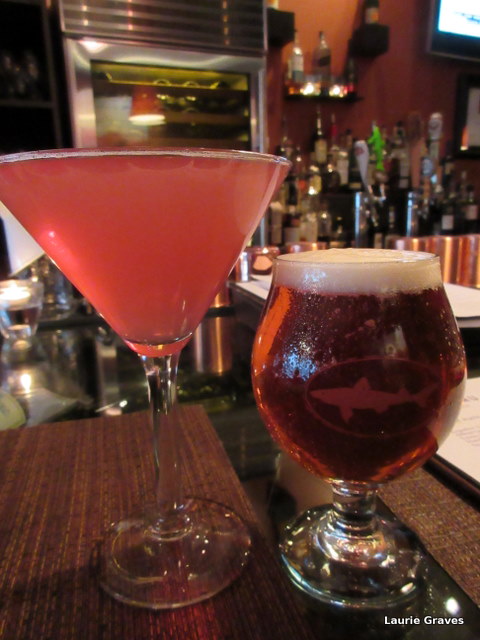
I had a cocktail.  In fact, I had two cocktails—after all!—and Clif had two beers. (He was the designated driver that night.)

IMG_1228

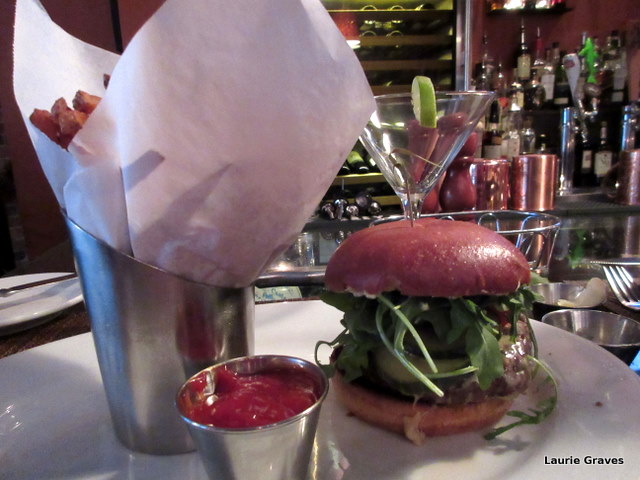
We both had burgers, which come with delectable fries at no extra cost. On Tuesday, everything on the bar menu is $9 or less, which means the food is quite the bargain. Especially if you can limit yourself to one cocktail or a glass of wine or beer.

IMG_1233

Home we went in a happy haze, full of good food and good drinks. What a way to end First Folio day.

Love of England: The Road to Little Dribbling

The roadAbout thirty years ago, my mother and I went to England to visit friends from Maine who had moved to North Yorkshire. Their cottage was just outside Whitby, tucked among rolling hills and a vista so broad that it seemed you could see halfway across the country. For me, it was love at first sight, and as our friends very kindly drove us from beautiful spot to beautiful spot, I knew I had found my heart’s home. This was only emphasized by the flowers—even the smallest yard had pots of spilling color—the wonderful tea, and the large number of dogs who were out and about with their people. Finally, England is the home of Shakespeare, Jane Austen, and J.R.R. Tolkien, three very different but nonetheless brilliant writers. How could I not fall in love?

For a variety of reasons, it is highly unlikely that I will ever return to England. But I can visit via books (and blogs!), and it was with great pleasure that I read Bill Bryson’s The Road to Little Dribbling. Bryson is perhaps best known for A Walk in the Woods, which was recently made into a movie starring Robert Redford and Nick Nolte. In the movie, the terrific Emma Thompson played Bryson’s wife, and in real life, Bryson’s wife is indeed English. Because of this, the lucky fellow is actually allowed to live in England—yes, I am envious—and The Road to Little Dribbling is an account of his traveling from one end of Britain to the other, from Bognor Regis in the south to Cape Wrath in the north. He dubs this route the Bryson Line.

But as to be expected from this lively, discursive writer, Bryson does not exactly follow this straight line. Instead, he zigs and zags his way through Britain, going to Wales, Cornwall, the Lake Distract, North Yorkshire,  Hampshire, and many other places, touching bases with the Bryson Line from time to time. Along the way, he visits museums, walks in the countryside, and drinks a fair amount of beer. Ever curious, Bryson writes about the history of the many places he visits. Then, of course, there is his famous snarkiness—his acerbic observations and crotchets—amusing but fortunately kept in check. For this reader, a little snarkiness goes a long way.

While not without its criticisms—no place, of course, is perfect—The Road to Little Dribbling is in essence a love letter to England, and for Bryson, as for me, the countryside is his greatest love. At the end of the book he writes that he loves England for many reasons, but chiefly because of “the beauty of the countryside. Goodness me, what an achievement….there isn’t a landscape in the world that is more artfully worked, more lovely to behold, more comfortable to be in than the countryside of Great Britain. It is the world’s largest park, its most perfect accidental garden. I think it may be the British nation’s most glorious achievement.”

So well put and so true. I have decided that The Road to Little Dribbling is a book for the home library—I borrowed it from our town’s library—and I will be putting it on my wish list.

Comfort Me with Reading

In Maine, winter is the perfect time for reading. The days are short, and aside from shoveling, outside chores are few. There are always inside chores, of course, but even so there are plenty of quiet opportunities for reading.

This winter, I have been thinking about the various reasons we read. On a pragmatic level, we read for basic information—manuals, how-to books, tutorials on the Internet. These can be a big help with projects as diverse as cooking to the most cost-effective way to fence in your yard for the dog.

We also read for intellectual ideas, and right now I’m slowly and with great difficulty working my way through Michael Lewis’s The Big Short. At times, I am absolutely stupefied by so much technical information about the workings of Wall Street, but still I read on, figuring that even if I only absorb a fraction of the book, I will know more than I did before I started.

We read for enlightenment and enlargement. For this we usually turn to the great novels—Middlemarch, Pride and Prejudice, Crime and Punishment, Moby Dick. Often these books require effort on our part, but when we are finished, we feel as though we have gained a glimpse of something essential about life and human nature.

Last but certainly not least, we read for pleasure and comfort. The value of this kind of reading cannot (and should not) be underestimated. Life can be joyous, but it can also be hard, and the older a person becomes, the more loss she or he has endured. Loved ones die, illness comes. That is the way of things, and somehow we must cope.

When life becomes hard, I turn to books for comfort, often Miss Read.  Somehow, reading about life in an English village in the 1950s has a calming effect on me.  I am always absorbed by the descriptions of nature, the sympathetic yet shrewd take on human nature, and the humor.

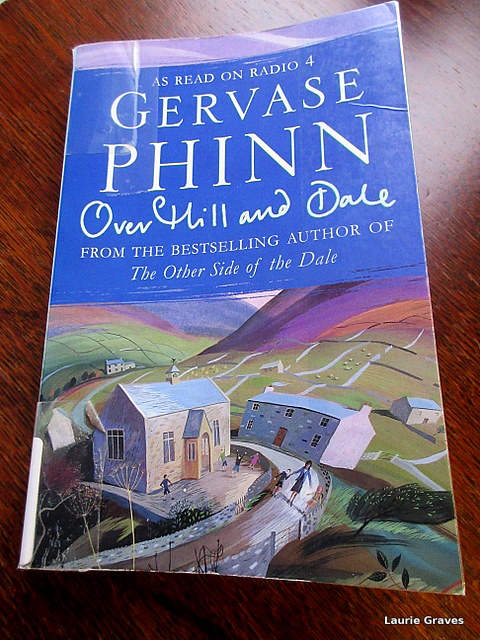
Lately, I have discovered Gervase Phinn, another English writer. (Do you think there is a trend here?) Phinn writes memoirs of his time as a school inspector in North Yorkshire, beginning in the 1980s. He is not a great stylist, but his books have a wonderful narrative flow, with vivid descriptions of teachers, students, parents, and colleagues. And, he makes me laugh out loud, to the point where my husband looks at me with raised eyebrows as I chortle over a passage in Phinn’s books. How often do books make us laugh? In my experience, not very often, and a book that does is a little gem.

I have been thinking that I should start collecting “comfort” books for my home library. (I already have several Miss Read books.) That way, the books will be right there when I need them, and I can also let friends borrow them when they are going through their own hard times.

IMG_0927

Movie Night: Black Narcissus (Based on the Novel by Rumer Godden)

About a year ago, Clif and I decided we would host a movie night at the little house in the big woods. We have three friends—Diane, Joel, and Alice—who love movies as much as we do, and Clif and I thought it would be fun to get together to watch a movie and then discuss it afterwards.

Over the course of the year we have fine-tuned the event. We start at about 5:30, we provide pizza and soft drinks, and our guests bring salad and dessert. Clif has a very good hand with pizza dough—he knows just how to stretch it—and we are able to buy a good frozen dough from a Maine company, Portland Pie Co. (The dough is available in our local supermarket.) I make a quick sauce using Muir Glen’s crushed tomatoes with basil, garlic, and a little dried oregano. Clif likes to use a mixture of cheeses—mozzarella, cheddar, and Monetary Jack.

We have two large pizza pans, one of which is cast iron, a present from my brother and his wife. And miracle of miracles, our blast-furnace oven does a great job with pizza. We bake the two pizzas for twenty minutes or so and voilà! Pizza for five or six, at a fraction of the cost of take-out.

IMG_0524

We take turns choosing the movie, and last night was Joel’s turn. From his own film collection, Joel brought several to pick from, and we quickly settled on Black Narcissus, a 1947 film, staring Deborah Kerr and Jean Simmons and based on the book by the late great English writer, Rumer Godden.

Black Nar

Black Narcissus is the story of a small group of Anglican nuns, led by Sister Clodagh (Deborah Kerr), who travel to a remote former palace in the Himalayas to open a convent. At the new convent, the nuns plan to teach the local girls, open a health clinic, and grow much of their own food. But high on the mountain, the air is thin and the wind always blows. The local British agent, the charismatic Mr. Dean, warns them not to stay, feeling that the mountain will be too much for them.

Naturally the nuns stay, and naturally Mr. Dean is right. It isn’t long before the mountain and the people who live there exert an unhinging force on the various nuns, in particular Sister Ruth, played with an over-the-top relish by Kathleen Byron. A chaste love triangle forms between Sister Clodagh, Mr. Dean, and Sister Ruth, resulting in tragedy.

First, the good. Black Narcissus is extremely strong on the visuals—on the cinematography and on the sets where most of the movie was filmed. The colors, the framing, the vividness of place—even though it was mostly a set—is nothing short of astonishing. The cinematographer, Jack Cardiff, won an Academy Award for Best Cinematography, and he certainly deserved it. Visually, the movie is a work of art.

Unfortunately, the move was weak with character development, relying too much on bug-eyed melodrama and crashing music. Apparently, this sort of melodrama was big in England in 1947, but it marred the story written by an author who excelled at character development.

Nevertheless, Black Narcissus is a movie worth seeing, if only for the beauty of the filming. Diane was right in suggesting this was really a group film, best seen with others so that we could all react to the various over-the-top scenes.

Next month is Alice’s turn to pick, and we will be heading back to India with Monsoon Wedding. I’m looking forward to it.

Book Group: The Storied Life of A. J. Fikry

The storied lifeLast night, I went to book group, which is hosted by our town’s library and run by the inimitable Shane Billings, the Adult Services Librarian. He started the book group over five years ago, and I’ve been with it since the beginning, with a few breaks here and there.

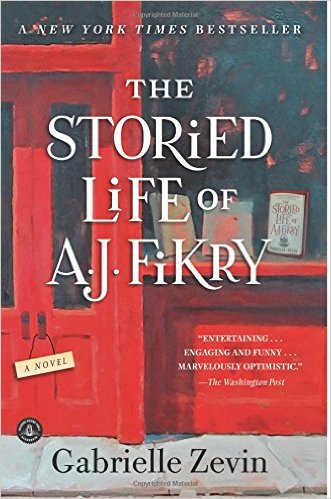
This month’s book was The Storied Life of A. J. Fikry by Gabrielle Zevin. Here are the basics of the story: A young but cranky man, A. J. Fikry, runs a bookstore on Alice, a fictitious island off the coast of Massachusetts.  When the story opens, A. J.’s wife has recently died in a car accident, and the grieving A. J. plans to drink himself to death. His suicidal plans are interrupted by Maya, an abandoned two year old who is left in his bookstore.  A.J.’s love for Maya—and hers for him—gives his life meaning. (And, yes, there is more than a little similarity between this story and Silas Marner.) From there the story sweeps out to include Lambiase, a kindly police officer;  A.j.’s dodgy sister-in-law, Ismay—how can she help being dodgy with a name like that?; and Amy, a dedicated bookseller from the mainland. There isn’t much of a plot—more a sweep of years, handled beautifully—spiced with the theft of a rare manuscript and another car crash that might or might not be murder. Finally, and perhaps best of all, there is the love of books that thrums through the story and connects the characters.

As was noted at book group, this is a sentimental story, but it is redeemed, to a large extent, by Zevin’s fine writing. In short, it is a sentimental tale told well.

There was a lively discussion about Ismay, the dodgy sister-in-law. Most of the members of the book group—composed mainly of older women—felt sympathy for Ismay, but the one young man who comes loathed her character. He didn’t see that Ismay had any redeeming qualities. Certainly, this point of view, while a little harsh, could be defended, and indeed in the book, young Maya doesn’t much like Ismay either.

One of the great things about our book group—Title Waves, it’s called—is that by and large, for over an hour, we discuss the book and nothing else. There is little chit-chat about personal matters, and we take the books and the discussions very seriously. After all, we are people who love books. At the same time, we are able to laugh and joke about our disagreements. There are some, like me, who have been there since the beginning, and there are many newcomers, too. All are welcome.

As Mona, one of the members, put it, “We all feel safe to express our opinions. It’s all right to disagree, and we do it respectfully.”

Yes, we do, and it is this attitude, along with the books, that has kept me coming to book group for over five years.

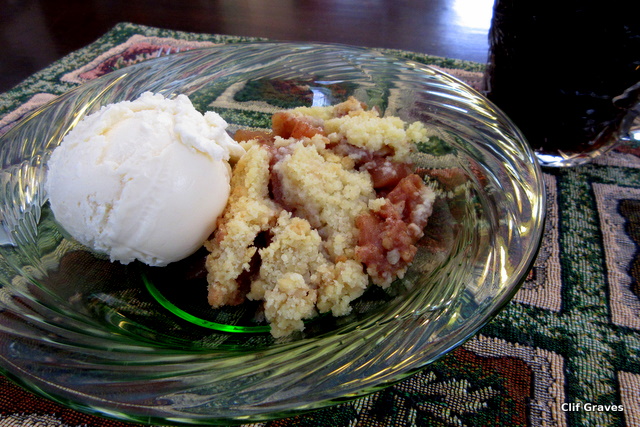
Apple Crisp and Stories

IMG_0513

On Sunday, our friends Cheryl and Denny and Judy and Paul came over for homemade apple crisp and talk. As I’ve noted in a previous post, I really love hosting afternoon get-togethers with friends. We have a good-size dining room with an old Victorian table—the original chairs, long gone, were filled with straw—that can easily be expanded to accommodate eight to ten people. However, for me, six is the perfect number for good conversation.

Apple crisp must surely be one of the best desserts to serve at a gathering. It can be made ahead of time, tucked in the refrigerator, and baked forty-five minutes or so before guests arrive. Old apples, a little wrinkled, taste perfectly good, and my blast-furnace oven does a fine bubbling job of baking the crisp. The recipe I use comes from a Craig Claiborne New York Times Cookbook, and I just follow his instructions. If I had made enough  modifications to call the recipe mine, then I would happily share it. But I haven’t.

Then there is the smell of apples, cinnamon, and cloves as they blend and bake. It wafts from the kitchen and drifts to the dining room, and I expect this smell stimulates the appetite. (Let’s just say that it’s a good thing I made plenty for seconds.) So you have warm spiced apples and a crunchy, buttery topping. Perfect, right? Almost. It needs a scoop of vanilla ice cream to slowly melt into the warm mixture. Whipped cream is all right, but to my way of thinking, ice cream is the jewel in the crown, so to speak.

As we sat around the dining room table, we talked about many things, but one topic in particular stuck with me because I’ve been thinking about it lately—the importance of stories and how we all have them.

Judy told of how one day, when her mother was young—this would have been in the 1930s—she came home to find her mother (Judy’s grandmother) sobbing as she did the ironing.

“What’s wrong, what’s wrong?” Judy’s mother asked.

As Judy’s grandmother ironed, she listened to the radio, to an afternoon soap opera, and something sad had happened to one of the characters. Hence the tears.

After hearing this story, I replied, “I think the story gene runs strong in humans. Whatever the medium, we will always have stories. I’m sure of it.”

Everyone nodded, and Cheryl recounted how one Christmas her book group listened to a recording of A Child’s Christmas in Wales read by the great man himself, Dylan Thomas. All the lights were turned off except for the ones on the Christmas tree, and by the sparkling lights they listened to this fine writer read his own words.

“Sounds wonderful,” I said, thinking that I might like to do this next year, but with just Clif and me. (My book group meets at the library, and somehow, it just wouldn’t be the same to do it there.)

“It was,” Cheryl said, smiling as she remembered.

Warm apple crisp, friends around the table, shared stories. Another finest kind of way to spend a winter’s afternoon.


Christmas with Miss Read

During this busy time of year, especially when I have a cold—as I do now—I inevitably turn to Miss Read (aka Dora Saint) for some peace, common sense, and just plain fun. I am lucky enough to own Miss Read’s Christmas: Village Christmas and The Christmas Mouse, and how nice it is to just take it from the bookshelf.

What do I like so much about Miss Read? First, there are her depictions of nature. This description of rain is from the first two paragraphs in The Christmas Mouse: “The rain began at noon. At first it fell lightly, making little noise. Only the darkening of the thatched roofs, and the sheen on the damp flagstones made people aware of the rain. It was dismissed as ‘only a mizzle’….But by two o’clock…[t]he wind had swung round to the northwest, and the drizzle had turned to a downpour. It hissed among the dripping trees, pattered upon the cabbages in cottage gardens and drummed the bare soil with pock marks.”

When I read that description, I could feel, hear, and see the rain. Such lovely, evocative writing.

Then, there is what the The New Yorker called Miss Read’s “beery sense of humor.” In The Christmas Mouse, the story revolves around three generations—Mrs. Berry, the grandmother; Mary, her widowed daughter; and Frances and Jane, Mary’s two young daughters. It is Christmas Eve, and the children are beside themselves with excitement. (Thank goodness that never changes!) Frances and Jane have just bounded from their bath into their mother’s bedroom.

“‘The water’s all gone. Frances pushed out the plug—‘

‘I never then!’

‘Yes, you did! You know you did! Mum, she wriggled it out with her bottom—”

They began to giggle, eying each other.

‘Let’s go down and frighten [Gran], all bare,” cried Jane.

‘Don’t you dare now!’ said their mother, her voice sharpened by the thought of the [girls’] slippers being wrapped below.”

Finally, there is Miss Read’s great respect for work and home. Here she describes Mrs. Berry and her husband: “Amelia and Stanley were true homemakers….She could make frocks for the children, curtains, and rag rugs as competently as she could make a cottage pie or a round of shortbread….Stanley saw to it that any stonework or woodwork was in good repair. They shared the gardening, and it was Mrs. Berry’s pride that they never needed to buy a vegetable.”

In Maine, I’ve known many a Franco-American and many a Yankee who would fit the description of Amelia and Stanley.  And I still do.

Perhaps that’s why Miss Read never grows stale for me. Her observations about human nature, work and home, and the natural world continue to ring as true now, in 2015, as they did when she wrote in the 1960s and 1970s,

IMG_0013

Bright Colors for a Gray Day

Yesterday was all golden light in central Maine. Today, just the opposite—gray, chilly, and rainy. Clif has started the first fire of the season in the wood furnace in our basement. (In the winter, we mostly heat our house with wood. In the fall and spring, we use either electric or propane.)

Today would have been a perfect day to make the first apple pie of autumn. Indeed, that is what I had planned to do, and I had invited our friends Judy and Paul to come share pie with us. However, along with the gray weather, we have an uninvited guest—a cold. Right now it is visiting me, and I have no doubt that it won’t be long before it visits Clif. Couples are good at sharing such things.

Therefore, this morning I called Judy to cancel our pie get-together, and I promised to reschedule when the coast was clear, so to speak. A cold is a minor illness, but why spread germs when you don’t have to?

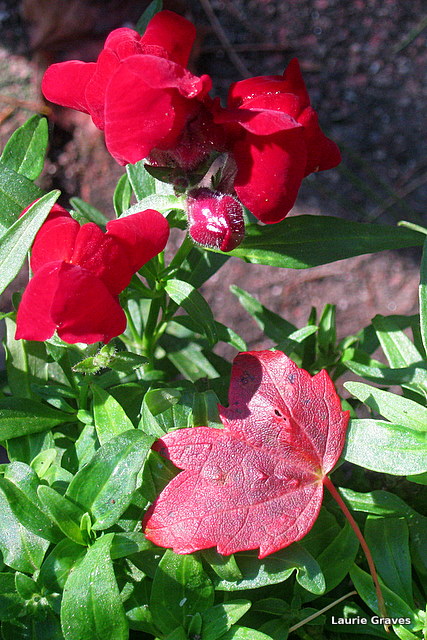
To make up for the gray day and the cold, both inside and out, here is a picture of red dwarf snap dragons—such a plucky flower!—and a red leaf.

IMG_2526

I am reading Gladys Taber’s The Book of Stillmeadow, and I’ll conclude with the opening passage of the October section: “The special gift of frosty gold days comes now; time to lay down the household tasks and shut the door on routine. For every October, when I see the trees over the meadow, I think, ‘I shall not look upon her like again.’ And every October is different, strange with new beauty.”

This was true nearly seventy years ago, when the book was published. And no matter the weather or where the cold is, inside or out, it is true today in New England.

At least in Maine.

Another Look at Squirrels: From An American Year by Hal Borland

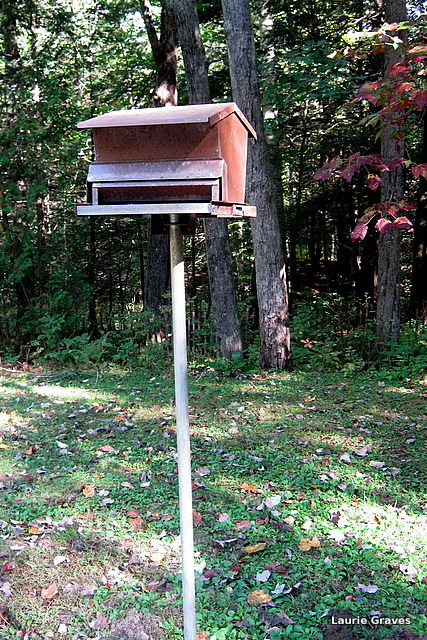
The bird feeder, sans squirrels

If you feed birds, chances are that you consider squirrels to be nothing more than a nuisance.  Indeed squirrels eat so much seed that it is often difficult to keep a feeder filled, especially a small one.  While I have no particular grudge against this furry animal who, after all, is just trying to make a living, I am very mindful about the cost of sunflower seeds. Our budget simply does not allow for replacing the seeds that the squirrels whip through with such astonishing speed. I compromise by spreading seed on the ground—some for the squirrels as well as crows, mourning doves, and, yes, mice.

Recently I came across a writer—Hal Borland—who also had some sympathy, and even empathy, for squirrels. According to Wikipedia, Hal Borland “was a well-known American author and journalist. In addition to writing several novels and books about the outdoors, he wrote ‘outdoor editorials’ for The New York Times for more than 30 years, from 1941 to 1978.”

In An American Year Borland writes about baby squirrels by his home. “Our baby squirrels were down on the ground today, for the first time. After that initial venture from the nest, they came out each morning, gaining confidence by the minute….But even on the fourth day they still descended the tree tail downward, in the manner of a black bear cub.”

Borland then goes on to describe how gradually the babies learned to go down head first and how cautious and frightened they were when they were on the ground. But Borland concludes, “From now on they’ll be coming and going many times a day. The mystery is broken. They have found the ground. The world is theirs—for a time.”

Even though I have lived in the woods for over thirty years, I have never been lucky enough to see baby squirrels venture to the ground for the first time. How I would love to see this!

Borland, with his beautiful, precise prose, reminds me yet again what an observant layperson can bring to nature writing. But better still, he reinforces my belief that when you look closely at the natural world, you can gain not only knowledge but also sympathy for the creatures who are struggling to earn their keep.

To my way of thinking, this sympathy can only be a good thing, especially when you consider how quickly we humans are driving so many animals to extinction.

For now, anyway, the squirrels are thriving. Next spring I’ll be on the lookout for baby squirrels leaving the nest.

And I’ll definitely be reading more of Hal Borland, who was introduced to me by Gladys Taber, in one of her books.