Category Archives: Books

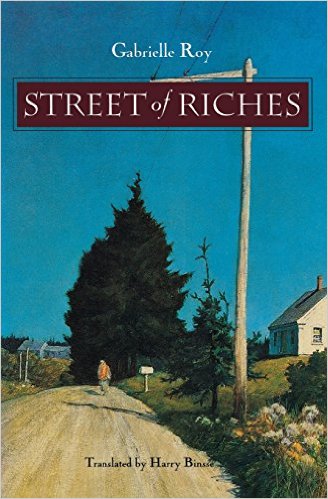
Street of Riches By Gabrielle Roy

Street_A while back, a friend and I formed a little book club, comprising just the  two of us. One year we read Victorian novels, and this year we are reading nineteenth- and twentieth-century French literature—translations because, alas, neither of us reads French well enough to make it through a whole novel.

My friend and I are quite different. He lives in a big city with his husband, and I live in the little house in the big woods. He is the sophisticated city dweller, and I am the country mouse. But we are bound by our love of books, and we recognized this in each other immediately after we met, when we could talk of nothing else except books, books, books. For me, and perhaps for my friend as well, it is the best kind of talk there is.

I would like to think that Gabrielle Roy, the author of Street of Riches, would have been right at home with us. Roy (1909-1983) was a French Canadian writer who was born in Winnipeg, Manitoba. Street of Riches is a collection of interconnected short stories starting when the narrator—Christine—is very young and ending when she goes away to teach school.

The blurb on the back of the book calls the stories “semi-autobiographical,” and it doesn’t take too great a leap to imagine Christine as a stand-in for Gabrielle Roy. The slice-of-life stories are set in Manitoba in the early 1900s, and they chronicle the sadness of Christine’s parents, who are better apart than they are together; her mother’s restlessness; Christine’s childhood illnesses, which earned her the title of “Petite Misère”; the struggle to find her true self; and Christine’s yearning to become a writer.

Roy was a shrewd yet sympathetic writer—my favorite kind of writer—who gives both of Christine’s parents their due. In each story there is piercing clarity and wisdom, written from an adult’s point of view but with great empathy for the young Christine and her family.

Street of Riches is, so far, the best book I’ve read this year, and through interlibrary loan I’ve ordered Roy’s The Road Past Altamont. I’m so grateful that my book buddy suggested Street of Riches for our little book club. I had never heard of Gabrielle Roy, and now she is one of my favorite writers.

I’ll end with a quotation from Street of Riches, from the story “Whooping Cough”:

“Why does one not learn sooner that one is, oneself, one’s best, one’s dearest companion? Why this great fear of solitude, which is merely an intimate commerce with the sole true companion?”

Why, indeed? Written like a true writer.

Eligible: A Modern Retelling of Pride and Prejudice

EligibleI am a person who has what might be called “enthusiasms.” In no particular order they include writing, photography, dogs, tea, Shakespeare, flowers, movies, theater, food, and, in particular, Jane Austen. I am such a fool for Jane Austen that I will see or read anything that is remotely connected with her, even though this often dooms me to despair. In particular, I am thinking of the horrible Austenland, a charmless. unfunny movie about a Jane Austen fan who goes to England to re-enact the world of Jane Austen.

Therefore, when on National Public Radio, I heard of Curtis Sittenfeld’s Eligible: A Modern Retelling of Pride and Prejudice, I knew I would have to read it. But would it be a flop on the order of Austenland—how could anything be that bad?—or would it be an engaging retelling of Austen’s most buoyant novel? Readers, I am happy to report that it was the latter rather than the former, and while it doesn’t quite live up to Pride and Prejudice, Eligible is, as the saying goes, a good read.

Eligible is set in Cincinnati, Ohio, where the Bennet family—at least most of them—live in debt in a ramshackle Tudor. Mrs. Bennet is a shopaholic, Mr. Bennet hides in his study, and three of the daughters—Kitty, Mary, and Lydia—sponge off their parents. Liz, a magazine writer, and Jane, a yoga instructor, have flown the nest and live in New York City. However, Mr. Bennet’s bypass surgery brings Liz and Jane back to Cincinnati.

Enter “Chip” Bingley, an emergency room doctor and the recent star of the reality-television show Eligible, where “[o]ver the course of eight weeks…twenty-five single women had lived together in a mansion…and vied for Chip’s heart…” And who should Chip’s best friend be? Why none other than the dark, handsome Fitzwilliam Darcy, a neurosurgeon who went to medical school with Chip.

And so the story begins, and, in general, it follows the contours of Pride and Prejudice. Darcy, in true Darcy fashion, manages to be haughty and insulting at a party, where Liz overhears his disparaging remark about her. This, in turn, gives rise to Liz’s prejudice about Mr. Dacry. Cousin Willie Collins winds up with LIz’s best friend Charlotte, while Mr. Bennet is as funny and detached in Eligible as he was in Pride and Prejudice. And Mrs. Bennet and Lydia? Well, let’s just say that Sittenfeld does an effective job of channelling these two ninnies into the twenty-first century.

There are also some major differences, most of which I’m not going to get into as it would spoil the plot. However, I do want touch on a couple of them. Along with the pairing of Jane and Bingley and Liz and Darcy, one of the book’s major concerns is sex and sexuality, and Sittenfeld explores this in a way that is moving and generous and not in the least gratuitous. Toward the end of the novel, Liz reflects “that if a Cincinnatian could reinvent herself as a New Yorker, if a child who kept a diary and liked to read could ultimately declare she was a professional writer, then why was gender not also mutable and elective?” Why, indeed?

But the biggest difference is that for all of the young women in Eligible, not much is at stake if they don’t wind up with the right partner.  Charlotte is a smart professional woman who does not need a husband to live a good life. The same is true for Liz, and it’s mostly true for Jane. In short, women today have more options—better options, in my opinion—than they did in Jane Austen’s time, where making a good match was the best thing that could happen to a woman. The extremely limited options available to women in the eighteenth and nineteenth century bring a dark note into Pride and Prejudice, and it makes it a deeper story than Eligible is.

Nevertheless, Eligible is very much worth reading.  In the end, I found myself routing for the characters in their own right, as Sittenfeld conceived them rather than as crossovers from Pride and Prejudice.

That, of course, is the mark of a good book.


A Regency Bonbon: Friday’s Child

Friday'sEvery once in a while when, say, the political season just drags me down, and I simply hate the thought of having to choose between the lesser of two evils, I find myself turning to Georgette Heyer and her Regency novels for some relief. For the uninitiated, Georgette Heyer wrote Regency novels, lots of them, from 1932 to 1974, but according to Wikipedia, she also wrote thrillers, detective,  and historical fiction. In fact, Heyer is credited with creating the Regency romance genre, and she is well known for meticulous research and authentic period details. (Officially, the British Regency began in 1811 and lasted until 1820, and Jane Austen’s books were published during this period.)

All right. Let’s clear the air—Georgette Heyer was no Jane Austen, who while writing about love and the upper class, delved into the condition of women and the cruelties of the British aristocracy.  Heyer, while not ignoring the excesses of the upper class, blithely skimmed across them. Simply put, Austen is deeper than Heyer. Also, Heyer’s writing style is not as fine as Jane Austen’s. There, we’ve gotten that out of the way.

But what fun Georgette Heyer’s novels can be, and sometimes, fun is exactly what a person needs. Recently I came across Heyer’s Friday’s Child in my bookcase, and I decided it was exactly the right book to distract me from the political season. And so it was.

Friday’s Child is equal parts romance novel, farce, and screw-ball comedy,  and Heyer whips the reader through the first months of the improbable marriage of the very young Hero Wantage and the self-centered Lord Sheringham (aka Sherry). Hero and Sherry have known each other from childhood, and when Sherry comes upon Hero, a poorly-treated orphan who is down in the dumps because her guardian and cousin is insisting that Hero go to Bath to become a governess, well, Sherry does what any high-minded young male of the Regency era might do—he proposes marriage. (An added inducement is that Sherry won’t come into his large inheritance until he marries.) Hero, who has been in love with Sherry since she was very young, immediately accepts the proposal.  In today’s parlance, it is a win-win situation.

Off to London the pair go, where Hero gets into one “scrape” after another. Hero, who falls into the category of the adorable but naive heroine, must be schooled by Sherry and his friends, well-meaning but imperfect and hilarious teachers. Most of Hero’s mistakes involve making the wrong sorts of friends and going to the wrong sorts of places, thus opening her up to public shame and snubbing. However, on a more serious note, both Hero and Sherry run up huge debts while gambling.

Unlike most romance novels, the central concern of the story isn’t whether the two protagonists will end up together—indeed they are married early in the story. Instead, the plot revolves around Sherry, who must learn not to be so selfish and to fall in love with his sweet but hapless wife. I must admit that as I chortled my way through Friday’s Child, I wasn’t particularly worried about this. With all such novels, the destination is never in doubt. Instead, it is the delightful journey that matters.

Friday’s Child, like all of Heyer’s Regency novels, is a bonbon of a story.  As it is with many rich sweets, one is definitely enough, and it will probably be quite a while before I read another of Heyer’s books. (Richard Russo’s Everybody’s Fool is waiting for me at the library.)

Still what a delight to read a book that made me laugh out loud.  And while Friday’s Child certainly falls into the guilty pleasure category, the New Yorker’s blurb on the back of the book gets it exactly right: “Nimbel, light-hearted…Almost too good to be true.”


The Summer Before the War by Helen Simonson

summerWhen Helen Simonson’s novel The Summer Before the War opens, it’s just another drowsy summer in 1914 in the coastal town of Rye in Sussex, England.  Snout, an unlikely but bright Latin student, is busy poaching rabbits and doing odd jobs to add to his growing pile of coins.  Agatha Kent, one of the pillars of the community, is enjoying the company of her two nephews, practical Hugh Grange, who is studying to be a doctor, and snobbish Daniel Bookham, a poet.  There are parties and teas to attend.

Except it’s not just another quiet summer in Rye. Agatha Kent has done something most unusual. She has persuaded the school board to hire a woman to be the new Latin teacher in the town’s school. Apparently, in England in 1914, men taught Latin, and The Summer Before the War begins with the arrival of Beatrice Nash to assume the position of Latin teacher.

Beatrice Nash is young, attractive, bright, an aspiring writer, progressive, and poor. In short, she is everything a heroine should be, and I was rooting for her right from the start. While Agatha Kent might be Beatrice’s champion, the mayor’s wife, Mrs. Fothergill, is Beatrice’s enemy and, of course, Agatha’s as well. During the course of the summer, Agatha and Mrs. Fothergill will work very hard to outmaneuver each other, with Beatrice often caught between the two women.

Much of the novel deals with Beatrice trying to make her way on her own—her father has recently died—in a town where her status is far from assured. With Agatha as Beatrice’s champion, the way is easier but certainly not easy for this bright, genteel but poor young woman who has never taught before and has much to learn.

For many novels, this would have been enough. As the story progresses, it is clear that Hugh and Beatrice are attracted to each other. Do we want them to get together? Of course we do. But there are complications. Hugh is committed to another woman, not quite engaged but heading in that direction. In the meantime, the repulsive Mr. Poot, the Mayor’s nephew, is angling for Beatrice.

But as the title suggests, this is the summer before the war, the Great War, as it is known, where so many young men lost their lives. Suddenly, the book’s tone takes a turn from pointed yet amusing to very serious. Many of the young men we have come to know in the book go off to war, and Helen Simonson has such a knack for vivid characters that I had a lump in my throat as they left Rye for the killing fields of France.

Readers, I must confess that one night I stayed up until 2 a.m. reading this book. Simonson, a terrific writer, skilfully weaves in many issues in this book that begins as a comedy of manners. Class, gender, poverty, sexuality, ambition, and literature are subjects that are explored in The Summer Before the War. Then, of course, there is war and its terrible toil.

Finally, as is the case with so many British writers, Simonson has a wonderful feel for the natural world, and there are many beautiful descriptions of Rye and the seaside. Indeed, the book opens with “The town of Rye rose from the flat marshes like an island, its tumbled pyramid of red-tiled roofs glowing in the slanting evening light. The high Sussex bluffs were a massive, unbroken line of shadow, from east to west, the fields breathed out the heat of the day, and the sea was a sheet of hammered pewter.”

This fine book will go on my wish list so that I can have it in my home library.

Beatrix Potter: A Life in Nature by Linda Lear

BeatrixA few weeks ago, my friend Cheryl, knowing how much I love England and books about nature, recommended that I read Beatrix Potter: A Life in Nature by Linda Lear. As luck would have it, the book was available in our library, and I checked it out.

When most people think about Beatrix Potter, Peter Rabbit and all the small animals in her other stories come to mind. And how you feel about Beatrix Potter often depends on how much you like charm and fancy. I must admit that I am a sucker for such things. Seldom is anything too fanciful for me, but I do understand how some people might find Potter’s work a little too twee. Those trousers, that hat, the little dress, and on a rabbit, duck, or pig.

However, as Linda Lear makes it clear in her lengthy but absorbing biography of Beatrix Potter, the creator of Peter Rabbit was a multi-talented, extremely bright woman who made herself useful in a time when women of her class were not expected to do much. Peter Rabbit and the other animal tales were but one aspect of this complex woman.

Born in 1866 to parents who were extremely conservative and overprotective—some might say smothering—Potter was nonetheless encouraged to draw, paint, and explore nature on summer trips her family took to England’s Lake District and to Scotland. As a young woman, Potter become fascinated by fungi, and she spent much of her time painting and observing them. Eventually she came up with her own theory of germination and spores. (This was in her pre-Peter Rabbit days.) She submitted a paper “On the Germination of the Spore of Agaricinea” to the Linnean Society in… 1897.”

Lear writes, “The Linnean Society did not reject Potter’s paper because they never seriously considered it….Beatrix was too insignificant a player for the establishment to be concerned with. To have noticed her would only have called more attention to her unwelcome and unproven theories…That they were antagonistic to her as a woman and as an amateur goes without saying, and their bad manners account for the LInnean Society’s official ‘apology’ for the sins of historic sexism a century later.”

And that was that. Except for Beatrix Potter, it wasn’t. Over the years, she had written picture letters to the children of a former Governess, Annie Moore. “Annie Moore suggested that some of {Potter’s]  pictures letters could be made into interesting books for little children….Beatrix was taken by the idea.”

Hence, Peter Rabbit was born, to be followed by Benjamin Bunny, Jemima Puddle-Duck, Jeremy Fisher, and various other characters that would become beloved by generations of children. I don’t think I’m spoiling anything by revealing that Potter’s books sold very, very well. In addition, Potter, who was a brilliant marketer—is there anything this woman couldn’t do?—came up with what we would now call spin-off products: games, dishes, stuffed animals, and various other related items.

Peter Rabbit and Company made Potter an independently rich woman. To add to Potter’s wealth, an aunt died and left a substantial inheritance to her niece. Did Potter then decide to rest and retire in style, say, taking in the sights of Europe or taking a trip around the world?

She did not. Instead Potter continued to write, bought land in the Lake District, got married at age forty-seven, started raising sheep, and bought more land—well over 3,000 acres, which she would later donate to the National Trust so that the land would be preserved after her death.

This review is just a survey of this remarkable woman who was so enormously talented and creative yet did not believe in women’s suffrage. (I certainly have a hard time wrapping my mind around that contradiction.)

Lear’s biography accomplished what a good biography should. It expanded my appreciation of the subject, whom I had taken for granted as a children’s writer, which, in all fairness, would have been enough. Little did I know of Potter’s other accomplishments, this energetic Victorian who blazed through life, turning her attention not only to rabbits and ducks but also to fungi, sheep breeding, and land preservation.


If I Had a Bucket List…Shakespeare’s First Folio

As the title of this post indicates, I don’t have a bucket list. I have nothing against them, but a bucket list is not for me. Instead, I prefer to focus on each day, on my various projects, on nature, on family and friends.

However, if I did have a bucket list, then seeing Shakespeare’s First Folio—a book published in 1623 that contains thirty-six of Shakespeare’s plays—would be at the top of my list. It might even be number one. (I fell in love with Shakespeare when I was in seventh grade, and it has been an enduring love.)

Well, lucky me, lucky me—the First Folio is now in Portland, Maine. The Folger Shakespeare Library, which has eighty-two copies of the First Folio—has sponsored a First Folio Tour, where in 2016 this great book will be displayed in all fifty states as well as in Washington, DC, and Puerto Rico. In Maine, the Portland Public Library was chosen as the host site, and as Portland is only a little over an hour from where we live, getting to the First Folio is pretty easy. (How glad I am that I don’t live in northern Maine. I guess I still would have made the pilgrimage.)

Our friends Alice and Joel, who are also fans of Shakespeare, were over last weekend, and as we discussed the First Folio, I wondered if I would cry when I saw it.

Rather than look at me as though I were crazy, they just nodded, and Joel compared the First Folio to the Holy Grail. Or something like that. And how right he was. For those of us who love literature and plays, Shakespeare is at the top, reigning supreme.

Readers, I did not cry when I saw the First Folio on Tuesday. I was in too much awe. An attendant led us into a small darkened room, which, when the doors opened, came the blast of Handel’s Messiah. Just kidding about that last bit. The room was as quiet as an empty church.

IMG_1221

The First Folio, of course, was in a case, and the book was opened to Hamlet’s “To be or not to be” speech. I stayed for some time gazing at this beautiful old book with its gold-edged pages. The First Folio is very modern in its layout and very Elizabethan in its spelling. It looked pretty much the way I thought it would except for the large size and thickness. This was not a book for everyday folks. According to the Portland Public Library’s website, the First Folio “originally sold for one British pound (20 shillings)—about $200 today.” And in The First Folio, Peter Blayney writes that “nothing quite like it had ever been published in folio before….The folio format was usually reserved for works of reference…and for the collected writings of important authors…”

In Elizabethan times, plays were not considered “important” but instead trivial, the mass entertainment of the time “unworthy of serious consideration as literature.” But somehow, two of Shakespeare’s fellow actors thought it worthwhile to publish the First Folio, and to them we must be forever grateful. Without that First Folio, many, if not most, of Shakespeare’s plays might very well have been forgotten and lost.

What to do after such an experience? Why, on to Lewiston to Fuel, my favorite restaurant in Maine.

IMG_1227

I had a cocktail.  In fact, I had two cocktails—after all!—and Clif had two beers. (He was the designated driver that night.)

IMG_1228

We both had burgers, which come with delectable fries at no extra cost. On Tuesday, everything on the bar menu is $9 or less, which means the food is quite the bargain. Especially if you can limit yourself to one cocktail or a glass of wine or beer.

IMG_1233

Home we went in a happy haze, full of good food and good drinks. What a way to end First Folio day.

Love of England: The Road to Little Dribbling

The roadAbout thirty years ago, my mother and I went to England to visit friends from Maine who had moved to North Yorkshire. Their cottage was just outside Whitby, tucked among rolling hills and a vista so broad that it seemed you could see halfway across the country. For me, it was love at first sight, and as our friends very kindly drove us from beautiful spot to beautiful spot, I knew I had found my heart’s home. This was only emphasized by the flowers—even the smallest yard had pots of spilling color—the wonderful tea, and the large number of dogs who were out and about with their people. Finally, England is the home of Shakespeare, Jane Austen, and J.R.R. Tolkien, three very different but nonetheless brilliant writers. How could I not fall in love?

For a variety of reasons, it is highly unlikely that I will ever return to England. But I can visit via books (and blogs!), and it was with great pleasure that I read Bill Bryson’s The Road to Little Dribbling. Bryson is perhaps best known for A Walk in the Woods, which was recently made into a movie starring Robert Redford and Nick Nolte. In the movie, the terrific Emma Thompson played Bryson’s wife, and in real life, Bryson’s wife is indeed English. Because of this, the lucky fellow is actually allowed to live in England—yes, I am envious—and The Road to Little Dribbling is an account of his traveling from one end of Britain to the other, from Bognor Regis in the south to Cape Wrath in the north. He dubs this route the Bryson Line.

But as to be expected from this lively, discursive writer, Bryson does not exactly follow this straight line. Instead, he zigs and zags his way through Britain, going to Wales, Cornwall, the Lake Distract, North Yorkshire,  Hampshire, and many other places, touching bases with the Bryson Line from time to time. Along the way, he visits museums, walks in the countryside, and drinks a fair amount of beer. Ever curious, Bryson writes about the history of the many places he visits. Then, of course, there is his famous snarkiness—his acerbic observations and crotchets—amusing but fortunately kept in check. For this reader, a little snarkiness goes a long way.

While not without its criticisms—no place, of course, is perfect—The Road to Little Dribbling is in essence a love letter to England, and for Bryson, as for me, the countryside is his greatest love. At the end of the book he writes that he loves England for many reasons, but chiefly because of “the beauty of the countryside. Goodness me, what an achievement….there isn’t a landscape in the world that is more artfully worked, more lovely to behold, more comfortable to be in than the countryside of Great Britain. It is the world’s largest park, its most perfect accidental garden. I think it may be the British nation’s most glorious achievement.”

So well put and so true. I have decided that The Road to Little Dribbling is a book for the home library—I borrowed it from our town’s library—and I will be putting it on my wish list.

Comfort Me with Reading

In Maine, winter is the perfect time for reading. The days are short, and aside from shoveling, outside chores are few. There are always inside chores, of course, but even so there are plenty of quiet opportunities for reading.

This winter, I have been thinking about the various reasons we read. On a pragmatic level, we read for basic information—manuals, how-to books, tutorials on the Internet. These can be a big help with projects as diverse as cooking to the most cost-effective way to fence in your yard for the dog.

We also read for intellectual ideas, and right now I’m slowly and with great difficulty working my way through Michael Lewis’s The Big Short. At times, I am absolutely stupefied by so much technical information about the workings of Wall Street, but still I read on, figuring that even if I only absorb a fraction of the book, I will know more than I did before I started.

We read for enlightenment and enlargement. For this we usually turn to the great novels—Middlemarch, Pride and Prejudice, Crime and Punishment, Moby Dick. Often these books require effort on our part, but when we are finished, we feel as though we have gained a glimpse of something essential about life and human nature.

Last but certainly not least, we read for pleasure and comfort. The value of this kind of reading cannot (and should not) be underestimated. Life can be joyous, but it can also be hard, and the older a person becomes, the more loss she or he has endured. Loved ones die, illness comes. That is the way of things, and somehow we must cope.

When life becomes hard, I turn to books for comfort, often Miss Read.  Somehow, reading about life in an English village in the 1950s has a calming effect on me.  I am always absorbed by the descriptions of nature, the sympathetic yet shrewd take on human nature, and the humor.

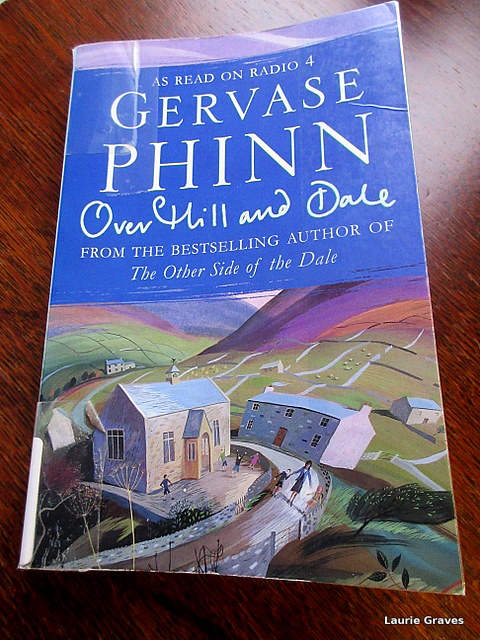
Lately, I have discovered Gervase Phinn, another English writer. (Do you think there is a trend here?) Phinn writes memoirs of his time as a school inspector in North Yorkshire, beginning in the 1980s. He is not a great stylist, but his books have a wonderful narrative flow, with vivid descriptions of teachers, students, parents, and colleagues. And, he makes me laugh out loud, to the point where my husband looks at me with raised eyebrows as I chortle over a passage in Phinn’s books. How often do books make us laugh? In my experience, not very often, and a book that does is a little gem.

I have been thinking that I should start collecting “comfort” books for my home library. (I already have several Miss Read books.) That way, the books will be right there when I need them, and I can also let friends borrow them when they are going through their own hard times.

IMG_0927

Movie Night: Black Narcissus (Based on the Novel by Rumer Godden)

About a year ago, Clif and I decided we would host a movie night at the little house in the big woods. We have three friends—Diane, Joel, and Alice—who love movies as much as we do, and Clif and I thought it would be fun to get together to watch a movie and then discuss it afterwards.

Over the course of the year we have fine-tuned the event. We start at about 5:30, we provide pizza and soft drinks, and our guests bring salad and dessert. Clif has a very good hand with pizza dough—he knows just how to stretch it—and we are able to buy a good frozen dough from a Maine company, Portland Pie Co. (The dough is available in our local supermarket.) I make a quick sauce using Muir Glen’s crushed tomatoes with basil, garlic, and a little dried oregano. Clif likes to use a mixture of cheeses—mozzarella, cheddar, and Monetary Jack.

We have two large pizza pans, one of which is cast iron, a present from my brother and his wife. And miracle of miracles, our blast-furnace oven does a great job with pizza. We bake the two pizzas for twenty minutes or so and voilà! Pizza for five or six, at a fraction of the cost of take-out.

IMG_0524

We take turns choosing the movie, and last night was Joel’s turn. From his own film collection, Joel brought several to pick from, and we quickly settled on Black Narcissus, a 1947 film, staring Deborah Kerr and Jean Simmons and based on the book by the late great English writer, Rumer Godden.

Black Nar

Black Narcissus is the story of a small group of Anglican nuns, led by Sister Clodagh (Deborah Kerr), who travel to a remote former palace in the Himalayas to open a convent. At the new convent, the nuns plan to teach the local girls, open a health clinic, and grow much of their own food. But high on the mountain, the air is thin and the wind always blows. The local British agent, the charismatic Mr. Dean, warns them not to stay, feeling that the mountain will be too much for them.

Naturally the nuns stay, and naturally Mr. Dean is right. It isn’t long before the mountain and the people who live there exert an unhinging force on the various nuns, in particular Sister Ruth, played with an over-the-top relish by Kathleen Byron. A chaste love triangle forms between Sister Clodagh, Mr. Dean, and Sister Ruth, resulting in tragedy.

First, the good. Black Narcissus is extremely strong on the visuals—on the cinematography and on the sets where most of the movie was filmed. The colors, the framing, the vividness of place—even though it was mostly a set—is nothing short of astonishing. The cinematographer, Jack Cardiff, won an Academy Award for Best Cinematography, and he certainly deserved it. Visually, the movie is a work of art.

Unfortunately, the move was weak with character development, relying too much on bug-eyed melodrama and crashing music. Apparently, this sort of melodrama was big in England in 1947, but it marred the story written by an author who excelled at character development.

Nevertheless, Black Narcissus is a movie worth seeing, if only for the beauty of the filming. Diane was right in suggesting this was really a group film, best seen with others so that we could all react to the various over-the-top scenes.

Next month is Alice’s turn to pick, and we will be heading back to India with Monsoon Wedding. I’m looking forward to it.

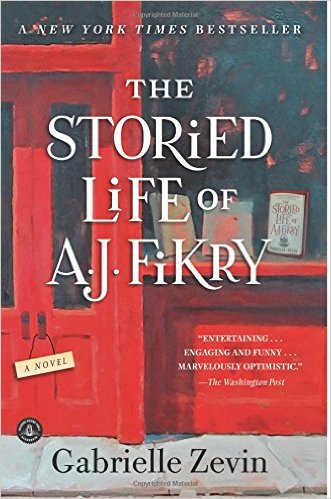
Book Group: The Storied Life of A. J. Fikry

The storied lifeLast night, I went to book group, which is hosted by our town’s library and run by the inimitable Shane Billings, the Adult Services Librarian. He started the book group over five years ago, and I’ve been with it since the beginning, with a few breaks here and there.

This month’s book was The Storied Life of A. J. Fikry by Gabrielle Zevin. Here are the basics of the story: A young but cranky man, A. J. Fikry, runs a bookstore on Alice, a fictitious island off the coast of Massachusetts.  When the story opens, A. J.’s wife has recently died in a car accident, and the grieving A. J. plans to drink himself to death. His suicidal plans are interrupted by Maya, an abandoned two year old who is left in his bookstore.  A.J.’s love for Maya—and hers for him—gives his life meaning. (And, yes, there is more than a little similarity between this story and Silas Marner.) From there the story sweeps out to include Lambiase, a kindly police officer;  A.j.’s dodgy sister-in-law, Ismay—how can she help being dodgy with a name like that?; and Amy, a dedicated bookseller from the mainland. There isn’t much of a plot—more a sweep of years, handled beautifully—spiced with the theft of a rare manuscript and another car crash that might or might not be murder. Finally, and perhaps best of all, there is the love of books that thrums through the story and connects the characters.

As was noted at book group, this is a sentimental story, but it is redeemed, to a large extent, by Zevin’s fine writing. In short, it is a sentimental tale told well.

There was a lively discussion about Ismay, the dodgy sister-in-law. Most of the members of the book group—composed mainly of older women—felt sympathy for Ismay, but the one young man who comes loathed her character. He didn’t see that Ismay had any redeeming qualities. Certainly, this point of view, while a little harsh, could be defended, and indeed in the book, young Maya doesn’t much like Ismay either.

One of the great things about our book group—Title Waves, it’s called—is that by and large, for over an hour, we discuss the book and nothing else. There is little chit-chat about personal matters, and we take the books and the discussions very seriously. After all, we are people who love books. At the same time, we are able to laugh and joke about our disagreements. There are some, like me, who have been there since the beginning, and there are many newcomers, too. All are welcome.

As Mona, one of the members, put it, “We all feel safe to express our opinions. It’s all right to disagree, and we do it respectfully.”

Yes, we do, and it is this attitude, along with the books, that has kept me coming to book group for over five years.