Category Archives: Art

Some Thoughts on Shadows

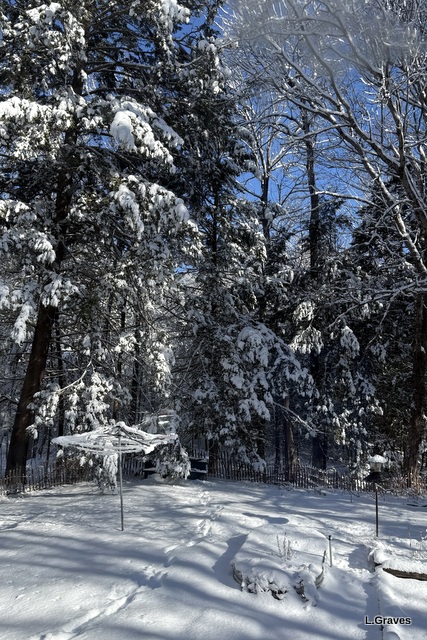
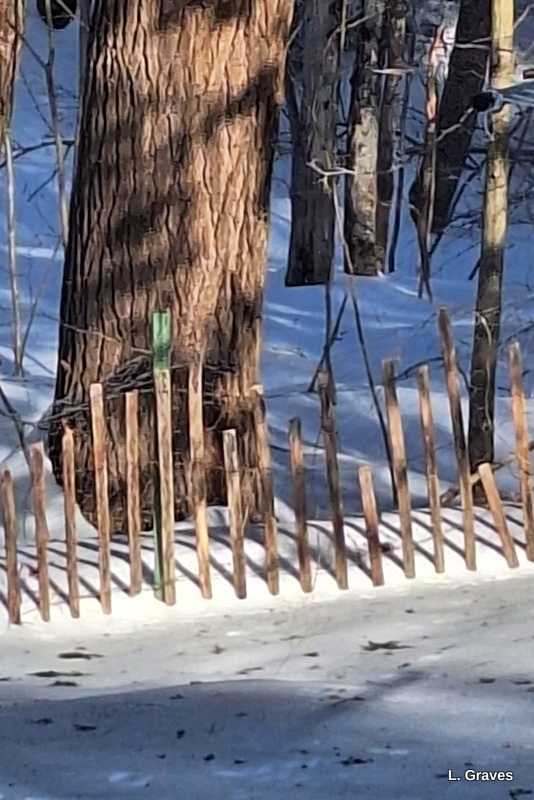
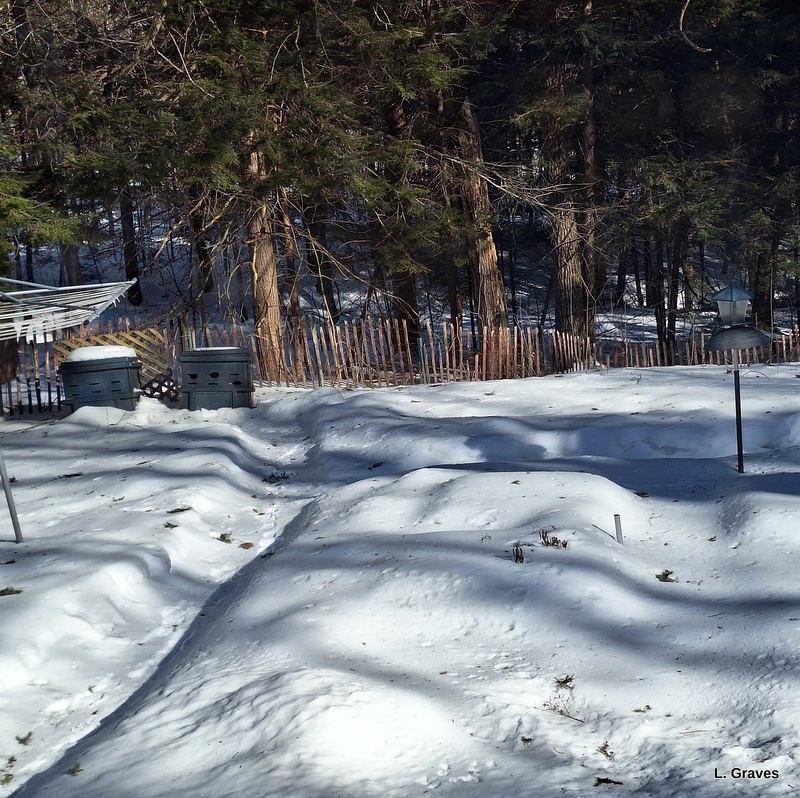
In Maine, we have moved from deep winter to late winter and will soon be approaching the purgatory that is mid-March. But we still have a few weeks to go until purgatory, and in the meantime winter reigns, that time of shadows on the snow. How I love to see the shadows in our backyard.

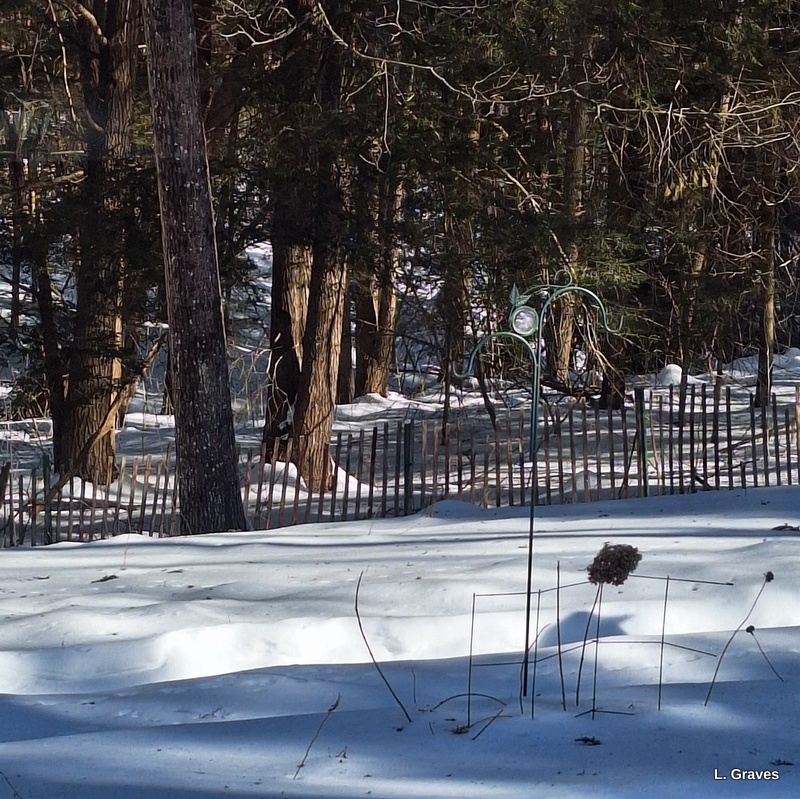
The way the slats from the fence register on the snow,

the way the blue shadows stripe the yard,

and the way the dark shadows fill the woods.

Such a beautiful season, and even though staying warm is expensive, I never wish for winter to hurry into spring. Each year, I  welcome winter with a glad heart and am always renewed by this still, cold season that encourages a person to turn inward.

While we don’t want to turn inward indefinitely—we need spring and the exuberant return to life—winter, for me at least, is a necessary time to examine personal shadows and try to come to terms with them.

If this sounds very Jungian, well, it is. Years ago, I blasted through the books of the late, great Canadian writer Robertson Davies, who was a great admirer of Carl Jung, author and psychiatrist, among other things. If I remember correctly, Davies maintained that Jung, with his emphasis on the unconscious, was the patron saint of artists, all of whom, one way or another, dig deep into the unconsciousness to produce art. The deeper the dive, the greater the art. (By art, I mean art in general, which includes literature, dance, music, theater, and, yes, movies.)

Therefore, as I am surrounded by the shadows of winter, I settle in to read and think and write.

Spring will come soon enough.

********************************************************************

Listening

Bob Dylan: “A Hard Rain’s A-Gonna Fall

Bob Dylan, a musician who has been much in the news because of the bio pic A Complete Unknown, certainly dug deep to write his songs. “A Hard Rain’s A-Gonna Fall” beautifully illustrates this.

To See: The Art of Noticing

To see takes time…
—Georgia O’Keefe

Seeing is one of my obsessions. Not in the strict sense—although I place a high value on my vision—but rather in a more intuitive, artistic sense, to notice and to explore what is not always apparent.

All around my yard, there are creatures living their own lives, trying to get by in a world both hostile and abundant. Often they remain hidden, but sometimes I catch glimpses of them.

This little toad at the edge of my patio,

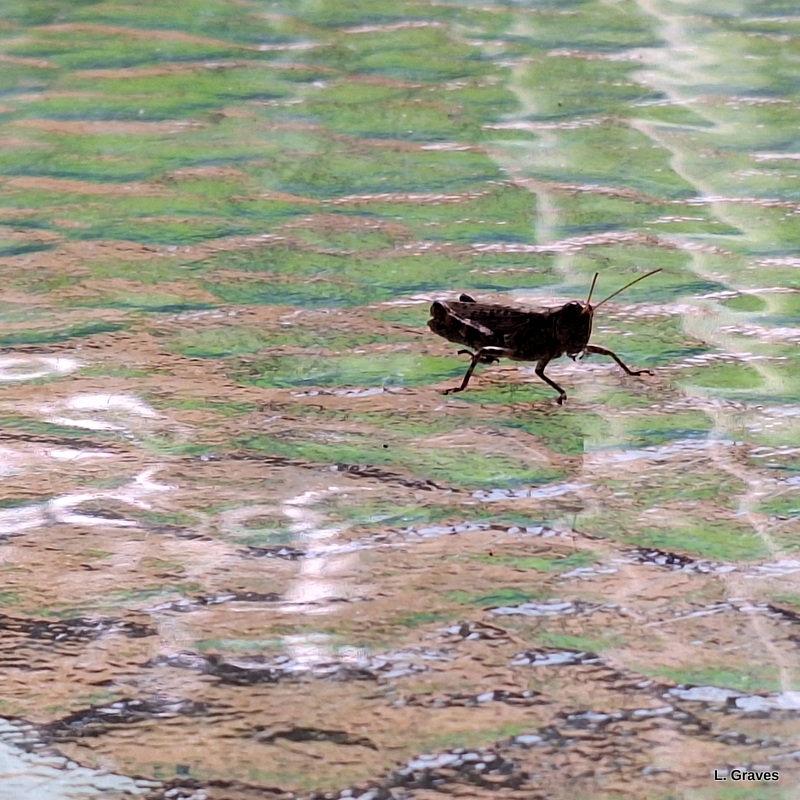
a grasshopper on what looks like a ripple of water but is really the top of our outside table,

and a tiny moth (I think) resting on a sage leaf.

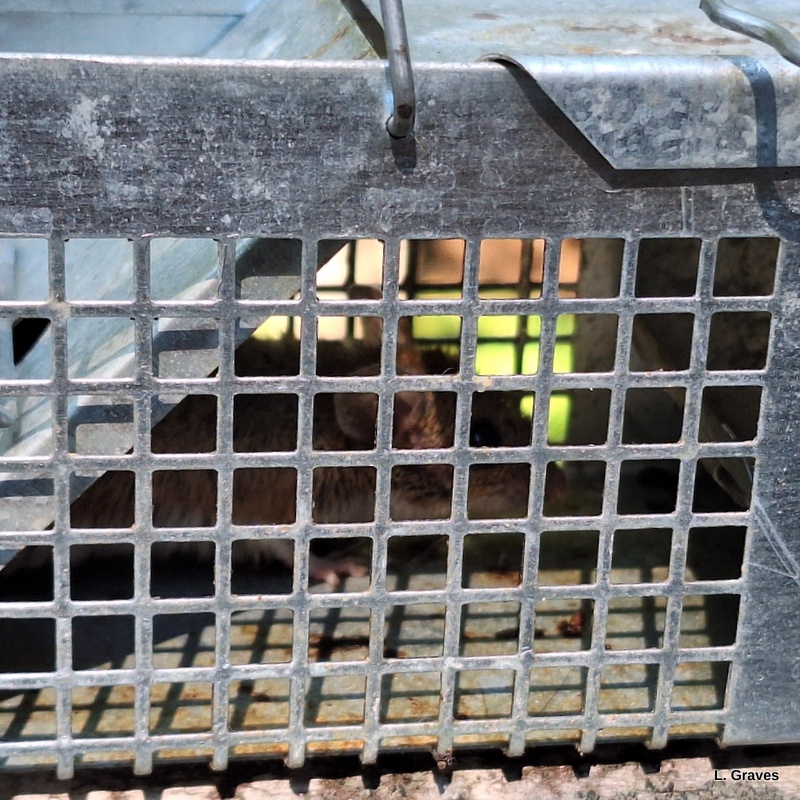
Then there is this mouse, one of many who thinks inside is better than outside. Can’t say I blame the little rodents, but my thinking is opposite. Over the years we have trapped hundreds of mice, releasing them in a field far from here and with no homes in sight.


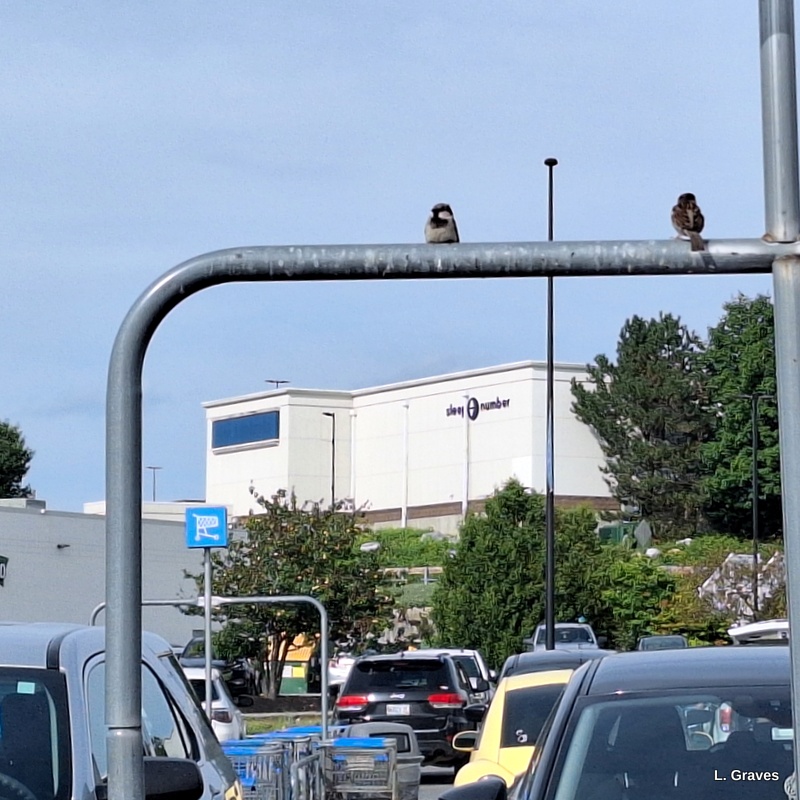
Even in a place that doesn’t seem to support nature, these birds make their home near this parking lot.

Nature—in other words, life—is all around us, if we take the time to notice. And to borrow from the writer Verlyn Klinkenborg, in the pattern of noticing lies the art.

**********************************************************************

Watching: Movies
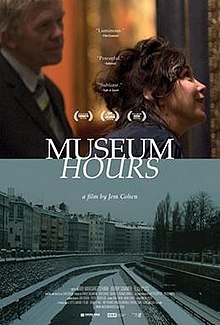
Museum Hours (2012)
Directed by Jem Cohen

Museum Hours seems to run tangent to what I just wrote about noticing the world around us. Much of the film takes place in Vienna’s Kunsthistorisches Museum, where a museum guard, Johann (Bobby Sommer), befriends a woman named Anne (Mary Margaret O’Hara) who has come to Vienna to be with an ailing relative. Through their love of art, Johann and Anne form a bond (platonic), and they explore their past and present using various paintings as a springboard.

In Museum Hours, art is not a series of static pieces unrelated to life. Instead, art is about life, where the artist looked and noticed and captured something essential.  Museum Hours is one of the most illuminating movies about art that I have ever seen, and its ending moved me to tears: Art is around you in everyday life. All you have to do is look.

However, this is a movie that requires patience and attention. Museum Hours is so leisurely that even some of my indie-film-viewing friends found it, ahem, a little slow.

However, for those whose have the patience, Museum Hours is such a rewarding movie.


In Which I Write about August As Well As the Classic Film Alexander Nevsky

For the first part of July, the heat was terrible in Maine—at least for Mainers. The heatwave coincided with the Maine International Film Festival, and Clif, Dee, and I were more than happy to sit in air-conditioned cinemas as we watched movies.

Then, around July 18, it was as though the weather gods flipped a switch, and suddenly we were in August. Black-eyed Susans and Queen Anne’s lace, not normally July flowers, were in full bloom. Crickets, another August treat, were singing at night, and during the day, grasshoppers buzzed.

And the weather? Delicious as only a traditional Maine August can be: hot and dry during the day and wonderfully cool at night. The windows are open all the time, and the air inside the house smells so fresh.

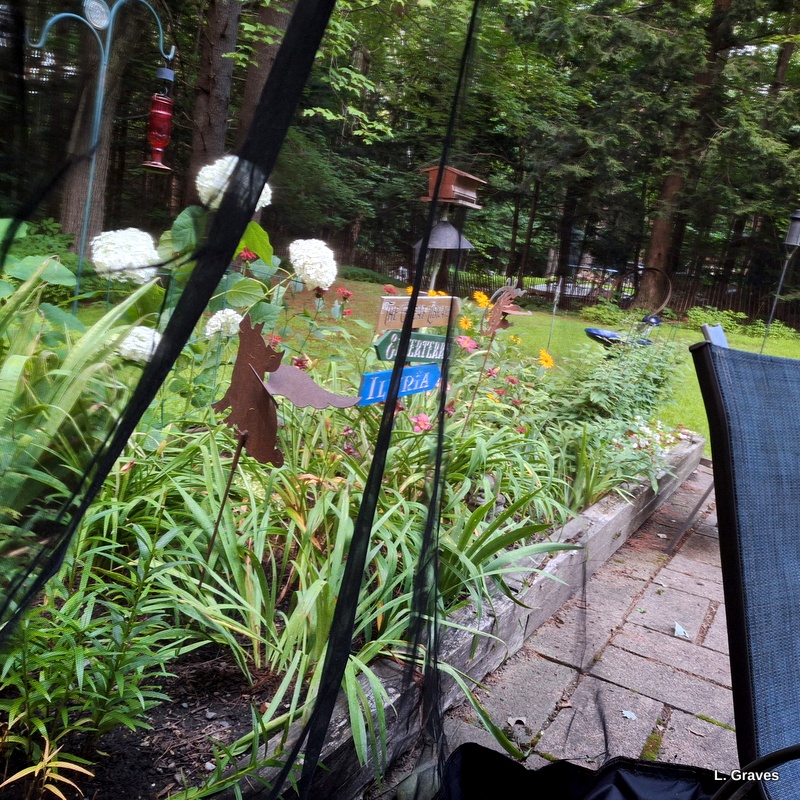
What will true August bring us, I wonder? More of the same would be nice, but in this time of climate change, who knows? Whatever the case, Clif, Dee, and I are enjoying this weather. We are spending as much time as possible in our screen house on the patio.

As we chat about this and that—often movies—we sip our drinks, and listen to the noises from the woods and yard. Gold finches twitter at each other as they vie for spaces on the feeders. A fledgling blue jay calls to its parents. Nearby, crickets sing their sweet song of summer, and in the far distance, in the woods, we  catch the ethereal song of a hermit thrush.

Magical might be a word that is overused, but magical is what this time is.

**************************************************************************

Watching: World Cinema
Alexander Nevsky directed by Sergei Eisenstein

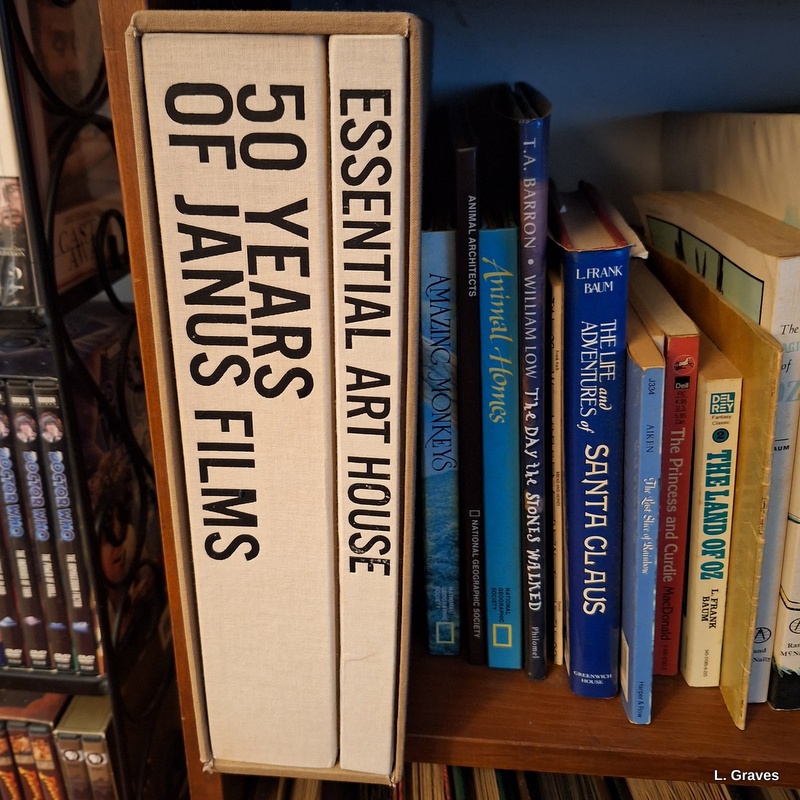
In my previous post, I wrote about how much I like foreign movies, and that our daughter Dee has a huge DVD collection of them. To be more specific, the major part of her collection is Essential Art House: 50 Years of Janus Films released by the Criterion Collection. Janus Films is a film distribution company founded in 1956 in Cambridge, Massachusetts, and they helped bring world cinema to the United States with such classics as The Seventh Seal, one of my absolute favorites.

There are 50 movies in the set, and this should keep us busy for a while. (Don’t worry. I don’t plan to write about all of them. Only the ones that catch my attention.) The DVDS are in alphabetical order by title, and this is how we will work our way through the collection, starting with the first one, Alexander Nevsky, a 1938 Russian film directed by Sergei Eisenstein.

Alexander Nevsky is billed as a historical film, and strictly speaking, this is true. The movie is set in the thirteenth century, centering on the real-life conflict between Teutonic Knights and Prince Alexander. But really it’s a Russian propaganda film, featuring Russia against Germany, a reflection of the situation between the two countries in 1938.

As a result, the characters are stiff and one dimensional, with Prince Alexander being all virtue and valor and the Teutonic knights being a rotten bunch. Indeed, one of the bad guys even looked like an evil sorcerer, as though he had just slithered in from a fantasy movie. As someone who prefers character-driven movies, whatever the genre, this should have been a deal killer.

But it wasn’t. Alexander Nevsky has such a crazy energy that it carried me along. The battle scenes between the Teutonic Knights and Prince Alexander’s forces are nothing short of jaw-dropping, with hundreds and hundreds of extras and horses rushing toward each other. I don’t suppose there were many retakes of these battle scenes, and this was well before the time of CGI and special effects.

In addition, the movie is in black and white, and the cinematography captures everything in crisp detail.

So, in the end, who wins? Prince Alexander or the Teutonic Knights?  No spoilers here. Watch for yourself and see how a propaganda film can still be a marvel of early cinema.

July 31, 2024
Addendum: Yikes! I forgot to mention the rousing score and the composer, Sergei Prokofiev.  The music certainly added energy to an already energetic movie.

South of the Border to Bedrock Gardens in Lee, New Hampshire

The property was a 37-acre dairy farm that had been abandoned for about 40 years. The first years were clearing out the acres of poison ivy, and the pucker-brush. Work on the farm as a landscaped project started about 1987….Bed by bed, gardens were eked out. In 1991, a wildlife pond was added….Now, about 2/3rds of the property is garden.”
From the Bedrock Gardens website.

Thursday was quite a day for this homebody. In my trusty red Honda Fit, I traveled out of Maine to go to Bedrock Gardens in Lee, New Hampshire, where I met my blogging friend Judy of New England Garden and Thread.

We had hoped other bloggers from northern New England would be able to join us, but that did not work out. A busy time of year, I know.

But two is indeed company, and as soon as we met, we chatted as though we were old friends, which, in a way, we are. We have been blogging friends for many years and have gotten to know each other through our words about our lives in Maine and New Hampshire.

Here we are at the entry to fabulous Bedrock Gardens. Lovely Judy is on the left, and I am on the right.

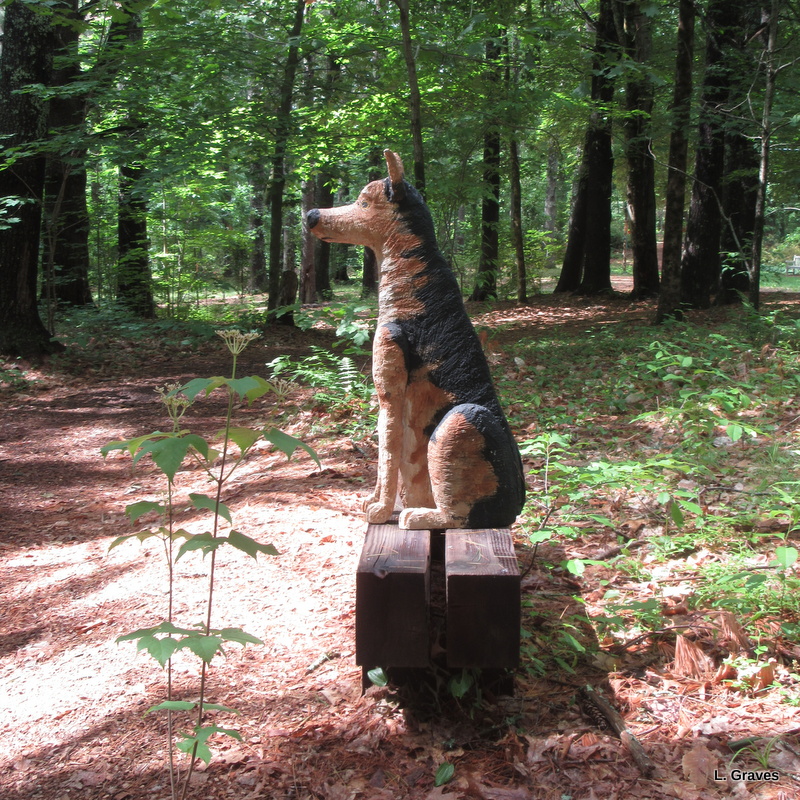
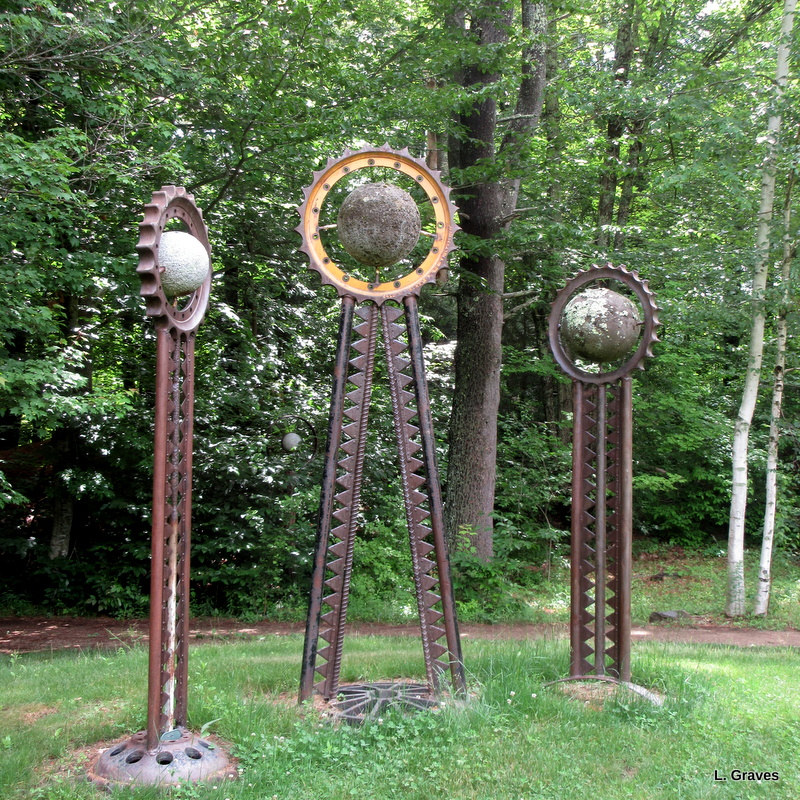
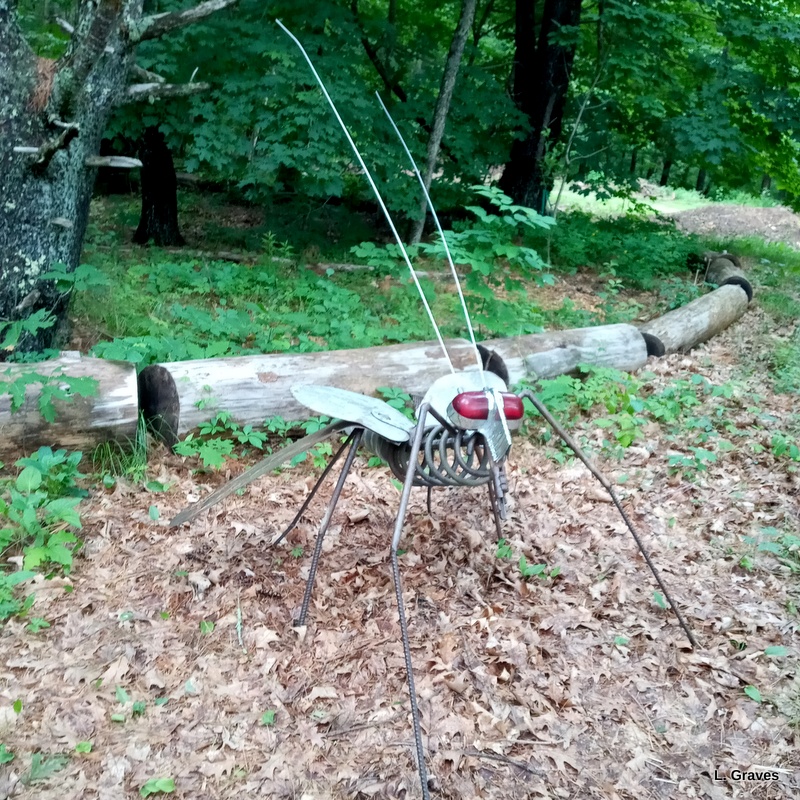
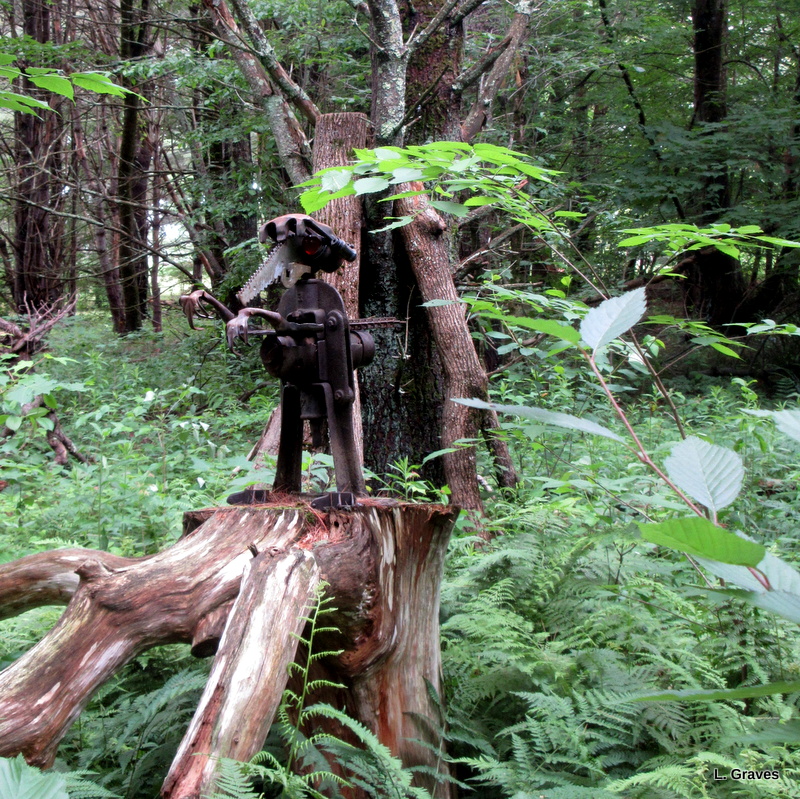
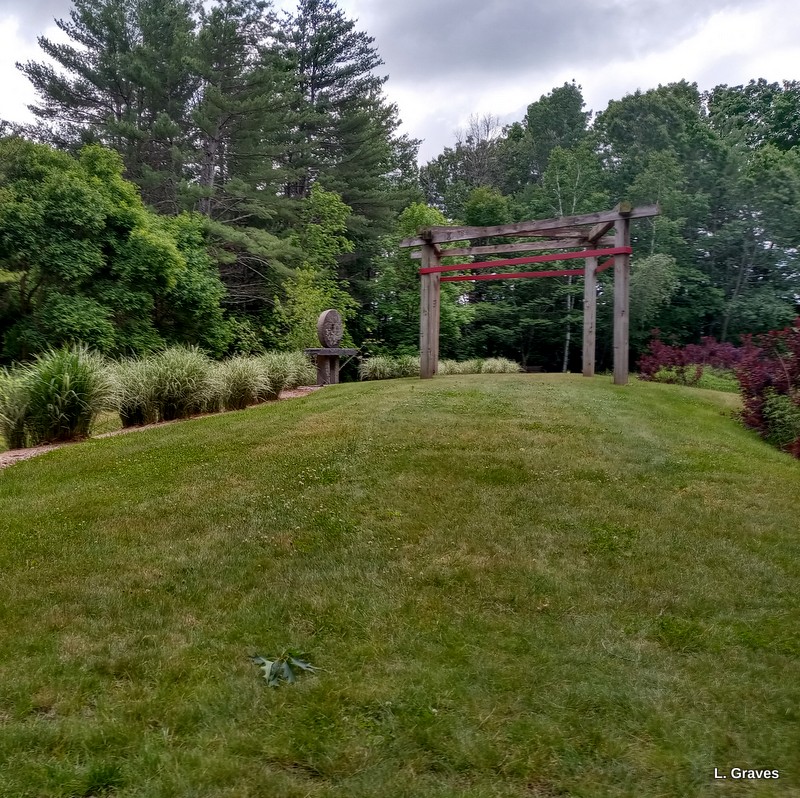
And here are some pictures of Bedrock Gardens, a really wonderful place. I am afraid my pictures do not do justice to these beautiful  gardens with its many sculptures, most of them done by Jill Nooney, one of the founders who designed and planted Bedrock Gardens.

A faithful canine waited near the entrance to the gardens.

We went through the magic pathway,

where three guardians waited.

What was this lurking in the woods?

Or this?

Then there was this fine fellow.

Finally, a more tranquil scene.

After spending over two hours at Bedrock Gardens, Judy and I went a few miles down the road to Emery Farm Market and Café.  We had delicious bagel sandwiches, and we were able to sit on the café’s porch, where we could eat and chat as long as we wanted.

What could make this already excellent day any better? Why, an utterly delicious donut. (Longtime readers might remember my passion for donuts.)

All too soon, it was time to head home. But I was full of good memories and good food. As we would say in Maine, it was a finest kind of day.

I am hoping that meeting with Judy in the summer will be an annual event, perhaps in New Hampshire, perhaps in Maine. Such a great pleasure to meet with blogging friends.


Did We Leave Our Car Windows Open?

In the United States, last Sunday was Father’s Day, and to celebrate, Clif and I had went on an honest-to-God outing, something we haven’t done since March 2020, right before the pandemic closed everything down. First we went to the Colby College Art Museum in Waterville, where we saw an exhibit featuring prints of the U.S. artist Mary Cassatt (May 22, 1844–June 14, 1926).

My first impression of the prints was that they were subtle to the point of being dull. But a closer look disabused me of that notion. A lesson, that’s for sure—first impressions are not always accurate. Cassatt was a master portraitist who focused on mothers and children. Cassatt’s ability to capture nuance and emotion shines forth even in her prints. I was utterly amazed that she could give them so much life.

Here is a short video featuring the curator of the exhibit.

After looking at the exhibit, we wandered around the rest of the museum. We found ourself on the lowest floor of the museum, where there were no windows, and we heard a loud rush of water that sounded suspiciously like rain. Could we really be hearing rain so far down?

It seems that we could. When we went upstairs and looked out a window, we saw the rain bucketing in sheets.

Clif asked, “Did we leave our car windows open?”

Yes, we did. The day was hot and humid, and we thought it would be more comfortable to leave the windows open. Boy, were we ever wrong.

The tempest didn’t last long, and when we went back to the car, there was water, water everywhere pooling inside the center console. Fortunately, I was able to mop up most of the water with napkins from the glove compartment.

But the cloth seats were soaked, and after two minutes of sitting on them, so were our backsides.

Nevertheless, onward we went to the second part of our outing—to Buen Apetito for Mexican food. Fortunately, we sat at a booth with plastic seats. As we squished our way in, I explained the situation to our server, who laughed and took it in stride.

“No worries!” she said.

With that settled, we started with a beer—Lunch not Miller Lite— for Clif and a margarita for me.

We shared an order of potato flautases, which I forget to take a picture of. And because it was Father’s Day weekend, we also split dessert, a deep-fried banana tortilla with scoop of vanilla ice cream sprinkled with cinnamon.

As we would say in Maine, wicked good.


Some Favorite Blog Posts from Friends Far and Near

Note: After marathon gardening for two months, I’m still not in the swing of things, But eventually each week I hope to feature more posts from snappy blogs I follow.

Ju-Lyn, from Touring My Backyard, received the gift of a kabocha  pumpkin, which is one I’ve never heard of.

From New Zealand, Thistles and Kiwis featured highlights of a trip to Auckland.


About the “Naughty Corner”

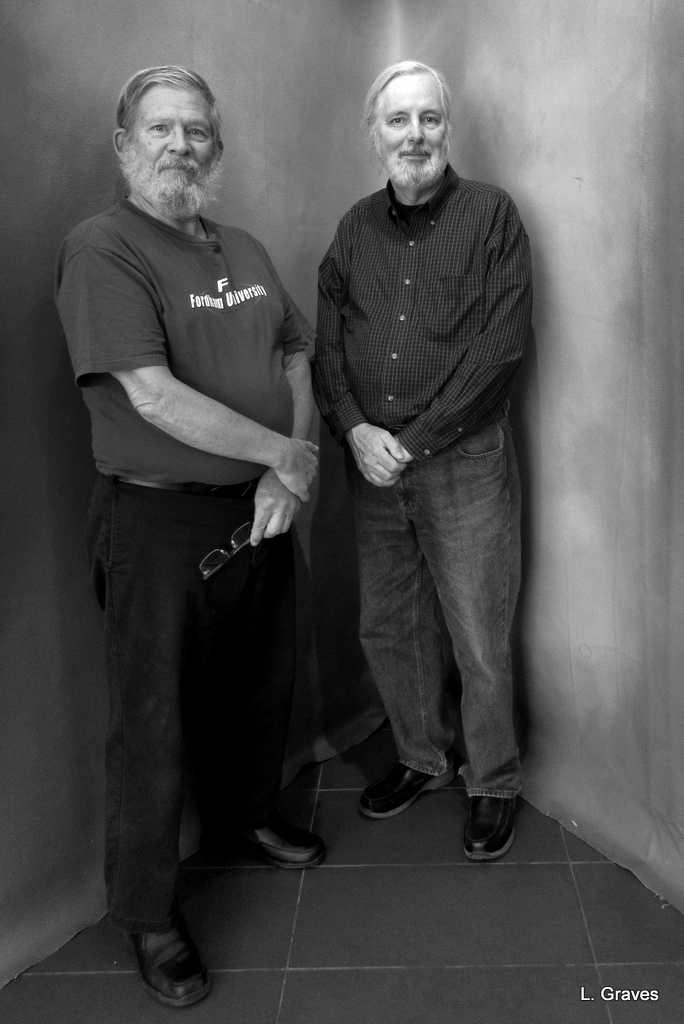
On yesterday’s post, I featured this picture of my husband, Clif, and his friend John.

My blogging friend Tialys—who, by the way, has a wonderful blog—asked, “But why are they standing in the naughty corner?” (Clif and I had a good giggle over this question.)

I had never thought of the portrait that way, but I can see Tialys’s point. John and Clif are, after all, standing in a corner. After thinking about the question, I decided that further explanation was needed.

The corner is a backdrop at the Colby College Museum of Art in Waterville, Maine, and is part of an exhibit called I Am Not a Stranger: Portraits by Séan Alonzo Harris.

Here is an explanation of the exhibit from the museum’s website:

Presented by Waterville Creates! in partnership with the Colby Museum, I Am Not a Stranger: Portraits by Séan Alonzo Harris will include approximately fifty new studio photographs of Waterville residents….This major new work by Harris, an accomplished photographer who is new to Waterville but has lived and worked in Maine for over twenty years, aims to represent the people of Waterville, build bridges across difference, and create a platform for storytelling and community reflection rooted in our shared space.

I Am Not a Stranger includes some of Harris’s portraits of Waterville residents, and if you click here, you will see selected works from the exhibit.

The gray corner was also part of the exhibit, and I asked a woman working at the reception desk if museum goers were allowed to have their pictures taken against the backdrop.

“Oh, yes!” the woman answered. “Snap away!”

Hence the portrait of John and Clif, two very photogenic guys.

The corner backdrop can be interpreted in a number of humorous ways. But it seems to me that the gray background frames the Waterville residents—and John and Clif and anyone else—in a way that gives them dignity and attention that everyday folks don’t normally receive. The backdrop guides your gaze and encourages you to look, really look, at the people in the photographs. The black and white only serves to heighten the mood.

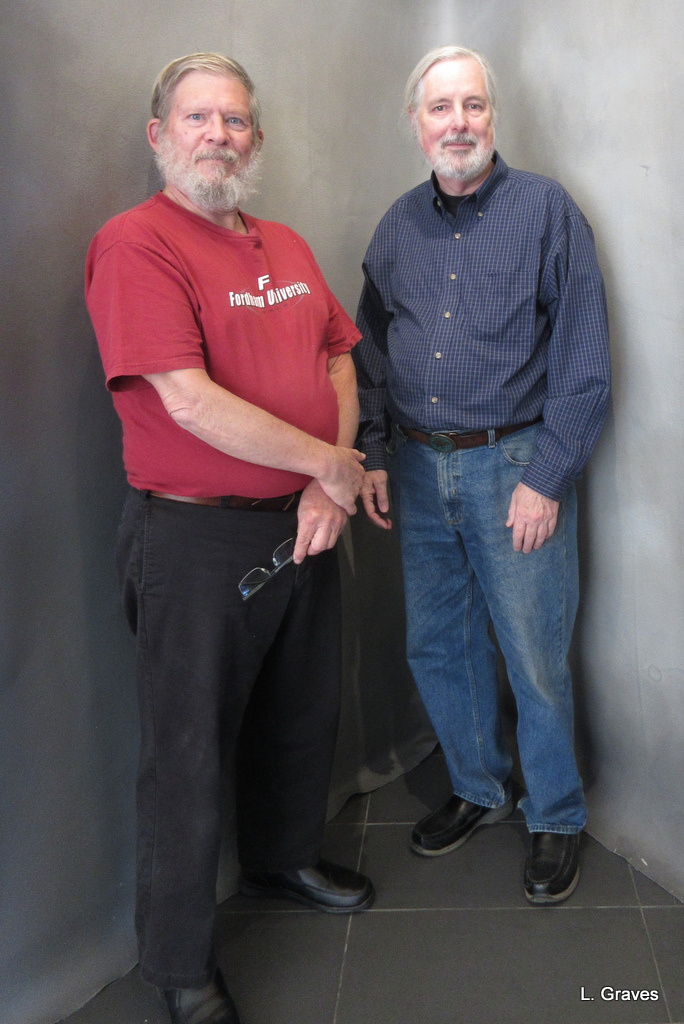
Here is the same picture in color.

Better in black and white, don’t you think?


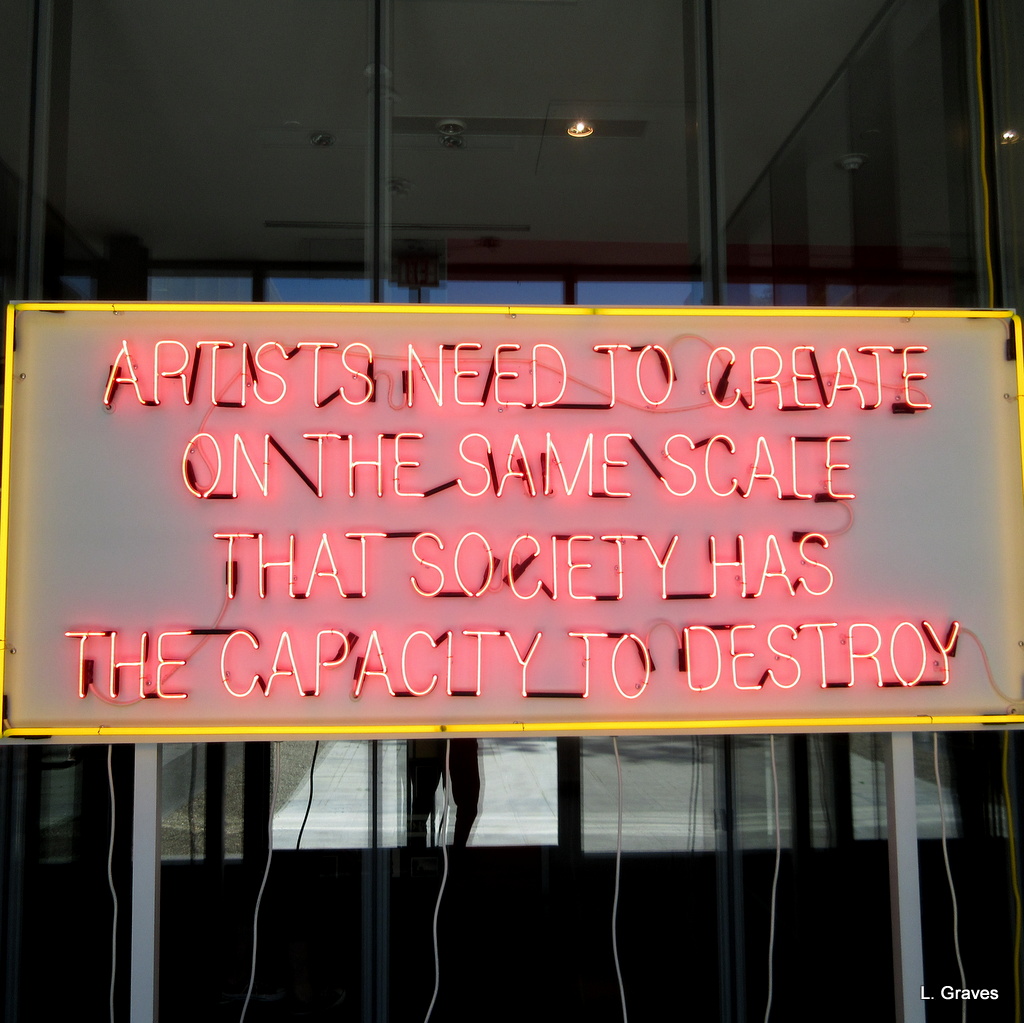
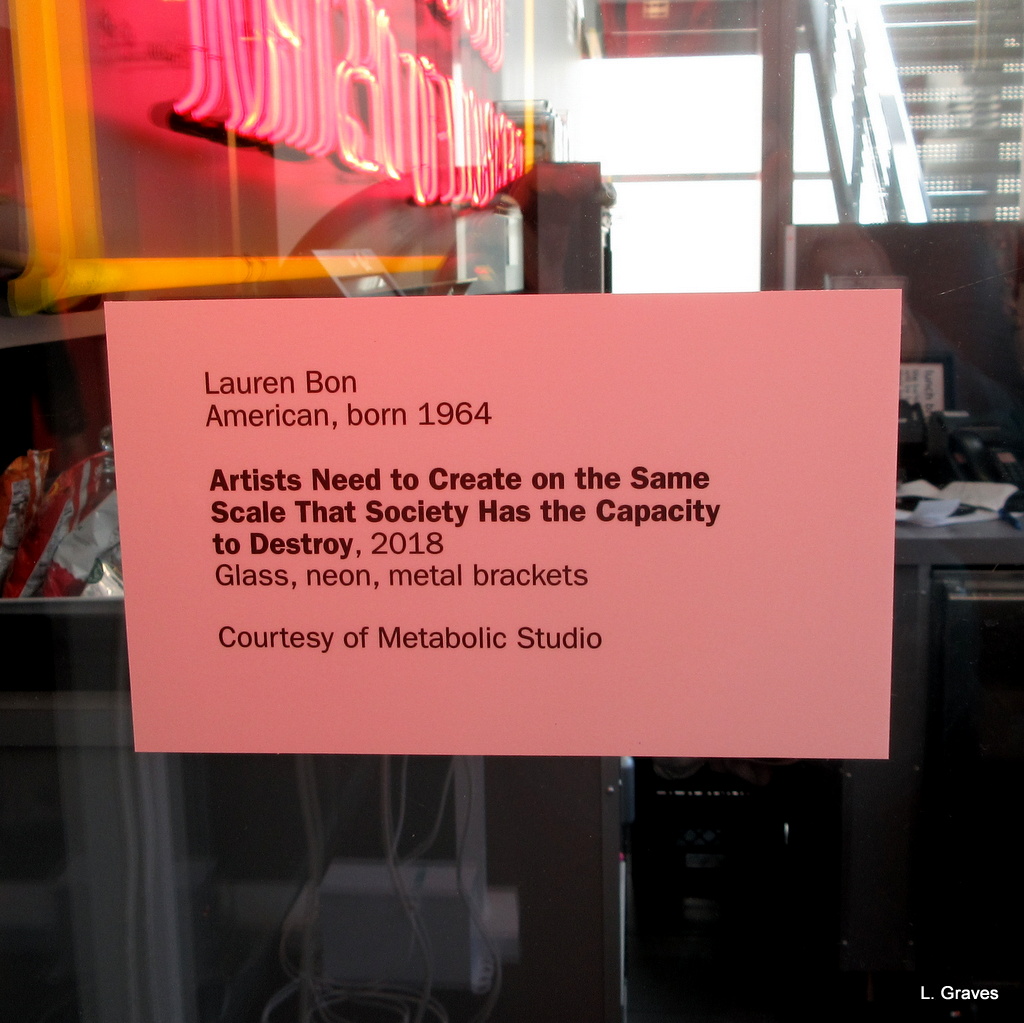
Artists Need to Create…

For someone who doesn’t stray far from home, I seem to have quite the busy little life. I suppose no matter where you live there is always something going on, and observant writers, photographers, and artists try to catch as much of it as possible.

Last week, our daughter Dee came to visit, and we celebrated our birthdays. Hers is in October, and Clif and I have birthdays in September. What a time we had! We went to three movies; ate dinners at a Thai and Mexican restaurant (not the same place); had fires in our fire pit, where we made S’mores; got together with friends; and went to two terrific art exhibits at Colby College and Bates College. Have I left anything out? I don’t thinks so.

Dee left yesterday, and now it’s time to hunker down and work on my fantasy novel Out of Time. I am at 70,000 words, and I might have been a wee bit optimistic about when I would finish.  I had hoped it would be by the end of September, but now it looks like it won’t be until some time in October. (Still ahead of schedule. My original goal was to finish by December.) Therefore, I’m going to resume blogging—yes, I have missed it—albeit on a somewhat limited scale with more images than words and perhaps featuring posts from other blogs.

Anyway, here is today’s image, taken at the fabulous Colby College Museum of Art.

Created by

Yes, yes, and yes!


MIFF Warriors

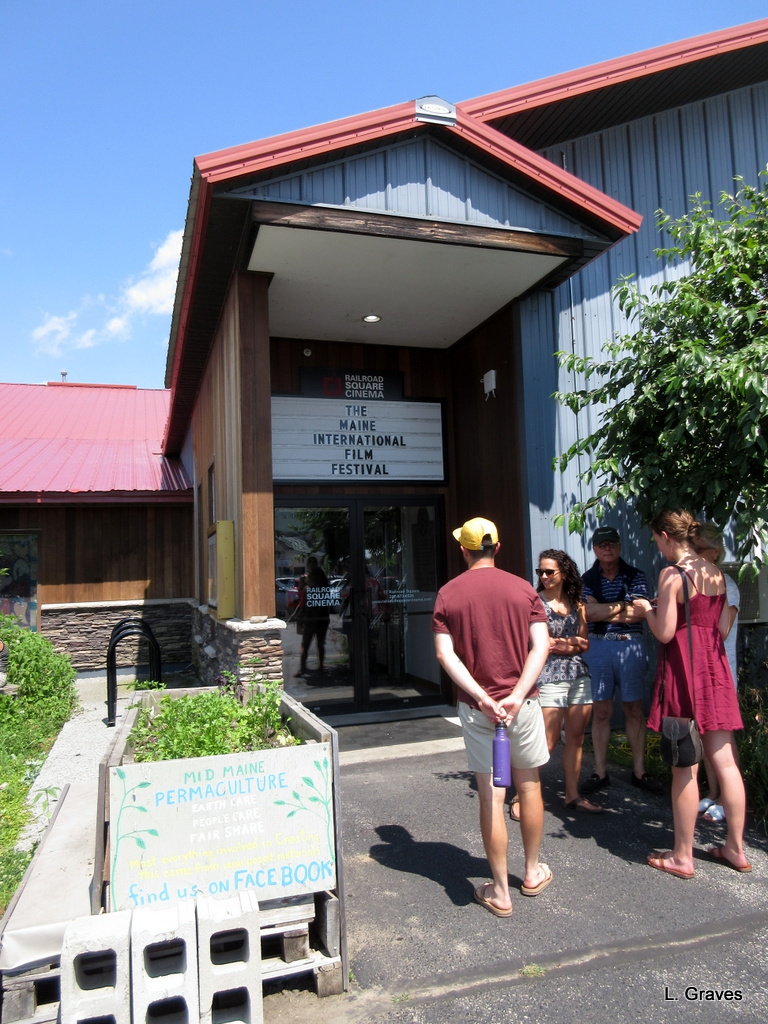
What a week it was at the Maine International Film Festival, also known as MIFF! (I wrote about MIFF in my last post.) Every year we have a fabulous time watching movies, many of them foreign, that will most likely never come to a theater near us. We eat out. We have drinks. We meet with friends.

But this year was even more extraordinary because of a fourteen-hour Argentine film called La Flor.  No, I did not make a typo when I wrote “fourteen-hour.” According to Wikipedia, La Flor has “a length of 868 minutes including intermissions.” Even by MIFF standards—past festivals have included long films—La Flor is unique both in its scope and length.

Did we sit for a fourteen-hour stretch to watch La Flor? We did not. The movie was shown in four parts, one per day. Here is a short description from Wikipedia: “La Flor is broken into six separate episodes, connected only by an on-screen appearance by Llinás [the director] explaining the film’s structure. The first four episodes have the beginning of a story but finish in medias res. The fifth episode is the only one to proceed from start to end, and the last episode has just the conclusion of a story. ” Four actresses—Elisa Carricajo, Valeria Correa, Pilar Gamboa, and Laura Paredes—star in different roles in five of the episodes.

Clif, Dee, and I quite sensibly decided to start with the first part of La Flor and then go from there. We were immediately taken by the energy of the stories—the first a grade B movie about an extremely scary mummy and the second a tale about two musicians who were once a couple but have separated and try to come together to record a song. Without the outstanding acting of the four actresses listed in the paragraph above, none of the episodes would have worked. These talented actresses held La Flor together.

By the time we were done with the La Flor, Clif, Dee, and I felt like MIFF warriors, and the small band of moviegoers who made it to the end felt the same way. I nearly proclaimed, “We few, we happy few, we band of moviegoers.” We all agreed that we deserved purple heart badges.

You might be tempted to scoff at us. After all, how hard can it be to sit and watch movies? If we’re talking about, say, Spider Man or Toy Story or some romantic comedy, it’s not that hard. (But fun!) However, when you’re watching a movie of La Flor‘s length and reading subtitles the whole time, it is an intense albeit rewarding experience.

The same could be said for most of the movies at MIFF, and we saw others besides La Flor. Few of them are fluff, many of them are foreign, and after a while, fatigue sets in. I heard one moviegoer exclaim, “I ache all over.” With my creaky knees, I could certainly sympathize.

Still, we wouldn’t miss this film festival for anything. Although Clif and I are tired, and it will take us a few days to recover, we also feel letdown that the festival is over and that Dee is back in New York.

But there is work aplenty. My third unfinished book—Out of Time—beckons. So onward, ho.

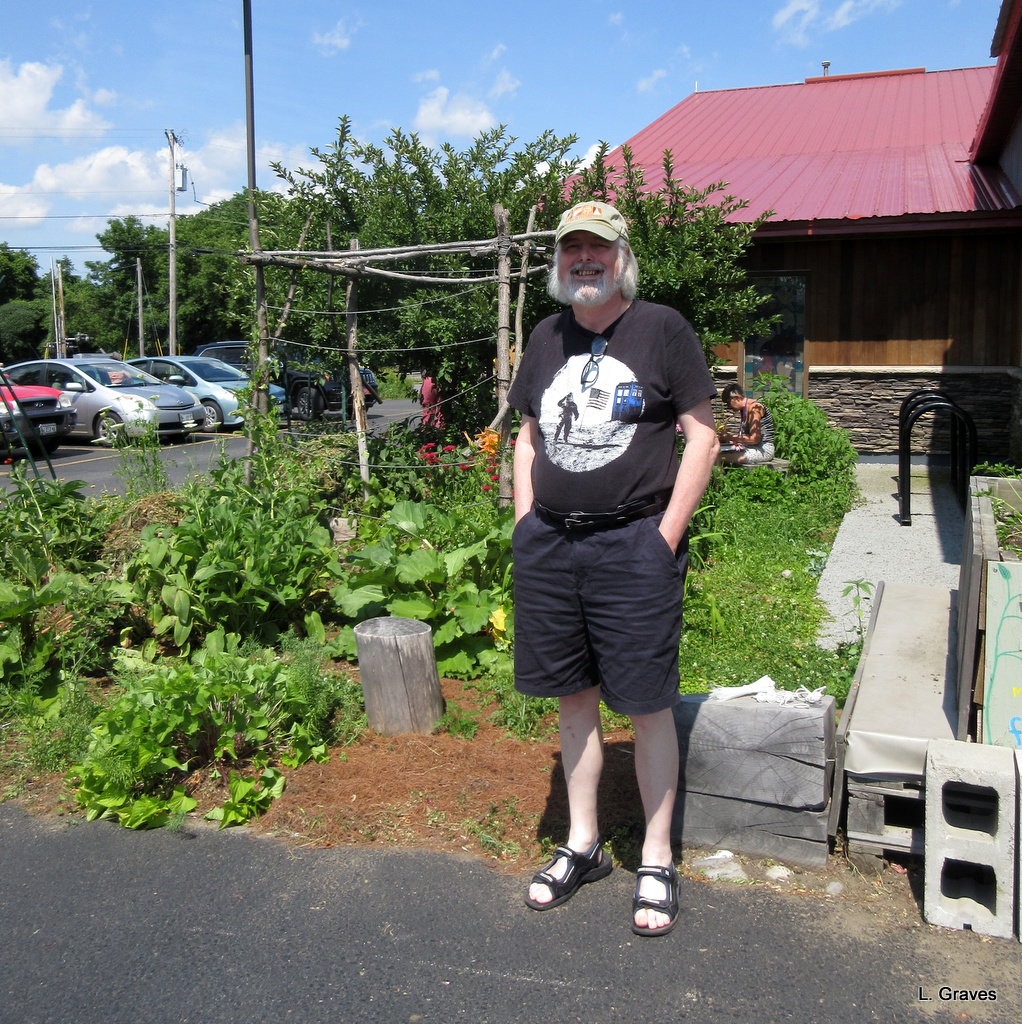
Clif, one of the MIFF warriors, at Railroad Square

A Spark on Water Street in Augusta

Once upon a time, towns and small cities in Maine were thriving, busy places. Maine is a state with many rivers, and along those rivers were factories that made shoes, spun wool, and produced paper. There was a downside: Those factories polluted the water and the air. But they also provided good jobs. Then, in the 1970s and 1980s, the factories left, one by one, to go to places where there was cheaper labor, first in the southern part of the United States and then out of the country all together.

The devastating effect of this on Maine, a small, rural state with only a million people, cannot be overstated. No big tech companies rushed in to fill the void, the way they have in more populous states in southern New England. Therefore, young people left—Maine has the largest percentage of senior citizens in the country.  Many of those who stayed behind pieced together a patchwork life of part-time work.  Or, full-time jobs that barely pay enough to raise a family, buy a house, and pay for a college education. (Hannaford Supermarkets is one of the largest employers in Maine, along with Wal-Mart.)

Not surprisingly, when the great factories fell silent, once flourishing downtowns went into a tailspin. Business after business closed, and all over Maine there were so many empty store fronts that Tim Sample, a Maine humorist, joked about the “Vacant Building Festival” in Eastport, Maine, where the locals supposedly quip that “If you could buy a Greyhound bus ticket with a food stamp, we’d all be outta here.”

Funny, but ouch, and this applies to much of Maine, not just to Eastport.  It certainly applies to central Maine, to Augusta, the state capital, whose downtown on Water Street has been moribund for so long that only an old timer like me remembers when it was thriving.

However, lately there have been sparks of life on Water Street, and those sparks have burst into a little flame. Appropriately enough, Cushnoc Brewing Co., a brewery that also serves pizza baked in a wood-fired oven, seems to have been one of the first to light the spark in Augusta. (My son-in-law Michael maintains that breweries have done a lot to revive communities. Perhaps he is right.)

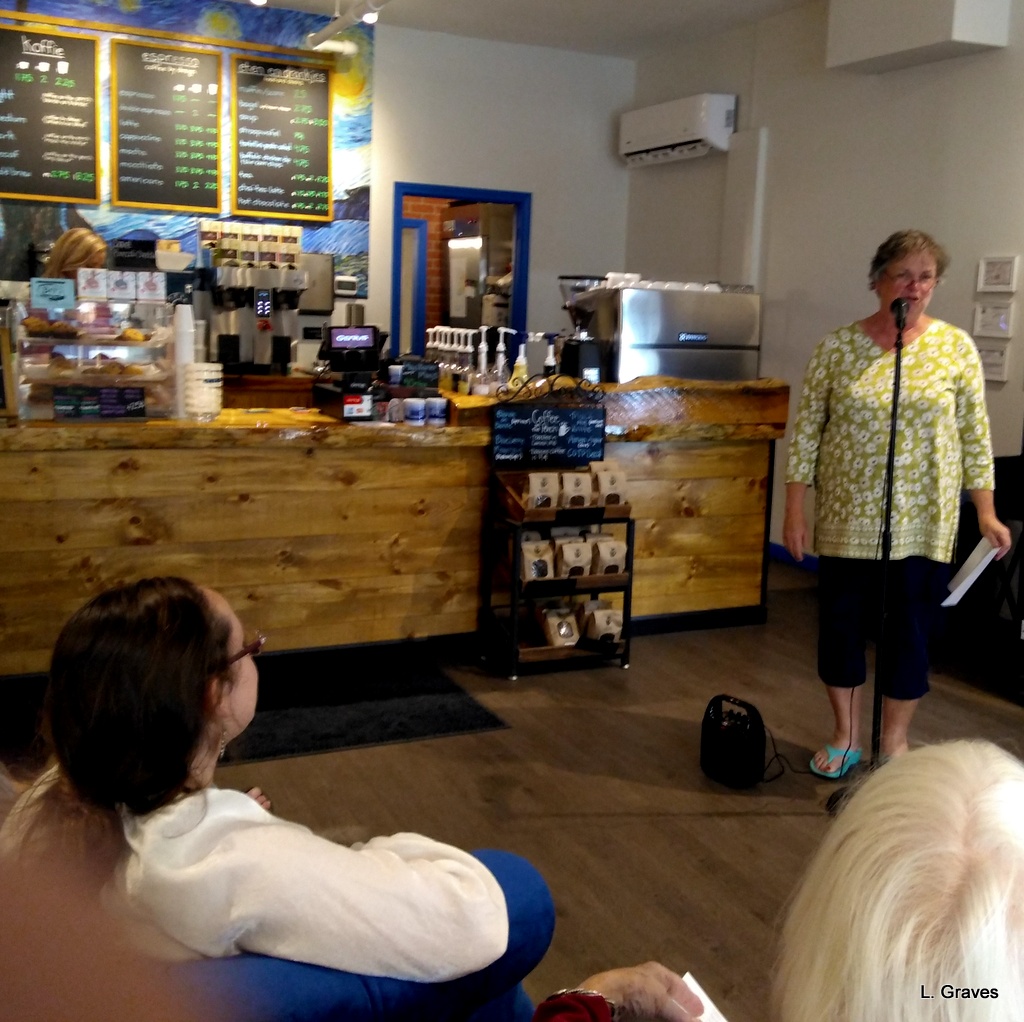
Along with Cushnoc came other businesses—Otto’s, Circa 1885, and most recently Huiskamer Coffee House, where we went on Saturday to hear our friend Claire Hersom read poetry along with Jay Franzel and Bob MacLaughlin.

Huiskamer Coffee House is a delight. There are couches, comfortable chairs, tables, and Vermeer and Mondrian prints. (What a contrast between the two artists!)  Wonder of wonders, there was good tea—Harney & Sons—as well as good coffee. Grace Fecteau, one of the owners, let us use our own mugs for tea and coffee, but there are ceramic mugs and plates.

Here is a view of the coffee house from our table.

And here is a picture of the delightful Claire.

As the poets read, subjects ranged from the Red Sox to back country roads to being poor in Maine. To having a father with Alzheimer. Some of the poetry was intense, some of it was funny, and all of it was close to the bone.

How nice that the coffee house was full of people listening to poetry. Tea and coffee were drunk, scones and soup eaten.

When Clif and I left, it was still light out, and on Water Street, there were cars parked on both sides of the road. People walked on the sidewalk.

Even five years ago, Water Street was deserted on nights and weekends. Not anymore.

May this spark continue to grow.


A Week in Two Acts

Act I

What’s Making Me Droopy

On Monday, Winter let us know it was not quite done with Maine by sending a storm that dropped five or six inches of snow. Once again, Clif had to take Little Green out for a spin, and once again,  the town’s snowplow left a tall, hard ridge of snow at the end of our driveway.

The week before, the backyard was free enough of snow that I had hopes of starting to pick up the many sticks that have fallen over the winter. But no, nature had other plans. No picking up sticks for me, no getting a whiff of spring.

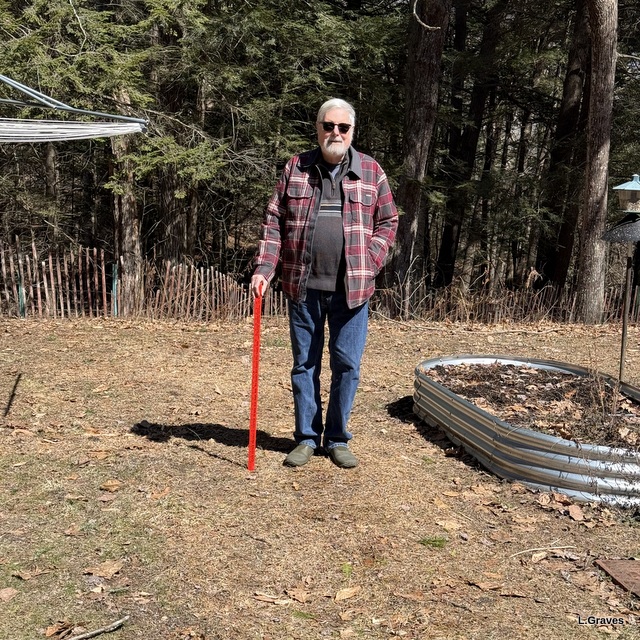
Here is Snow-Gauge Clif in the backyard.

And here he is in the front yard. Despite the snow, Clif still looks perky.

However, I am not quite as perky. You might even describe me as  droopy, and I keep repeating, “Soon Spring will come. Soon Spring will come.”

Act II

What’s Making Me Happy

After moaning about Winter and its bony grip, I thought I would balance this post with something that’s making me oh so happy. It’s a picture of a junco—birder lovers, please correct me if I’m wrong—that I bought at a craft fair last week.

Clif and I were at the fair with our books—we did well!—and right across from us sat a talented photographer named Norma Warden. I chatted with her for a bit, and Norma told me she recently moved to Maine from California. She is unfamiliar with the Maine craft fair scene, and I gave her a few tips.

After spending the morning and part of the afternoon admiring Norma’s work, which blends photography with a painterly sensibility, I bought one of her pictures. Birds and art are two of my weaknesses, and when they are combined at a good price, who am I to resist?

The picture is hanging on the wall by my desk, and every time I look at that little bird, I smile.

Here is a link to Norma’s website, where you will find her lovely art selling for amazingly reasonable prices.