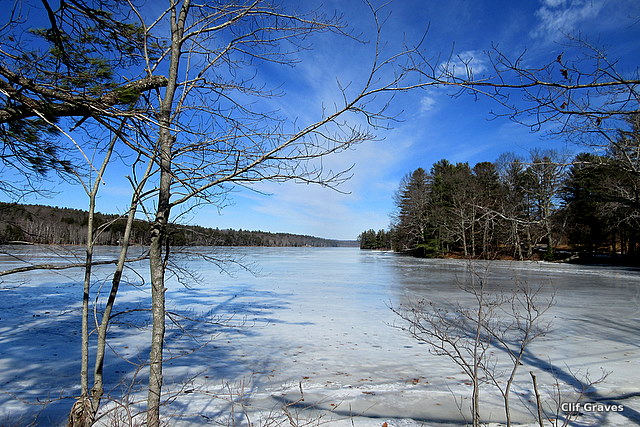

Clif and I are huge fans of the small things in life. While we appreciate big showy events as much as the next person, we both feel it’s the little things that jazz up our lives. There’s not a day that goes by that I’m not grateful for this attitude because let’s face it—most people’s lives are made up of small events, and if you don’t enjoy them, then this means that most days you’re just marking time.
For example, yesterday I wrote about my eager anticipation for being able to hang laundry outside for the first time this season. Readers, you can bet that when this joyous event occurs, it will be duly noted in this blog. I also wrote about mucking about in the yard, getting damp and cold, then coming in, settling in the living room, and having popcorn while reading. A simple but oh-so-good pleasure.
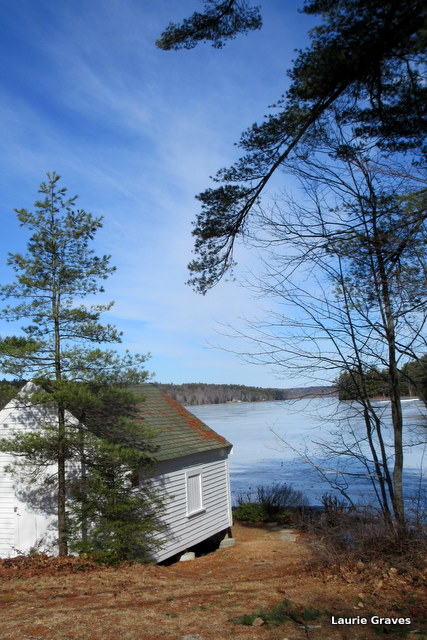
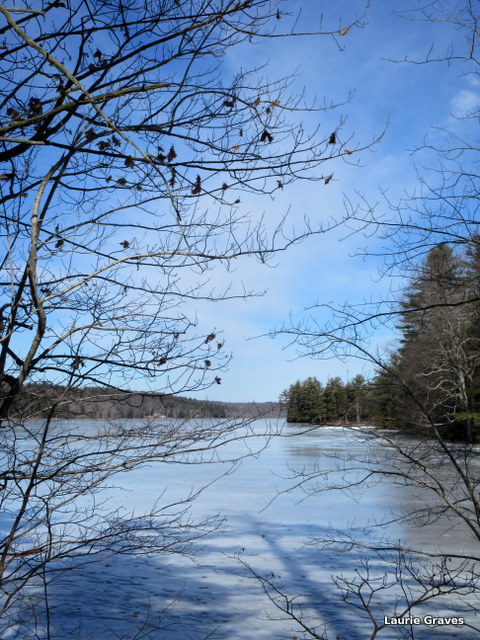
Another one of our many small pleasures is waiting for “ice-out” on the patio in our backyard. For this, a bit of a backstory is in order. We live in a part of central Maine that has many lakes and ponds, so ice-out—when the water is free and clear of ice—is a big event for the whole town. When the ice goes out on the lakes and ponds all depends on what kind of winter we’ve had. Last year, according to Maine’s Department of Agriculture, the ice didn’t go out on the Lower Narrows Pond until April 22. (Happy birthday, Shannon!) This year, if things continue the way they have, the ice could be out by the end of March. The DOA notes, “If the current weather pattern continues through March as it has all winter, Maine lakes may set new records for ‘early’ ice out on our lakes and ponds. Recently, we have had ‘early’ ice out during the spring of 2006, 2010, and 2012. It will be interesting to see if we break any century old records this year.”
As the lakes and ponds in central Maine go, so goes the patio at the little house in the big woods. Last year was a cold and very snow winter, and the date for ice-out on the patio was April 16, not all that different than it was for the Lower Narrows Pond, just down the road. This year, if the season progresses the way it has with record warmth and little snow, I expect the patio to be free and clear of ice by the end of March.
Then will come another event, another small thing, that Clif and I look forward to in early spring—bringing up the round patio table from down cellar. At first, we’ll just have tea on the patio, but as the season progresses, we’ll have supper on the patio as well. We’ll bring up the big rectangular table, and we’ll have friends over for wine, appetizers, grilled bread, grilled pizza, and homemade ice cream.
Stay tuned!
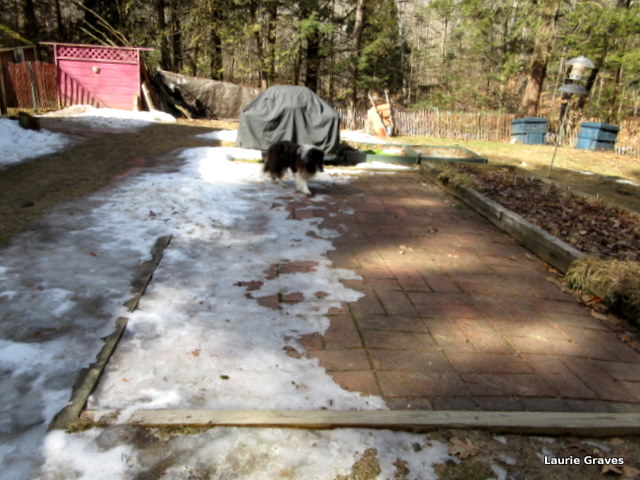
In Maine, what a difference a week can make. The snow is nearly gone from the backyard, and we can see the garden and some of the patio. The area by the clothesline is free, and I long to start washing blankets so that I can hang them outside.

“Not quite yet,” Clif has advised. “The ground is still too soft, and the weight of the blankets will pull the line over.”
He is right, of course, and I’ll hold off washing the blankets for another few weeks. But now and then, I look longingly out the window at the line.

Yesterday, in an extreme case of Pushing the Season, Clif and I went outside and mucked around for a bit. I mean this literally. Our shoes left footprints in the mud, and where it was shady—this includes the whole front yard—we left footprints in snow that is as soft as a coconut slushy.

I had originally gone out to pick up sticks in the backyard. When you live in the woods, there are always a fair number that fall during the winter. I gather them and put them in a large garbage can, and we use them in the firepit in the summer.
The ground was really too soft for this chore, but Clif soon found another that was more appropriate. That is, removing usable wood that had been trimmed by the power company and left in an untidy clump in our front yard. While he was at it, he brought out the ladder and sawed some branches that were hanging too low. We saved what we could use, and the rest I hauled into the woods, where I made a little brush pile for the creatures who live there.
All in all, we spent a good couple of hours at our task, and when we were done, the front yard looked much better. We came in with wet feet and a sense of accomplishment. I popped some popcorn and we settled in the living room to read and to eat our snack. The dog, who had been supervising outside, jumped on the couch so that he, too, could have some buttered popcorn. All was snug and cozy.
I’m going to conclude with a wood metaphor. Going out on a limb, I’m predicting that winter is over, and we are on the cusp of mud season, early spring in Maine. The days are ever so much longer, and yesterday I heard our resident cardinal singing his spring song.
Naturally, this winter I did not accomplish anywhere near as much as I wanted with my inside chores—the perpetual cleaning and decluttering. Never mind! On bad days I will work on those projects. Right now, I am itching to be outside, even if it’s only to muck about in the yard.
Of course, Mother Nature might give us one her little surprise March snowstorms, which will cover all the bare ground and make everything even wetter and soggier. But the snow won’t last long.
Spring is edging her way in, and how welcome she is.

 Last Saturday at Railroad Square, we saw the Iranian film Jafar Panahi’s Taxi. (It was part of a film series—Cinema Explorations—that Clif and I help organize.) The filmmaker, Jafar Panahi, a gadfly of the Iranian regime, has for some years been under house arrest and has been forbidden to make films. His response? Make movies that pretend not to be movies but of course really are movies. Hence, Taxi, where he flouted house arrest to drive around Tehran in a taxi and film various passengers and their conversations.
Part documentary, part narrative, part cinéma vérité, this terrific movie explores different aspects of Iranian life and culture. Executions, women’s rights, imprisonment, repression, movies, and superstition are all discussed as passengers come and go.
I was especially taken with the section of the movie where Panahi picks up his teenage niece Hana from school. Hana is a budding filmmaker, and she carries her trustee Canon camera around so that she can shoot street scenes as her uncle drives through Tehran. Panahi and Hana talk about making movies, and she worries about the filming restrictions her teacher has placed on her. The teacher’s list is long, but “sordid realism” is a particular bone of contention for Hana.
Now, when we Americans think of the term “sordid realism” what might come to mind can be very nasty—graphic sex, graphic violence, disturbing behavior, bad language. I must admit that I tend to avoid movies that dwell too much on what I consider sordid realism. However, if a movie is very good, then I will make exceptions.
But to the Iranian censors, sordid realism means something quite different. Instead, it is a term—almost doublespeak—applied to anything that might make Iranian society look bad. In the niece’s case, it applies to a young street boy who steals money dropped from a bridegroom on his way to his car after his wedding. Hana has filmed the theft, and tries to convince the young boy to return the money. However, things don’t go exactly as Hana wants, and the boy ends up with the money.
After her uncle drives away from the boy, Hana frets about this at some length, knowing that her film won’t win any prize money if it contains such sordid realism as a street boy stealing money. And without the prize money, how can she go on to make a better film next time?
How indeed? I expect that Hana’s worries are also shared by her uncle. How can artists create with such unreasonable restrictions and censorship? As Panahi so deftly illustrates with this movie, it can be done. But at what cost?
As I mentioned earlier, I am not a fan of what I consider sordid realism, but unless animals and children are harmed in the process, I firmly believe that filmmakers have the right to make the kind of movies they want. For example, I have never seen the The Wolf of Wall Street. Too many friends have warned against it for the sheer ugliness of the sex scenes. But that is my individual choice, one that I don’t necessarily expect others to make.
And that makes all the difference.
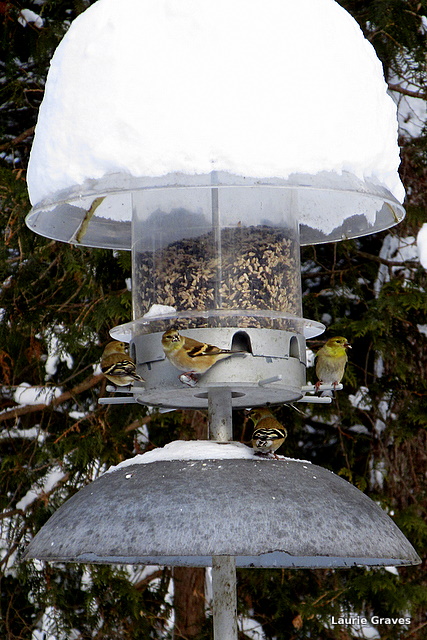
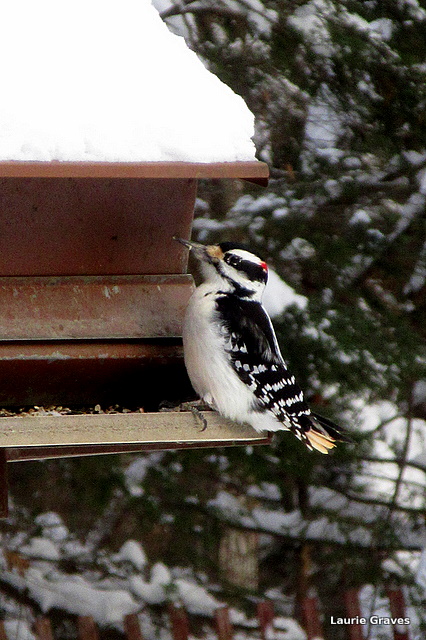
At the little house in the big woods, whatever the season, the backyard is aflutter with birds, and it gives me great joy to watch them as they flit from the trees to the bird feeder. Finches, woodpeckers, chickadees, nuthatches, and many other birds come to eat. Our friends Beth and John are just as crazy about birds as we are, and last year on a warm spring day, we spent a happy afternoon on the patio, watching the birds.
In the winter, of course, I watch from inside, often as I am doing dishes. Winter is a hungry time for birds, and there are always a lot clustered at the feeders.
The other day, as I was watching the birds in the backyard, I remembered the time I freed the birds at Woolworth’s in Waterville. I was three or four years old, and in those far-gone, innocent times, I was allowed to look at the toys and the pet section by myself while my mother did her shopping. I was a quiet child. not prone to running around and screaming and breaking things. My mother felt as though she could trust me, but you know what they say about the quiet ones.
On the day I set the birds free, I watched the bright fish swim in their tanks and listened to the bubbling sound that came from the water. I admired the silky hamsters, curled in a ball, their little noses twitching from time to time. Then I came to the birds, tweeting and jumping in their cages. I remember feeling sorry for them, trapped in such a small space.
Without hesitation, I undid the latch of one the cages and opened the door. With a swoosh, the birds flew from the cage, and their quick motion startled me, making me realize that what I had done was probably not a good thing, at least from the store’s point of view.
I found my mother, but I didn’t tell her about the birds until we were at the lunch counter, and two parakeets went by.
“Look at those parakeets,” my mother said. “I wonder who let them out.”
I confessed right away. “I let the birds out.”
“Shush,” she said, and I could see that she was trying not to smile.
Our food came, and as we ate, birds flew over our heads, and I could hear them twittering. No doubt they were eventually caught and returned to their cages. But for a short time, anyway, they had escaped their confinement and did what birds are born to do—fly.
When we got home, my mother scolded me, just a little, telling me I was never to let the birds out again, and I didn’t. But to this day, I see my younger self and my quick little fingers, unlatching the cage door and letting the birds fly free.
And it still makes me smile to think of it.
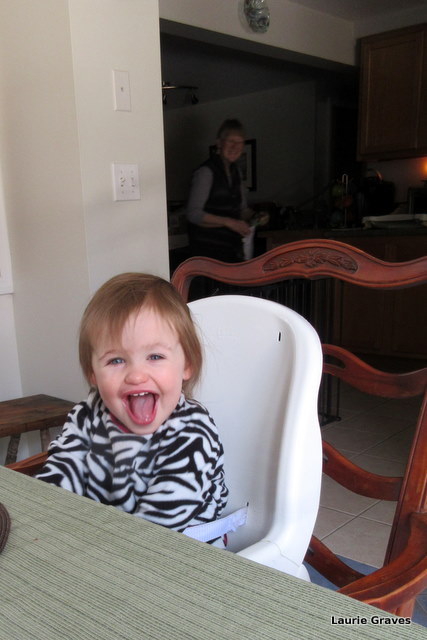
Yesterday, I was invited to have lunch with my friend Beth and her granddaughter Piper, who soon will be two.
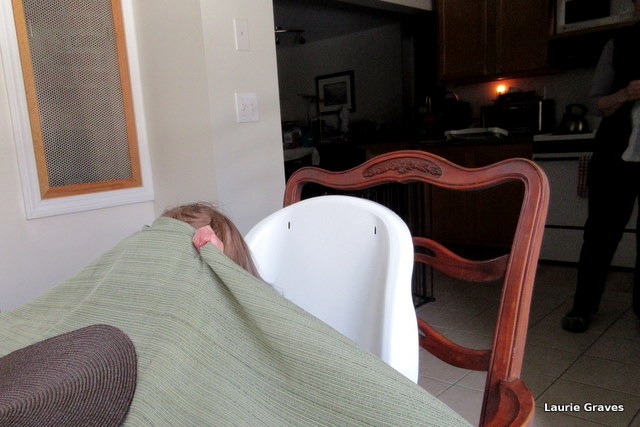
Before lunch we played a game of peekaboo.
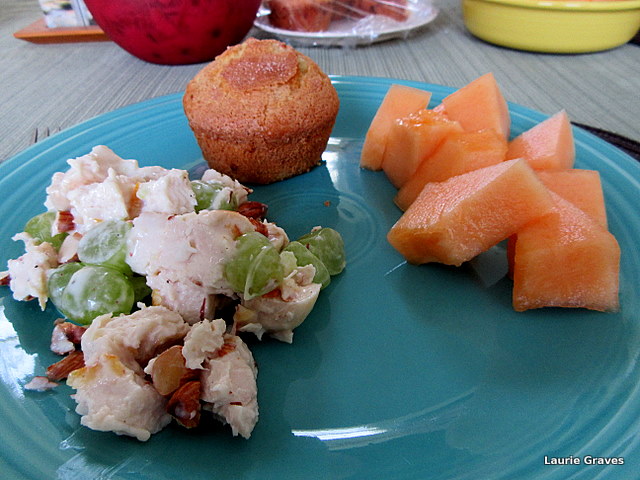
Then came a wonderful lunch of chicken salad with grapes, almonds, and a bit of marmalade with the mayonnaise; raspberry muffins; and cantaloup. For dessert, hermit cookies. Let’s just say my reputation as A Good Eater remains untarnished.
After lunch, we had tea and chatted while Piper played, involving us from time to time in say, ball or change the baby doll’s diaper.
All too soon, it was time to leave so that Piper could have stories and a nap.
Before I left, I said, “When the weather is good, come join Liam and me for a walk on the trails behind the Winthrop high school.”
“Piper has a jogging stroller,” Beth said. “And we’ve gone on the trails in Vaughn woods.”
“Then trails at the high school shouldn’t give you any problem,” I said.
Piper blew me a kiss, and I blew one back. As I drove home, I thought about what I would have for Beth and Piper after the walk. A light lunch, perhaps, and some little toy—toy farm animals or dinosaurs for Piper to play with.
I’ll be on the lookout.
Last night was movie night at the little house in the big woods, where we were joined by three friends—Alice and Joel and Diane—to watch and discuss a movie. Last night was Alice’s turn to choose, and she picked Mira Nair’s Monsoon Wedding.
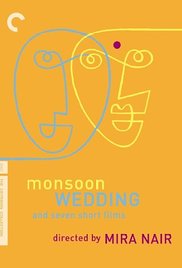
The movie came out in 2001, and this was a second viewing for all of us. Alice and Joel told of how they saw Monsoon Wedding for the first time at the Toronto Film Festival, right after the terrorist attacks on September 11. A joyous, bright film about an arranged marriage in India, Monsoon Wedding was just what Alice and Joel needed to see after the terrible attacks. (Can fifteen years have really passed since that dreadful day? We had a daughter living in New York City and another one living in Washington, DC. It is a day Clif and I will not forget.)
But back to movie night. Clif made two of his delectable pizzas. We always mean to get a picture of them, but somehow, between the rush to eat and watch the movie, we never do.
We were more on top of things with the beautiful dessert—a pumpkin roll—that Alice made. As soon I saw that roll, I knew it should have its picture taken.

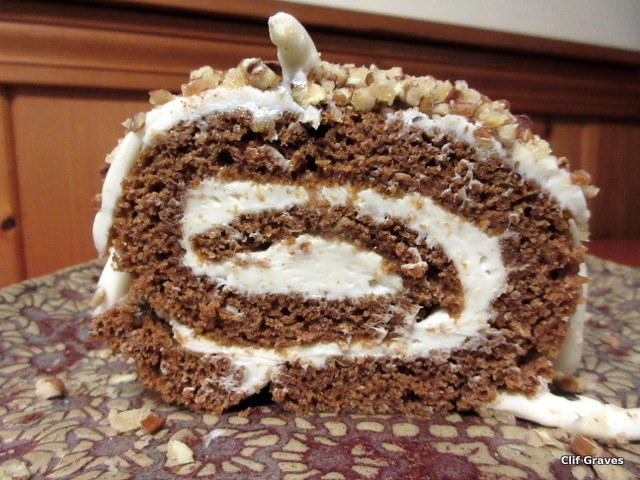

I am happy to report that the pumpkin roll tasted just as good as it looked. After watching Monsoon Wedding, we had coffee, tea, and pumpkin roll as we discussed the various aspects of the movie—in particular, arranged marriages. While acknowledging there were no guarantees with any marriage, I noted how strange it would be to marry someone you had never met or seen.
“Different customs for different cultures,” Diane observed, and how right she is.
We can be grateful to movies and books (and blogs!) that bring us glimpses of other cultures. They remind us that the world is full of diversity, and they enlarge our perspective, which is always a good thing.
Yesterday, Clif and I took the afternoon off and headed to Brunswick for a movie and gelato. We had a gift certificate for each event, which meant that except for the gas, the outing was free—our favorite price.
Brunswick has an arty downtown filled with cafés and restaurants and various other shops. While it’s fun to walk on the sidewalks and look at the window displays, crossing the street is another matter. For some inexplicable reason, four lanes go through the downtown, and getting across them can feel like a heroic effort. There is only one spot with a sort of island and a walk signal to help pedestrians cross. Otherwise, it’s just a crosswalk. Hoping that cars will see you and therefore stop, you hold your breath as you scurry across the road.
But Clif and I made it safely across the road to Eveningstar Cinema, which shows independent films. We went to see Youth, directed by Paolo Sorrentino, who seems to be Fellini’s artistic, if not actual, heir. Odd characters are liberally sprinkled throughout this film—a grotesquely obese former sports star; a masseuse with jug ears, braces, and a rodent-like face; an expressionless woman who makes giant soap bubbles for the evening’s entertainment.

Youth is set in a resort in the Swiss Alps, and the resort is frequented by the weary one percent, who all appear as though they are about to die of ennui. Somehow, though, despite the the odd characters and the stylized and often surreal look of the film, Youth is a moving exploration of old age and the regret and diminishment that come with it. At the center of the story are Fred Ballinger, a composer, and Mick Boyle, a movie director. They are played respectively, and wonderfully, by Michael Caine and Harvey Keitel, who in real life do not at all seem to be diminished by age.
The esoteric Youth is not what I would call a crowd pleaser—although there were plenty of people who came to see it on a Wednesday afternoon at 1:30—but both Clif and I are admirers of this director, who manages to combine surrealism with deep emotion, not an easy trick.
After the movie, we again courted death by crossing the main street to have gelato at the incomparable Gelato Fiasco, where we both had hazelnut and chocolate. So very good.
Since December, the days have gotten longer, and we were able to make it home before dark. The older I get, the more I like this, especially during the winter.
The afternoon had been sunny and fifty degrees warmer than it was on Sunday. What a wild swing! However, this meant the house was warm, and there were still coals in the wood furnace. Clif had no problem restarting the fire.
For our supper we had chili on baked potatoes—I keep cans of chili in the pantry for just such an occasion, when we are out and about and want an easy meal to fix when we come home. A cozy, hearty supper after a good afternoon in Brunswick.