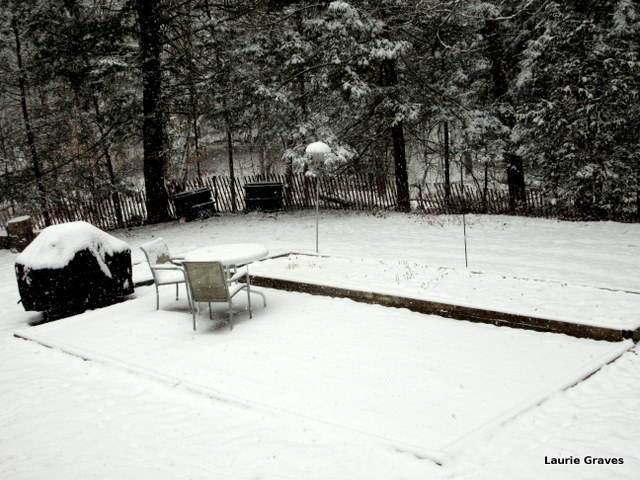
Yesterday, according to my calendar, was the first day of spring, and this is what greeted me when I got up this morning.
Snow, and not just a dusting. Ah, March. No matter how you might lull us into thinking that spring is here, you always have a little snowstorm up your sleeve to show us who’s boss.
Once more, Little Green will be pressed into service to clean the driveway. Out will come the shovels, and the scraper for the car. Fortunately, the snow is light, and it doesn’t look as though there will be power outages. For this we must be very grateful.
The snow won’t last long. Still, even though I know this, a snowstorm the end of March feels like a setback.
Yesterday was our thirty-ninth wedding anniversary, and the bright, beautiful day was filled with simple pleasures.
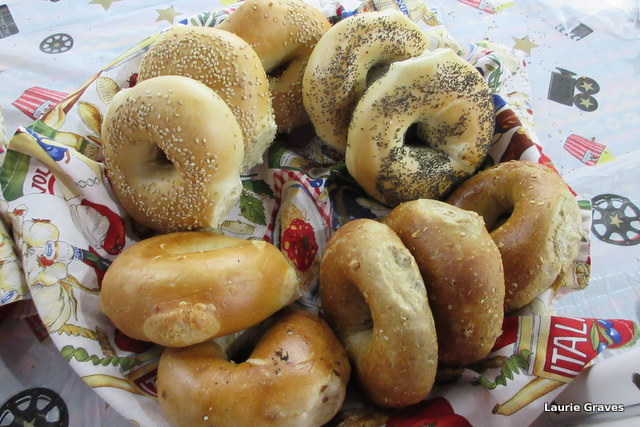
First, we went to Railroad Square Cinema for Cinema Explorations, a winter film series. As Cinema Explorations begins at 10 a.m., delicious bagels, provided by Bagel Mainea, are available. Clif and I can never resist.
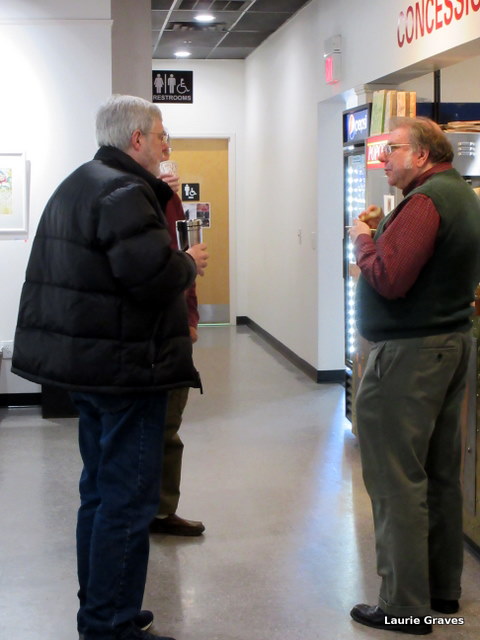
We always get to Railroad Square early so that there is time to chat. Clif is on the left, and our friend Joel is on the right.
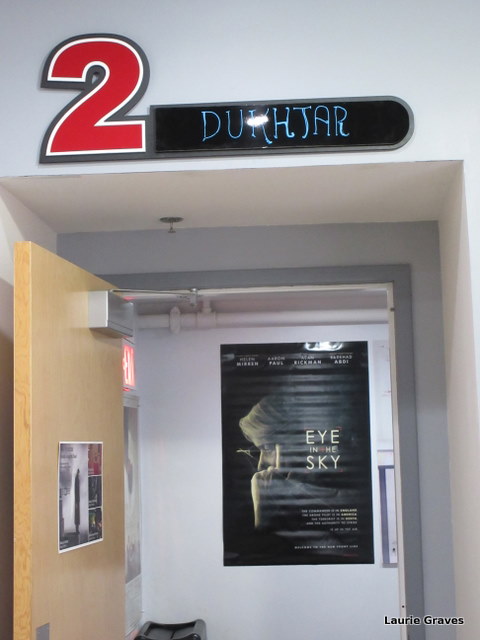
The movie Dukhtar, which means daughter in English, was showing, and it is the last of the film series. This excellent Pakistani film is about a mother and her young daughter who flee from the latter’s arranged marriage. Dukhtar is by turns tender, harrowing, sad, and triumphant, a movie very much worth seeing.
(Eye in the Sky, a movie with Helen Mirren and the late, great Alan Rickman, will be coming soon, and Clif and I are looking forward to seeing it.)
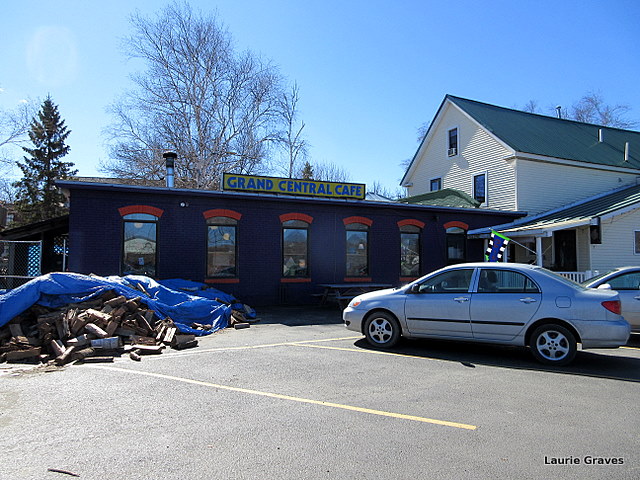
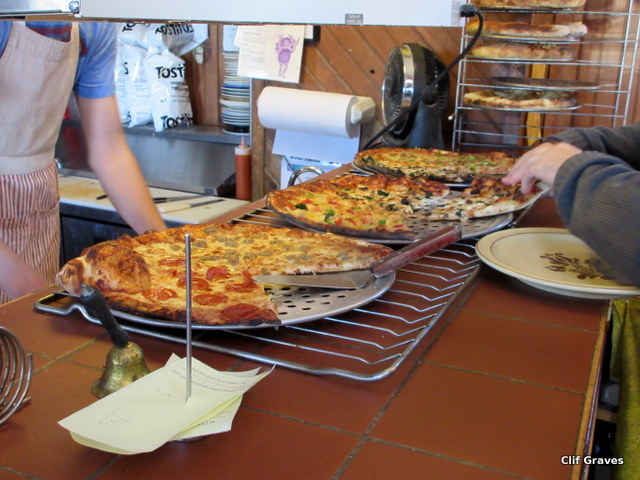
What to do after the the movie? Why, go across the parking lot to Grand Central Cafe for pizza with friends and a discussion about Dukhtar.
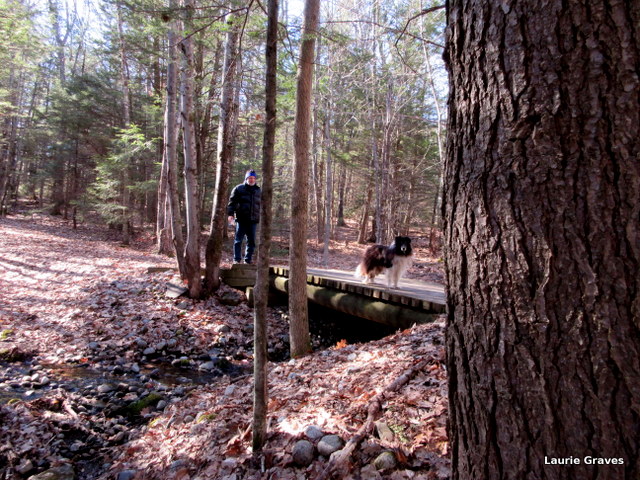
Because the day was so fine and the dog had been left alone for a fair amount of time, we decided that after pizza, a walk in the woods was in order.
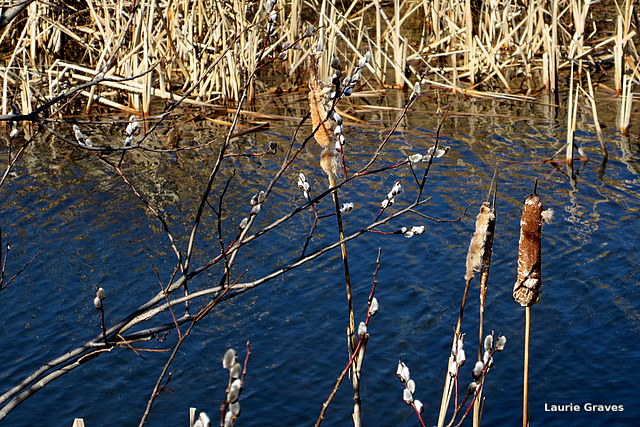
I was taken by the juxtaposition of pussy willows next to frayed cattails.
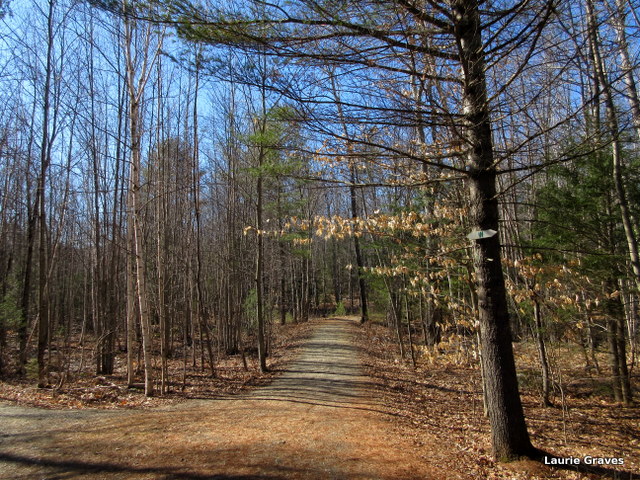
In the woods, the snow is completely gone.
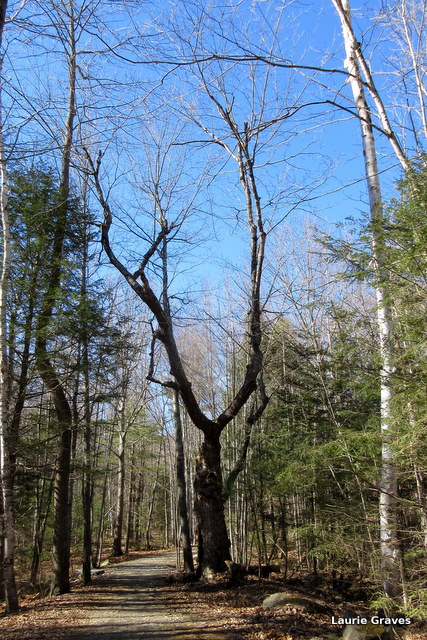
The horned tree stands guard over the trail.
Two of my favorite guys.
Clif and I ended the day with Trader Joe’s Mandarin Orange Chicken, egg rolls from our local Chinese restaurant, and white rice we cooked ourselves. We both had a rum and coke to go with this meal.
March is what you might call a temperamental month, giving ample proof to the old chestnut that if you don’t like the weather in Maine, just wait a bit, and it will change. Yesterday morning, when I went out to get the mail, the weather was so mild and warm I decided that after lunch, I would poke around the yard, doing bits of clean-up. But the weather had other plans—thunder and rain. No yard work for me.
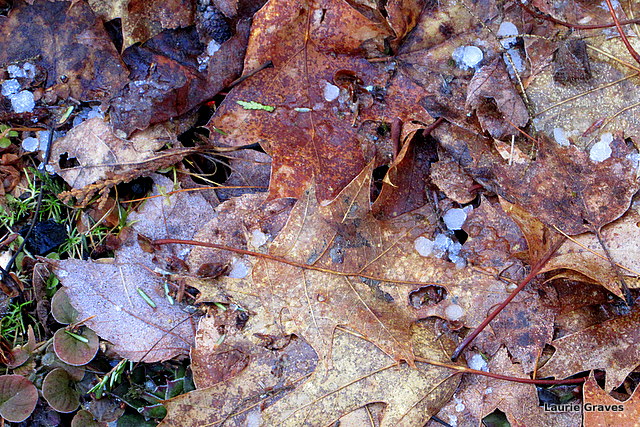
Last night, as Clif and I were watching Bosch, we heard a rapid patter against the house. Clif paused the show—we were watching it on Amazon Prime—and “That sounds like hail,” I said. This morning when I looked outside, my suspicions were confirmed when I saw little ice balls scattered on the leaves around my garden.
The weather forecast for the next few days? More thunder and rain, and then the prediction that every Mainer dreads but expects this time of year—a major snowstorm on Sunday that will go into Monday. If we do get this storm, I can almost guarantee that the snow will be wet and heavy, and the possibility of a power outage rears its ugly head.
Ah, well. Our shovels are at the ready, and Clif will bring in some wood. I’ll be sure to fill my big pots with water because at the little house in the big woods, no power means no water. (We have a well.) And on Sunday, maybe I’ll make turkey soup and some biscuits. Then, if the snow comes we’ll have a big batch of comfort to get us through the storm.
In the meantime, I’ll listen to the male cardinal singing his spring song. Perhaps the dog and I will take a walk up the road to check if the pussy willows are in bloom. I’ll also check on the little swamp to see if the ice is out. If there is no ice, then the peepers will soon be singing their spring song, and this always lifts the spirits.
But snow, snow, stay away. Don’t come back until next winter.
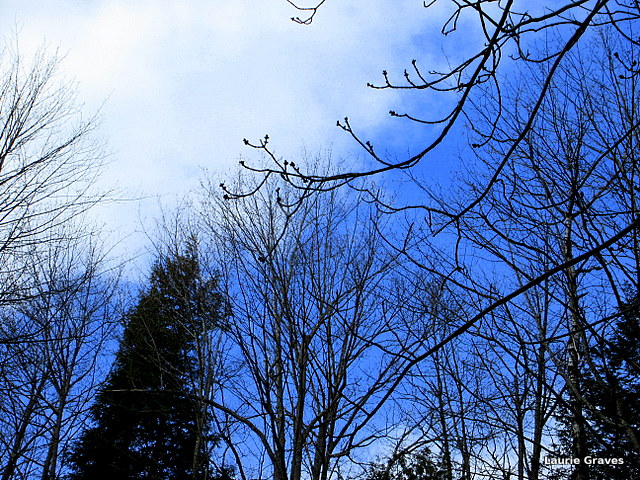
With their tiny buds against a blue sky, the trees, at least, think it’s spring.
As the title of this post indicates, I don’t have a bucket list. I have nothing against them, but a bucket list is not for me. Instead, I prefer to focus on each day, on my various projects, on nature, on family and friends.
However, if I did have a bucket list, then seeing Shakespeare’s First Folio—a book published in 1623 that contains thirty-six of Shakespeare’s plays—would be at the top of my list. It might even be number one. (I fell in love with Shakespeare when I was in seventh grade, and it has been an enduring love.)
Well, lucky me, lucky me—the First Folio is now in Portland, Maine. The Folger Shakespeare Library, which has eighty-two copies of the First Folio—has sponsored a First Folio Tour, where in 2016 this great book will be displayed in all fifty states as well as in Washington, DC, and Puerto Rico. In Maine, the Portland Public Library was chosen as the host site, and as Portland is only a little over an hour from where we live, getting to the First Folio is pretty easy. (How glad I am that I don’t live in northern Maine. I guess I still would have made the pilgrimage.)
Our friends Alice and Joel, who are also fans of Shakespeare, were over last weekend, and as we discussed the First Folio, I wondered if I would cry when I saw it.
Rather than look at me as though I were crazy, they just nodded, and Joel compared the First Folio to the Holy Grail. Or something like that. And how right he was. For those of us who love literature and plays, Shakespeare is at the top, reigning supreme.
Readers, I did not cry when I saw the First Folio on Tuesday. I was in too much awe. An attendant led us into a small darkened room, which, when the doors opened, came the blast of Handel’s Messiah. Just kidding about that last bit. The room was as quiet as an empty church.
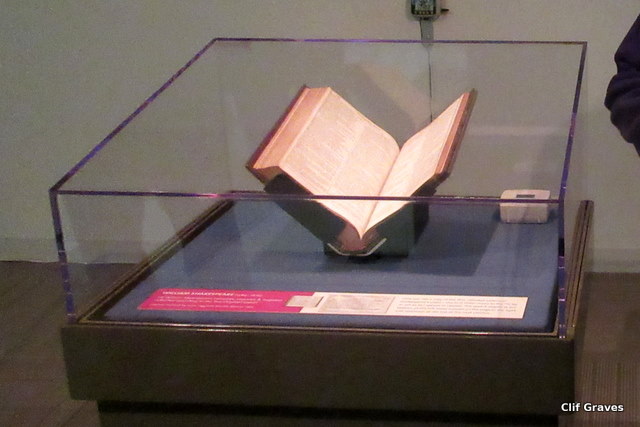
The First Folio, of course, was in a case, and the book was opened to Hamlet’s “To be or not to be” speech. I stayed for some time gazing at this beautiful old book with its gold-edged pages. The First Folio is very modern in its layout and very Elizabethan in its spelling. It looked pretty much the way I thought it would except for the large size and thickness. This was not a book for everyday folks. According to the Portland Public Library’s website, the First Folio “originally sold for one British pound (20 shillings)—about $200 today.” And in The First Folio, Peter Blayney writes that “nothing quite like it had ever been published in folio before….The folio format was usually reserved for works of reference…and for the collected writings of important authors…”
In Elizabethan times, plays were not considered “important” but instead trivial, the mass entertainment of the time “unworthy of serious consideration as literature.” But somehow, two of Shakespeare’s fellow actors thought it worthwhile to publish the First Folio, and to them we must be forever grateful. Without that First Folio, many, if not most, of Shakespeare’s plays might very well have been forgotten and lost.
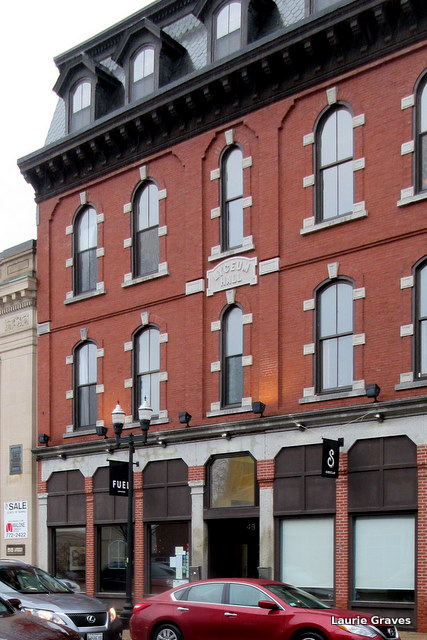
What to do after such an experience? Why, on to Lewiston to Fuel, my favorite restaurant in Maine.
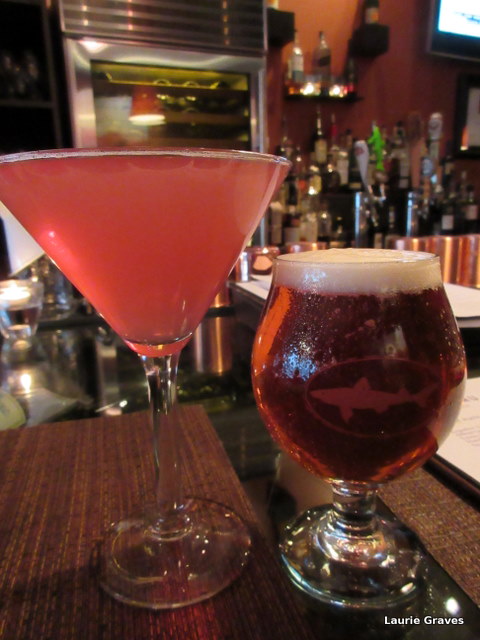
I had a cocktail. In fact, I had two cocktails—after all!—and Clif had two beers. (He was the designated driver that night.)
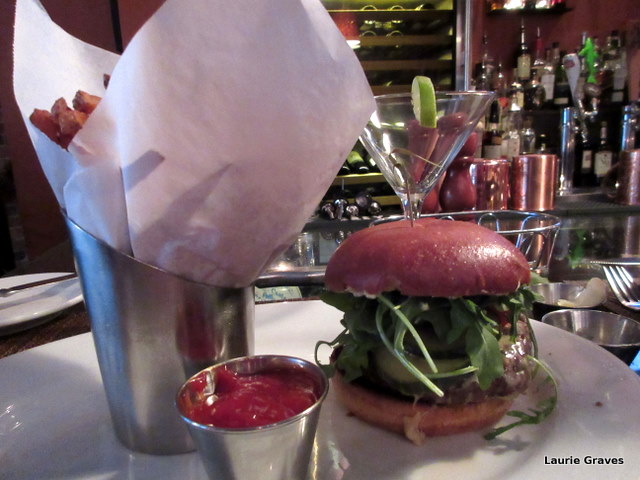
We both had burgers, which come with delectable fries at no extra cost. On Tuesday, everything on the bar menu is $9 or less, which means the food is quite the bargain. Especially if you can limit yourself to one cocktail or a glass of wine or beer.
Home we went in a happy haze, full of good food and good drinks. What a way to end First Folio day.
Yesterday—3-14—was pie day, and we went to to visit our friends Judy and Paul to celebrate this happy day. Now, I like cake as much as the next person, but given a choice between a good piece of cake and an equally good piece of pie, I would choose pie every time. In short, I am a huge fan of pie.
Judy made a blueberry pie, and oh my, does she have a good hand with the crust. Judy makes such good pies that if she invites you over for pie, then do not hesitate. Go.
Judy’s grandmother taught her to label pies with an initial, for example “B” for blueberry. I think this is an excellent idea. That way, if you bring your pie to an event, there is no confusion as to what kind of pie it is.
For me, when it comes to pie, the crème de la crème is the edge, where there is just a smear of fruit or berry. I save that part for last, just as I save the tail for last when I am eating lobster. The edge of Judy’s pie was everything it should be—flaky, brown, and so satisfying.
On the way home, Clif said, “Her crust is as good as yours.”
This is high praise coming from my Yankee husband, a compliment for both Judy and me.
“Winthrop is an excellent farming town, and the moral character of its inhabitants is said to be uncommonly good. It was incorporated in 1771. Population, 1837, 2,003. Wheat crop, same year, 5,194 bushels.” —From Hayward’s New England Gazetteer of 1839
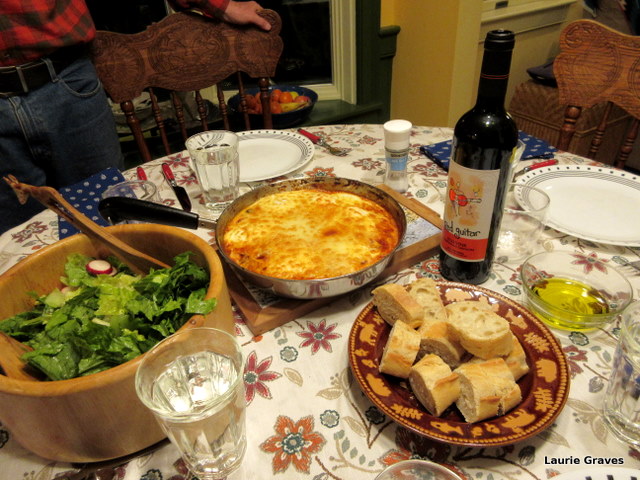
On Saturday, our friends Cheryl and Denny invited us to dinner. They live in a very old—for Maine—farmhouse, and it has been on this road for many, many years. As we ate the excellent meal—eggs cooked in a spicy tomato mixture that was both sweet and tangy—Cheryl and Denny spoke about the history of Winthrop and the Narrows Pond Road.
Such a good meal!
We went back ten thousand years ago when the glacier receded and much of the area was underwater. Then we sprinted forward to the 1800s, when Winthrop was an abolitionist town, and Cheryl and Denny’s house was part of the Underground Railroad. Perhaps the town’s uncommonly good moral character led to Winthrop being an abolitionist town?
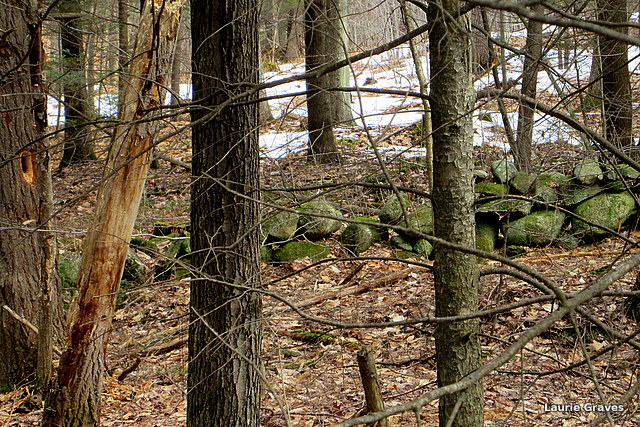
We also talked about the stonewalls that run through the woods behind our houses.
“This was once all open fields,” Cheryl said.
Clif and I, of course, knew this, but then Cheryl added, “A monastery owned most of the land.”
A monastery? In Winthrop, which seems like a quintessential Yankee Protestant town? I wonder if the monastery grew wheat.
“It was on the hill next to the bank. A big old building. It’s torn down now.”
I do remember that building. It was still standing when we moved here in 1984. By then the monastery was gone, and at one point the house had a copy center in it.
Cheryl continued, “A woman I know remembers this road when it was all fields. There were no woods and only three houses. Ours and two others, and one was the town farm, where poor people went. This road used to be called Town Farm Road.”
For the past two days, I’ve been thinking about all the changes that have come to this town, to our little road. Once the glaciers were here, and then they retreated. On their way north, escaped slaves stopped in this town, for rest, shelter, and food. Their long journey was nearly over.
And sixty or sixty-five years ago, there was open farmland all along this road. No woods. In fact, no little house in the big woods. (Our house was built in 1969.) How fast the trees take back the land. In his book Second Nature, Michael Pollan observes that nature abhors a garden. How right he is. Leave the land alone, and within sixty years or so it will fill in and become woods.
This is heartening. We need trees and forests, and in parts of the world deforestation is a big problem. But where trees were cut down, they can grow back again, and in a relatively short amount of time.
Nevertheless, a part of me yearns for the open fields, sprinkled with orchards, that were once here. I’ve seen pictures—taken from the top of hill, from the monastery, as it turned out—of what it was like in Winthrop when there was no main highway to cut the town in half, and there was a broad sweep of land that the eye could follow.
Highways, forests, and fields. All necessary parts of life for people and so hard to get in just the right balance.
Now the question remains: When will the ice go out on the Upper Narrows Pond? My friend Dawna, who lives by the pond, thinks it will be out tomorrow—Monday, March 14. She has promised to let me know.
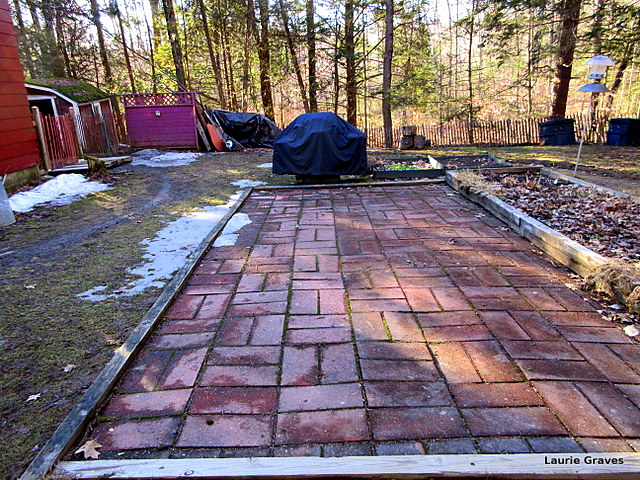
It’s very odd how ice-out on our patio corresponds so closely to ice-out on the Narrows.
One of life’s wonders, and at the little house in the big woods, it gives us something to ponder.
More things to marvel at: Yesterday, I saw the first chipmunk in our backyard. They’ve come out of hibernation. I also heard tree frogs for the first time this year. No peepers yet.
When we have such things to keep track of, is it any wonder that Clif and I are never board even though we hardly travel?
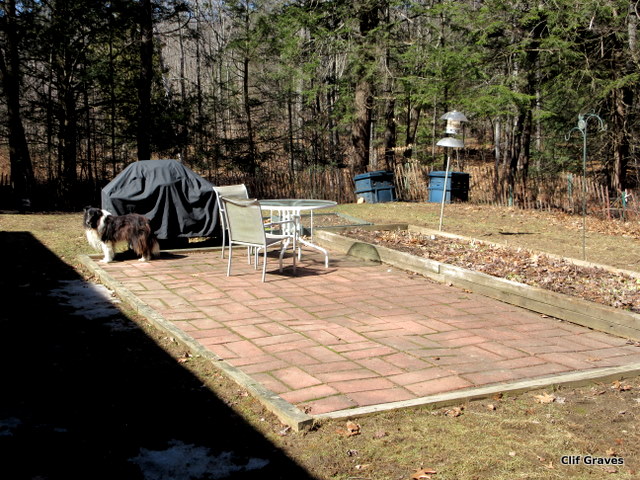
The ice is almost gone from the patio, and I predict it will be ice free by next week. If all goes as expected, we will be a month ahead of where we were last year. It is very tempting to remove that last little bit of pesky ice. But no, I will let it melt on its own so that I can have an accurate record of when the patio is truly ice free.
Today is a sunny day, and my plan is to sweep the patio and do a bit of cleaning in the backyard garden. I’m going to bring out a couple of chairs and the small glass table. Who knows? If it’s warm enough, Clif and I might just have afternoon tea on the patio. The first of the season.
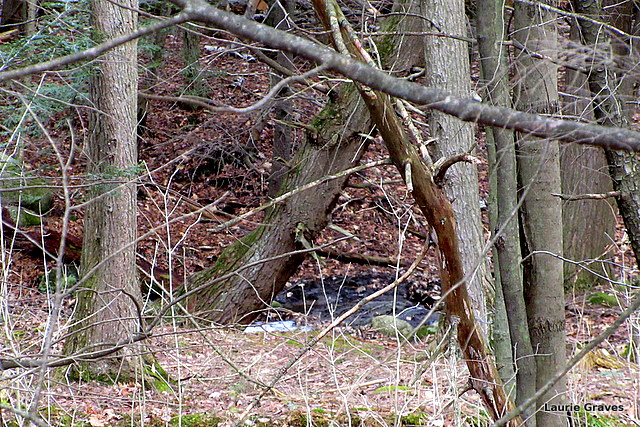
Behind our house are the woods. If you look carefully, especially in the spring, you can just catch the rush of the stream.
Behind our house live many woodland animals—foxes, raccoons, deer, fishers, porcupines, coyotes, mink, owls, and even bears. Only once in a while do we see these animals, but never long enough to get a picture of them.
Behind our house, there were once fields where crops were grown. As with so much of New England, we have the remnants of stone walls, an enduring proof of the hard labor of those who once lived on this land.
Behind our house there are many trees, some of which have fallen, giving nourishment to this beautiful fungi.
Behind our house is our backyard, with a patio and a grill. In the summer and early fall, it is our second living room, where Clif and I relax, where we get together with friends and family. Right now, in March, the backyard doesn’t look like much, but soon, soon, the mud will dry, the trees will bud, and we will be back on our patio, cupped in the green hand of the woods.
A blog about nature, home, books, movies, television, food, and rural life.






 Notes From the Hinterland