

Making Sugar Easter Eggs: A Day of Fun, Crafts, and Fellowship
Yesterday was warm and sunny, a finest kind of day to head an hour north to my friend Beth’s house. With two other friends in tow, off we went in my little red Honda Fit—a.k.a. Sparky. Beth had invited us over for a day of food, crafts, and fellowship. A perfect trio.
Courtesy of JoAnne, we started with appetizers and the best chai I have ever tasted. To guild the lily, there was even whipped cream and a sprinkle of cinnamon on top of the chai.

Then it was on to the craft. Since Easter is coming up, and Spring is supposedly right around the corner, Beth organized a sugar Easter egg craft for us. She made sugar eggs and provided all sorts of little items for us to decorate them.
Because I am always drawn to animals, I chose a dog and a cat to start with. From there it was off to the icing, flowers, and other fun things.

Here is the finished egg, with a peek-a-boo kitty and a sweet dog on top.

The other eggs are just as sweet.
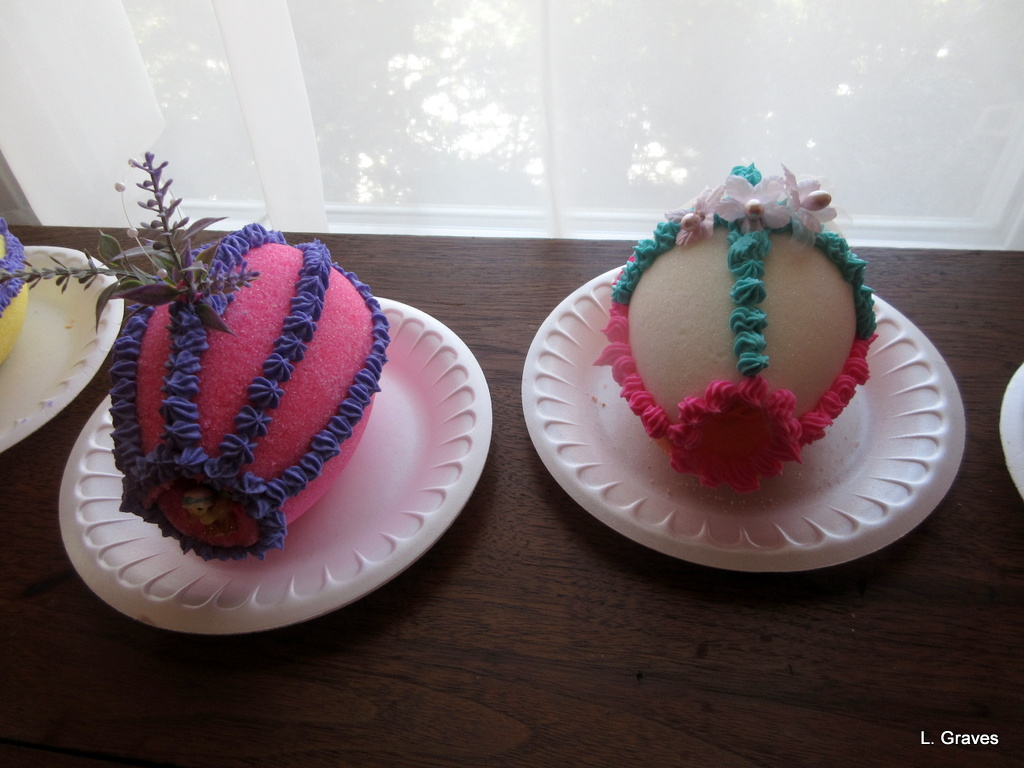

After making the eggs, we cleaned the dining room table and had lunch: an utterly delicious chili; a tasty fruit and quinoa salad; and for dessert lemon cookies and bread as well as apple crisp.
What a wonderful afternoon! And yesterday we lucked out with the weather because this is what it looks like today from my office window. Yes, readers, it is snowing. Six inches are predicted. Sigh.

Never mind. My thoughts have turned to our next get together, which will be at my home in June. I’ve planned a Book Buddy Brunch, where we share a book that has moved us in some way and read a short passage from it.
Fingers crossed that it doesn’t rain so that we can eat on the patio.
But if it does rain, we’ll gather around the dining room table, eat, and talk. We’ll have a good time no matter the weather.
Prepare for Astonishment
All right. Maybe it’s just me. Maybe it’s been far too long since I’ve been on the patio. Maybe it’s been too long since I’ve had the fluttering birds around me. But readers, the difference between last week and this week has me in a flurry of excitement. Finally, finally, the snow is melting in our backyard.
Cue the visuals. This was our backyard last week.

Here it is this week.
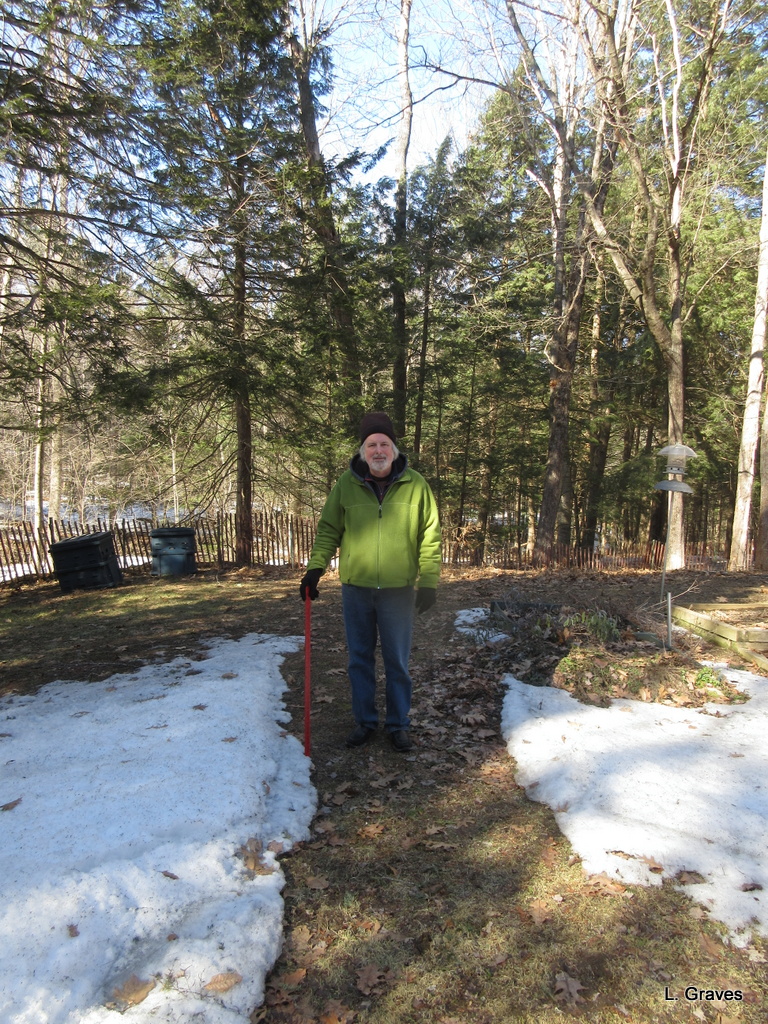
Is that not progress? Or, how about this?
Last week.
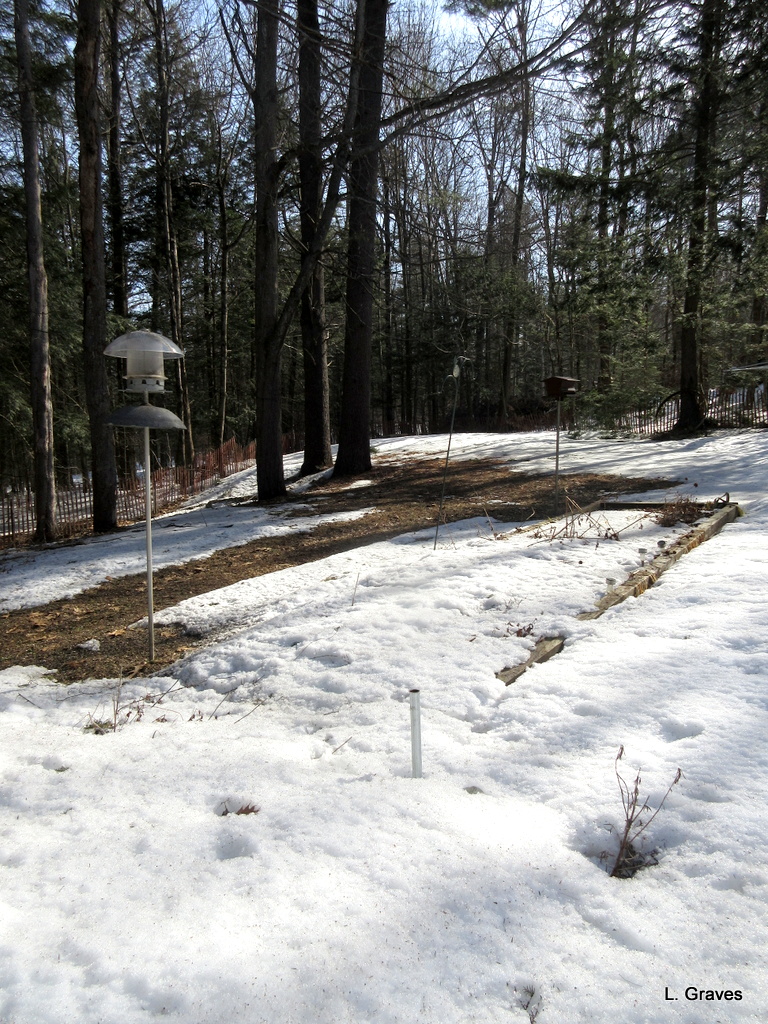
This week.

And the back flower bed is—wait for it!—completely snow free.

There has been so much progress with melting snow that next week I should be able to start picking up all the sticks and branches that have fallen over the winter. Be still, my trembling heart.
I will admit that the progress has been slower in the front yard.
Last week.

This week.
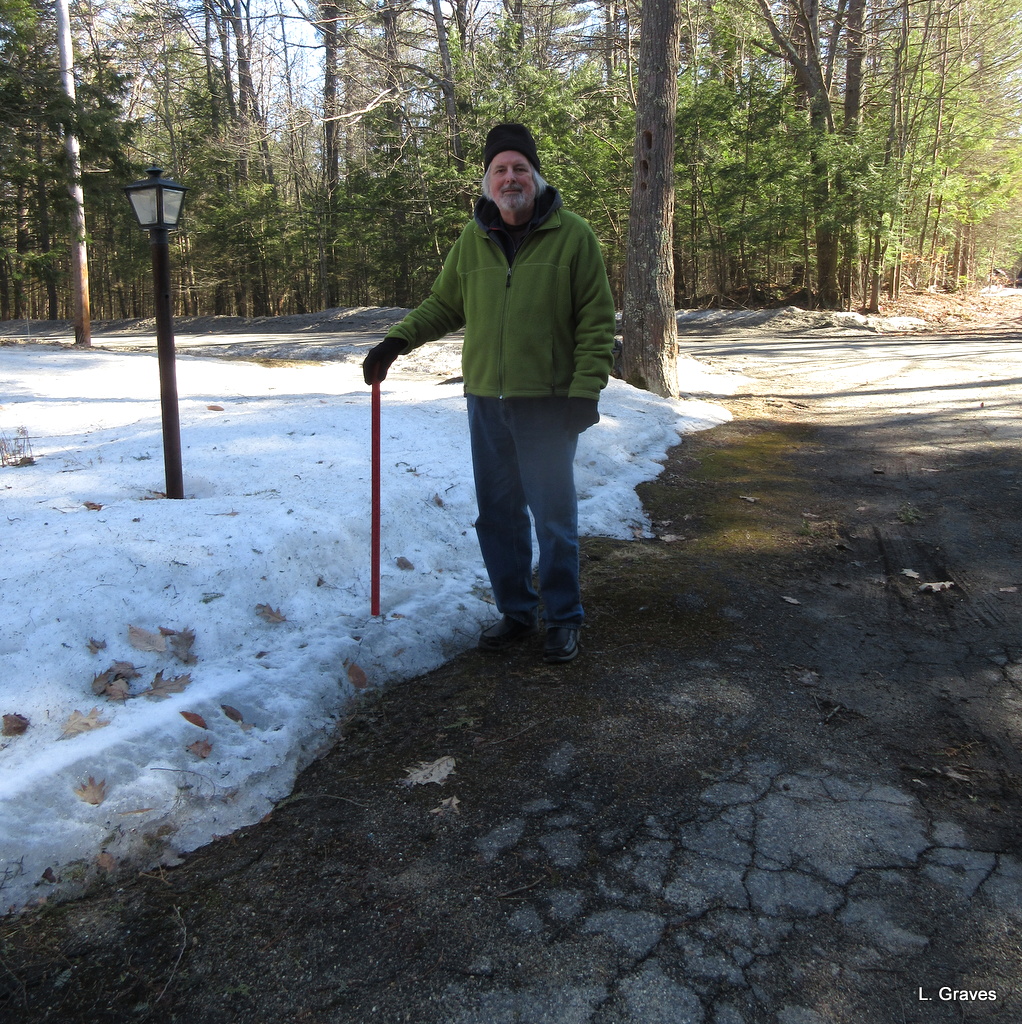
Still, progress has been made.
I can hear the snickers of those who live in places where Spring is in full bloom. But for this Mainer, the dream of Spring is becoming a reality. By the end of the month, the small patio table will be out, and Clif and I will raise our glasses to beautiful Spring.
Just you wait.
A Food Store that Actually Smells Like Food: The Gardiner Co-op
On Monday, April 1, the first day of Earth Month—or April Fool’s, depending on the way your mind runs—Clif and I went to the Gardiner Co-op to buy some bulk items. Gardiner is about fifteen miles from where we live, and nowadays, we always enjoy going to this up-and-coming city that was once in the doldrums with too many empty storefronts and a shabby main street.
But Gardiner did something that other communities would do well to emulate: It decided to invest in itself by giving grants and tax breaks to small, local businesses. Now the main street is a lively place with restaurants, a donut shop, art studios, and the Gardiner Co-op. Gardiner is a small city to enjoy, with different festivals to celebrate each season.
Because we went on Monday, the main street was quiet, and we were able to get a parking spot not far from the Co-op. On our way, we passed this snappy exhibit at Art Dogs Studios, an arts collective.
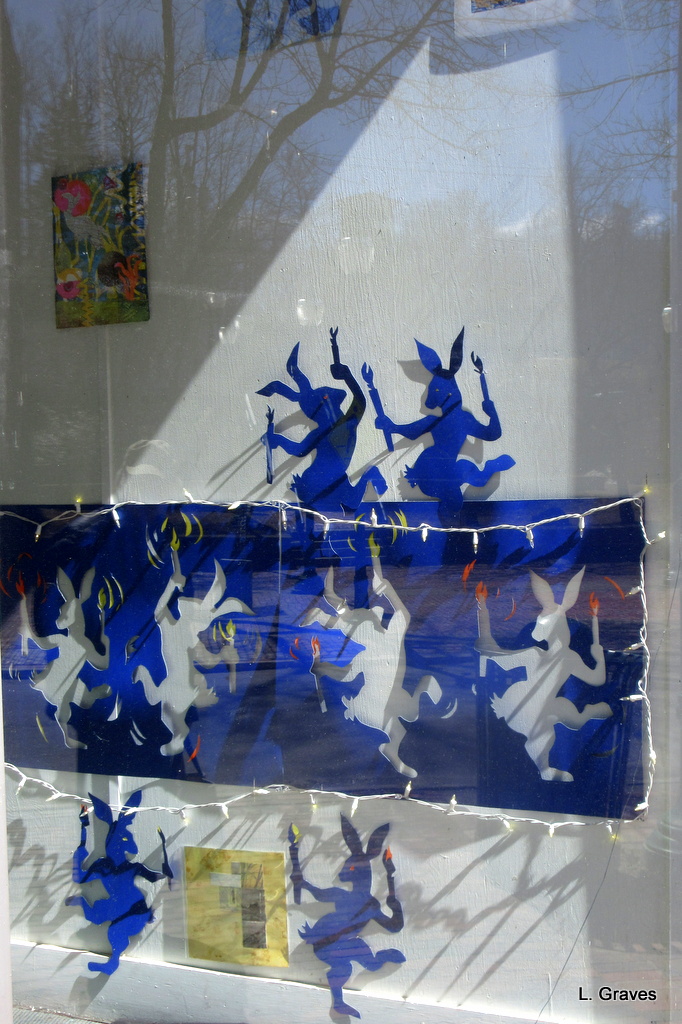
Then it was on to the Gardiner Co-op. This shot shows what a lovely old city Gardiner is.
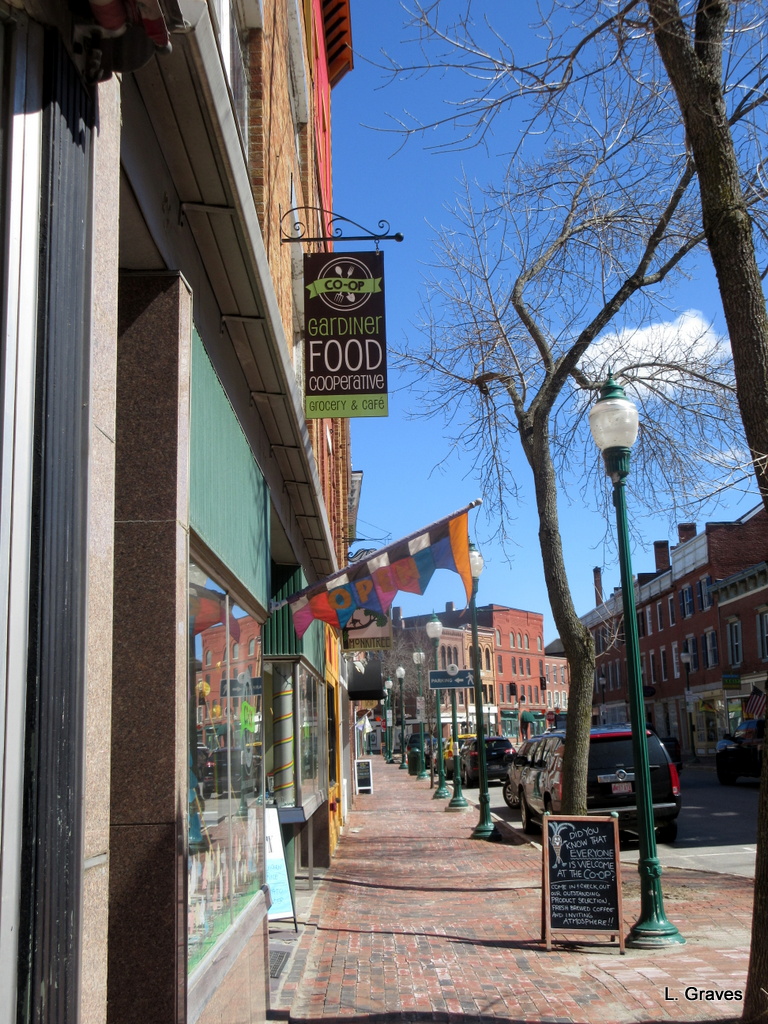
At the Gardiner Co-op, here is the cheery, welcoming sign that greets customers. That is one lively carrot!
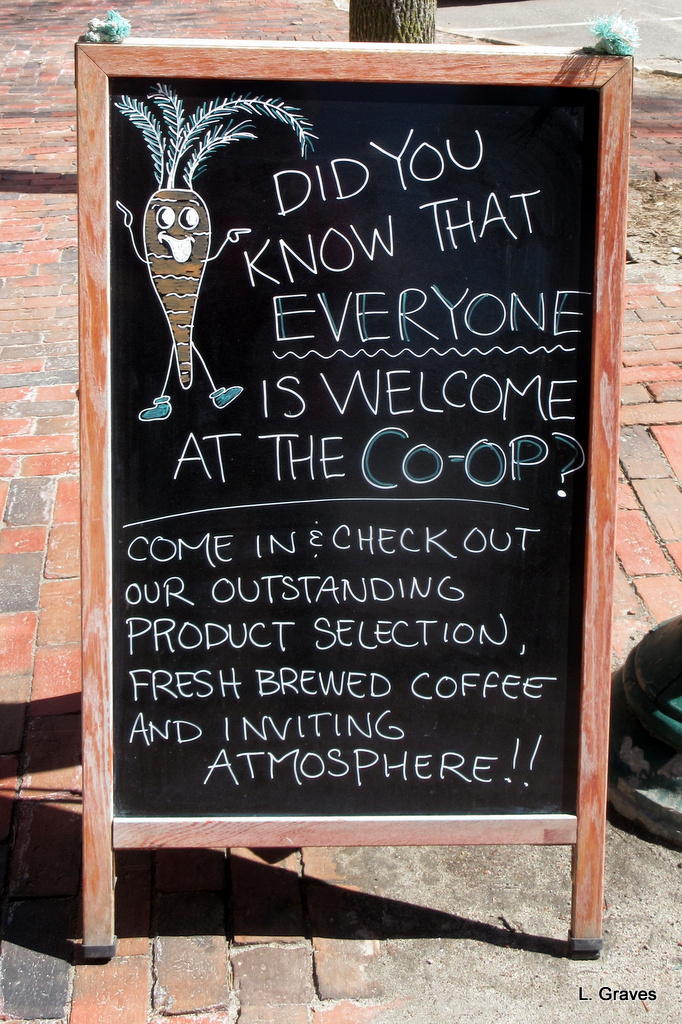
There are many things to like about the Gardiner Co-op, but for me, one of the best things is that the store actually smells like food. This might sound silly, but cast your mind back to the various grocery stores where you shop. How many of them actually smell like food? Mostly, they have a generic store smell, and if you closed your eyes, you might not even realize there was food in the store.
While the Gardiner Co-op is small, it is cozy rather than cluttered, and the store is filled with good things to eat—fresh fruit and vegetables, some canned goods, and a fair number of bulk items, including coffee and peanut butter.
Naturally, we brought our own containers, and they where cheerfully weighed by the woman running the store. She praised us for bringing in our own containers. “Wonderful!” the woman said. “Because of this, there will be less plastic going into our landfills.” She smiled at me, and I felt as proud as kindergartner getting a gold star for good behavior.
The Co-op also has a cafe—no doubt this is where some of the good smells are coming from—and next time we go, we will have a cup of soup before we shop.
Here is what we got at the Gardiner Co-op: chickpeas, black beans, nutritional yeast, onion powder, and garlic powder.
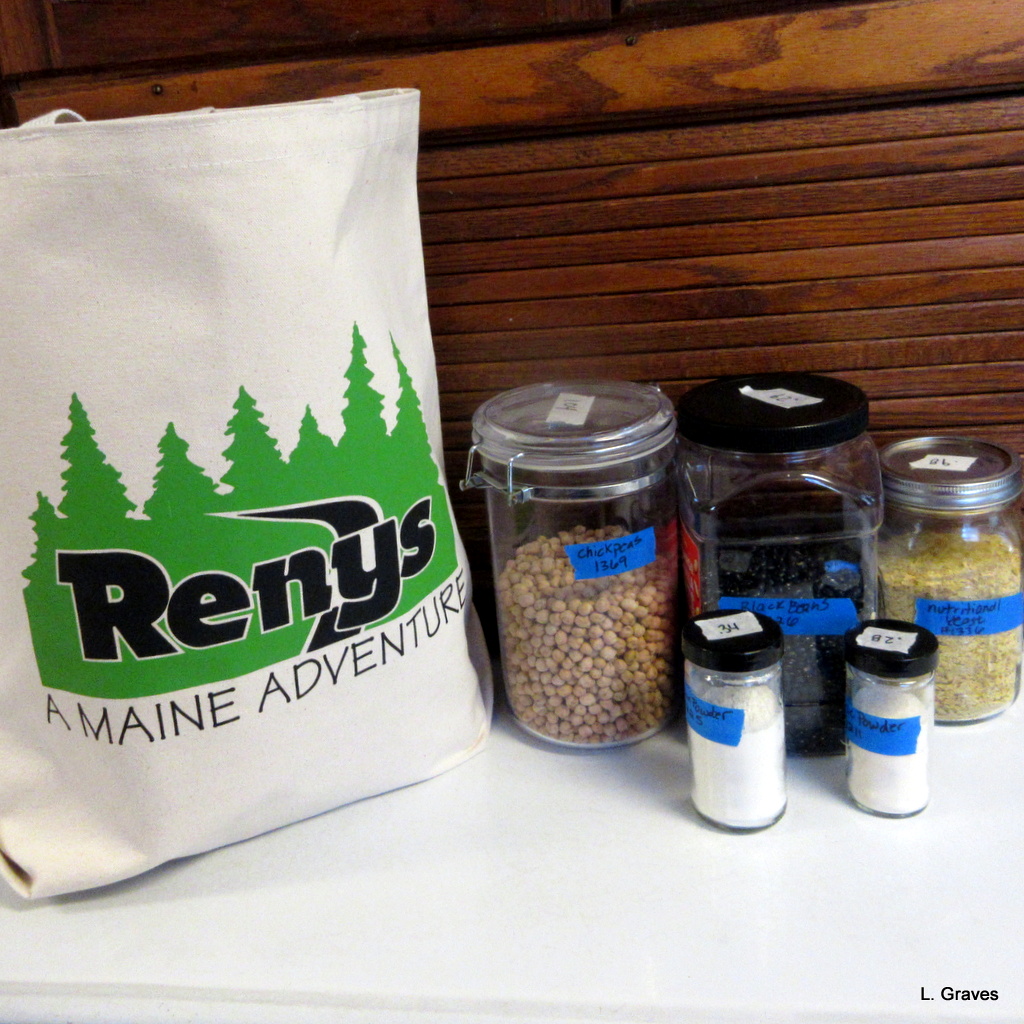
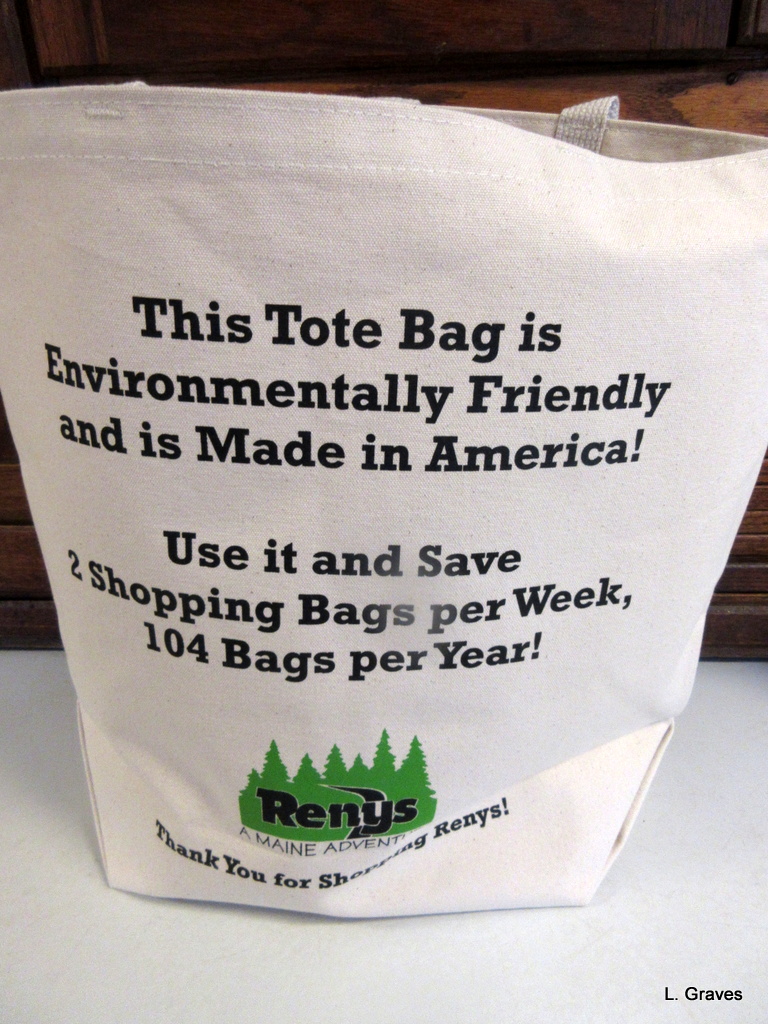
Note the perky Renys bag by the jars of food and spices. Renys, an old-timey Department Store, is also in Gardiner, and I bought the bag in honor of Earth Month. This canvas bag is sturdy, roomy, and made in the US, and it will be a wonderful addition to the bags I keep in the car.
Here is a view of the back side. Shameless advertising, I know, but what the heck. As the old saying goes, if it’s true, it ain’t bragging.
Salut April, Salut Earth Month
April is finally here, and with all due respect to T.S. Eliot, it is not the cruelest month. Not by a long shot. In Maine, that honor goes to March, which, thank the weather gods, is behind us for another year.
For many reasons, April is one of my favorite months. The snow melts at a rate that can only be called astonishing. The sun is higher, the days are warmer, and Spring is definitely on its way. In April there is hope that at last Winter has released its bony grip on the land.
Another reason I love April is that our youngest daughter was born on April 22, and that day will always be a sweet day for me. (As will October 29, the birth of my eldest daughter.)
April 22 also happens to be Earth Day. As Earthday.org notes, “Each year, Earth Day—April 22—marks the anniversary of the birth of the modern environmental movement in 1970….The idea for a national day to focus on the environment came to Earth Day founder Gaylord Nelson, then a U.S. Senator from Wisconsin, after witnessing the ravages of the 1969 massive oil spill in Santa Barbara, California.”
I came of age during the 1970s, and I was profoundly affected by the environmental movement. I don’t think it’s an exaggeration to state that it has made me the person I am. Along with my family and my writing, my concerns and focus as an adult have always been on the environment.
My teenage self—foolish in too many ways—was not wrong to be concerned about the environment. Forty-nine years later, that concern has been upgraded to alarm as the ravages of climate change become more and more obvious.
Earth Day has now been expanded to Earth Month, where all of April is set aside for celebrating our beautiful planet. Some people scoff, proclaiming such things are gimmicky. They note that every day should be Earth Day, and that we shouldn’t need special designations. Maybe so, but we humans have a yen for symbols and stories, and focused in the right direction, this is a good thing.
Earth Day and Earth Month turn our attention to something of vital importance—Earth, our only home. So bring on the stories, the celebrations, the attention. May they bloom into something more.
I’ll end with a picture of the beautiful Kennebec River, nearly free of ice the beginning of April. I’ve told the following story before, but it bears repeating as it is an example of what we humans can do when we put our minds to it.
In the 1960s, when I was a child, the Kennebec River was so dirty that no one even wanted to stick their big toe in it. There were no eagles, no ospreys, no birds of prey. Nobody sat by the Kennebec River to admire the teeming wildlife. Dank and foul smelling, it was a river to be avoided.
Then came the Clean Water Act of 1972, and slowly the river came back to life. No longer a dumping ground for chemicals and other foul things, the river became, well, clean. Eagles have made a comeback. Ospreys hunt for fish. In the spring, sturgeon jump. In Hallowell and other places, people come to this river to watch the sparkling water and the creatures who live in and by it.

So salut April, Earth Day, and Earth Month!
On the Verge of Spring with Snow-Gauge Clif
Finally, finally, March is coming to an end. The days are longer, the weather is warmer, and at long last, the snow is beginning to melt. Once the snow starts going, it does so at an astonishing clip, and Snow-Gauge Clif is here to chronicle the progress.
Here he is in the front yard. I know. Still a lot of snow. But just you wait. By mid-April, it will be mostly gone.
Despite all the snow that still remains, progress has been made. The front roof is now clear.

And look at the driveway. No ice! Be still my trembling heart.

Now for the backyard, which gets more sun than the front does. There are actually bare patches here and there.

I’ve saved the best for last. Lo and behold. The patio is emerging.

Readers, next week be prepared for astonishment.
Quercus and Lisa Save the Scones
For the past couple of months, I have been trying to make scones. Note the word trying. You might also remember Yoda’s pithy advice about trying.
But readers, try I did. I used one of Alton Brown’s recipes, and although my scones tasted good, they came out flat as a cookie (American for biscuit). This meant I couldn’t easily cut them in half and spread butter on them. And what is the use of making scones if you can’t cut them in half and spread something on them, whether it be butter, jam, or cream? None, as far as I could see.
But being persistent, I didn’t give up. After all, I reasoned, I have a light hand with biscuits (the American kind) and pie crust, and there seemed to be no good reason why I couldn’t make decent scones.
As I have come to do with so many things, I asked my blogging friends for guidance. Lisa, from arlingwords, suggested placing the scones closer together so that they would rise rather than spread. And the inimitable Quercus had three pieces of advice: Add more flour, use a two-inch cutter, and make sure the dough is thick.
Yesterday, in another attempt to make good scones, I followed Lisa’s and Quercus’s suggestions. I am happy to report that I finally had success. My scones were light, they could be cut in half, and they were not too sweet but sweet enough.


My scones were square rather than round or triangular, but Quercus had assured me that shape didn’t matter.

Clif, undeterred by their square shape, pronounced the scones “pretty darned good,” which is Yankee for delicious and high praise indeed. After eating one, he hurried back for seconds.
Now that I have figured out how to make good scones, the time has come to make them for friends when they come over for tea or coffee.
Starlings and Little Fishies: A Follow-up Post to Nobody’s Environmentally Perfect
On Monday, I posted a piece called “Nobody’s Environmentally Perfect,” and the title indicates one of the themes: How those of us who care about the environment often lurch imperfectly as we try to live lighter. From there, I moved on to Sami Glover’s post in Treehugger, where he questioned how much difference personal responsibility makes when it comes to tackling climate change. I ended with “Nevertheless, Clif and I try to live ever lighter….While we might not be environmentally perfect and perhaps never will be, we have made progress, which gives me hope….Readers, do you have any thoughts about this?”
Readers, you certainly had thoughts about this, and they brightened my day. How wonderful to think of all of you—not only in this country but also around the world—giving serious thought to climate change, waste, and green living. Most readers felt that individual actions do indeed matter, and here are some of the responses from various blogging friends:
This came from The Snail of Happiness, who quoted John Taylor, a climate change advisor in Suffolk, UK: “For me, [climate change] is like a murmuration of starlings. It looks big, but look closer and you will see it is really made up of thousands and thousands of smaller individual actions and choices….Yes, please care about the bigger picture, but if you act in the areas that you directly influence, you have the power to be the bird that turns. So do something in your life today, and be proud and tell people about it. The birds around you will see and follow suit, and soon that change will ripple through out the whole flock.”
Love Those “Hands at Home” noted, “One of my blog pals makes the case that ‘one plus one plus 50 makes a million’–I think that’s the attitude we should take about being little fishies swimming upstream. We can be a big school of fish, and teach the world some lessons!”
Island Time takes waste and packaging seriously. “Humans and their waste, what a huge problem. Everyone has to do their bit… every little bit counts. We recycle everything we can, and more and more I refuse to buy things that include a lot of packaging… Often I will remove the bulky packaging from items and leave it behind in the store from whence it came. If everyone did this, perhaps the stores would tell their suppliers to lose the packaging.”
On the other hand, A Wordy Woman comes at the issue from a completely different angle. “I do it because I feel that it is right and responsible and so it would be uncomfortable and against my own nature to live otherwise. I would feel bad about myself, especially knowing that people in other parts of the world, most of whom are not part of the problem, are already suffering greatly because of a changing climate and associated weather. ”
There were many other wonderful, supportive comments, and if time allows, do read them.
I’ll end with this note of thanks: Blogging friends, you rock. Knowing that so many of you are out there, doing what you can to make the world a better place, inspires me and fills me with hope.
Onward, ho!
Signs of Red

Nobody’s Environmentally Perfect
On Saturday, our friend Diane came over for lunch, and Clif made his tasty pizza. As a hostess present, Diane brought a jar of her delectable applesauce, made from old-timey apples from an orchard in southern Maine. Those apples are so sweet and so good that the sauce doesn’t need any sugar. What a treat!
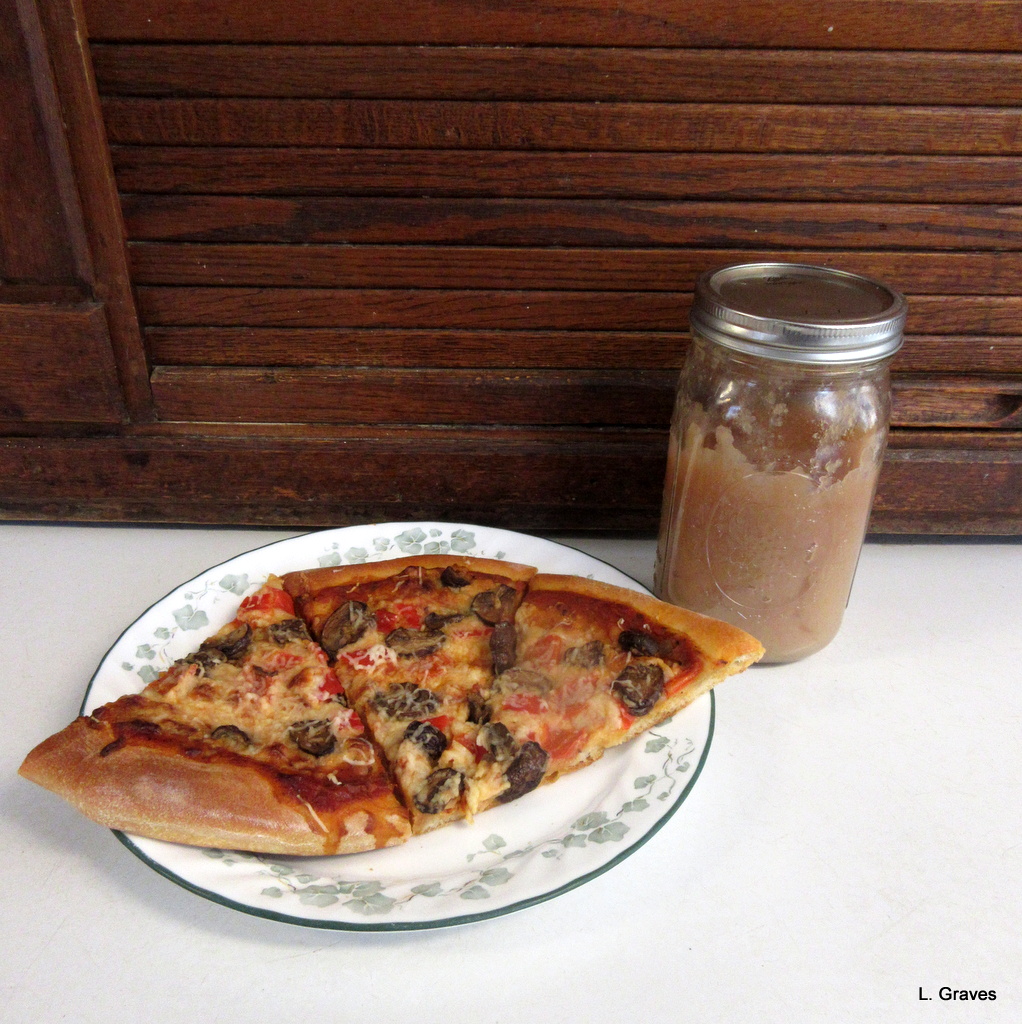
Mainers are of the opinion that almost anything goes with applesauce—I think it’s because not so long ago, fresh fruit was not easy to get in the winter in this northern state. However, we draw the line when it comes to eating applesauce with pizza. Instead I made a salad and a homemade vinaigrette. But that night with a supper of egg and toast, we broke into our jar of apple sauce.
After lunch, we settled into the living room, and our talked ranged from politics to the environment. Diane is as keen about green living as we are, and at one time she lived in a solar home on a dirt road in a town so small that it makes Winthrop look big.
So I look to her for green advice. While Clif and I have made good progress with the trash we produce—we’ve cut the amount in half—there are things we still struggle with. One of them is Ziploc bags. We wash and mend them, but eventually there are so many holes in the bags that we must throw them away. And there they are in the landfill for a long, long time.
Slowly, we’re weaning ourselves from Ziplocs. We use jars for leftovers, both in the refrigerator and in the freezer. If we buy rolls or bread—mostly I make my own—we save those wrappers to be reused. But we haven’t quite made the break from those darned Ziplocs.
I explained this all to Diane, and she said patiently, “Nobody’s environmentally perfect. The important thing is to do the best you can with the resources you have.”
Wise words. As I’ve written before, Clif and I live on a budget as big as a minute, which means we can’t buy as much local and organic food as we would like. But we buy as much as we can afford, and I cook most of our food from scratch.
Both Clif and I are conscious about what we use and what we discard. Because we are Mainers, this is not that hard for us. We were both brought up to keep things until they were so worn that, really, nobody else would want them.
Then, today in Treehugger, I read a piece by Sami Grover that questioned how much difference personal responsibility makes when it comes to tackling climate change. Grover writes, “In a world where unsustainable choices are the default option, where fossil fuels are excessively subsidized, and where environmental costs are not borne by those responsible for the damage, living a truly sustainable life means swimming upstream.”
Even though I like to think that Clif and I are making a difference by living as lightly as we can, in fact we are just two tiny fish “swimming upstream.” Until the system changes, it will indeed be very difficult to turn the tide of global warming. (Thought I’d stick with the water metaphor.)
Nevertheless, Clif and I try to live ever lighter. Somehow we just can’t go back to our old ways when we produced four or five bags of trash a week. A week! Most of it was household garbage—paper, plastic, boxes, food scraps. While we might not be environmentally perfect and perhaps never will be, we have made progress, which gives me hope.
Readers, do you have any thoughts about this?

