Once upon a time, towns and small cities in Maine were thriving, busy places. Maine is a state with many rivers, and along those rivers were factories that made shoes, spun wool, and produced paper. There was a downside: Those factories polluted the water and the air. But they also provided good jobs. Then, in the 1970s and 1980s, the factories left, one by one, to go to places where there was cheaper labor, first in the southern part of the United States and then out of the country all together.
The devastating effect of this on Maine, a small, rural state with only a million people, cannot be overstated. No big tech companies rushed in to fill the void, the way they have in more populous states in southern New England. Therefore, young people left—Maine has the largest percentage of senior citizens in the country. Many of those who stayed behind pieced together a patchwork life of part-time work. Or, full-time jobs that barely pay enough to raise a family, buy a house, and pay for a college education. (Hannaford Supermarkets is one of the largest employers in Maine, along with Wal-Mart.)
Not surprisingly, when the great factories fell silent, once flourishing downtowns went into a tailspin. Business after business closed, and all over Maine there were so many empty store fronts that Tim Sample, a Maine humorist, joked about the “Vacant Building Festival” in Eastport, Maine, where the locals supposedly quip that “If you could buy a Greyhound bus ticket with a food stamp, we’d all be outta here.”
Funny, but ouch, and this applies to much of Maine, not just to Eastport. It certainly applies to central Maine, to Augusta, the state capital, whose downtown on Water Street has been moribund for so long that only an old timer like me remembers when it was thriving.
However, lately there have been sparks of life on Water Street, and those sparks have burst into a little flame. Appropriately enough, Cushnoc Brewing Co., a brewery that also serves pizza baked in a wood-fired oven, seems to have been one of the first to light the spark in Augusta. (My son-in-law Michael maintains that breweries have done a lot to revive communities. Perhaps he is right.)
Along with Cushnoc came other businesses—Otto’s, Circa 1885, and most recently Huiskamer Coffee House, where we went on Saturday to hear our friend Claire Hersom read poetry along with Jay Franzel and Bob MacLaughlin.
Huiskamer Coffee House is a delight. There are couches, comfortable chairs, tables, and Vermeer and Mondrian prints. (What a contrast between the two artists!) Wonder of wonders, there was good tea—Harney & Sons—as well as good coffee. Grace Fecteau, one of the owners, let us use our own mugs for tea and coffee, but there are ceramic mugs and plates.
Here is a view of the coffee house from our table.

And here is a picture of the delightful Claire.
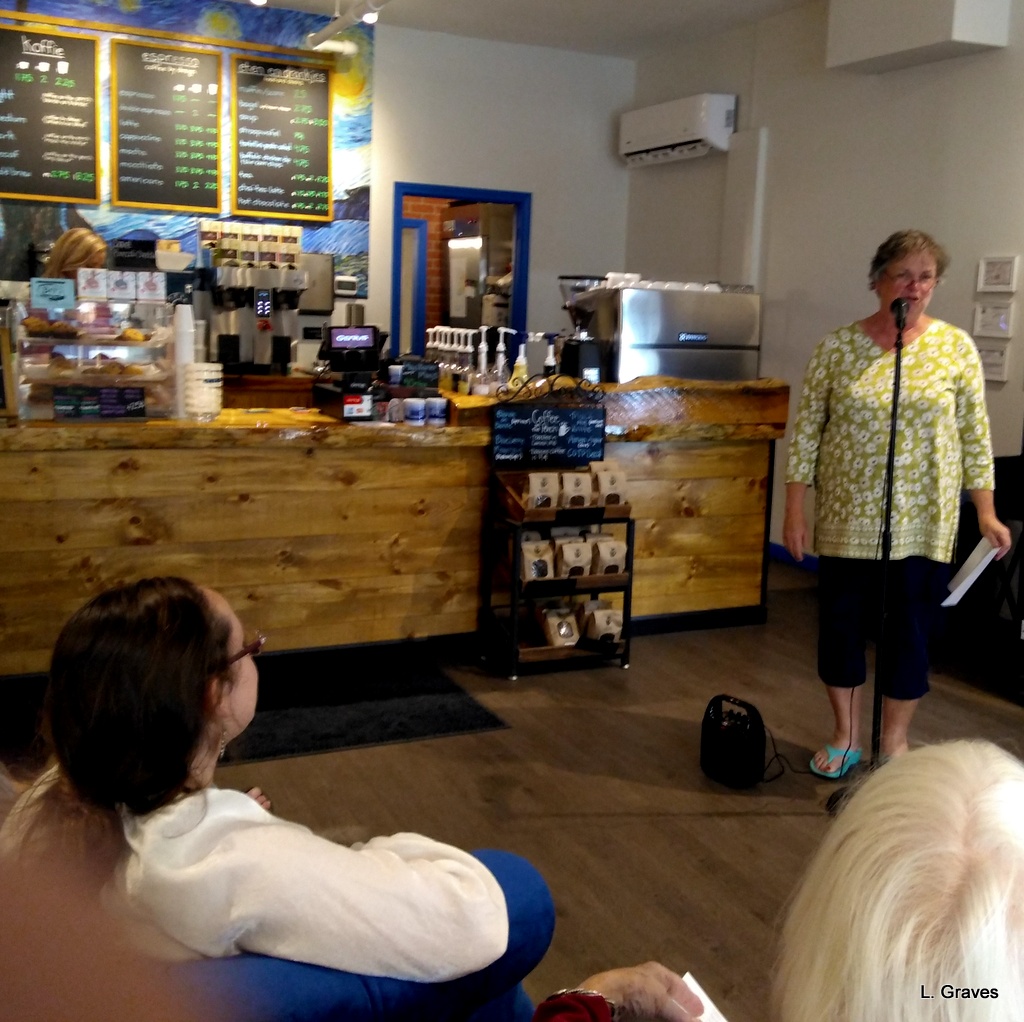
As the poets read, subjects ranged from the Red Sox to back country roads to being poor in Maine. To having a father with Alzheimer. Some of the poetry was intense, some of it was funny, and all of it was close to the bone.
How nice that the coffee house was full of people listening to poetry. Tea and coffee were drunk, scones and soup eaten.
When Clif and I left, it was still light out, and on Water Street, there were cars parked on both sides of the road. People walked on the sidewalk.
Even five years ago, Water Street was deserted on nights and weekends. Not anymore.
May this spark continue to grow.