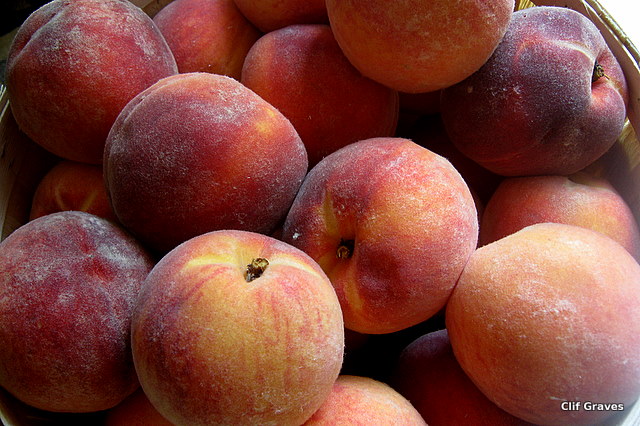
Today our friends Judy and Paul came over for coffee, tea, and homemade brownies. Judy’s brother and sister-in-law, visiting from Connecticut, came, too. Clif and I always enjoy meeting new people, and we had a great time getting to know Judy’s brother and sister-in-law. But especially exciting for this foodie was what Judy’s family brought from Connecticut—a basket of ripe peaches from a local orchard. (As opposed to the not-so-ripe peaches on sale at the local grocery store.)
Now, I have a sweet tooth, and I can’t think of a single fruit I don’t like. However, peaches are way, way at the top of my list, and this Maine girl doesn’t get tree-ripened peaches very often. It is a very happy day when I do get them.
Amazingly enough, in recent years, a few peach orchards have been established in Maine. Climate change combined with varieties developed to withstand the cold have brought peach orchards to this northern state. While there have always been individual trees that have managed to thrive in select micro-climates in Maine, there were never actual orchards. Unfortunately, the local peach orchards are quite a distance from where I live, and I don’t get them very often.
How good it is, then, to have friends who have family who are willing to bring peaches to me.
Peaches, peaches, peaches. As soon as everyone left, I grabbed a peach and ate it. From the first bite, it was sheer bliss—soft but not too soft, sweet and juicy. I gobbled it down without offering Liam even one bite, and it was only when I was done that I noticed him staring reproachfully at me. He likes peaches nearly as much as I do.
“Don’t you worry,” I told him. “There are plenty more. I promise I’ll share some of the next one with you.”
Now that August is ready to leave, the August weather has arrived—hot, dry sunny days and cool evenings. I’ll take it. Better late than never.
Every night that it is nice, Clif and I bring our plates to the patio so that we can eat outside. We know these days are numbered, and we try to squeeze in as many outside meals as possible. Last night, with its deep blue sky and setting sun, was especially beautiful for this. I had made chicken in a slow-cooker, using Farmer Kev’s garlic, potatoes, and carrots. (A recipe will follow next Thursday.)
As we ate, we talked about the day’s events, and we watched the birds come to the two feeders on either edge of the patio. At one point, there was a downy woodpecker, a goldfinch, and a nuthatch all in a row at the brown feeder with its single perch in the front. A male cardinal chirped and came to the feeder. The other birds flew away.
I said to Clif, “Before the cardinals came this year, that brown feeder was what you might call the least-favored feeder. Birds fed from it, but not very often. I hardly ever had to fill that feeder.”
“True enough,” Clif replied. “The tube feeder with all the little perches was the favorite one.”
“The cardinals are new to the neighborhood, and the brown feeder is good for them. Do you suppose their presence encourages the other birds to go to that feeder?”
Clif said, “Maybe the cardinals are trend setters, and the other birds want to eat where they eat.”
Could this be even remotely true?
“Who knows?” Clif said. “It’s just a thought.”
One thing is certain. Before the cardinals nested in the woods by our backyard, few birds came to the brown feeder. Now that the cardinals are eating at this feeder, the other song birds flock to it.
Such are the things we puzzle about as we eat our supper in the late August dusk. Our very own backyard continues to be one of the most interesting places we can be.
Finally, finally the heavy humidity has cleared. There was a downpour last night—yet again—but this time the rain took away the humidity. Today is bright, sunny, dry, a little cool even, which is the way August is supposed to be. Especially the end of August.
No more of my complaining to Clif: “If I had wanted tropical weather, then I would have moved to the tropics.”
I can only hope that the hot, humid weather is behind us as we move to September, which in the past few years has become one of the nicest months in Maine. (August once held that honor, but those days seem to be gone.)
Despite the heat and humidity, or maybe because of it, the tomatoes are flourishing and so is the basil. In truth, I have never grown such lush, healthy basil, and I am thrilled to have it. Basil is my favorite herb.
The zucchini, of course, seems to be growing like a house afire, and I have noticed that in my CSA bin, the zucchinis are considerably bigger than they were a few weeks ago. They are not too big to resent. Not yet. But I expect that day is coming.
Fresh garlic has made its appearance in the CSA bin, and I never, ever resent garlic. It keeps beautifully, and it enhances so many dishes.
Tomatoes. Garlic, Zucchini. Basil. What to do, what to do?
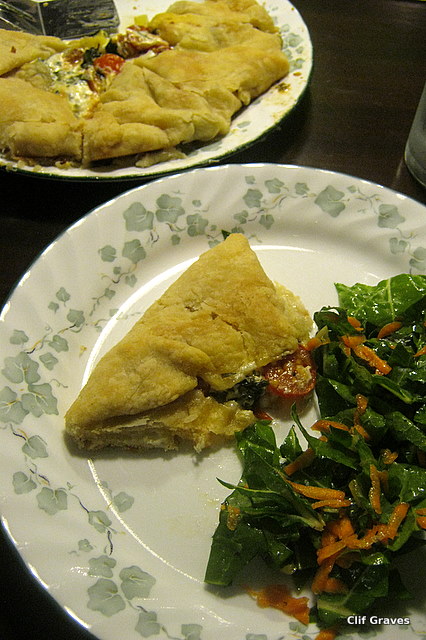
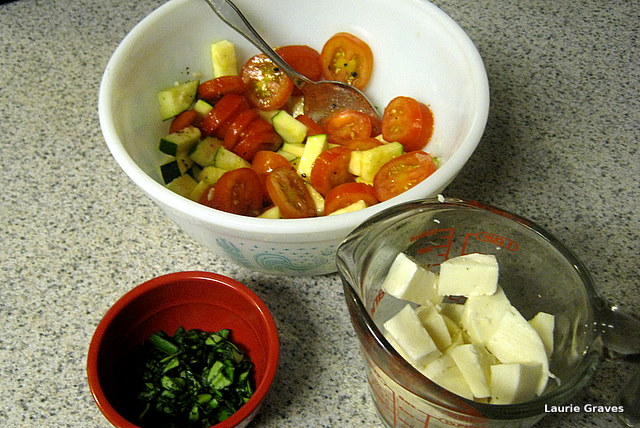
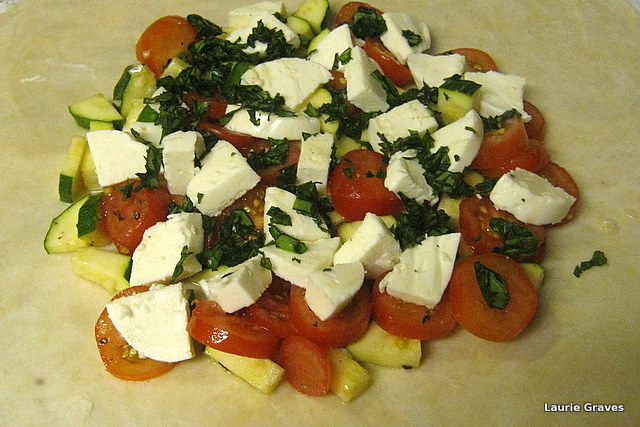
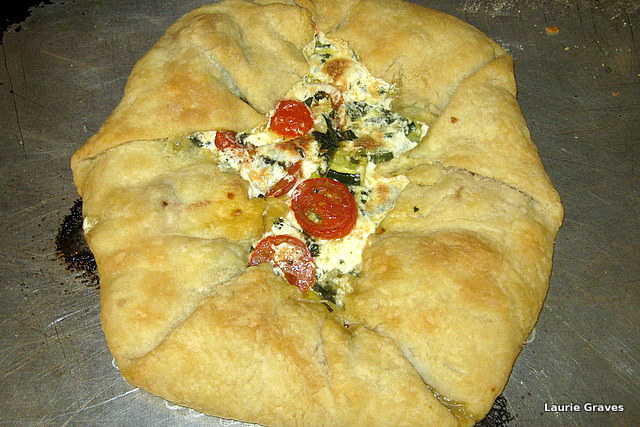
How about adding some fresh mozzarella and making a tomato and zucchini galette? That’s just what I did, and along with a Swiss chard and shredded carrot salad, it made a mighty fine late summer meal.
A note about the tomatoes for the galette: Tomatoes, of course, are watery, and this is not necessarily a good fit with pie dough. I used a variety called Juliet, which grows in my own little garden. It is a small roma-like tomato and does well with only six hours of sun. It is not as watery as other tomatoes, and I would recommend using either roma or cherry tomatoes for a galette. One suggestion I have read is to slice the tomatoes, put them on paper towels, salt them, and let them drain for about twenty minutes. I didn’t do this for the galette I made last night, but I will probably do it next time.
A note about the zucchini: I didn’t sauté it before using it in the galette. I just chopped the zucchini into small pieces, mixed it with olive oil, garlic, basil, cheese, and tomatoes, and it was just fine.
Anything else to mention? Ah, yes. The pie crust. I enjoy making pie crust, and I am not too bad at it, if I do say so myself. But for those who hate to make pie crust or just don’t have the time, by all means go out and by the pre-made crusts. There are some pretty good ones out there, and there is no need to deprive yourself of galette if all that is holding you back is making pie dough.
Tomato and Zucchini Galette
Makes one galette, which will feed three or four people, depending on appetite and on what else is being served.
Ingredients
For the pie dough
1 cup of flour
6 tablespoons of shortening
1/2 teaspoon of salt
1/4 cup of cold water (I let the water run for a while before using it.)
For the filling
1 cup of sliced tomatoes
1 cup of zucchini, cut in large chunks
1 cup of sliced, fresh mozzarella cheese
2 tablespoons of chopped basil
1 tablespoon of olive oil
1 clove of garlic, minced
Salt and pepper to taste
Directions
Preheat the oven to 425°
For the pie dough
In a large bowl, combine the flour and salt. Mix well. Add the six tablespoons of shortening. With a fork or pastry blender, cut the shortening into the flour until it is in pea-sized pieces (Someday I will do a pie dough tutorial. I promise.)
Add the water all at once, and with a large spoon mix until the dough forms a ball. Do not overmix. Too much handling makes tough pie dough.
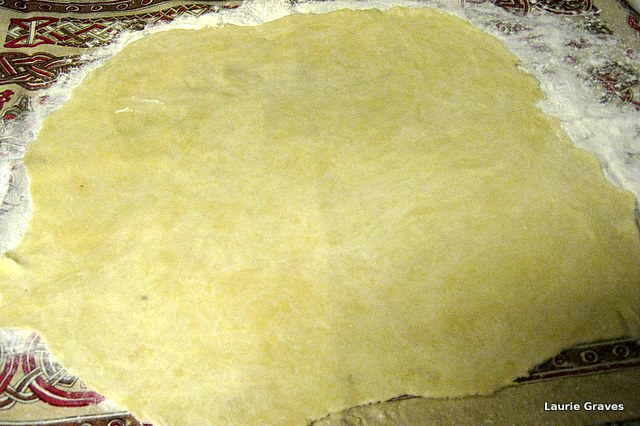
On a floured cloth or surface, roll out the pie dough into a large circle.
By either folding it in half or in quarters, transfer the dough to a baking sheet. Unfold so that is a full circle.
For the filling
In a medium-sized mixing bowl combine the tomatoes, zucchini, mozzarella, olive oil, garlic, basil, and salt and pepper. Mix well.
Place the filling in the center of the pie dough on the baking sheet. Make sure there is about a two-inch border.
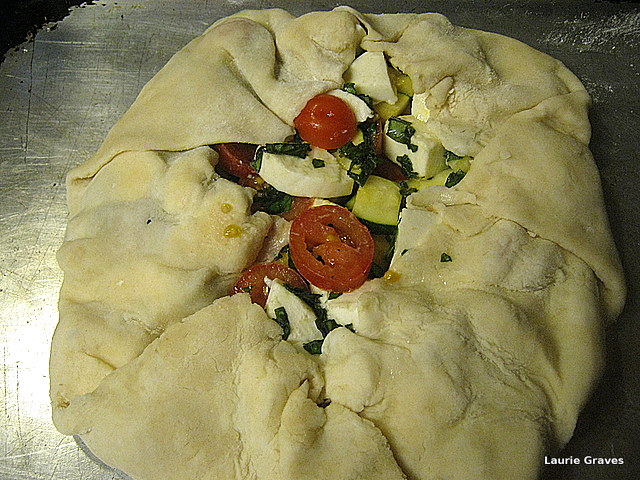
In small sections, fold and crimp the dough over the filling. It is fine for the edges to look rough. This is a galette, a rustic dish.
Bake for 25 or 30 minutes until the galette is golden brown.
Yesterday was quite the day for little Winthrop. Our own Bailey Library hosted a poetry reading by Richard Blanco, who describes himself as “[m]ade in Cuba, assembled in Spain, imported to the U.S.A.” And now Blanco lives in Bethel, Maine, which is not that far from Winthrop. Lucky us!
Blanco, you will recall, read at President Obama’s second inauguration, and his poem “One Today” emphasizes the bonds that connect us, a message this divided country needs to hear over and over again: “One sun rose on us today, kindled over our shores,” (Donald Trump, are you listening?)
As Richard Blanco is only one of five poets to have read at a presidential inauguration, I think it’s fair to call him the Mick Jagger of the poetry world. Not surprising, then, that the auditorium at the high school was packed. The estimate was between three and four hundred people. I’d put it closer to four hundred. By the time Blanco started his presentation—part personal history, part slide show, part poetry reading—there were no good seats left.
Blanco’s theme—or obsession, as he calls it—is home. He maintains that his obsession began in the womb, when his family left Cuba, “that land that is near yet so foreign.” He was born in Spain, and while he was still a baby, his family came to Miami—so close to the United States, he joked—and as far as Blanco was concerned, everyone in Miami was Cuban. (He also joked that he and his partner moved to Maine for the diversity.)
Television brought the non-Cuban world to Blanco, and from an early age, he realized that he and his family were outside the cultural norm. Blanco yearned to be in America, and for him, the grocery store Winn-Dixie symbolized everything that America represented. And ate. All the food Blanco and his family ate came from small Cuban grocery stores. Nowadays, of course, we think it is cooler to go to small shops rather than chains, but in the 1970s, when Blanco was a child, that was not the case.
Blanco’s grandmother, who sounds like quite the force of nature, refused to shop at Winn-Dixie. It was too expensive, she said, and they didn’t belong there. But when she saw a flyer advertising chicken at a great price, she relented. Blanco went to Winn-Dixie with his grandmother, and “I was finally in America.” I suppose, in a way, he was. Or at least one version of it.
As Blanco grew older, he learned the value of his own culture, but like anyone who is born outside the cultural norm, it takes a while. Indeed, his experience sounds so much like the experience my generation of Franco-Americans had. Many of us, at some point, rejected our heritage, only to come back to it as adults, to realize that there was an incredible richness in being Franco-American.
But I understood the embarrassment he felt when going on vacation with his parents, who, lets face it, didn’t really fit in outside their small Miami circle. Their budget was tiny, their suitcases were battered, and they brought their own food, which definitely did not come from Winn-Dixie. My inner child cringed along with Blanco as he described the experience.
Blanco also had to come to terms with being gay and with a grandmother who was not exactly accepting, shall we say. This, combined with being Cuban American, is very rich material for a poet. As the writer Geoffrey Wolff has put it, a good story is a hell of a gift.
For over an hour, the audience sat in rapt, silent attention as he read poetry and charted his journey to find home. “America is still a work in progress. It is our duty to contribute to that narrative.” Then, “The question of home is a global one.” Also, ” Nature is the universal home.” (This is one of the reasons he was drawn to Maine. Along with the diversity.) And finally, “We are always home.”
When he finished, Blanco received a standing ovation, which he certainly deserved. As a poet, as a speaker, he is warm, funny, sad, and wise. His use of language is both beautiful and down-to-earth. Blanco is a true artist, and after listening to him, I felt enlarged.
Yesterday, I went to the dentist’s office to have my teeth cleaned, and while I was there, I had X-rays. Clif will be retiring from his job the end of September, which means no more dental insurance. I figured that if any work needed to be done, then September was the month to do it. Well, good thing I had those X-rays. As it turns out, I need to have a tooth extracted, and I need a new crown. All will be done around my birthday. Happy birthday to me!
My teeth are naturally straight, and even though they are a little yellow from all the tea I drink, they look pretty good. However, sometimes looks can be deceiving. Every two years, I have X-rays, and they inevitably show that something must be done to Laurie’s teeth. In the past, it was fillings. Now, it is crowns, and with this new one, I will have had five crowns. As for the extracted tooth…it is going from the bottom and cannot be fixed.
Our out-of-pocket cost for the five crowns has been about $2,500. What a nice Canon camera I could get for $2,500. I know. Teeth are important, but I can’t help feeling a little wistful about the money spent.
When I came home, I told Clif about my teeth, and while he agreed with my assessment about the money, he was philosophical about the matter. “You need your teeth,” he said.
Indeed, I do.
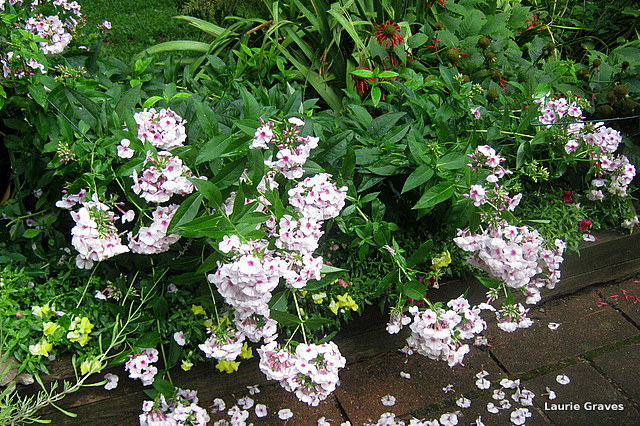
After discussing teeth, Clif mowed the front lawn, and I tidied the patio and back garden. I cut back the phlox so that it wasn’t leaning over the dwarf snapdragons and touching the patio. Afterwards, I propped them up with green wire fencing. I swept the patio and cut some of the spent stalks from the daylilies. The garden still looked ragged, but it was a decided improvement. At least things were tidy. More or less.
The sky was clear, the sun was setting, and Clif and I decided it would be an ideal time to have drinks on the patio. We both know we only have a month, at best, where we will be able to do this. We talked about my teeth, his retirement, and our sidelines—selling photo cards, computer consulting, and the strong possibility of a book being published in 2016. Our card business has begun to pick up, and we are excited about all our ventures.
As Katherine White would put it, onward and upward. Even the prospect of dental work couldn’t dim our enjoyment of the evening.
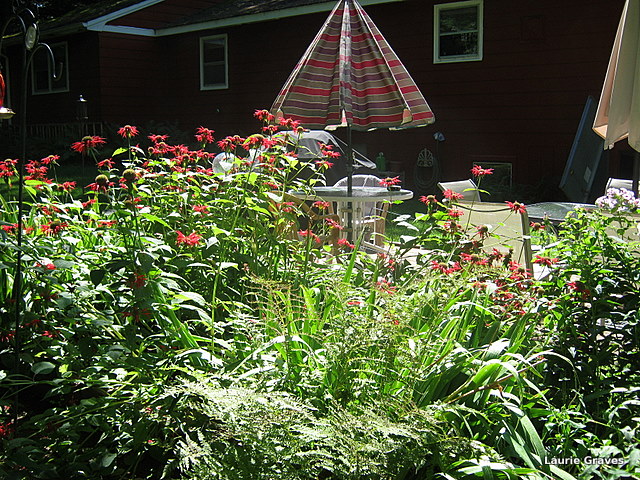
Last Friday, a hard rain came. It beat down the backyard garden, making the already ragged bed look even more ragged. The bee balm is helter-skelter, and the phlox has been bent so far down that it is touching the patio.
However, to borrow from Jason from his excellent blog Garden in a City, the weather has gone from being hot and humid to cool and humid, which is an improvement. Still. I mourn the old days in Maine when August was hot—but not too hot—and dry with cool nights. How I loved those days, which we have not had for many, many years.
I will do what I can for the gardens. I’ll prop up the phlox so that it is not touching the patio anymore. I’ll cut the flowerless stems of the daylilies, which were spectacular this year. They, it seems, love the humid heat. I’ll also sweep the patio. But I won’t do any major cutting back for another month or so. Clif and I both agree that we would rather have a ragged garden than one that looks as though it’s been given a crew cut.
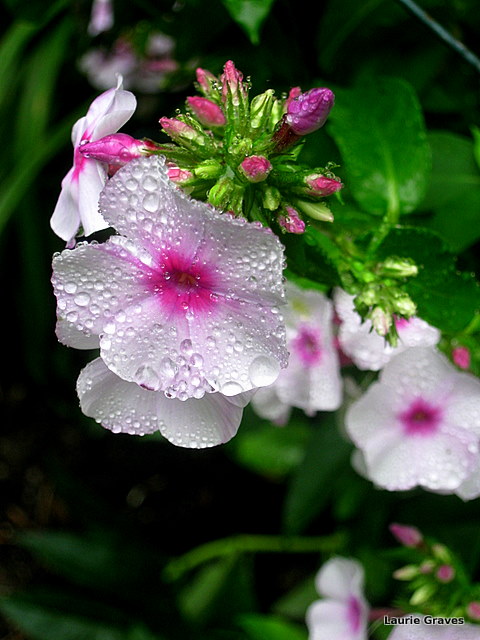
After the hard rain, I went out to take some pictures, and I will admit I got some nice photos of a variety of phlox that had not been beaten down.
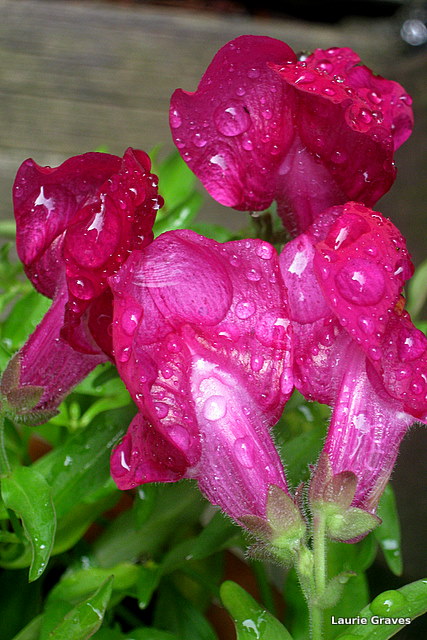
Somehow flowers with rain drops always look pretty.
As do the hens and chicks, veiled by a spider’s web.
As I was taking pictures in the front garden, a little frog hopped out of a low bird bath and disappeared into the tall growth. Too quick for me to get a picture. Unfortunately.
Another consolation is that even though August is humid, the crickets still sing their high, sweet song. It wouldn’t be August without them, just as it wouldn’t be spring without the peepers. When you live in the country, you look forward to the voices of the natural world that come with each season—the peepers, the loons, the wood thrush, the buzzing grasshoppers, the crickets. What a loss it would be not to have them!
At night, the windows are open in my bedroom, and I fall asleep listening to the crickets, who will sing until the cold silences them. By then my windows will be closed, and one frosty night when I return home from, say, book group at the library, I will notice that the crickets are no longer singing. Next year, next year they will sing again.
It’s my guess I’ll have another few weeks where I’ll be able to leave my windows open and be soothed by the crickets’ song as I fall asleep.
All right. Even for someone like me, who loves summer, this high heat and humidity has gone on a little too long. I am ready for cooler weather.
In fact, this is starting to look pretty good.
The picture, of course, was taken last winter when Liam looked a little frosty. And while I don’t really want it to snow—not yet—I have been thinking ahead to Christmas and to cards, which I love to send.
This will be our Christmas card for 2015, and I have found it very soothing to look at it during this extreme heat and humidity.
The card is a good reminder that the seasons change in Maine, that it won’t always be this hot, and that instead of melting down at around 2:00 every afternoon, soon enough I’ll be putting wood on the fire.
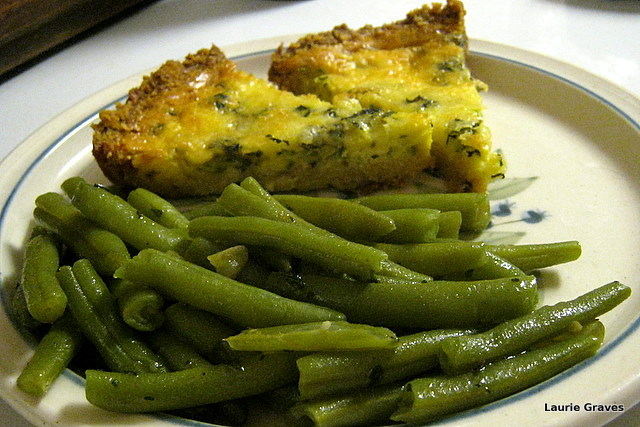
Yes, that is delectable zucchini quiche next to the beans with brown butter.
Well, maybe not everything, but brown butter is a culinary delight that is right up there with chocolate, fresh corn on the cob, and garden tomatoes. It is that good, and if you haven’t tried it, then get out a little saucepan and brown some butter.
It’s not hard. On medium heat, melt a couple of tablespoons of butter, but when the butter is melted, don’t remove the pan from the heat. Instead leave the pan on for about five minutes, until the butter becomes, well, brown. You will have to watch it because while you want brown butter, you don’t want burned butter. So leave the pan on the burner until the melted butter takes on a nice brown color.
Now, what to do? You could add some chopped sage, which becomes crispy nuggets of deliciousness in the brown butter. Then, you could drizzle the brown butter and sage over green beans, the way I did on Farmer Kev’s beans pictured above.
You could drizzle the brown butter and sage over pasta with sautéed summer squash and zucchini. Sweet red peppers would make a good addition to the squash and zucchini, but for this dish, I would stay away from green peppers. Too sharp.
You could drizzle the brown butter and sage over cooked carrots. Boil or steam the carrots until tender, drain, and add the butter.
What about new red potatoes? Remember the title of this post. Of course brown butter is delicious on potatoes.
Winter squash and delicata squash also shine with a drizzle of brown butter, with or without sage.
Even though we hardly eat it anymore, I’m even going to sneak in a suggestion for fish, any white fish, but especially haddock. Bake the fish at 350° for fifteen or twenty minutes, until it is flaky. Remove the fish from the oven and drizzle the brown butter—without sage this time—over the fish. Close your eyes as you eat the fish. You will wonder, is this fish or lobster? I don’t know why brown butter on haddock tastes like lobster. But it does.
So as August wends its way to September, as the green beans continue to flourish, as the carrots grow bigger, and as the squash and peppers ripen, treat yourself to some fresh vegetables with brown butter.
Once you do, you’ll be plotting ways to use brown butter on other things, sweet as well as savory. As I mentioned in the opening paragraph, brown butter is that good.

 Today our friends Judy and Paul came over for coffee, tea, and homemade brownies. Judy’s brother and sister-in-law, visiting from Connecticut, came, too. Clif and I always enjoy meeting new people, and we had a great time getting to know Judy’s brother and sister-in-law. But especially exciting for this foodie was what Judy’s family brought from Connecticut—a basket of ripe peaches from a local orchard. (As opposed to the not-so-ripe peaches on sale at the local grocery store.)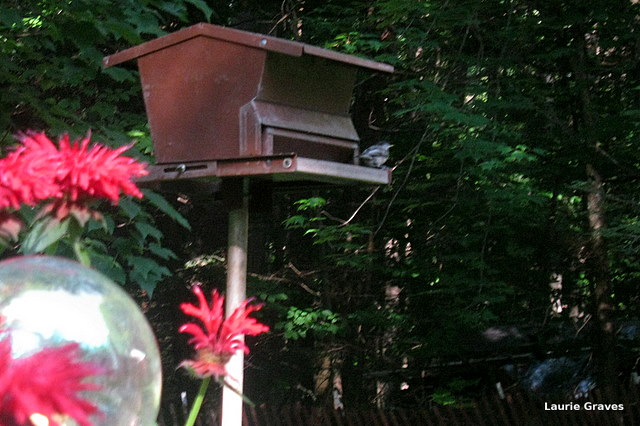









 Notes From the Hinterland