Category Archives: Recipes

When Life Gives You Turnips, Make Patties

If I’m going to be honest, then I have to admit that turnips are not my favorite vegetable. Oh, I don’t hate them. If someone serves turnip to me, I can eat it and still maintain a pleasant expression. (But then, that is true with me for most food. I am not a picky eater. I am a good eater.) However, turnips certainly don’t make my taste buds soar the way sugar-snap peas, corn, and cucumbers do.

What to do, then, with the turnips, so hard and white, tucked in the CSA box that Farmer Kev delivered a couple of weeks ago? I had put the turnips in a bowl with water and then had put the bowl in the refrigerator. I change the water every few days, and the turnips have remained plump and hard. But I knew the turnips couldn’t stay this way forever, and the time had come to eat them.

Clif suggested, “Make them into patties.” Clif  loves patties—almost any kind—the way some people love chocolate.

“All right,” I said. I had done this last year, but I hadn’t kept the recipe, so I rooted on the Internet and found one at Simply Recipes. I used that recipe as a guideline, but I made enough changes so that I can safely call it my own.

Because turnip and potatoes cook at different rates, I boiled them  in separate pans—the potatoes took about fifteen minutes and the turnip was closer to twenty. When the vegetables were soft, I drained them, put them in a bowl, and mashed them with a fork. When the potatoes had cooled, I added 2 small cloves of chopped garlic, 1/2 cup of grated cheddar cheese, 1 beaten egg,  1/4 cup of flour, 1/2 teaspoon of salt, and several grinds of pepper. Clif, who loves frying patties as well as eating them, dropped them by large spoonfuls into hot oil in a cast-iron frying pan.

As the patties turned a lovely, golden brown pan, I had a good feeling about them. Surely something so visually appealing would taste good. And readers, they did.

Clif pronounced the patties, “Pretty darned good,” which in Yankee parlance is the equivalent of delicious. We sprinkled salt on top of the cooked patties and spread a dollop of mayonnaise. As I ate my turnip patty,  I not only had a pleasant expression on my face but also a smile. Clif was right. The turnip patties were tasty.

If someone wanted to get fancy, then he or she could make some kind of aioli to go with the patties. But this was a Thursday night supper, and mayonnaise worked just fine. I made corn bread to go with the patties, and a beet green salad with shredded carrots, sunflower seeds, and feta.

I have two more turnips in the bowl of water in the refrigerator, and I know what the turnips’ fate will be—more patties. This year, I’ll keep the recipe, with all its hand-written amendments, and file it in my veggie recipe folder. That way, next year, I’ll know just what to do with turnips.

IMG_6517

Turnip and Potato Patties (Adapted from a recipe on simplyrecipes.com)

Makes four to six patties

1 1/2 cup of peeled and cubed turnip

1 cup of peeled and diced potatoes

1 large or 2 small cloves of garlic, minced

1 egg, beaten

1/4 cup of flour

1/2 cup of grated cheddar cheese

1/2 teaspoon of salt

Several grinds of pepper

In separate saucepans, boil the turnip and the potatoes. The turnip will take about twenty minutes, and the potatoes will take about fifteen minutes. When the vegetables are very soft, drain them,  combine them in a bowl, and mash them with a fork. When the mashed mixture has cooled, add the garlic, the egg, the flour, the cheese, the salt, and the pepper.

In a heavy frying pan—seasoned cast iron works best—heat about 1/4 inch of oil until it starts to shimmer. Drop the mixture by large spoonfuls into the pan and press them thin, about 1/2 inch. (We used two cast iron frying pans so that we could cook the patties all at once.) Fry the patties until they are a lovely golden brown, about four minutes on each side.

Serve with more salt and pepper. Add a dollop of mayonnaise and rejoice that humble turnip can taste so good.


Shakshuka for Supper

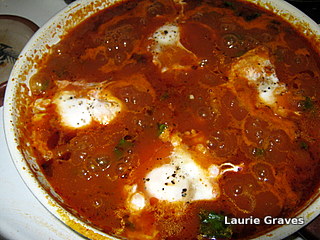
Last night I made shakshuka for supper.  And what is shakshuka? Basically, it’s a Middle Eastern dish that includes poached eggs in a tomato sauce. I love poached eggs. They are my go-to supper when I have meetings and come home late. I always have them with buttered toast, of course. But until yesterday, I had never even heard of shakshuka. I came across the dish on Food52, a terrific website that features tasty recipes that are relatively simple and inexpensive to make. I saw poached eggs, I saw tomato sauce, and I thought, “This is a meal I am going to like.” I had everything I needed for shakshuka, and I decided to make it last night for supper.

I modified the recipe a bit. As onions bother my stomach unless they are simmered for a very long time—half a day or so—I decided to use green peppers and garlic instead.  For those with a hardier stomach, onions would be great.

But essentially, I followed Kendra Vaculin’s recipe from Food52. My sauce was apparently runnier than the one Kendra made as I was unable to make “four little pockets in the saucy mess” for poaching the eggs. It didn’t matter one bit. The eggs poached beautifully without the pockets. (After all, what could be runnier than water?)

The title for Kendra’s recipe is Shakshuka with Grains and Feta. For the grains I cooked basmati, but quinoa or farro was also suggested. I think couscous would be good, too. For greens, I used beet greens—Farmer Kev’s—but spinach or  Swiss chard or any other green would work just fine.

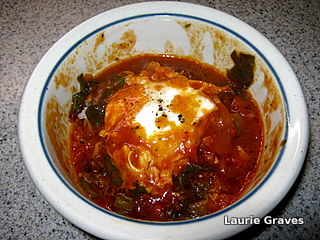
Now, I’ve waited until last to post the pictures because if I’m going to be honest, I would have to admit that this dish is not particularly photogenic. Kendra was right to call it a mess. But what a glorious mess! It came out exactly the way I hoped it would, with the eggs, the sauce, and the rice blending as a perfect trio. I used a sauce that had oregano, but if I hadn’t I probably would have added some just to give it a little zip.

As I scooped up egg, sauce, and rice, I thought, “What could be finer on a warm summer’s eve than this hearty but economical and simple dish?” Nothing I could think of.

Eggs simmering in sauce


In the dish, over rice


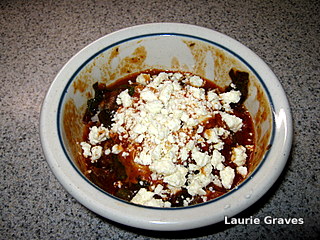
With feta
With feta

Chickpea Cutlets for a Cool Spring Night

Spring is here, but how cool it still is. The other day I met a friend at the grocery store, and she said, “Look what I’m wearing—a turtle neck, a sweater, a big shirt, and a jacket.” I nodded. I was similarly dressed, and when I got home, I shed the jacket but kept the triple layers. It is as cool inside as it is outside, and my husband and I are too stubborn to use the heat.  We are both longing for warm days where we can sit outside and be comfortable wearing a short-sleeved shirt.

Despite the cool weather, the plants and trees and lawns are thriving. The green of the new growth is so bright that it lights up the gloomiest days, which we have had in abundance this past month. The woods in back are positively aglow with green, and I love looking into them as I work in the kitchen. The dwarf irises, with their deep purple flowers, are ready to bloom. They are one of the first flowers in my gardens, and they are eagerly anticipated.

img_5758

The birds also seem to be thriving, and our feeders are busy. For Christmas, Clif bought me a lovely red-glass hummingbird feeder, and last week I boiled some sugar and water, filled the feeder, and put it on a hook in the backyard. It didn’t take long for the hummingbirds to find it, and I was thrilled to see the flash of red and green and hear the whirring of wings as I worked in the yard.

However, a few days ago when I was working in the kitchen, I was even more thrilled when I saw a burst of bright blue at one of the other feeders. “Clif, Clif, come here. I think there’s an indigo bunting in our backyard.” Clif hurried to the window and then to the bird book. Yes, that blue beauty was indeed an indigo bunting, and we stood and watched as the bunting picked at the sunflower seeds. I’ve only seen an indigo bunting one other time, while I was driving, and a streak of blue crossed the road in front of me.

This weekend, we are planning on having a barbecue for Memorial Day. Who knows what the weather will do? Naturally, we have two plans—grilled teriyaki chicken if the weather allows and broiled if it doesn’t.

In the meantime, as we still eat most of our meals inside, here is the recipe I promised for the chickpea cutlets, which are so tasty and easy to make that they are fast becoming a staple in our house. We heat up a bit of jarred spaghetti sauce to go on top of them, but if time allows, homemade, of course, is always best. Basically, these cutlets are a variation on a recipe for chickpea patties I posted a while ago. But I’ll repost the pattie recipe, with added instructions for making the cutlets.

img_5631

img_5635

[amd-zlrecipe-recipe:37]

What a Difference A Week Can Make

Last week, the little house in the big woods was snowbound, with only the barest hint of bare ground in the backyard. While the front yard still has plenty of snow, the backyard has made real progress and now has more bare ground than snow. And all in one week!

Not anyone's idea of beauty, but to me it looks just grand
Not anyone’s idea of beauty, but to me it looks just grand

Yesterday morning, I hung clothes on the line for the first time this season, and there was a thin layer of packed ice around the clothes line. It was so slippery that I wished I had worn my grippers. I didn’t fall, but I had to be very careful as I hung the laundry. But in the afternoon, when I took in the laundry, the ice had completely melted. It almost felt like time-lapse photography in real time.

One of my favorite signs of spring---laundry on the line
One of my favorite signs of spring—laundry on the line

There is much to do in the backyard, but it is still too mucky for a real clean-up. I love this time of year—working outside in the warm sun. It beats anything I can do inside, and that includes cooking or writing and most certainly cleaning.

I've had this sage plant for 3 years. Will I get another year out if it?
I’ve had this sage plant for 3 years. Will I get another year out if it?
Brave little irises
Brave little irises

Even though it is much warmer now than it has been since, say, October, it is still cool enough for soup and probably will be until June. This is Maine, after all. And soup—tomato chickpea—is what we will have for supper tonight.

From the four Cornish hen carcasses left over from our anniversary meal, I made a stock in the usual way—with water, onion, garlic, peppercorns, and salt. After the stock had simmered for several hours, I let it cool overnight in the refrigerator so that I could skim off the fat. In addition, I soaked 2 cups of dried chickpeas overnight and cooked them in the morning. Into the slow-cooker went the stock, the chickpeas, and a 28-ounce can of tomato puree. Since I had a lot of the tomato stock, I coarsely chopped 6 carrots and 4 ribs of celery and sauteed them with olive oil, adding 3 cloves of garlic for the last minute or so. After the vegetables were soft, I added them to the slow-cooker and let everything bubble for four hours.

Because the Cornish hens had been so wonderfully spiced, I did not need to use additional spicing in the soup. Otherwise, I would have added some rosemary and perhaps some oregano. Tonight, I’ll  cook some pasta, which we can add to the bottom of our soup bowls. We have found that pasta put directly into the soup swells and swells until the pasta is quite unappealing. So now we add pasta directly to our bowls and ladle hot soup on top.

This made a huge batch of soup. Clif and I will eat it for several nights, and I’ll freeze the rest for that happy, busy day when there’s too much going on outside to fuss in the kitchen.

And just for something a little extra, here’s a spring song, courtesy of Sesame Street.

The Curious Case of the Disappearing Quiche

img_5467A week or so ago, as I was rereading volume 3 of the Tightwad Gazette, I came across a “recipe” for quiche. Actually, it was more like a guideline, and I expect beginning cooks would be flustered by the inexact measurements listed—1 or 2 cups of milk, 3 or 4 eggs, that sort of thing. The piece put me in the mood for quiche, and especially interesting was a reader suggestion for an alternative crust made from grated potatoes mixed with a bit of oil.

Now, it must be said that I love making pie crust as well as eating pie crust, and I am not at all intimidated by the process of rolling dough. However, pie crusts are, ahem, a little on the fattening side, and as Clif and I are constantly trying to lose weight—sometimes successfully, sometimes not—a quiche for a weekday meal seemed a bit excessive.

But, I reasoned, what if I used a grated potato crust rather than a traditional pie crust? What if I used milk rather than cream as the base for the quiche? And what if broccoli were the primary ingredient? Might quiche be an acceptable weeknight meal? And with just the two of us, we’d have enough leftover for 2 or maybe even 3 meals.

So using the Tightwad Gazette as my guide, I set about making the crust with shredded potatoes. Then I improvised with the filling, adding leftover breakfast sausage as well as broccoli. I also had some leftover sour cream, and as suggested in the Tightwad Gazette, I added that to the milk. I didn’t add any spicing—herbs or garlic—I just wanted to see how the basic quiche would turn out.

Not too bad, as my Yankee husband put it. We both liked the potato crust, but agreed that it might be worth fiddling with this. The instructions were to bake the potato crust in a pie plate 15 minutes or until the crust was just beginning to brown. Then the quiche mixture was added and the whole thing was baked for about 50 minutes. By doing this, when the quiche was finished, the edges of the crust were crisp and delicious while the underneath was pale and soft. While the underneath was good enough, Clif and I wondered if it would be possible to have the entire crust brown by lining the edges with foil, removing the foil after about 20 minutes, and baking the crust until the whole thing was golden brown. And maybe mixing a little roasted garlic into the shredded potato before pressing it into the pie plate.

An experiment for another time.

In the meantime, we had quiche for our supper, and Clif and I contentedly ate. And ate. By the time we were done, there were only 2 pieces left, hardly enough for another meal for 1 night never mind for 2 nights.

I had had 2 pieces, one more than I should have eaten, but this meant that Clif had had 4 pieces.

“That’s right,” he said when I pointed this out. “Make me the butt of another one of your blog jokes.”

“You did have 4 pieces,” I said. “I wouldn’t be lying.”

“I really like quiche,” Clif admitted. “And we haven’t had it for a while.”

No, we haven’t. And potato crust or not, I think perhaps we should save quiche for the weekend, when we allow ourselves to have treats. That way, it wouldn’t matter how many pieces were left.

[amd-zlrecipe-recipe:36]

A Sideswipe of a Storm and a Good Day to Make Blueberry Muffins

img_5437Yesterday, central Maine got lucky. The big storm that swept up the Eastern Seaboard brought us wind but not much else. We didn’t even lose our power. “The storm was a sideswipe,”Paul Fitzsimmons, a forecaster from Caribou, said. “Maine was on the western fringes of the storm.”

For that we must be grateful, even though the weather is still brisk, and the little house in the big woods is still surrounded by snow. To celebrate being sideswiped by what would have been a major and destructive storm had it hit us head on, I decided to make sour-cream blueberry muffins with a brown sugar topping. Of course, any day would be a good day to make blueberry muffins.

But a warm muffin and a cup of tea is a fine thing to have the day after being sideswiped by a storm, when the days are getting longer and the birds are singing. And with tea in hand, I stood in my bright dining room and saluted spring. Come, spring. Take the cold weather away. We are ready.

[amd-zlrecipe-recipe:35]

Recipe Challenge: Skillet Tuna & Noodles

A while back, as I was clipping coupons—yes, I am a coupon clipper—I came across a recipe called “One Skillet Tuna Noodles.” The basics were good—egg noodles, tuna, frozen vegetables, milk, and water. But then there was the problem ingredient—1 can of condensed cheddar cheese soup. Granted, the canned soup makes the preparation extremely speedy, and for many busy families, in the evening all they want is to put together quickly a fairly decent meal, for heaven’s sake. I understand that. In fact, I’ve been there myself when I worked outside the home and still had five people to feed every night.

But, I wondered, could I make a cheddar cheese sauce from scratch and still have the meal ready in a reasonable amount of time, say, under an hour? I decided to challenge myself with this recipe makeover.

First, a qualification. I am very, very comfortable making a basic white sauce, to which cheddar cheese can be added. Clif and I like casseroles with cheesy white sauces, and I make them fairly often. My vision of this skillet dish was basically as a casserole in a large frying pan. For people who are not as familiar with making a cheese sauce, the process might take a little longer.

Second, a hint. For speedy preparation, get everything ready ahead of time, or mise en place, as the French put it. This will ensure no last-minute awkward fumbling for this or that, which can really slow down the process and sometimes even ruin a meal.

The following is step-by-step instructions of what I did.

1. Set a large stock pot of salted water to boil on the stove.

2. Measure 9 ounces of egg noodles into a bowl and set by the stove.

3. Measure a cup of frozen vegetables—I used peas—and set by the stove. (Next time I would use 2 cups.)

4. When the water boils, add the noodles and the veggies, set the timer for 10 minutes, and put a colander in the sink. While the noodles are cooking, start getting everything in place.

4. Take out skillet. I used a big electric one.

5. Open a 6 ounce can of tuna, flake it in the can, and set by the skillet.

6. Mince 1 clove of garlic, put it in a small bowl, and set by the skillet.

7. Measure 4 tablespoons of flour into a small bowl. Add 1 teaspoon of salt and 1/4 teaspoon of pepper. (Actually, I just scrapped some pepper into the flour.) Set this by the skillet.

8. Cut up 4 tablespoons of butter and put into the unheated skillet.

9. Grate a cup of cheddar cheese and set by skillet.

10. Measure a cup and a half of milk. In a separate cup, measure a cup of sour cream. (Or plain yogurt. Or add another cup of milk if you don’t have yogurt or sour cream, so that you have two and half cups of milk.) Set by the skillet.

11. Measure 1 teaspoon of dried dill into a small bowl, and, you guessed it, set it by the skillet.

12. By now, perhaps even earlier, the noodles and veggies should be done. Drain them into the colander and let them set while you prepare the cheese sauce.

13. Heat the skillet using a medium heat—350 degrees in an electric skillet. Keep an eye on the butter and as soon as it is melted add the minced garlic. Let it sizzle for about 30 seconds.

14. Add the flour, salt, and pepper, and stir, stir, stir until the roux is a golden brown. This will take a couple of minutes.

15, Add the milk and stir until the mixture is thick and bubbling. In a big skillet, this shouldn’t take long.

16. Add the cheese, tuna, and the dill and stir until the cheese is melted.

17. Reduce the heat to low, and add the sour cream or yogurt, if using. Heat slowly—you don’t want the sour cream to curdle—until everything is warm.

18. Add the noodles and the peas, and again, heat slowly until the mixture is very warm but not bubbling.

And there you have it. A skillet dinner with a cheese sauce made from scratch. The whole process, from beginning to end, took me 30 minutes. Not as speedy as opening a can of soup, but an acceptable amount of time nonetheless.

This could never be considered a company dish, but it is warm, tasty, frugal, and pretty quick to make. Clif had 2 servings and pronounced it “Not too bad,” which in Yankee parlance means good enough.

Here are some pictures Clif took of me as I made the white sauce and then added the rest of the ingredients:

Stirring the roux
Stirring the roux
Adding the cheese and tuna after the milk has been added
Stirring in the sour cream
Adding the noodles and peas after the sour cream has been added. The heat is on low, and everything is gently warmed.
Suppa is ready
Suppa is ready

How I Got 3 Meals from 2 Chicken Breasts and 4 Sweet Potatoes

img_5225I know. The title of this post is akin to the miracle of the fish and the loaves. However, no miracles were performed. Instead, just some thrifty stretching of food with my trusty slow-cooker. Also, I want to hasten to add that these 3 meals were for Clif and me, just the 2 of us. Yet even with this qualification, 3 meals from 2 chicken breasts and 4 sweet potatoes come under the heading of pretty darned frugal, which can only be a good thing during this very cold winter. And tasty, too, if I do say so myself.

Here is what I did. I took 4 medium sweet potatoes and cut them into large cubes. (I didn’t peel them.) I sprinkled salt and pepper on them and added a cup of water. I put two large chicken breasts on top of the sweet potatoes and seasoned them with more salt and pepper as well as thyme and sage. (I didn’t measure. I just sprinkled liberally.) Then I added two cloves of minced garlic. Onion lovers could certainly substitute or add onions as well. I set the slow-cooker on high and let everything cook for about 4 hours.

On night 1, we each had half a chicken breast and some sweet potatoes. Clif and I could have eaten more, but we refrained, which meant that we had both leftover chicken and sweet potatoes. Also, there was a lovely broth from the water and the chicken. I removed the chicken and sweet potatoes from the broth, and put them into separate containers.

Because I have a large refrigerator, I left the broth in the slow-cooker’s crockery and tucked the whole thing in the refrigerator. The next day, I used this as the base for meal 2.

I put the crockery with the broth into the base of the slow cooker, and turned it to high. I added 4 cups of water; 1 whole onion, peeled; 2 cloves of garlic, roughly chopped; 1/2 teaspoon of salt; and 1/4 teaspoon of ground pepper. (Actually, I didn’t measure the pepper. I just ground some in.) If I had had some celery, I would have included a rib or two in the stock, but I didn’t.

I let the stock bubble on high for about 5 hours.  Then, I removed the onion. Into the slow cooker, I added the sweet potatoes, with the skins removed, and using my immersion blender, I pureed the sweet potatoes into the stock. Right there, I had a lovely, creamy soup that would have been fine just as it was.

However, Clif likes his soup to have ingredients, and if we do have a creamy soup, he loads it with crushed saltine crackers. Knowing his preference, I usually add ingredients to most every soup I make. So into the sweet potato soup I added the leftover chicken, chopped into large pieces, and 2 cans of black beans. In the refrigerator, we had leftover couscous, and I added that as well, but any small- or medium-sized pasta would work. (Because pasta and couscous have a tendency to swell, the next time I make this soup, I would add warm pasta or couscous or even rice to the bottom of each serving bowl and ladle the soup on top.)

I made some biscuit muffins to go with the soup, and Clif was a happy husband.

The third meal, of course, was leftover soup and biscuit muffins.

Now, this kind of meal could be amended in a couple of ways. For those living alone and who have a small slow-cooker—yes, Megan, I am directing this at you—the ingredients could be halved, and you would get at least two meals from this. For those with a bigger family, load that slow-cooker right up. In fact, maybe even have 2 of them going.

However it is done, you will still have 2 or 3 thrifty meals, perfect for this time of year when the nights are long and oh so cold.

img_5249


A Variation on a Theme: Slow-Cooker Chicken One Night, Chicken Soup the Next

img_5078Last week at our local grocery store, chicken was on sale, and chicken was what I bought. They were little roasters, and I picked up 2 of them, one for the freezer and one for immediate use. Usually, when I buy roasters, I, well, roast them in the oven and then make soup with whatever is leftover. This time, however, I decided to do everything in the slow-cooker, which has become my favorite small appliance. (If I had children at home, I would invest in 2 slow-cookers so that I could make twice as much and have leftovers.)

For meal 1, I cut up some carrots and potatoes—I wish I had cut up more—and put them in the bottom of the slow-cooker. I sprinkled salt and pepper on them and added 3/4 cup of water. On top of the vegetables, I put the little chicken and sprinkled more salt and pepper along with some dried thyme and sage. (No, Shannon, I didn’t measure.) At this point, onion or garlic could have been added, but I wanted the meat and vegetables to be mellow, so I left them out.

I set the slow-cooker on high, and four hours later we had succulent chicken and tender vegetables made so tasty by the broth that they didn’t need butter. (The skin is the weak point with chicken in a slow-cooker. It is slimy rather than crisp, but as I told Clif, we shouldn’t be eating the skin anyway.) There was a nice amount of broth at the bottom of the crockery, and as I have a big refrigerator, I just put the crockery with the broth on the top shelf. The leftover chicken went on a plate of its own.

The next morning, I skimmed the fat from the broth in the crockery, put the crockery in the slow-cooker, and turned it on to high. I added the leftover chicken and bones; 4 small cloves of garlic, cut in half; 1 whole onion, peeled; 2 ribs of celery, cut in big chunks; 2 big carrots, unpeeled and cut in big chunks; 1 small bay leaf; 3 whole cloves, stuck in the celery; a teaspoon of salt; some ground pepper; and finally, water to cover the bones. I am letting this simmer for about 5 hours.

As I write, I can smell simmering soup. I’ve tasted the broth, of course, and it tastes exactly the way it should. In a little while, I will strain the soup and pick the meat from the bones. As we ate most of the potatoes and carrots I cooked yesterday, I’ll boil some potatoes and carrots to a add to the soup. (Next time, I will indeed cook more with the first meal.)

“Corn bread or bran muffins to go with the soup?” I asked Clif.

“Bran muffins.”

So we’ll have chicken soup with bran muffins tonight, and it’s my guess there will be enough leftovers for another meal of soup and muffins. Not bad for a 5-pound bird.

In fact, I would say it was down-right frugal.


A Weird Weather Weekend: Part II—A Warm Walk on the Beach

img_5058In yesterday’s post, I wrote about the ice storm we had on Saturday and how, despite the slippery roads, Clif and I drove 25 miles to go to a movie at Railroad Square Cinema. And we weren’t the only ones at the Square.

But what a difference a day can make. By Sunday, the sun was out, the sky was blue, and it was warm—around 50 degrees at the little house in the big woods. I jokingly suggested to Clif that it was time to bring out the summer clothes.

With nary a thought about icy roads, we headed to South Portland to visit with Shannon. She would make lunch for us, and Clif would measure for shelves he plans to make for her kitchen. What a lovely lunch Shannon made—a sweet and savory squash soup with spicy chickpea croutons, homemade biscuits, and a salad. (Shannon found the soup recipe on a blog called My New Roots.)

img_5054

Shannon had suggested that if the weather allowed, we might go for a walk on Crescent Beach in Cape Elizabeth. With the sun shining and the temperature holding at 50 degrees, the weather certainly allowed, so with dogs in tow, off we went to Crescent Beach. When we reached the town parking lot, we all laughed. It was nearly full, with only a few empty parking places. After all the storms and the extreme cold, it seemed we weren’t the only Mainers keen to get outside and feel the warm sun on our faces.

As an extra bonus, the tide was out, and the wide beach sparkled ahead of us. Blue sky, puffy clouds, the deep blue sea, jagged islands, the sound of the waves—I walked as if in a dream. What a great pleasure it was to stroll on the beach and not feel as though my face was going to freeze and shatter. Only a few days ago, when I had taken the dog for a walk, I had worn a headband as well as a hat, a neck warmer, my heaviest coat, and leggings under my pants. Now here I was, walking on the beach without a hat and gloves. It was sheer bliss.

Afterwards, Shannon would remark in an email: “It was quite a wonderful thing to go walking on the beach and be so comfortable in January! I felt like I got recharged and rejuvenated afterwards!”

Yes, indeed. We all felt as though we had been given a gift, and so we had.

img_5061