Category Archives: Food for Thought

The Freedom To Be Weird

IMG_7931Several years ago, an acquaintance called and asked me if I would be willing to take a short poll about Winthrop. I said yes. He asked me several questions and ended with the big one, “What is it you like best about Winthrop?”

I thought for a few minutes. “What I like best about Winthrop is that you can be as weird as you want to be, and as long as you don’t hurt anyone, nobody bothers you.”

The man laughed. For reasons that I won’t go into, he knew exactly what I meant.

Now, I realize this sounds like faint praise that perhaps doesn’t acknowledge Winthrop’s other fine features: its lakes, its woods, its library, its schools. It is also a safe town with a responsible and pragmatic police department. These are all important things.

But the freedom to be as weird as you want to be is a very great freedom indeed. This means you never have to worry about keeping up with the Joneses. Or anybody else for that matter. If you wear scummy jeans to Hannaford or to Rite Aid or to the library, nobody gives you a look that indicates you should have thought twice before stepping out of the house. You can drive an old car. You can bike all over town, and people think it’s cool. Heck, you can even ride your bike through the drive-through at the Credit Union, and the teller will smile at you. (I mention the this because unfortunately, Winthrop is not a biking community where such transactions are taken for granted.)

Another biking story. One day, I rode my bike in the rain to the Winthrop Food Pantry, where I was volunteering. When I got there, I was a little dishevelled, and I went to the bathroom, looked in the mirror, and fluffed up my hair. Unfortunately, I did not look at my backside until I got home, where I discovered  a line of mud that went from my butt all the way up my back from where the rear tire had splattered me. Nobody said a word. Nobody even gave me a funny look. They just came along with me to select their food.

Do you make bread and crackers? Good for you. Do you buy most of your clothes at thrift shops? So what. Are you a liberal black man in this mostly white and somewhat conservative town? Then you just might get elected to the State House of Representatives.

I credit this live and let live philosophy, which can be found in many other towns in Maine, to our Yankee heritage, which encourages a high tolerance for eccentric—aka weird—behavior.  Again, as long as you don’t hurt anyone, you are free to be as unconventional as you want to be.

In Frugalwoods, a blog I follow, Mrs. Frugalwoods wrote about how she has had to work through worrying about what other people think and about living up to societal expectations. Because of this, nothing she did was ever good enough, and she writes, “I was stressed, anxious, preoccupied with doing ‘the right thing,’ and out of touch with who I really am and what actually makes me happy. I wasted so much time, energy, and creativity worrying about what people might or might not be judging me for.” At the ripe old age of thirty-one, Mrs. Frugalwoods has made much progress with this ultimately self-defeating attitude.

Mrs. and Mr. Frugalwoods are considering a move to Vermont, another Yankee state that has a high tolerance for eccentricity. The Frugalwoods dub themselves as “frugal weirdos,” and I’ve no doubt that Vermont will let them be as weird as they want to be.

Just as Maine would.



Coyote Tail

IMG_7865Last Friday, the dog and I walked to the Narrows on a windy afternoon. I heard a flag pole rattling, which reminded me of the Police’s “King of Pain.” There were lots of people ice fishing on the Narrows, and trucks were parked along the causeway. The dog and I had to brush against the trucks as we passed. Otherwise, we would have been in the middle of the road. Because I had to walk so close, I couldn’t help noticing that in one truck, a full coyote’s tail hung from the rear view mirror.

As a lover of all creatures canid, it pained me to see that tail, to think of how that beautiful animal was no longer running through the forest, possibly in the woods behind my house. Naturally, this is all speculation. Who knows where that coyote was killed?

But why kill a coyote? Why kill a bear for that matter? Or any other animal that you are not going to eat? On the way back home, I reflected on hobbits, who never hunted for sport. If only humans would follow their example.

I thought with sorrow about the coyote tail for the rest of the day, and I have come to the conclusion that the older I get, the softer I have become. Why this should be, I don’t know. It seems to me that age should harden us to the cruel ways of the world, but somehow, at least with me, it hasn’t.

When I was eight, my family moved to North Vassalboro, a small rural town outside of Waterville. Our house was on the edge of the town and the countryside. Many people had gardens, and some had cows as well. Back then, animals were killed regularly and without much thought. If a raccoon came into the barn, my father shot it. If our neighbors had too many kittens, they were shot. We had chickens, and I saw my father kill them. While I didn’t necessary like all this killing, it seemed to me a fact of life.

Even though I still live in a rural town, I have moved away from this killing, both directly and indirectly. Our diet is mostly plant based. We occasionally eat chicken—every other week or so—and once in a while we eat fish. But mostly it’s vegetables, with some dairy and eggs.

I suppose the urge to hunt, to be a predator, is a part of our ancient heritage. It still runs strong in some people. But where does it end? Raccoons, kittens, chickens, coyotes, other people, the land, the water, the planet. Does killing ripple ever outward?

Restraint is a word most of us don’t like. It implies a Puritanical, joyless approach to the world. But with so many of us on this planet, if ever there were a need for restraint, it is now.

Until the ice goes out on the Narrows and the fishing stops, I think I’ll walk the other way, to where the trees will soon be tapped for maple syrup. That way, there will be no brooding all day about an animal that once ran in the woods and whose tail is now used for decoration.


Why Don’t Americans Eat Healthier Food?

IMG_7863Among foodies, there is a lot of hand-wringing about how Americans eat. The general feeling is that we eat too much of the wrong kind of food, which in turn makes us fat and unhealthy. Alas, there is some truth to this. We are an overweight country, with an increasingly large number of children suffering from obesity and diabetes. As anybody who shops regularly at a supermarket can attest, many of the aisles are filled with food that should only be considered treats to be eaten sparingly as they do little to nourish our bodies. (I also want to point out that there are good things to eat, too—fruit, cheese, vegetables, rice, rolled oats, beans. Somebody must be eating these things or the stores wouldn’t stock them.)

In addition, Americans are often chided for how little money they are willing to spend on food.  In Treehugger, Margaret Badore writes, “According to the USDA Economic Research Service, 6.7 percent of consumer expenditure went towards food in 2013. Compare that to 9.3 percent in the United Kingdom, 13 percent in South Korea, 15.7 percent in Brazil, 26.1 percent in China, and 29.6 percent in India.” (I keep close track of our household expenditures, and Clif and I spend 13 percent on food. I guess we’re above average in that sense.)

As someone who is, ahem, food obsessed, I think about these things, too. Why are we such a fat nation? Why don’t we spend more on food? Why don’t we eat better? We know better, and this is true for those who struggle with poverty as well as for more affluent folks. For many years, I volunteered at our local food pantry, and how grateful the recipients were when fresh fruit and vegetables were available.

First, let’s consider cost.  We have a government that subsidizes what has come to be known as Big Ag, those mega companies with their mega farms that grow vegetables—corn, soy, and wheat—that are not meant to be eaten in their original state but are instead processed with sugar, salt, and fat and many ingredients that are unpronounceable.  This type of food is highly profitable, and many people have a huge appetite for it.  (I don’t exempt myself from this group of people. If I’m going to be honest, I have to admit I have a weakness for Double Stuf Oreos.)

Nevertheless, despite the Big Ag subsidies and the relatively low cost of food, many Americans feel financially stretched, and cutting back on how much is spent on groceries is one way to trim a budget.

And why do Americans feel so financially stretched? Unlike most European countries, our government has been pretty stingy when it comes to subsidizing health care, transportation, higher education, childcare and affordable housing. These things take a huge chunk out of our budgets, to the point where there is often little left over for much of anything else. (I do want to note that Obamacare has mitigated much of the misery caused by lack of health insurance—I know a woman, pre-Obamacare, who lost her house because she had to choose between paying for cancer medication and her mortgage. She chose life.)

However, money isn’t the only way Americans feel stretched. We also feel stretched for time, and I expect this also has a big effect on how we eat. In most families, both parents work outside the home. They rush to get the children to school or daycare, they rush to work, and then they rush to get back home to their children, who might be involved with sports or other activities. We live in a rush, rush society where we always feel harried, where we barely have time to comb our hair much less prepare a home-cooked meal. And this is true for parents at every economic level.

To add to this harried feeling, Americans have fewer vacations than Europeans—the French pretty much take off the whole month of August. Indeed, many Americans—those who work in low-paying service sector jobs—don’t have any vacation time at all. The same applies for maternity leave and sick time.

Is it any wonder, then, that so many Americans feel stressed? Is it any wonder that so many people turn to fast food for both convenience and comfort? There it is, dinner in a box or in a bucket, with very little preparation required. After a long day of rushing, how soothing it is to eat that salty fried chicken or burgers and fries, washed down with a shake.

I have an immodest proposal. Actually, I have two immodest proposals. First, let’s take some of the money we use to prop up Big Ag, and instead use it to help small farms and to subsidize services that are for the common good—health care, affordable housing, public transportation, childcare, higher education. If people felt less pinched financially , then they just might be willing to spend more money on food.

Second, let’s give Americans more vacation time, more time away from work, more maternity and sick leave. If they felt less pinched for time, then they might actually find the energy to serve more home-cooked meals.

I am not optimistic that my immodest proposals will be implemented anytime soon. There is too much big money dependent on keeping things just the way they are. However, who knows what might happen if we spent more money on the common good and gave people more time off?

Maybe, just maybe, we wouldn’t have such an obesity problem.


Gather Around the Table

IMG_7836Not long ago, when I was having tea with my friends Mary Jane and Liz, the conversation turned to Marion Healey, a Winthrop resident who died a little over a year ago. Marion was one of Winthrop’s prominent residents. For forty years she worked as the treasurer/manager of the Mill Workers Credit Union, now the Winthrop Area Federal Credit Union. Indeed, the new building was named in her honor.

But what we spoke of were two traits that made Marion especially dear to the community—her hospitality and her intense interest in other people. Mary Jane said, “Being around Marion’s table was one of the best places to be. Once when I visited, I remember how she wanted to know all about my life before I came to Winthrop.”

I understood exactly what Mary Jane was getting at. When you talked to Marion, you felt as though she was giving you her complete attention, that you really mattered. A priceless gift and small wonder that she was so beloved in Winthrop.

When Liz and Mary Jane left, I thought more about Marion and her wonderful hospitality. I remembered my own parents and the many people they welcomed into their home. It was a rare week when someone didn’t come over. If the numbers allowed, we almost always gathered around the kitchen table. Coffee was served along with some kind of treat, often homemade. (My mother was a terrific baker and could bake almost anything.)  I come from a gregarious ethnic group—Franco American—and there were always lively discussions around that table.

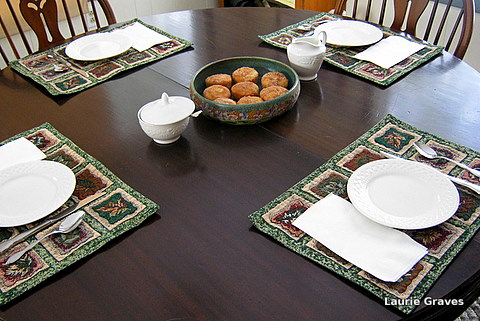
At the little house in the big woods, we are blessed with a good size dining room. In the center is a dark round table my mother-in-law bought at an antique shop in Bangor. The original  chairs, stuffed with straw, wore out long ago, and it’s my guess the table was made sometime during the late 1800s. The table came with two leaves, which means ten people can be comfortably seated.

I have carried on my parents’ tradition of inviting people over and gathering around the table. Sometimes it’s for a meal, but sometimes it’s just for muffins and tea and coffee. Yesterday our friends Joel and Alice came over. I made French donuts, and we talked about the things we love to talk about—books, politics, and movies. I can’t think of a better way of spending a winter’s afternoon.

Next week, our friends Beth and John will be joining us for Sunday brunch. A couple of weeks later, other friends will be coming for tea, muffins, and talk.

These gatherings are not elaborate, and they are inexpensive. What Clif and I are giving are the gifts of time and hospitality. Marion valued these gifts as did my parents. In our hectic world, it is easy to become so caught up in busyness that we forget to give these gifts.

But these gifts are so worthwhile, and Clif and I will continue to gather people around our table for as long as we can. As Marion so beautifully illustrated, these gifts can ripple outward long after a person has passed.


Keeping My New Year’s Resolution

IMG_7760We are just two months into 2015, and I’ve accomplished something I’ve never done before—I am half-way through my New Year’s resolution. Normally, my resolutions start out with a bang, and I make a strong showing in January. Then comes the cold of February, and my enthusiasm begins to flag. By the end of the month, as I desperately long for spring, all those lofty goals I made on New Year’s Eve have fizzled.

But not this year, and with any luck, in a few months, my New Year’s resolution will be fulfilled. Readers are no doubt wondering what my secret is, and being a generous soul, I will share it. The trick is to resolve to do something pleasant rather than something unpleasant. If I had discovered this simple trick years ago, I would have saved myself from a long string of broken resolutions and the resultant guilt.

Here is what I did for this year’s resolution. For our New Year’s Eve gathering, I asked family and friends to make lists of best books and movies read and watched in 2014.  This they did, and I resolved to pick one item—either a book or a movie—from each person’s list to read or watch.

I started with a book Clif recommended—Buddy Holly is Alive and Well on Ganymede by Bradley Denton. Clif owns the book, which made it an easy one to get started with. I must admit that I never would have read this book if not for my New Year’s resolution. Clif has a weakness for Sci-Fi, the quirkier the better. Me, not so much. However, I absolutely loved this romp of a novel that is a wild blend of Philip K. Dick, Elmore Leonard, and Loony Tunes. At the same time, the central mother-and-son relationship is warm and difficult and moving. In short, it felt real.  And, yes, Buddy Holly was indeed alive and well on Ganymede.

I was off to a great start, and for my second book I chose one from my friend Alice’s list–-Shores of Knowledge by Joyce Appleby. This nonfiction book couldn’t be more different from Buddy Holly. In Shores of Knowledge, Joyce Appleby explores how the discovery of the new world not only brought ill-gotten gains to European countries but how it also expanded them intellectually. New cultures and new species shook a narrow world view that had been carefully cultivated by the Catholic church. In the Shores of Knowledge,  Appleby draws a line from Columbus to Darwin and in between she fills in with journalists and naturalists and what would come to be known as the scientific community.

Last weekend, I read a book  from my son-in-law Mike’s list—Train Dreams by Denis Johnson. This novella follows its main character, Robert Garnier, who comes of age in the early 1900s in Idaho. In the course of  116 pages, Garnier must cope with tragedy, loss, and the wilderness all twined with a touch of the supernatural. Trains, of course, figure heavily in the story. It’s a haunting tale that somehow manages to be both aloof and moving.

Three books down, one book and two movies to go. Earlier, I made light of this resolution, calling it pleasant, and certainly it is giving me pleasure to fulfill this resolution. But it is also doing something else—broadening my horizons and encouraging me to stretch beyond the books and movies I would normally read and watch.

Maybe, just maybe, even though this resolution is pleasant, it is also worthwhile.


A Day Off

IMG_7731When you work at home, there is really no time off. Somehow, even when I take a break from writing, chores find a way of insinuating themselves into the day, and there always seems to be just one more thing to do. However, every once in a while, I decide I need to have a personal Sabbath day and put chores on hold.

Yesterday was such a day. For various reasons, I was frazzled and yearned for a day of rest. So I took the day off, and the only chore I did was laundry.

When such days are rare, they are truly a treat. Yesterday, it was sheer bliss to take as much time as I wanted to read the various blogs I follow; to relax on the couch and read We took to the Woods, a book my friend Mary Jane let me borrow; to eat whatever junky snack I felt like having; to walk with the dog to the Narrows and take some pictures.

IMG_7728

IMG_7727

Supper was simple—scrambled eggs with smoked Gouda, toast, and fries. There was hardly any prep time involved.

By the end of my day off, I felt rested—joyful, even—and ready to tackle the various projects I had put on hold.

In truth, I love my busy schedule and wouldn’t want too many days off. But every now and then it is good to slow down, relax, and recharge.

IMG_7730

A Creative Life

Lately I’ve been thinking about creativity and how it enriches and enhances everyday life. We can’t all become great artists. To do so requires a combination of talent, hard work, persistence, and—something we might hate to acknowledge—good luck. While chance might only favor the prepared mind, there is something to be said for being in the right place at the right time and having the right people pulling for you.

But I truly believe that most of us can live a creative life and that this is not the sole province of the enormously talented. As with many things, there is no one path to living a creative life, and vive la difference!

I feel extraordinarily lucky in knowing many, many people who live creative lives. In fact, I know so many that I really can’t list them all, but here are a few: John, a scrounge extraordinaire and a librarian who supplements his library’s tiny budget by scouring book sales and his town’s transfer station for books that he not only adds to the collection but also sells for additional income. There is Shari, who is so accomplished with knitting and needlework and who makes the loveliest pieces, often from scraps. There is Diane, a true green bean, who has made her old house snug and energy efficient. She also makes snappy jewelry from found objects.

I must add my son-in-law Mike who draws, paints, and takes pictures; my daughter Shannon who cooks the most wonderful meals; my daughter Dee and her keen intellect, which gives a creative edge to everything she does. My engineer friend Jim who can fix pretty much anything. My own husband, Clif, and his photographer’s eye, and  Farmer Kev, who grows food for so many people.

All right, I’ll stop. Apologies to friends and acquaintances who were left out. Kudos to all of you, especially those who do volunteer work. This, too, is a form of creativity that uses one of our most precious resources—time.

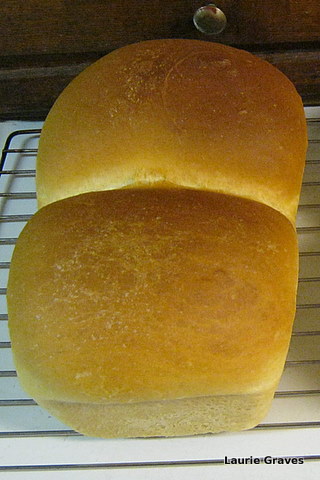
In my own life, I bake and cook, making pretty much all the bread that we eat.

IMG_7563

I’ve learned how to take pictures, something I never thought I’d be able to do. I’ve come late to photography, thus proving that even as you age, you can learn new things and expand what you do.

IMG_7674

And, of course, I write, five days a week, sometimes more, depending on what is happening. Writing is the center of my day, and without it, my life would feel out of whack. Words and story are definitely the thing for me.

By weaving creativity in with everyday life, we bring a spark that adds meaning to all that we do.  Creativity can also bring a much-needed attention to how we live. Can we create from things that would ordinarily be thrown out? Cook from scratch and thereby use less packaging? Scrounge useful items from the transfer station? Fix things when they are broken? In the end, a creative life is often a green life, and if there’s one thing we need people to do more, then it is to be as green as possible.

I’m going to end with a quotation from one of my favorite writers, Miss Read, who wrote stories about English village life. Here is her description of one of the characters—Mrs. Willet: “She can salt pork or beef, make jams, jellies, wines, and chutneys and pickles; she can bake pies…She makes rugs, curtains, and her own clothes. She can help a neighbour in childbirth…She is [a] good… gardener and sings in the choir…It is a creative life. There is something worthwhile to show for energy expended which engenders the desire to accomplish more. Small wonder that the Mrs. Willets of this world are happy, and deserve to be so.”

Small wonder, indeed.

Is It Decent?

IMG_7617As I wrote in a previous post, last weekend we visited our friend Diane, and one of the things we talked about was her work at her town’s local food pantry.  On Monday, I got an email from her telling me that because of the bad weather, only ten families came to the pantry. A normal Monday count is fifty families. Ten families out in bad weather to get food. Fifty families when the weather is good. And Diane lives in an affluent community that is not known for the number of people who need food assistance.

By a strange coincidence—it’s funny how often this happens—there was an editorial in last week’s Sunday Kennebec Journal about the greater Portland area and General Assistance. (Diane does not live in Portland.) The gist of the piece was that Portland’s General Assistance is not excessively generous and is, in fact, greatly needed. “Demand for General Assistance spiked in 2009, the first year of the worst recession in 80 years. The budget has climbed each year since then as the benefits of the recovery have been disproportionately distributed to the people at the high end of the income scale. That’s why in Portland you can see lines outside trendy restaurants and at the soup kitchen a few blocks away.”

That last sentence really caught my attention—the notion of two lines of people, one group waiting to get into a trendy and almost certainly expensive restaurant while another group waits in line for the soup kitchen. What kind of city, what kind of state, what kind of country do we have where there are two lines so far apart?

People, of course, are entitled to spend their money any way they want, but is it decent to flock to a trendy restaurant, where the meals are usually $25 or even higher, while so many people wait in the soup kitchen line? Before the Great Recession, I’m not sure if I would have asked this question. I am a foodie, and I love the idea of a vibrant food scene with good chefs and good restaurants. A happy day for me is going to an outdoor food fair—when the weather is good—and nibbling on food here and there. When times were better, Clif and I would occasionally go to a restaurant where the meals were expensive.

But the Great Recession has clarified a lot of things, one of them being the terrible inequality in this country. People are twisting themselves inside out to have a safe, comfortable place to live, enough fuel to stay warm, enough food to eat, education for their children, and in too many cases, health care. (Diane spoke of how some of the people who come to the food pantry have lost all their assets, including their homes, because of illness and lack of health insurance.)

It is human, I know, to be concerned with the circle of people closest to you. It is easy to forget that there are other less fortunate circles. It is easy to look away, to justify, to want to splurge. But again I ask the question: Is it decent?

Making, Selling, and Buying Stuff

IMG_7323This morning when I got up, the sun was shining, the sky was blue, and I decided not to wait until the afternoon to take my walk in the woods. Therefore, I ate breakfast, read a few things online, and headed outside midmorning. But by then it was nearly too late. The sky had become cloudy, and the woods were almost too dark for pictures.

An important lesson for this beginning photographer: Go when the light is good. You never know when it will change. Luckily, there were glimmers of sunshine, and I was able to get a couple of nice shots, which I have included in this post.

However, a walk in the woods is never wasted. The cool, quiet of the winter woods always absorbs me while at the same time allowing me to think about things. What I thought about today was a post I read yesterday on Ben Hewett’s blog, where he wrote about the contradictions of not wanting to be part of a consumer society while at the same time wanting to make and sell things.

It’s a conundrum, that’s for sure, and like Ben I struggle with this contradiction. On the one hand, those of us who live in rich countries consume and shop too much. We are depleting natural resources at an alarming rate, and the obvious answer is to stop the excessive shopping.

On the other hand, Ben’s wife makes lovely birch-bark ornaments, and his sons make nifty wooden spoons. Ben writes books and depends upon the sales for his livelihood.  In the interest of not shopping too much, should we not buy their ornaments, spoons, and books?

Closer to home…I have two friends that make jewelry, and I have supported them by buying their earrings. One pair I gave to a friend for her birthday; the other I kept for myself, even though I have a chest full of earrings. To support my friends was good, but did I need another pair of earrings? I certainly did not.

Someday, I hope to  have my own books published, which will use Earth’s resources. Do I want people to buy them? You bet I do.  Clif and I are also planning to make clocks and calendars from photos we take, and, yes, we would like to sell those as well.

Clif and I discussed this last night, but we didn’t come up with any concrete guidelines. We live in a money economy, and we all must find ways to support ourselves. The three chief ways of doing this are growing and selling things; making and selling things; and providing services that people are willing to pay for. The first two involve Earth’s resources, and the last one depends on human resources.

I suppose the most Earth-friendly approach would be to focus on providing services, but to borrow from Jane in Pride and Prejudice, we are not all alike. Many of us like to create things, and our talents don’t necessarily mesh with providing services. Besides, if we all suddenly stampeded  in the direction of providing services, then there would be a glut, and no one would prosper.

Can shopping be sustainable? Can we create and buy without depleting resources? There are a lot of us on this planet, and we might have gone beyond the point where we can do this.

Nevertheless, I wish for Ben and his family to prosper through their endeavors.  Ditto for my friends who make jewelry. And, of course, for Clif and me and our projects.

And maybe learn to create with as many recycled materials as we can?

IMG_7326


Learning about General Tso

IMG_7262For over ten years, Clif and I have been on a committee that organizes a winter film series held at Railroad Square Cinema in Waterville, Maine. At first the film series was called MIFF in the Morning, but it is now called Cinema Explorations. And explore cinema we do, choosing foreign films and documentaries that would not normally be showing at a cinema near you. The film series starts in January and runs every other weekend until March. (For specific information about the movies and the times, here is the link to Maine Film Center.)

The first film in the series, the documentary The Search for General Tso, was shown last weekend, and Clif and I went on Saturday, on opening day. How gratifying it was to see the lobby full of people and to hear the happy hubbub of people as they ate bagels, courtesy of Bagel Mainea. It was a good thing The Search for General Tso was shown in the largest cinema because the house was three quarters full, and people who came late had a hard time finding a good seat.

As the title suggests, The Search for General Tso is about one of the most popular Chinese dishes in America. That is, General Tso’s chicken.  The filmmakers ask the question, who was General Tso,  why do we Americans love his chicken so much, and where did this dish come from? During the course of the film, we find out that General Tso was indeed a real person in nineteenth-century China, and he might have loved to eat chicken. The film also explores the history of Chinese immigrants in American, the extreme prejudice they faced, and how opening restaurants and laundries were two of the limited options available to them to earn their livelihood.

I’m not going to spoil the mystery of The Search for General Tso. I encourage readers to watch this snappy doc for themselves. It is well filmed, the pacing is great, and the animation used to recreate scenes is really nice and not at all cheesy, the way non-animated re-enactments  often are. On the General’s website, there is a list of cinemas showing this movie, and it is also available through VOD.

After the film, there was a brief skype discussion with the engaging Jennifer 8 Lee, author of The Fortune Cookie Chronicles. Unfortunately, she was getting ready to board a plane when we skyped, and we didn’t hear half as much from her as we would have liked. Still, it was good to hear her comments about the film, however brief those comments might have been.

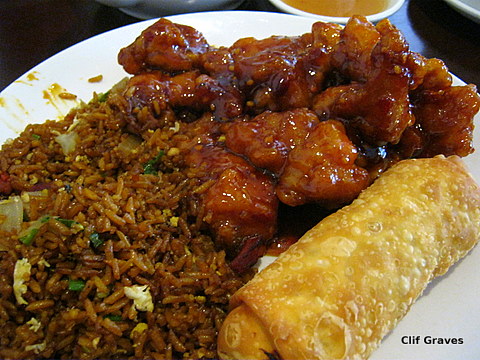
What to eat after the film? Why, Chinese food, of course. Clif and I, along with our friends Joel and Alice, the unofficial chairs of Cinema Explorations, went to Jin Yuan on Temple Street in Waterville. Clif, Joel, and I ordered General Tso’s chicken. (Alice broke rank and ordered and a curried dish.) The three of us thought the chicken was very tasty. A good end to a good  film.