Category Archives: Books

Fall Is Tapping on Our Shoulders; Reading Agatha Christie

On Sunday evening, it was a little too chilly to sit comfortably in the screen house.

“Let’s have a fire,” I suggested.

For Christmas, Dee had bought us a new fire pit, and in early spring we had tested it once on the patio. We wanted to see if the fire pit worked properly—it did—and after that trial run, we set it to one side to be used come fall.

Fall, it seems, has come tapping on our shoulders. Both Clif and Dee agreed that a fire was a good idea, and soon we were having drinks around the fire pit.
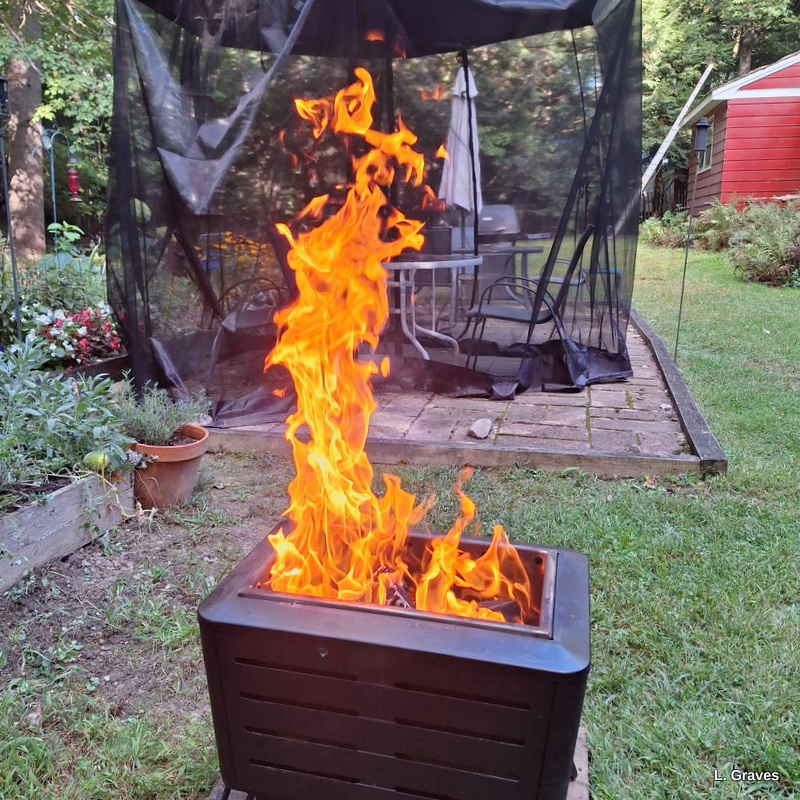
I realize this fire looks out of control, but it really didn’t seem that way when we were sitting around it. I am happy to report that the fire stayed in the pit, and the only thing that burned was the wood that fed the fire.

As we chatted and had our drinks, the neighbor’s cat came for a visit.

Fortunately, he left without catching this little chipper.

Above us, the sky was a brilliant blue.

In Maine, September is surely one of the most beautiful months of the year—warm days, cool nights, and usually not too much rain. I probably should have saved this post as an item for Thankful Thursday, but here it is on Monday, a grateful way to begin  a week that supposedly will be filled with blue skies and sunshine.

********************************************************************

Reading

Agatha Christie: The Mirror Crack’d , A Caribbean Mystery, and Nemesis from Five Complete Miss Marple Novels

Confession Time: Until this past month, I had never read an Agatha Christie novel. Seems incredible, I know. I am nearly sixty-seven, and I hadn’t read the grande dame of mysteries.

My excuse? I am not a huge mystery fan. They are not the books I naturally gravitate toward. (That would be literary fiction and fantasy. Not the usual combination, I know, but there it is.)

So what changed my mind? Shane Malcom-Billings, a librarian extraordinaire who work at our town’s library. He has put together an Agatha Christie book club, and I thought, why not? Somehow, it sounded fun. Shane is a wonderful book club leader, and I’m looking forward to his take on Agatha Christie. Our first meeting is this Friday, and it will be one where we discuss Agatha Christie in general. After that, we’ll be reading specific books. I figured I should read a few novels so that I would have something to add at that first meeting.

I found a compendium of five Miss Marple novels—the three I read are listed above—and off I went, staring with The Mirror Crack’d.

I wasn’t sure what to expect when I started reading The Mirror Crack’d. Would I like it? Would the writing be full of clichés? Would the story come at the expense of the characters? Here are my answers: Yes, no, and somewhat.

The writing style is solid and is not loaded with hackneyed phrases. Miss Marple is a wonderfully sympathetic character, a woman who is dealing with aging and all that this brings yet who is still sharp enough to solve mysteries. If I were younger, I might not be as drawn to Miss Marple as I am, but as I approach my seventies—my, that sounds old!—I am completely sympathetic with her frailties.

There is also a fair amount of humor in the books, especially when Miss Marple puts on a doddering old-woman act to trick characters into revealing more than they want to.

The other characters, I’m afraid, are more one dimensional. They are there to commit crimes, to be suspected of having committed a crime, or to help Miss Marple. Not much nuance.

Never mind. I like Miss Marple so much that I’m willing to overlook the lack of depth in the other characters.

What will I think of Christie’s other protagonists?

I don’t know. Stay tuned.


Thankful Thursday: Mexican Food, Corn, and the Return of Interlibrary Loan

This post is part of a series called Thankful Thursday, where I list some things to feel thankful for. To some extent, focusing on what is wrong appears to come naturally to most people, who often complain, complain, complain when they get together with family and friends. (I’m no exception, that’s for sure.) So focusing on things to feel thankful for seems like good spiritual practice, a way to counterbalance the tendency toward negative thinking.

Mexican Food

After going to see the movie Sing Sing, which I wrote about on Monday’s post,  Clif, Dee, our friend Joel, and I headed to Buen Apetito for Mexican Food. Along with the tasty food, one of the things I really like about Buen Apetito is how willing they are to let customers split a dish. Not only does this save money, but it also allows better portion control. While some things can be taken home for later, what we like to order doesn’t make for good leftovers.

And what did we order? Buen Apetito’s delicious potato flautases, which are shells stuffed with mashed potatoes and fried until crisp. I suppose day-old potato flautases might be worth reheating, but Clif and I prefer them hot from Buen Apetito’s kitchen.

Over dinner we talked about Sing Sing and other movies we might be interested in. We also talked about politics and did our best to solve the world’s problem. As usual, we fell far short of the mark, but nonetheless, we try.

Corn, Corn, Corn

I know, I know. I’ve listed corn in a previous post, but I just can’t help featuring corn again. Yesterday we received eight ears from our own Farmer Kev, and my oh my they were good. Soon, the corn will be done for the season, but until then, we rejoice in those sweet ears slathered with salt and butter.

The Return of Interlibrary Loan

I’ve saved the best for last. Maine has a terrific interlibrary loan system where participating libraries can freely order requested books they don’t have from other libraries. We have a lovely but small library with both a limited budget, limited space, and thus a limited collection. For someone who is an eclectic reader who, say, particularly likes mid-twentieth century British women writers, interlibrary loan is a godsend. I go online, see if the book is available at other libraries—often it is—and order it. The book is then shipped directly to my library.

But a terrible thing happened at the beginning of summer. The interlibrary loan system, run by the Maine State Library, was temporarily suspended. Most of the routes are run by vans that are hired from a private company. Every few years, the Maine State Library has to get bids for this service, and this year they chose a different service that no doubt charged less. The incumbent company decided to appeal the decision and this shut down the interlibrary loan service until the court made its decision.

Readers, I am not one to complain, but I have to admit it was a dark three months without interlibrary loan. No longer did I have the larger world of books open to me, available with the click of a mouse. My only consolation was that I knew this interruption of service was temporary and that eventually the system would be up and running.

That happy day came on Thursday, and giddy with relief, I promptly ordered seven books not available at our library.

“Greedy,” Dee observed when I told her how many books I had ordered.

Guilty as charged. When it comes to books, I am indeed greedy.

Thankful Posts on Other Blogs

Cimple celebrates the return of fall and cool weather.

Debbie, from Musings by an ND Domer’s Mom, also celebrates cooler weather.

Ju-Lyn, of Touring My Backyard, writes, “With each sunrise, I give thanks for another day of possibilities.”

Barbara, of Thistles and Kiwis, features food, glorious food, some eaten at restaurants, some she cooked herself.

Carol Ann, of Fashioned for Joy, shares a week of delights, ranging from tea and scones at a tea house in Virginia to trips to a museum.

Au Revoir, Snow-Gauge Clif

The title of this post tells it all. Today, March 11, our yard is officially free of snow, and there is nothing for Snow-Gauge Clif to measure. In the past, we would hope to be snow free by our youngest daughter’s birthday on April 22. Some years we were. Other years, we weren’t.  This year, we are way ahead of April 22.

First, the front yard, with Snow-Gauge Clif,

and a broader view to chronicle our snow-free yard.

To the backyard.

Therefore, unless we get some snow in March—and we could—it is time to say au revoir to Snow-Gauge Clif who was only with us for two weeks this year. What the heck! Can this really be happening in Maine? A snow-free yard in mid-March? It seems that it is.

Onward to yard work, usually an April chore.

*******************************************************************

Reading

Crewe Train by Rose Macaulay
Published in 1926

The story of a girl—who doesn’t like to read, doesn’t like art, doesn’t like theater, and is what we Franco-Americans would call lazy—is not a natural fit for me. And so it was with Denham Dobie, the protagonist in Crewe Train. My initial take on Denham was that she was a boring lump of a young woman, and I almost stopped reading the book after the first twenty pages.

But then something unexpected happened—Rose Macaulay’s writing and her sympathy for this unsociable, unambitious character won me over. By the end, I was as worried about Denham as I would be if she were a member of my own family. Well, all right. Maybe I’m overstating the case. Still, I brooded about Denham.

When the book opens, Denham is living in relative freedom with her father, also unsociable, in Andorra, a small country between Spain and France. When Denham’s father dies, Denham’s aunt—her mother’s sister—takes her back to England in the hopes of training her to be a proper young lady. But this is no Pygmalion story, and Denham is no Audrey Hepburn.

Initially, Denham does try to please her fashion-conscious aunt. She  falls in love with and marries a kind but conventional man named Arnold, who likes to mess about in boats and play games with Denham. But Arnold also likes London and books—he works as a publisher—and plays and dinner parties. He likes being around people, and Denham does not. For her small talk is a misery, and she would much rather be  rambling around outside.

Denham and Arnold are an odd, uneasy couple, and I wound up feeling sorry for both of them as they tried to accommodate each other’s opposing tastes.

I won’t reveal the ending except to note that the casual cruelty of Denham’s aunt sets in motion an unhappy chain of events. Crewe Train, while not a tragedy, is a sad book despite its flashes of humor.

One more thing to note: Crewe Train was published in 1926, and in my experience, writers of that time frequently included racist words and descriptions in their books. So it is with Crewe Train. Not the worst I’ve read—that honor goes to the otherwise delightful Miss Pettigrew Lives for a Day—but not good all the same.

Nevertheless, Crewe Train is a book worth reading. Denham, for all her flaws, feels like a woman ahead her time, flailing as she tries to live on her own terms, unencumbered by possessions, free to wander the countryside, unconcerned with domestic duties.

All Denham wants is a simple life, not so easy for women of her class and generation in the 1920s.


A Year of Books

Last weekend we celebrated my son-in-law Mike’s birthday. Because they live in Massachusetts, Mike, our daughter Shannon, and the dogs came to Maine on Saturday to spend the night.

The day was astonishingly warm for early February in Maine.  When it comes to the weather nowadays, my thoughts always turn to my parents, who never would have imagined it could be so warm in midwinter. Such big changes.

Mike chose to go to Absolem Cider Company to celebrate his birthday. It is one of his favorite places in central Maine. It is one of mine, too.

Here we are, on the way to the barn at sunset. Note how shiny with mud the path is. It felt more like March than February.

However, inside all was cozy and dry. Soon we had our drinks, and it was cheers to the birthday boy.

Here is a picture of Mike and our daughter Shannon.

After our drinks, we went back home for presents, and this year, Clif and I had come up with something special for Mike—twelve books, one to be opened at the beginning of each month throughout the year.

I got the idea from my friend Doree, who had done this for her sister for Christmas and had written about it on Facebook. Immediately, I was smitten by the idea, and my thoughts turned to Mike and his birthday in February. Mike is an avid reader, and I knew he would be thrilled to get a book a month. Also, and this is sheer coincidence, of everyone in the family, Mike’s taste in books is most similar to mine, which made picking out books for him very easy.

Last Thursday, Clif and I wrapped and labeled the books. As we did so, I thought about how giving these gifts was a joy from beginning to end—choosing the books, deciding which books should go for which month, wrapping the books, and then seeing them laid out on our dining room table, small packages of delight waiting to be opened.

A closer look at February’s book.

And what was February’s book? Here is  New York, by the late great writer E.B. White, whom I mentioned in last week’s post.

It was so much fun to watch Mike inspect his books.

“This is amazing,” he said more than once.

Happy birthday, Mike, and happy reading!


Of Tea, Books, Eagles, and a Dear Friend

Last Thursday I went to one of my favorite places—the waterfront park in Hallowell—to meet Elizabeth, the granddaughter of my dear friend Barbara, who died  eighteen years ago. Elizabeth is from North Carolina, but she worked in Maine this summer, and we were able to meet several times.

The day by the river was overcast but not too chilly. I brought a thermos of tea and some cookies, and we settled in for a long chat. Elizabeth was only five when her grandmother died, and I told her stories about Barbara—about how she was one of the best home cooks I have ever known; about her passion for nature; about her love of story and writing.

Elizabeth not only resembles her grandmother, but she also shares Barbara’s love of books and nature. Accordingly, the talk soon turned to books, my favorite kind of conversation. (And Barbara’s, too.) What Elizabeth was reading—Rachel Carson—and what I was planning to read—The Bee Sting by Paul Murray. We discussed the current trend of not using quotation marks to set off dialogue. I admitted that I’m not a fan of leaving them out. Elizabeth thought that it all depended on the writing and how sometimes it worked to have dialogue without quotation marks.

As we sipped tea and munched cookies, the sun came out, illuminating a white house across the river.

Wouldn’t it be cool, I asked, if the house appeared only when the sun was shining a certain way? And that it would be invisible at all other times?

Elizabeth agreed this would be very cool.

While we were talking, we heard the shrill cry of bald eagles.  One flew right over us, and we were duly impressed. Unfortunately, I wasn’t fast enough to get a picture of that eagle.

However, I did get this picture, a little blurry, but clear enough to give an impression of this big beautiful bird whose species was nearly wiped out in this country. When I was young, I never saw a bald eagle. Now they are a common sight, proof that sometimes things do change for the better.

As we admired the eagles, I thought about Barbara and how thrilled she would have been to be part of this day. She would have jotted down some of Elizabeth’s book recommendations, just like I did. (The Golem and the Jinni and The City We Became.) She would have exclaimed with pleasure when the eagle flew over us. In her excitement, Barbara might have jumped out of her chair.
I remember one day when Barbara and I were going somewhere together, and I was driving, Barbara cried stop, stop! I stopped, and Barbara rushed from the car to examine a snapping turtle who was laying eggs along the side of the road.

So in a sense Barbara was with us by the river as Elizabeth and I talked in a way that was reminiscent of the way Barbara and I had talked many, many times.

A bittersweet and lovely day.


Of August Days and Jeri Theriault’s Poetry Reading

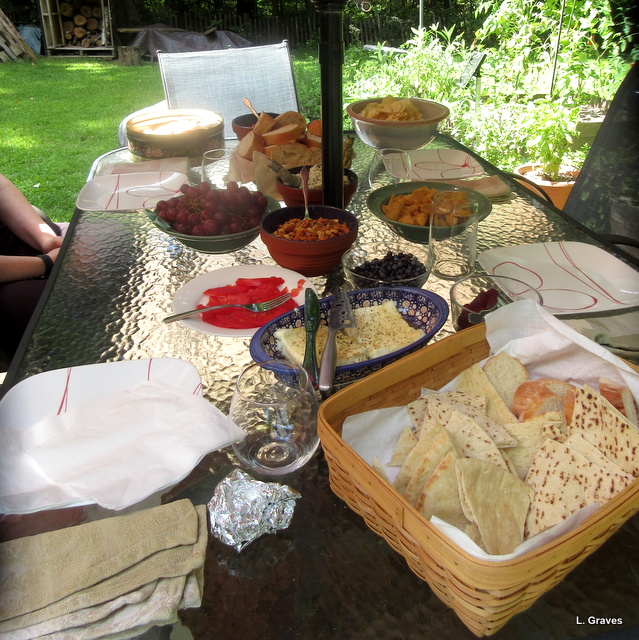
Sunday was one of those August days that draw tourists to Maine in the summer. Warm weather—around 80°—combined with low humidity and sunshine made for a perfect afternoon on the patio. As it turned out, we had invited our friend Jill over for drinks and appetizers, and we were thrilled that the weather gods decided to smile on us. Yes, we could have had drinks and appetizers inside, but how nice to sit on the patio and watch the birds flutter in out and of the woods as they visited the bird feeders.

A beautiful August summer afternoon in Maine. When the rain and cold and snow come, I will try to keep this day in my heart, to be warmed by the memory of good food and good conversation.

*****************************************************

From the Department of Good News

In this time of climate change when some people suffer from too much heat and others from too much rain, reading good news provides welcome relief. In her post “This week’s Small Pleasures #348,” my blogging friend Barbara of Thistles and Kiwis wrote about how bird counts are up in Wellington, New Zealand. Way, way up. Some by as much as 260%. If my knees weren’t so creaky, I would jump for joy.

*****************************************************

Listening: Poetry Reading at Greene Block + Studio in Waterville, Maine

Self-Portrait as Homestead by Jeri Theriault

Last Friday, I went to Waterville to hear Jeri Theriault read poetry from her terrific new book Self-Portrait as Homestead. Like me, Jeri is Franco-Amercan, and she also grew up in Waterville, a small mill city by the Kennebec River.

It gave me great pleasure to hear Jeri use the word “mémère” (grandmother) in her poetry. And what a thrill that the title of one of her poems comes from a street in Waterville’s South End, where I lived as a baby and visited every week as a child. My home, my geography, my ethnic group. While Jeri Theriault’s poetry ranges far from Waterville—to Iwo Jima and the Middle East—for me, Waterville was the center that rippled outward to other places. Perhaps someone not born and raised in Waterville would have had a different take, but that is what stayed with me no matter how far Jeri roamed in her poetry.

To add to the mood of the reading, Jeri’s husband Philip Carlsen and his son Mel played music between the poetry—Philip on the cello and Mel on the piano. So lovely, so lovely.

Jeri asked that the applause be held until the end, and she spoke about each poem, telling the audience how her poetry wasn’t memoir, which allowed her to use some artistic license; how she thought of the “self as house”; how the book was “supposed to be all feminist poems,” but somehow her father crept in. Jeri filled in her father’s silence with her own words as well as ones taken from a local newspaper article about his time in Iwo Jima.

After the reading, editor and journalist Bob Keyes had a conversation with Jeri, which illuminated her poetry and her process.

From her moving poetry to the music to the conversation, this was one of the best poetry readings I have ever been to. I bought Self-Portrait as Homestead, and instead of shelving it with my poetry collection, I will be tucking this one among my Franco-American books.

Jeri Theriault, on the left, with Claire Hersom, also a fine poet.


Spring is Here!

Spring has finally arrived in Maine.

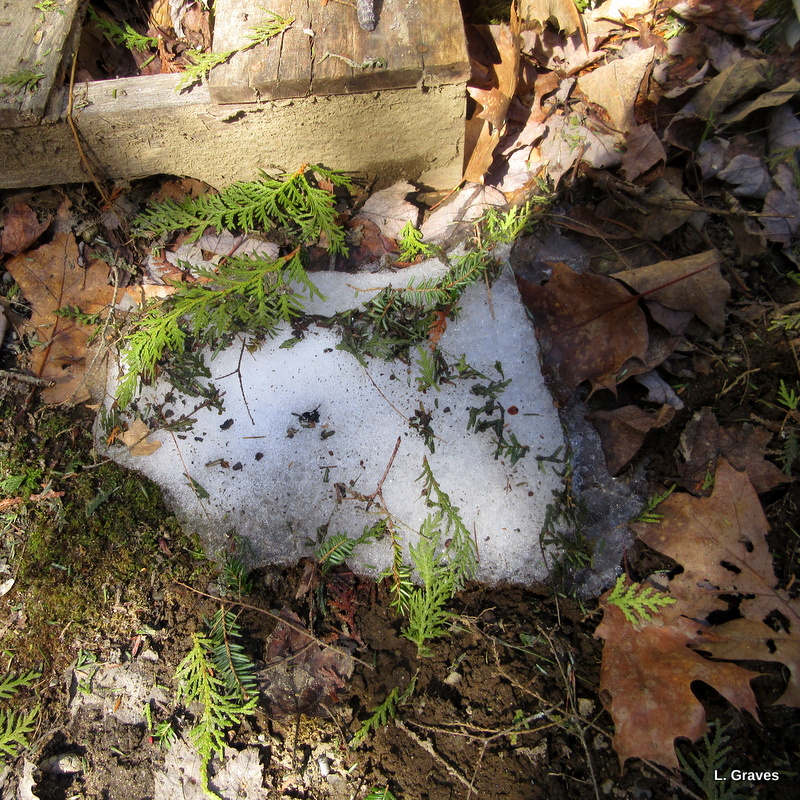
Last Wednesday, we had small patches of snow in the backyard.

But the next day, on Thursday, April 12, the snow was completely gone. In the little pond down the road, the frogs were clicking and clacking, but so far, no peepers.

On Friday, the temperature jacked up to 80°F, and heat records were broken statewide. Too hot for April in Maine, that’s for sure. Fortunately, by Saturday the temperature had dropped to something approaching normal for this time of year.

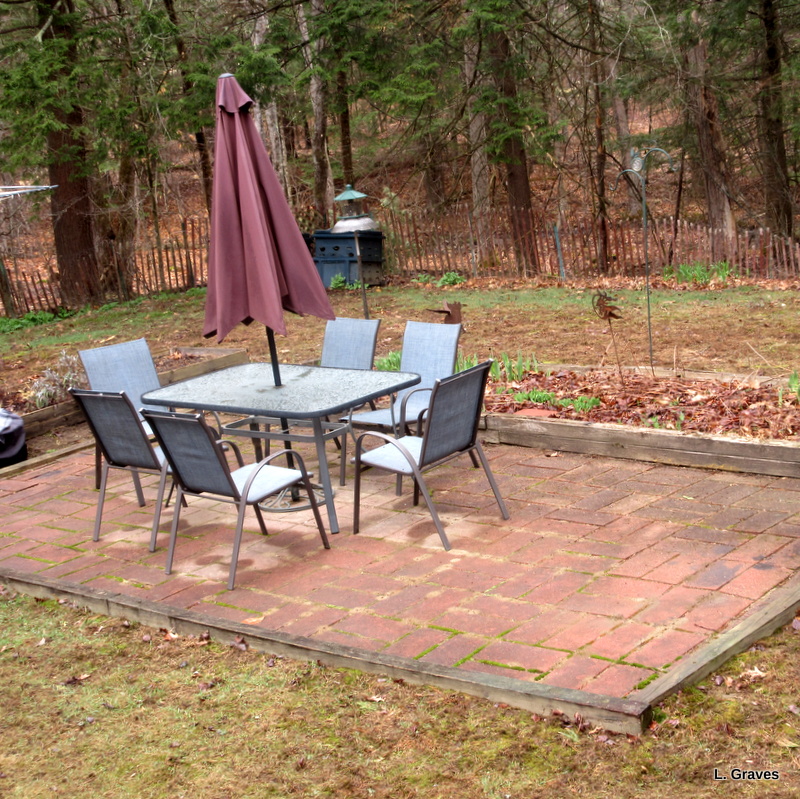
The table is now on the patio, and we had lunch out there several days in a row. If you look closely, you can see bright green coming up in the garden.

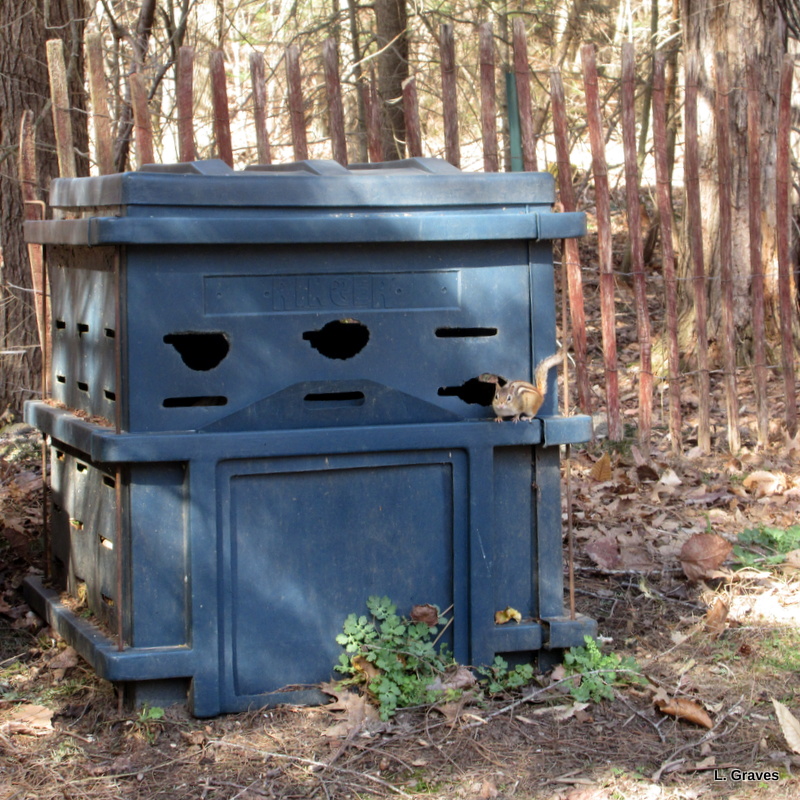
The chipmunks are out of hibernation, and they have decided that our compost bin is their neighborhood grocery store. Note how they have chewed the side vents to make bigger holes for easy in, easy out.

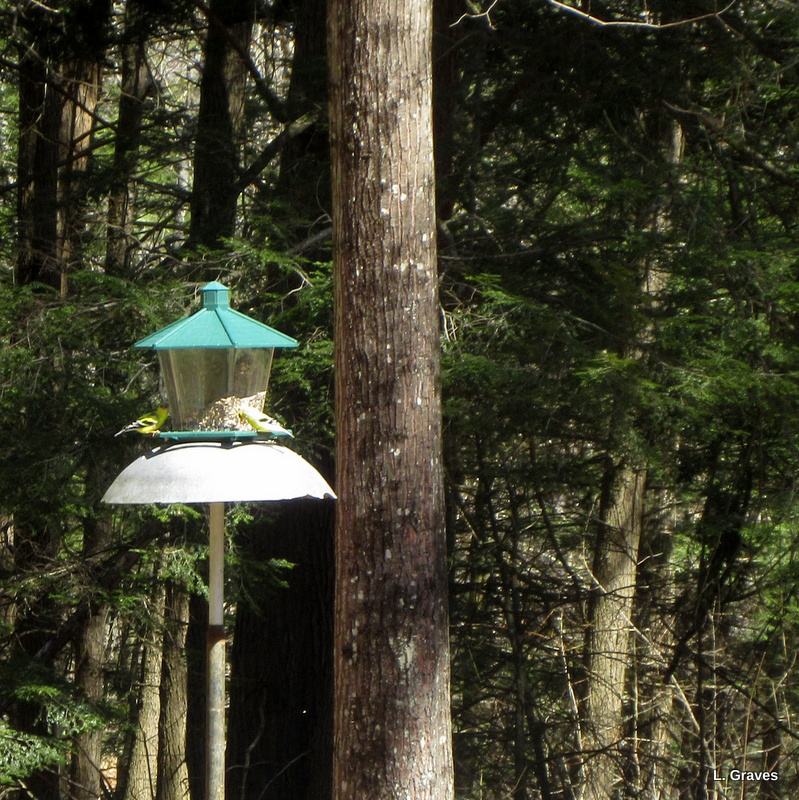
Overnight, it seems, the goldfinches went from drab feathers to bright yellow. (Dawn, from the blog Change Is Hard, has noted this, too.) Because of the sun, the goldfinch’s colors are washed out in the picture below, but the bird on the left gives some idea as to the yellowness of the feathers. I’ll try to get a better picture in the upcoming days.

Now the busy season has begun: raking, removal of leaves from the various beds, adding compost, moving plants. To borrow from a comment on a blog I read recently—alas, I can’t remember which one—it now takes me a week to accomplish what I once could accomplish in day. Ah, well. What I lack in speed, I make up with persistence. Despite my dratted creaky knees, I am outside most nice days.

Minerva, the guardian of the front yard, is waiting patiently for me to come around. By now, she knows that I always start in the backyard and work my way to the front.

“Soon, soon,” I promise her.

Wisely, Minerva makes no remark.

*************************************************************

Books: In Which I Toot My Own Horn

Normally, in this section, I feature books that are not my own. But this week I can’t resist sharing a blog post written by my blogging friend Alys of Gardening Nirvana. The title of the piece is A Meeting of Libraries, Real and Imagined, and it features copies of my book Of Time and Magic as they make their way to various Little Free Libraries near where Alys lives all the way across the country. (Two of the Little Free Libraries are in her very own front yard.)

Holy cats, I was pleased! And those Little Free Libraries are utterly adorable. If you have a chance, click on the link in the above paragraph and take a look not only at my book but also at the sweet little libraries whose mission it is to put books in the hands of book lovers.

Many, many thanks Alys.

Septic System Problems, Snow-Gauge Clif & and a Review of Small Things Like These by Claire Keegan

Don’t it always seem to go that you don’t know what you’ve got ’til it’s gone.
—Joni Mitchell

The past two weeks have been hard ones. First we lost our beloved cat, dear little Ms. Watson. Then, our septic system decided to stop working—toilets wouldn’t flush, and showers wouldn’t drain. As I’m sure readers can imagine, this was no fun at all.

Being Mainers, we tried to fix the problem ourselves. Clif used his trusty plumbing snake to see if he could find a clog. He couldn’t, and we set up a camping toilet in the big bathroom. We used a dishpan for washing up, dumping the water into a bucket and then emptying the soapy water outside. (In the summer, when we haven’t had rain for a while, I sometimes use the gray water on my perennials.) So we had a system, albeit a primitive one.

Eventually, Clif gave up and decided to call the plumbers. I am happy to report that they came came swiftly as did the folks who pumped our septic tank. Finally, after the second time the plumbers came, they found the problem, and with their much larger plumbing snake, they were able to dislodge a big clog that Clif had mistakenly thought was the edge of our septic system.

I thanked the plumbers profusely as they packed up their truck to go off to help someone else with a problem. Smiling, they indicated it was all in a day’s work. For them, I suppose it was. For us, it was something akin to salvation.

Now, the toilets flush, the shower drains, and life is back to  normal. The quotation at the beginning of this piece sums up how Clif and I felt about the situation.

Joni got it exactly right.

*************************************************************

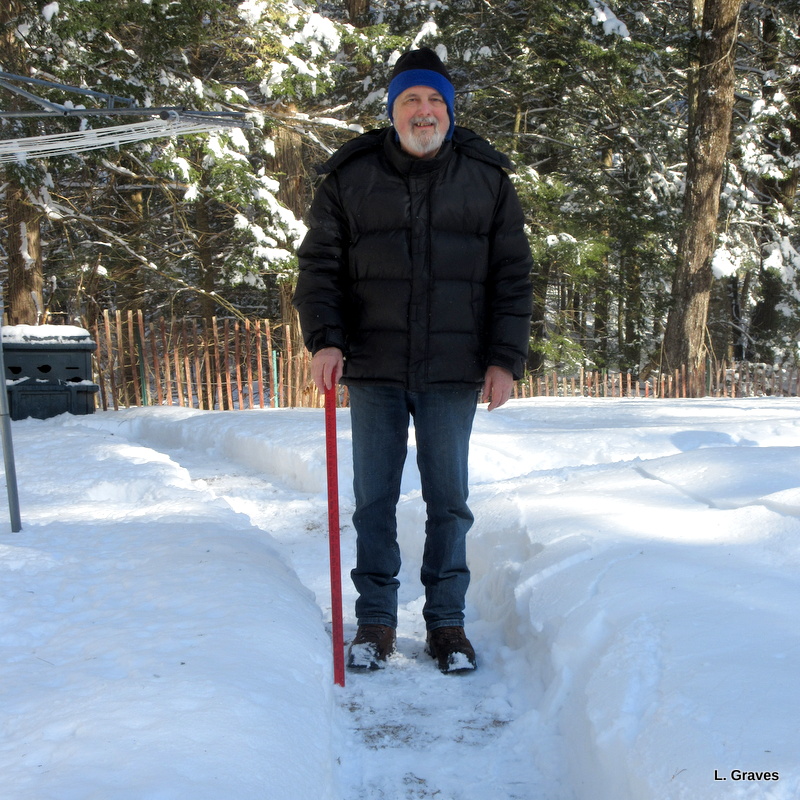
Plumbing problems or not, Clif was out with his trusty snow gauge to measure the snow.

Here he is in the front yard by the driveway and then on the walkway leading to the front door.

Over the past week, the weather has been warm and sunny, and the snow has actually gone down a bit. Here are last week’s pictures for comparison.

And here is Clif in the backyard.

Again, last week.

The path to the compost bin was actually muddy this week, and I had to step carefully so as not to lose my Sloggers. In Maine, this counts as progress, but up the East Coast, a nor’easter is blowing, and tomorrow’s forecast is for another foot of snow.

Dang! Snow-gauge Clif and I are ready for the snow to melt, not to accumulate.

*****************************************************

READING

Small Things Like These by Claire Keegan

Note: There are moderate spoilers in this review.

With its spare, beautiful writing, this gem of a short novel—set in the 1980s—is nearly perfect. In the Irish town of New Ross, Christmas is coming. Bill Furlong, a coal and timber merchant, works long hours to ensure his customers have enough fuel to stay warm over the holidays. At home, his wife Eileen and their five daughters bustle to get ready for Christmas. In her own way, Eileen is as busy as Bill is. I’m guessing many women will identify with Eileen and the hard work of getting ready for Christmas. I know I did.

While making deliveries, Bill reflects on his life as an illegitimate child raised by a single mother who worked as a domestic servant for “Mrs. Wilson the Protestant widow who lived in the big house a few miles outside town.” Mrs. Wilson, frugal but kindhearted, provided Bill and his mother with a warm, stable home and even helped Bill as an adult. Fortunately, in New Ross, there is little antagonism between Catholics and Protestants.

There is, however, a convent in New Ross where on one side is a school and the other side a home for unwed mothers. The convent, in many ways, is important to the economy of the town and especially to Bill, whose daughters go to school there.

In a tense, heartbreaking way, Bill’s reflections of his childhood converge with bringing coal to the convent and what he discovers. Then Bill must must make a decision that will reverberate with his family for years to come.

I’ll certainly  be reading more of Claire Keegan and have ordered Foster through interlibrary loan.


Snow-Gauge Clif & Book Review: Our Spoons Came from Woolworths

During the past week, we had three snowstorms, and the last one, on Saturday, was a corkah as we Mainers would say. Clif measured thirteen inches with his snow gauge, and the snow was wet, heavy, and hard to move. Our electric snow-thrower, Snow-Joe, just barely managed, and I did a fair amount of shoveling. Nature’s gym, as I like to call it.

Here is a picture or our car before we cleaned the driveway. Only a sliver of red shows through the snow.

More red in the snow as Mr. Cardinal comes to the feeder.

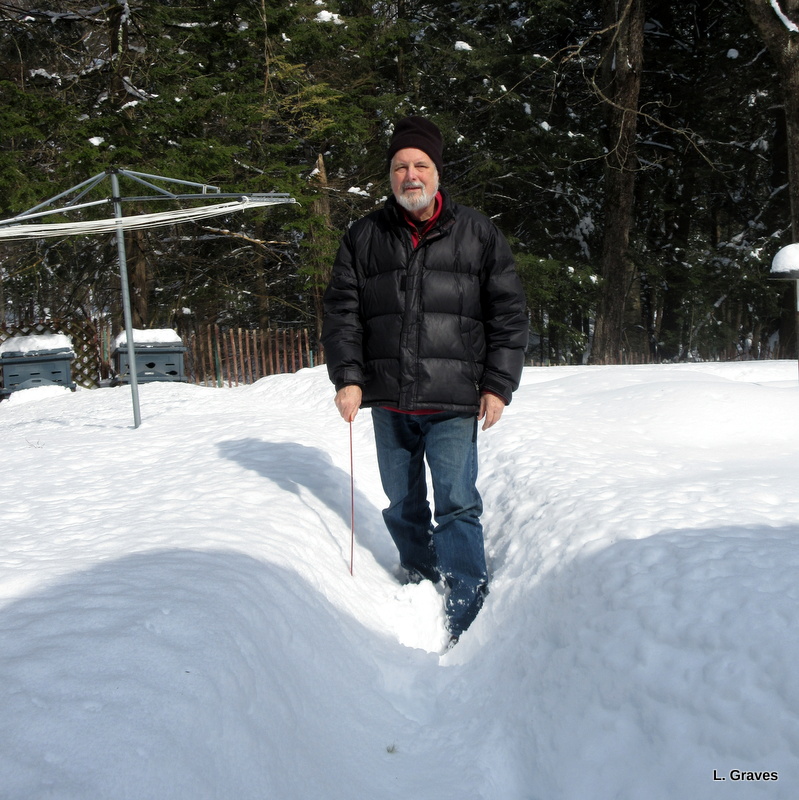
Now, on to Snow-Gauge Clif, who stood in a different place so that readers could see the tunnel that is our path to the front door.

Here he is in his usual place in the driveway.

And in the backyard.

It’s funny to think how in January there was so little snow that we were worried Snow-Gauge Clif would be out of a job this year. But Mother Nature said, “Not so fast,” and we now have snow aplenty. Good for the water table and the plants, but I think we have enough snow. I hope Mother Nature agrees.

****************************************************

I want to thank everyone for the notes of sympathy I received in the comment section of my post about little Ms. Watson. I really do appreciate it as did the rest of the family. A lovely example of how kind words of support really do matter.

****************************************************

READING

Our Spoons Came from Woolworths by Barbara Comyns

Note: There are moderate spoilers in this review.

Recently I have begun following a wonderful blog called JacquiWine’s Journal, which is mostly about books and a little about wine. For a book nerd like me, this blog is sheer delight. Jacqui especially likes novels from the mid-twentieth century, and so do I, particularly if the writers were women. These novel chart the ways women’s lives have changed over the twentieth century, and much of it is for the better. In one book I read, Elizabeth Jane Howard’s The Beautiful Visit—set in the early 1900s—a young girl’s parents forbid her from becoming a librarian because it doesn’t seem genteel enough to them.

Jacqui has introduced me to many good writers, and one of them is Barbara Comyns. Our Spoons came from Woolworths is a harrowing novel of living in poverty in the 1930s in England. The novel has autobiographical elements, and it follows the marriage of Charles and Sophia. Charles is a painter, and, among other things, Sophia works as a painting model.

A more hapless couple you will never meet. Charles thinks only of his painting and cares about little else. Sophia is innocent in most every way, including on how babies are conceived. As a result, Charles and Sophia live in terrible poverty, just barely scraping by. Not surprisingly, Sophia becomes pregnant, and there’s a harrowing scene of labor and delivery in a hospital where poor women go to have their babies. The woman are marched, literally, through the system and are left in their bloody shifts for far too long. In short, there is little tenderness, and the care is  minimal.

Sophia’s fortunes improve because of an inheritance, but once that is gone, life becomes even worse.

Our Spoons Came from Woolworths is a gripping read. Sophia’s voice is plain, steady, compelling. Through it all my sympathies were with her, despite her poor judgement. For her selfish husband, Charles? Zero.

The end is a bit like a fairy tale, but I have to admit it comes as a relief.


The Polar Punch Pastes Our Public Library

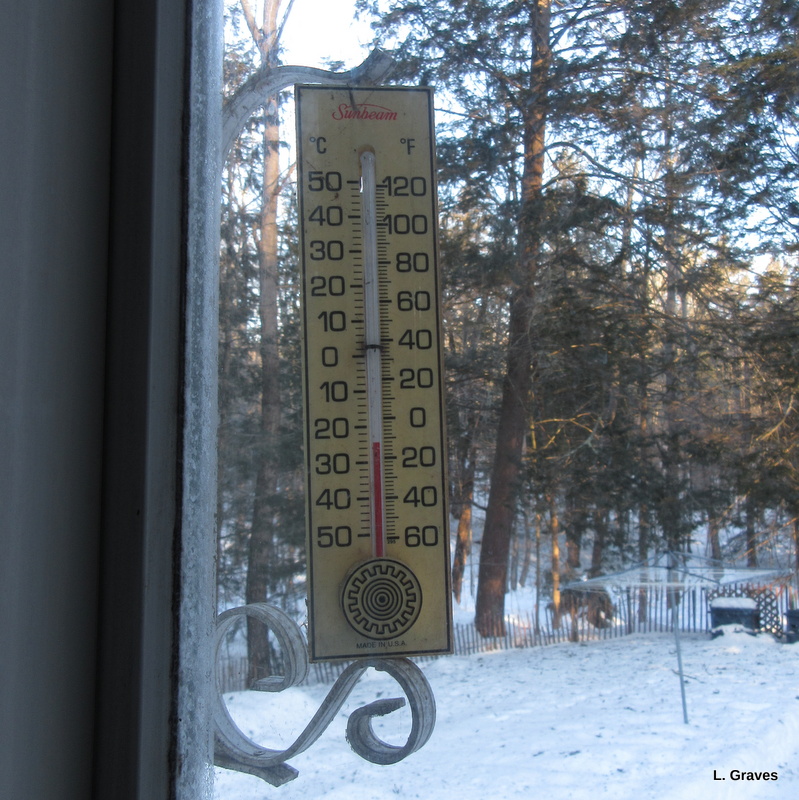
What a difference a week can make. On February 10, Allison Finch, of AccuWeather wrote, “In a remarkable weather turnabout, [in the Northeast] temperatures throttled up from the lowest levels of the year to late-March levels within a week.”

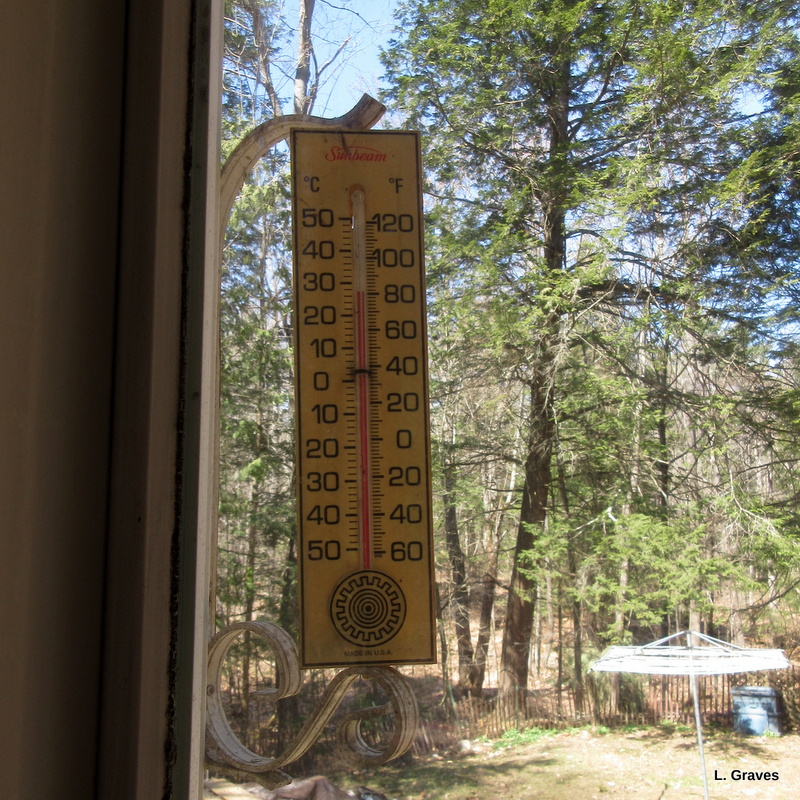
She was absolutely right. Here was the temperature at our house on Friday, February 3.

And here it was one week later on Friday, February 10.

A case of weather whiplash, that’s for sure.

Unfortunately for our town’s library, the polar punch did its dirty work before it left the state on Sunday, February 5.

In the Kennebec Journal,  Richard Fortin, the library’s director, explained what the librarians found on February 4: “We came in around 8:30 on Saturday morning and the building smelled like heating oil. We went into the furnace room and basically found that the oil filters and oil lines were encased in ice. There’s a fresh air vent in that room, and that extreme cold just came in and froze those lines.”

Frozen lines, of course, spell trouble.

“[Fortin] said this caused the oil’s consistency to resemble sludge or mud, so it was not able to get through the lines. This backed up the system and caused a major oil leak.

“The entire boiler was basically encapsulated with oil,” said Fortin. “It leaked through the cast iron. And the nozzle was spraying oil into the room.”

Not good. Not good at all. The library was closed for a whole week as the problem was dealt with. On Wednesday, The Maine Department of Environmental Protection “determined…the harmful materials in the air had dissipated enough that the library [was] safe.”

But the library still reeked of oil—the children’s section smelled especially bad—and there was major rearranging to do so that the library could open today, Monday, February 13.

Most of the books I read come from the library, and this polar punch incident at the library made me realize, yet again, how much I love my library and how much it gives to me. It’s not an exaggeration to say that the library is a cultural mainstay for me. Because of the library and its interlibrary loan system, the world of story and ideas is completely open to me. I don’t have to worry about cost or bookshelf space.

Whenever I go to events and sign my own book, Library Lost, I always add “Love Your Library.”

I certainly do love mine. I am so glad it’s reopened.

***************************************************************

Reading

The Thursday Murder Club by Richard Osman

This murder mystery novel is as airy as a chocolate soufflé and just as delicious. At an upscale senior retirement village in England, four friends—Elizabeth, Joyce, Ibrahim, and Ron—meet weekly on Thursday to talk about unsolved crimes. Naturally murder strikes, not once but twice, and the sleuthing seniors sally forth to discover who the killer is.

There are several storylines that converge in a satisfying way. Two detectives, Chris and Donna, become involved in investigating the murders. Although Chris and Donna aren’t fools, the seniors are always several steps ahead of them.

Osman has a deft touch that snaps the story along but allows for character development, a must for me as a reader. And although The Thursday Murder Club could be categorized as a light read, the novel touches on many aspects of aging—physical and mental diminishment, loneliness, regret, and grief—that are not so light.

However, friendship and community provide solace and bring purpose as well as happiness to Elizabeth, Joyce, Ibrahim, and Ron.

There are two more books in the series—both on the bookcase in my living room—with another slated to be published in September 2023.

Thanks to Barbara at Thistles and Kiwis for bringing Richard Osman to my attention. One of the great joys of blogging is to be introduced to writers I’ve never heard of. The same is true for television shows, movies, and podcasts. I really enjoy getting suggestions.