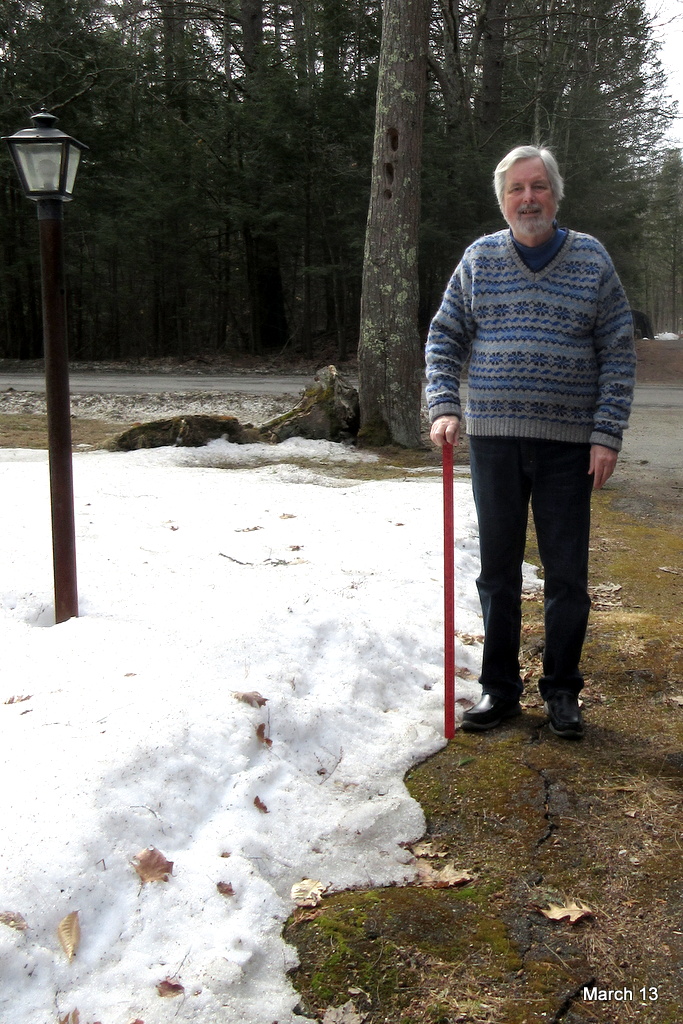
It’s the beginning of March, and at our home in the woods this can only mean one thing—the return of Snow-Gauge Clif to keep track of the melting snow in our yard. In Maine, March marks the beginning of the end of winter, and there is always speculation about when the yard will be snow free. Enter Snow-Gauge Clif with his trusty yardstick to measure the retreating snow.
Both Clif and I have had the notion that this winter has had much less snow than last winter did. As it turned out, our notions were correct. Here, in the front yard, is Snow-Gauge Clif at the beginning of March 2019:
Here he is in 2020, about two days ago.
Backyard, 2019:
Backyard, 2020:
Fortunately, we seem to have had enough snow to protect the perennials. I remember one year when we had a scanty snow cover, and I lost almost all the plants in the backyard garden. Because even when it doesn’t snow, it’s usually very cold in Maine in Winter. Believe it or not, snow provides insulation for the plants, and uncovered plants are not a good thing.
Now, blogging friends, brace yourself for excitement for the next month or so. If the snow continues melting at this pace, then it’s highly likely that the snow will be gone by the end of March. Last year the snow was gone in mid-April. What will it be this year? Only time will tell.
So stay tuned! Each Friday will bring a picture of Snow-Gauge Clif with his trusty yardstick.
Twenty-two years ago, Maine was hit with the mother of all ice storms that lasted for two days and left three inches of ice on the branches. Guess what happens to trees that have ice that thick? Lord, how their branches crack and break! On the night of the second day of the storm, I lay in bed listening to what sounded like a nonstop volley of gunshots ringing through the woods around our house as branches came down. Reverting to my Catholic girlhood, I said my Hail Marys over and over, praying that our house would not be damaged by falling branches. Perhaps Mary heard my prayers because our house was spared.
But the storm left behind a terrible swath of destruction. More than half the state lost its power, and because the weather was so cold, restoring power was difficult. Lines would no sooner be repaired when more branches would fall and break the lines again. We were without power for eleven days, and as I have noted many times, because we have a well, no power means no water. In those days, we had five people in the house, and five people go through a heck of a lot of water.
Now, from reading recent posts where I write about being prepared for, say, other ice storms or a certain nasty virus, you might think I was completely ready for the ice storm of ’98. But you would be wrong. We had no extra water stored in buckets down cellar, no supply of canned soups, no extra propane for our camp stove, not much oil for our lamps. We did have plenty of wood for our furnace, but that’s only because that’s how we heated our house back then.
So we didn’t freeze, but we struggled with all the things we didn’t have, especially water. Fortunately, the town has a public water spigot where residents can get water in a crisis such as this, but because of the treacherous roads, we couldn’t get out for a while. In addition, we weren’t caught up with our laundry as well as many other small things we take for granted when we have power.
We made do. What choice did we have? But for a while, the toilets were hideous, and we parceled out every drop of liquid we drank. As we struggled through the aftermath of the storm, I vowed we would never be caught flat-footed again. Going forward, we would have a stockpile of food, water, and supplies to help us get through emergencies big and small.
I have kept my vow. We now have a stockpile of supplies that have served us well. There have been other storms and other power outages. In 2017 we had a violent windstorm that again knocked out power to half the state, and we were without electricity for a week. (Many rural Mainers have a generator. We’ve thought about it but have not yet bought one and so far manage pretty well.)
The Coronavirus is a different type of crisis, but I am using similar methods to prepare. I know some people are probably shaking their heads when they read about how we have four or five months worth of toilet paper, facial tissues, peanut butter, and other necessities. When I look at our stockpile of treats, even I feel a little foolish. But I also feel secure knowing I have prepared the best I can for this virus.
I’ll conclude by sharing what Rhonda wroteon her excellent blog Down to Earth: “It does make sense to have extra food and medications at home to cover you if you need them. Worst case scenario, the virus will run through the community… and you’ll have enough food at home to feed everyone without having to go out. Best case scenario, the virus is a fizzer and you’ll have a cupboard full of food and you won’t have to shop for groceries for a couple of months. Win/win.”
Exactly.
As Clif’s photo illustrates, the ice storm of ’98 left us with beauty as well as destruction.
“It appears we are in the chaos that churns in between more stable eras.” –Heather Cox Richardson
As an American, I know I have a cheerful reputation to maintain, especially for my blogging friends across the pond. And mostly I am pretty cheerful, no small thing for someone who worries. A lot. But there you are—we all have contradictions, and for the most part, I am a worried optimist.
However, lately events have come together to leave me completely frazzled, worn out. First and foremost, there is politics. Between the Democratic primaries and Trump’s responses, everything is on full screech. What got us to this point has been building over the years and isn’t likely to go away soon, but how I wish this country would regain its footing. Everything feels off-kilter to me, off balance. And oh so ugly.
Therefore, when something like, say, the Coronavirus comes along, it makes everything feel even more unbalanced. I know. The virus isn’t supposed to be that bad, no worse than a usual cold or a mild case of the flu, at least for most people. (Some people have indeed died from it.)
But do I have any faith in the leadership at the top to steer us safely through what will more than likely be a pandemic, however mild it might be? No, I don’t. So I do what I can on a small scale. I have a nice stockpile of supplies, and because I am someone who is, ahem, more than a little food obsessed, this makes me feel secure. Dry milk, cereal, canned pineapple? Check. Green lentils, plenty of chocolate, and eggs? Ditto. If things go to heck in a hand-basket—and I sure hope they don’t—we are well stocked. If things don’t go to heck in a hand-basket, then I won’t have to go grocery shopping for quite a while. No harm in that.
Along with having plenty of food, I also live in a beautiful place. For me, the Maine landscape always provide great solace—the blue of the sky, the trees in every season, even when the branches are bare, the hushed feeling of the winter-white woods, the lush green ferns. Every season brings something different. All I have to do is look out my windows to see it.
So I’ll end with a picture of a tree by the town’s public beach, about a mile from our house. Right now, the tree is stark against the sky, but soon spring will come, and with it buds. Then green leaves to provide shade in the summer followed by a glorious burst of fall colors. The leaves drop, and we are back to dark branches against blue sky. A lovely cycle to console me.
I am happy to report that I’m coming to the end of the umpteenth revision of my YA fantasy novel Out of Time, the third in my Great Library Series. Phew, what a tangle of words a novel becomes when you give it close reading after close reading. My plan is to get Out of Time to the editor by the beginning of March, which is a week away.
This means it’s chop-chop time. Therefore, blog posts will be relatively short and filled with pictures. Lucky for me, Maine is a photogenic place to live.
Readers might recall that at the end of last week, the temperature was below zero.
Here was yesterday’s temperature, and the thermometer is in the shade. Quite the contrast!
A perfect time for a walk. In the last post, I looked down. On yesterday’s walk, I looked up. I think it was the glorious blue of the sky that drew my gaze to all the little things that were either growing on branches or that were still attached.
Last night was a cold one. When I got up this morning, the house was a chilly 55°F, and outside it was even chillier—dead calm and two below zero.
It was cold enough for a frosty garden on the storm window in my bedroom.
But by the time I went outside to take more pictures—around 10:00 a.m.—the temperature had risen to 18°F. Not balmy, to be sure, but warm enough to take pictures without wearing gloves.
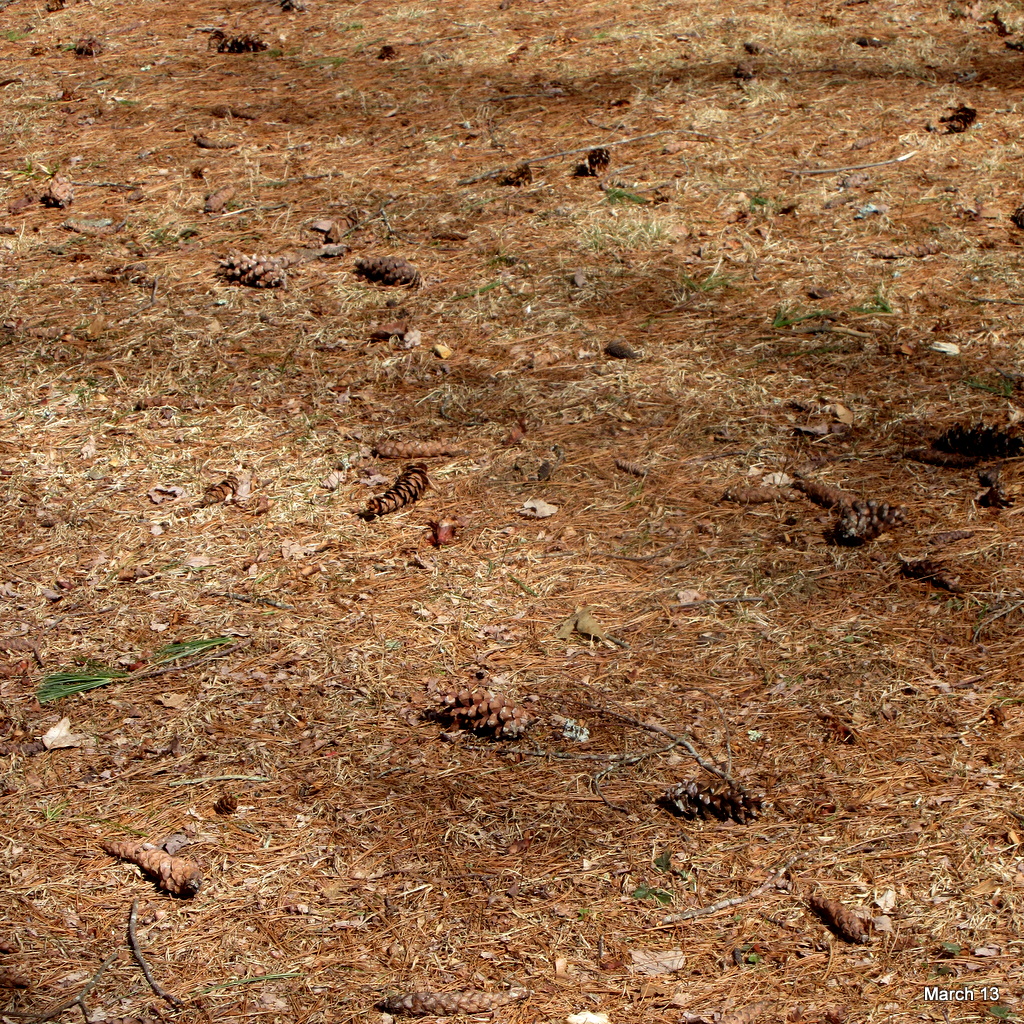
As many readers know, we live in the woods, and in the winter little cones, twigs, leaves, and branches are blown into the snow. Easy to pass by without seeing their modest beauty.
While I love scenic photography as much as the next person, I have always been interested in nature’s small vignettes—the overlooked, the unnoticed, the underappreciated.
At first glance, you might see a jumble of weeds, a thicket of twigs, a heap of dying leaves. You might be inclined to stop looking at this point.
Janelle Lynch invites you to look closer, and slower. She’d want you to see each image as a world in itself — not an accidental grouping of plant matter, but a well-ordered composition created by nature and fixed in time and space by her 8-by-10-inch large-format camera.
Her implicit message is that one needs only to be still, take your time and pay close attention to find the beauty that surrounds you. But, like meditation, this seemingly simple act is often more difficult than it appears.
How I was drawn by Lynch’s exquisite photos, and how I would love to have a bigger camera, which would allow me to take better pictures.
But I have the camera I have, and despite its small size, my wee camera does a pretty good job of capturing nature’s tiny delights. Therefore, out I will go in weather cold, mild, and hot, looking for the overlooked and making do with what I have. After all, that is the Maine way.
I will, of course, also take pictures that are broader in scope, to give readers a sense of what central Maine is like. But Lynch has inspired me to continue following my inclination for the small.
What an action-packed weekend we had! It started on Friday morning when Clif dipped pretzels in Ghiradelli chocolate to bring as a treat to trivia night at Van der Brew.
Now what could be better than beer, popcorn, and chocolate-covered pretzels?
I’ll tell you what. During the trivia game, I actually answered a sports question correctly. As I’ve mentioned before, sports is not my thing, and I always dread those questions because I never, never know the answers. Except this time I did. The question was this: Which baseball team won the World Series in 2016 after not having won since 1908? Readers, I almost fell out of my chair. Thanks to Chicagoan Scott Simon, the most excellent host of NPR’s Weekend Edition, I knew it was the Chicago Cubs. (I can still recall how excited Scott Simon was in 2016 when the Cubs won.) Holy cats, I was thrilled that I remembered this. The rest of the night had its ups and downs, but through it all I basked in the glow of my knowledge of the winner of the 2016 World Series.
For someone who lives in the hinterlands, the excitement of Friday night would have been more than enough for one weekend. But, readers, there was more. Much more. On Saturday I went with friends to Mount Vernon (population 1,640) to listen to the Sandy River Ramblers, a blue grass band. All the players and singers were good, but my oh my that mandolin player—Dan Simons—was outstanding. His fingers flew so fast on the strings that I thought my heart was going to break. Here’s a picture of Dan Simons playing the mandolin. Unfortunately, the light was not good, and I wasn’t sitting near the stage.
Then it was Sunday. Friends invited us over for for a late afternoon dinner. Other friends were also invited. We drank wine, we had delicious macaroni and cheese, and one of the best homemade cob salads I have ever eaten. I made my not-so-famous apple crisp. Kittens romped around us as we talked about music, books, and politics. Unfortunately, I didn’t get any pictures.
Yesterday was a lovely snowy day. Unlike freezing rain or sleet, this is exactly the sort of weather Maine should get in February. Before eating a breakfast of oatmeal and dried cranberries, I grabbed my wee camera and tried to get some pictures of the falling snow. While easy for the human eye to see, snowflakes are not easy for my camera to catch. (When I was a child, I remember tipping my head back, opening my mouth to the sky and letting the snow sprinkle my tongue.)
Can you spot the snow as it falls against Sparky, our red Honda Fit?
The snow is easier to see here, against the brown of the tree trunks and the red of our little shed and wheelbarrow. With all the red we have around our place, including on our house, you might think red is my favorite color. But it isn’t. Instead, blue is. Go figure.
Here again, the falling snow is visible against the tree trunks in the woods in our backyard.
I couldn’t resist taking a picture of our clothesline, which hasn’t had anything hanging on it since fall. Well, it has something now.
Early afternoon, it stopped snowing, and Clif went out with Little Green to clean the driveway and the walkway.
And what did we have for “suppah,” as we Mainers call it? A vegan beefy stew with Quorn Meatless Grounds and umami-ed with veggie Better Than Bouillon and nutritional yeast. Clif and I might be vegetarians, but we still like that rich gravy taste, and this soup gives us just what we want. I also made biscuits with oat milk to go with the soup.
My Yankee husband’s response? Pretty darned good. And the best thing about this soup is that as the flavors mingle, it’s even better on the second and third day.
No freezing rain. Soup and biscuits for supper. Who could ask for anything more?
A blog about nature, home, books, movies, television, food, and rural life.