All posts by Laurie Graves

I write about nature, food, the environment, home, family, community, and people.

Not Quite Spring

IMG_7890
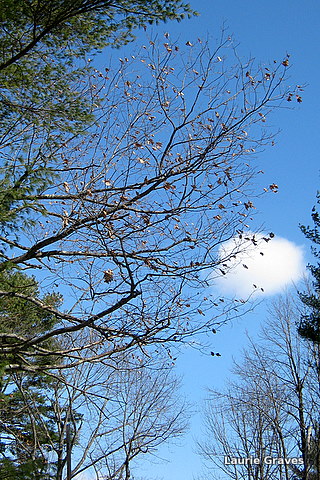
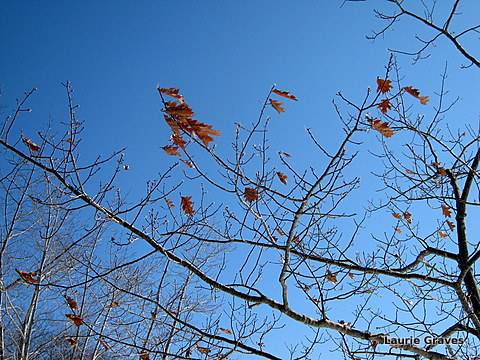
Beautiful March sky

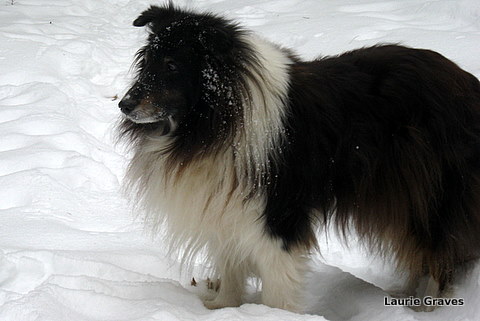
Yesterday, the dog and I took a walk to see if Mike—of Mike’s Maple Sugar House—had started tapping the maple trees not far from our home. It feels like maple syrup weather. The days are relatively mild—in the thirties and forties—and the nights are cool—twenty or a little below.

Up the road we went. The snow is still deep, but it has begun pulling back from the road, leaving a sandy mess that collects on the dog’s paws. As we left the woods and came to the fields, I heard a male cardinal singing his spring song. To me, it seemed a little early to be setting up housekeeping, but I suppose the cardinal was just thinking ahead, perhaps trying to get a jump on other male cardinals. A lovely song on a day so warm I didn’t need to wear a hat.

The snow has pulled away from the road

Liam and I rounded the corner, and one neighbor was visiting another neighbor in his driveway. The visiting man called out, “The weather’s getting pretty warm. Soon you’ll be on your bike.”

“I can’t wait,” I replied. “It’s been a long winter.” In the driveway was a snowmobile in a trailer. “But maybe not so long for you with your snowmobile,” I said to the owner.

The owner shook his head. “Nah. It’s getting old. I’m ready for spring.”

As are we all in central Maine. Nodding, I smiled and continued on my way. When I came to one of the spots where Mike taps the trees, I saw that there were no buckets collecting sap. Maybe next week.

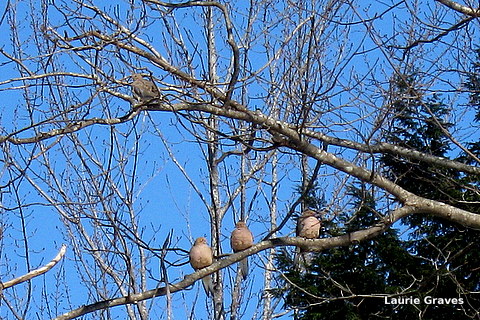
Liam and I walked back home. In the apple trees by Cheryl and Denny’s house I saw a robin, and again I heard the male cardinal singing his song.

The apple tree sans robin

It’s not quite spring, but soon, soon, it will come.


Why Don’t Americans Eat Healthier Food?

IMG_7863Among foodies, there is a lot of hand-wringing about how Americans eat. The general feeling is that we eat too much of the wrong kind of food, which in turn makes us fat and unhealthy. Alas, there is some truth to this. We are an overweight country, with an increasingly large number of children suffering from obesity and diabetes. As anybody who shops regularly at a supermarket can attest, many of the aisles are filled with food that should only be considered treats to be eaten sparingly as they do little to nourish our bodies. (I also want to point out that there are good things to eat, too—fruit, cheese, vegetables, rice, rolled oats, beans. Somebody must be eating these things or the stores wouldn’t stock them.)

In addition, Americans are often chided for how little money they are willing to spend on food.  In Treehugger, Margaret Badore writes, “According to the USDA Economic Research Service, 6.7 percent of consumer expenditure went towards food in 2013. Compare that to 9.3 percent in the United Kingdom, 13 percent in South Korea, 15.7 percent in Brazil, 26.1 percent in China, and 29.6 percent in India.” (I keep close track of our household expenditures, and Clif and I spend 13 percent on food. I guess we’re above average in that sense.)

As someone who is, ahem, food obsessed, I think about these things, too. Why are we such a fat nation? Why don’t we spend more on food? Why don’t we eat better? We know better, and this is true for those who struggle with poverty as well as for more affluent folks. For many years, I volunteered at our local food pantry, and how grateful the recipients were when fresh fruit and vegetables were available.

First, let’s consider cost.  We have a government that subsidizes what has come to be known as Big Ag, those mega companies with their mega farms that grow vegetables—corn, soy, and wheat—that are not meant to be eaten in their original state but are instead processed with sugar, salt, and fat and many ingredients that are unpronounceable.  This type of food is highly profitable, and many people have a huge appetite for it.  (I don’t exempt myself from this group of people. If I’m going to be honest, I have to admit I have a weakness for Double Stuf Oreos.)

Nevertheless, despite the Big Ag subsidies and the relatively low cost of food, many Americans feel financially stretched, and cutting back on how much is spent on groceries is one way to trim a budget.

And why do Americans feel so financially stretched? Unlike most European countries, our government has been pretty stingy when it comes to subsidizing health care, transportation, higher education, childcare and affordable housing. These things take a huge chunk out of our budgets, to the point where there is often little left over for much of anything else. (I do want to note that Obamacare has mitigated much of the misery caused by lack of health insurance—I know a woman, pre-Obamacare, who lost her house because she had to choose between paying for cancer medication and her mortgage. She chose life.)

However, money isn’t the only way Americans feel stretched. We also feel stretched for time, and I expect this also has a big effect on how we eat. In most families, both parents work outside the home. They rush to get the children to school or daycare, they rush to work, and then they rush to get back home to their children, who might be involved with sports or other activities. We live in a rush, rush society where we always feel harried, where we barely have time to comb our hair much less prepare a home-cooked meal. And this is true for parents at every economic level.

To add to this harried feeling, Americans have fewer vacations than Europeans—the French pretty much take off the whole month of August. Indeed, many Americans—those who work in low-paying service sector jobs—don’t have any vacation time at all. The same applies for maternity leave and sick time.

Is it any wonder, then, that so many Americans feel stressed? Is it any wonder that so many people turn to fast food for both convenience and comfort? There it is, dinner in a box or in a bucket, with very little preparation required. After a long day of rushing, how soothing it is to eat that salty fried chicken or burgers and fries, washed down with a shake.

I have an immodest proposal. Actually, I have two immodest proposals. First, let’s take some of the money we use to prop up Big Ag, and instead use it to help small farms and to subsidize services that are for the common good—health care, affordable housing, public transportation, childcare, higher education. If people felt less pinched financially , then they just might be willing to spend more money on food.

Second, let’s give Americans more vacation time, more time away from work, more maternity and sick leave. If they felt less pinched for time, then they might actually find the energy to serve more home-cooked meals.

I am not optimistic that my immodest proposals will be implemented anytime soon. There is too much big money dependent on keeping things just the way they are. However, who knows what might happen if we spent more money on the common good and gave people more time off?

Maybe, just maybe, we wouldn’t have such an obesity problem.



A Wall of Dirty Snow, a Flash of Red

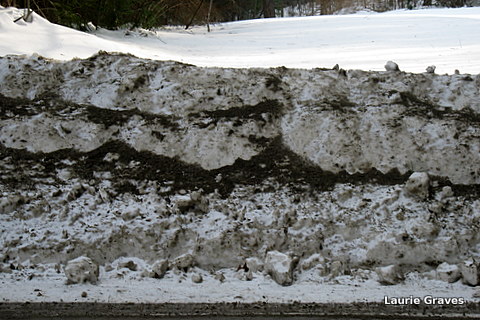
When I look out my front window, this is what I see:

IMG_7843Across the road, a wall o’snow, mixed with dirt, sand, and gravel. Not exactly the most beautiful sight, that’s for sure, but oh so typical of early March in Maine.

Still, I’m not complaining. All right, maybe I’m complaining a little bit. Nevertheless, despite the ugliness of the landscape, there are things to be glad about. The zero degree weather has given way to twenty, thirty, and even forty degrees. Yesterday, it was so warm—comparatively speaking—that when I went out to play ball with Liam, I didn’t even need a hat. I was perfectly fine without one.

There is also a softening in the air, which I can actually smell. Very cold weather has a particular smell, as does warmer weather. I noticed this on Monday, the second day of March. I was in the backyard, and I just stood there, breathing in this softening. (Later, when there is mud, the backyard won’t smell quite as good.) In the afternoon when I did errands, I spoke to various people about this softening smell, and they didn’t look at me as though I were crazy.  Instead, they nodded and said they had noticed it, too.

Even though we are still buried with snow at the little house in the big woods, and even though the snow has lost its glitter and fluff, a good change is coming. It doesn’t get dark now until 6:00 p.m., and on Sunday daylight savings time begins, which means the dark won’t come until 7:00 p.m. For me, early darkness feels oppressive, confining, and the longer days are a sweet relief. I don’t mind losing an hour to get extra light at the end of the day. Not at all.

As a contrast to the view out front, here is what I saw when I looked out back yesterday:

IMG_7855-1

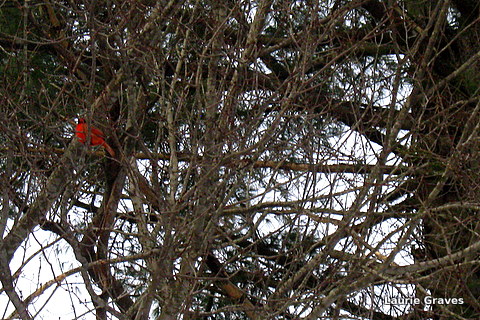
A flash of red, a male cardinal, an infrequent visitor as cardinals prefer a more open landscape. How wonderful it was to have him in my backyard. I just wish I had gotten a better shot of him with my little camera. For a good picture of him, I need a sunny day, and on clear days, I will be on the lookout for this little beauty.

So, in front—a wall of dirty snow. In back—a flash of red. Ugliness and beauty sit close to each other. I accept one and rejoice in the other.


From the Green-Bean Weirdo Files: Our Carbon Footprint

IMG_7848Clif and I are proud to admit that we are a couple of green-bean weirdos who love to talk about things like our carbon footprint, global warming, resource depletion, and overpopulation. While these topics might be a tad grim, we generally maintain an optimistic attitude as we work to align our lives with our environmental values.

Clif loves to figure out what our carbon foot print is, and this is the time of year for him to do so. As a sideline, he is a computer consultant, and the tax information we need for his business overlaps with what he needs to calculate our carbon footprint. Therefore, as is his wont, after finishing our taxes this year, Clif then moved on to figure out our carbon footprint. I must admit we were pretty pleased with the results. Last year, our CO2 emissions were  6.7 metric tons per capita. (A 13.4 total for our household divided by the number of people who live here, which in our case is two.)

To put this in perspective, in the average United States CO2 emissions (metric tons per capita) are 17. 56. This means our emissions are half that of the average American.  In Australia, they are 16.93; the United Kingdom—7.86. But to keep Clif and I from feeling too puffed up, we have Sweden (5.6) and France (5.6) to show us that it is possible to live in a modern society and go even lower than the 6.7 Clif and I are each responsible for.

How do we keep our carbon footprint relatively small? Here’s a short list.

  • We only have one car—something we can do because I stay at home. Our car is a Honda Fit, which is very fuel efficient.
  • We severely limit our travel. For the most part, we stay close to home and bike whenever we can. When we travel to visit Dee, we go by train or bus. We always combine errands. I never fly, and Clif flies only very occasionally, for his work.
  • We heat with wood and electricity. Our wood is local and sustainably harvested. In Maine, electricity production is fairly clean, with more generated by wind and falling water than the national average. We also have signed up for a carbon offset.
  • When we heat with electricity, we keep the house at a cool 60 degrees if we are not using a room and between 66 and 68 if we are.
  • We eat a lot of local food—by a rough estimate at least 50 percent.
  • We eat mostly vegetarian, which means some chicken but no beef, pork, or lamb.
  • We don’t produce much trash. We reuse and recycle. We don’t buy a lot of new things.

Here is what we could do to lower our carbon footprint even more, and in the upcoming years, we plan to do as many of these things as we can.

  • Install more insulation in our house.
  • Replace all the windows.
  • Further reduce our trash.
  • Replace the Honda Fit with an electric car.
  • Bike more.
  • Use LED lights.
  • Buy even more local food—flour, dried beans, corn meal. Unfortunately, right now these items are just too pricey for our modest budget.

Many years ago, it dawned on Clif and me that we could no longer pretend that it was perfectly all right for us to consume heedlessly and drive or fly wherever we wanted. As the climate changed and resources were ever more depleted, we knew that we were part of the problem and that our little actions mattered.

Therefore, we strive to live as lightly as we can while still living a good life. It is not easy. It requires effort and mindfulness and restraint. But never for one moment have we doubted that we are on the right path.

(If you want to figure out your carbon footprint, then there are a number of online options. Clif has used this spreadsheet, originally from the University of Maine at Orono, for a number of years.  2014 carbon calculator annual.)

Gather Around the Table

IMG_7836Not long ago, when I was having tea with my friends Mary Jane and Liz, the conversation turned to Marion Healey, a Winthrop resident who died a little over a year ago. Marion was one of Winthrop’s prominent residents. For forty years she worked as the treasurer/manager of the Mill Workers Credit Union, now the Winthrop Area Federal Credit Union. Indeed, the new building was named in her honor.

But what we spoke of were two traits that made Marion especially dear to the community—her hospitality and her intense interest in other people. Mary Jane said, “Being around Marion’s table was one of the best places to be. Once when I visited, I remember how she wanted to know all about my life before I came to Winthrop.”

I understood exactly what Mary Jane was getting at. When you talked to Marion, you felt as though she was giving you her complete attention, that you really mattered. A priceless gift and small wonder that she was so beloved in Winthrop.

When Liz and Mary Jane left, I thought more about Marion and her wonderful hospitality. I remembered my own parents and the many people they welcomed into their home. It was a rare week when someone didn’t come over. If the numbers allowed, we almost always gathered around the kitchen table. Coffee was served along with some kind of treat, often homemade. (My mother was a terrific baker and could bake almost anything.)  I come from a gregarious ethnic group—Franco American—and there were always lively discussions around that table.

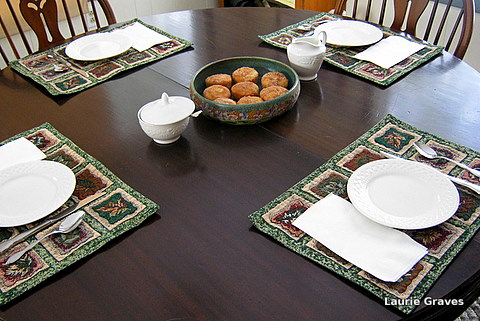
At the little house in the big woods, we are blessed with a good size dining room. In the center is a dark round table my mother-in-law bought at an antique shop in Bangor. The original  chairs, stuffed with straw, wore out long ago, and it’s my guess the table was made sometime during the late 1800s. The table came with two leaves, which means ten people can be comfortably seated.

I have carried on my parents’ tradition of inviting people over and gathering around the table. Sometimes it’s for a meal, but sometimes it’s just for muffins and tea and coffee. Yesterday our friends Joel and Alice came over. I made French donuts, and we talked about the things we love to talk about—books, politics, and movies. I can’t think of a better way of spending a winter’s afternoon.

Next week, our friends Beth and John will be joining us for Sunday brunch. A couple of weeks later, other friends will be coming for tea, muffins, and talk.

These gatherings are not elaborate, and they are inexpensive. What Clif and I are giving are the gifts of time and hospitality. Marion valued these gifts as did my parents. In our hectic world, it is easy to become so caught up in busyness that we forget to give these gifts.

But these gifts are so worthwhile, and Clif and I will continue to gather people around our table for as long as we can. As Marion so beautifully illustrated, these gifts can ripple outward long after a person has passed.


A Tra-La-La Kind of Day

Last night I went to bed feeling kind of glum. My joints ached, the day had been flat and unproductive, and I was tired, tired of winter. I vowed to start the next day with a better attitude, to lean into the many tasks I had planned, and to take pleasure in them.

When I woke up, I kept my promise to myself. Full of morning bustle, I made oatmeal, cranberry, and roasted walnut muffins—some for Clif and me and some to give to Pearl and George.

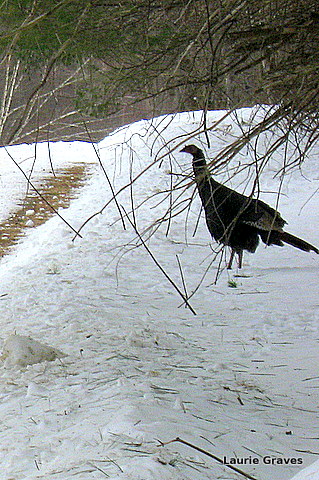
I delivered the muffins late morning. The sky was blue, and it was nearly thirty degrees, with no wind. I had brought my little camera with me, and what should I see at Pearl’s house, but turkeys by her bird  feeder. Had I learned my lesson from a couple days ago? I had not. I took pictures of the turkeys, but as I moved a little closer, these turkeys flew away, the way wild birds normally do.

IMG_7814

On my way home, I stopped by Maranacook Lake, wanting to take pictures of the ice village that springs up every winter—fishing shacks that don’t come in until the spring thaw makes the ice unsafe. As I took pictures, the sun warmed my face, and I needed neither hat nor gloves to keep me warm.

IMG_7822

Revitalized, I did more errands, stopping to take pictures of the ducks on Annabessacook Lake.  By the time I came home, all glum thoughts had been cast aside, and it felt like a tra-la-la kind of day.

IMG_7827-1

I even started thinking that soon I would be able to hang laundry outside.

IMG_7833

Well, all right. Maybe not in the next few days. But in a month or so, if the mud isn’t too bad in the backyard. I can start by hanging blankets and comforters on the line.

When that day comes, you’ll liable to find me rising like Mary Poppins over the rooftops of Winthrop.

Turkey Trot Trot Trot Or How I Escaped from Wild Turkeys

Waiting
Waiting

Yesterday, on our daily walk, the dog and I turned right rather than left at the end of the driveway, and we headed up the road away from the Narrows. While I never get tired of the beauty of the Narrows, I like to vary our walks. The dog likes it, too—different smells on different walks.

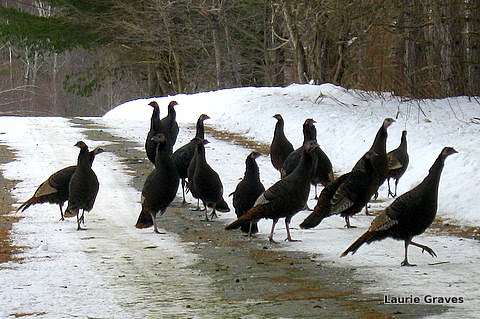
Partway up the long hill that gives me so much trouble on my bike, I looked down a lane that led away from the road, and I saw turkeys. Lots of them. I had my trusty little Cannon tucked in my pocket. Could I get a picture of them before they took fright and hurried away? I decided I would try.

Taking pictures while trying to manage a dog on a leash is always a challenge, especially in the winter when gloves are also an issue, but I have pretty much mastered the process. I throw the gloves on the ground, lock the leash so that it is very short, and put the leash cartridge between my knees.

I took several pictures of the flock, which just stood there and didn’t run at all. This should have given me a clue about their lack of fear, but instead, I thought, “Can I get a little closer for a better shot?”

The flock decides
The flock decides

The dog and I inched down the lane. I took a few pictures, and then the turkeys did indeed begin to move. But rather than hurry away from us, they came toward us. They moved with purpose and assurance and didn’t show any signs of slowing down.

“Oh, no!” I thought. “Those turkeys are going to take me down.” With my creaky knees, I knew there was no chance I could outrun them. Like a deer in the headlights, I watched in awful fascination as the turkeys came closer and closer. I could just see the headlines, “Winthrop Woman felled by turkeys.”

But then something rather wonderful happened. Man’s best friend—or in this case woman’s best friend—came to the rescue. Liam growled at the approaching birds. There was just one growl, but that’s all it took. The turkeys stopped, briskly turned around, and headed the other way.

“Good boy,” I said, patting Liam’s back. He gave me look that indicated it was nothing at all, that he was just doing his job. I put my camera back in my pocket, gathered my gloves, and unlocked the leash. Liam and I continued on our walk, unthreatened by fowl or beast.

Now, I’m exaggerating the turkey threat for comic effect. I expect I would have survived a turkey assault, even though it wouldn’t have been much fun. However, it really did feel like Liam saved the day with his one growl. It made me realize, yet again, how crucial dogs have been to humans over the centuries—for herding, for protection, for keeping other animals away from the farmstead. Even now, when most dogs—at least in the U.S.—are considered pets, they can still unexpectedly show us how  important they are to our well being.

There is no doubt about it. Yesterday, Liam was dog of the day, and how good it felt to walk by his side.

Oh, noble canine
Oh, noble canine

Farewell to February, a Tough but Exquisite Month

IMG_7799I never thought I would write this, but I am actually looking forward to March. In Maine, March is a grim, dreary month that we all somehow get through, even though we often wonder how in the world we do. In March, at the beginning of the month, it still snows, but it’s usually wet and heavy and difficult to shovel. It is cold enough so that we must wear hats and gloves and boots. As the month progresses and the snow melts, it brings what every Mainer loves to hate—mud and lots of it.

But this year, February has been so hard—so snowy, cold, and confining—that March will seem like a relief. The days are getting longer—Daylight Saving Time begins on March 8—and I am hopeful that the temperature will rise to at least thirty degrees. Then, I’ll actually feel like going for walk, even if I still have to wear a hat, gloves, and boots.

A restlessness—commonly known as cabin fever—often comes with February, and it came to me in spades this year. I long to be outside, in my yard, in the woods, on my bike. Instead, I am in my house. Fortunately, I don’t have seasonal affective disorder, so I am not depressed. Just antsy. Getting together with friends helps a lot. So does tea and muffins and brunches, some of which had to be canceled because of the weather.

One thing I will say about February in Maine—it is a beautiful month. Yesterday the dog and I walked to the Narrows, where I took more pictures.

IMG_7797

IMG_7786

IMG_7787

Farewell, February, you tough but exquisite month. As the warmer weather comes, I’ll push you to the back of my mind, but you will not be forgotten. Every year begins with you and your sister January, another severe month that keeps us on our toes, confines us, and reminds us that weather really does matter.

IMG_7798-1

Grocery Cart Snooping in a Small Town

IMG_7772On Sundays, we usually call our daughter Dee, who lives in New York. Last Sunday was no different, and it just happened to be the day of the Academy Awards. Clif had decided notions about what he wanted to eat on this big night of movie awards, and let’s just say his choices weren’t exactly healthy—fries and breaded chicken and snack cakes. (All right. I’ll plead guilty when it comes to the snack cakes.)

“I’m sure glad I didn’t meet anyone I knew when I went grocery shopping this afternoon,” I told Dee that night. “Considering what was in my cart, it would have been pretty embarrassing.”

“People look into your cart?” Dee asked. “That’s nosy.”

“It is,” I agreed. “But I do the same thing, so I can’t throw any stones.”

Dee again expressed amazement. Now, you’d think this country girl would know about grocery cart snooping in a small town, but she left Winthrop when she was eighteen, and the only grocery shopping she’s done has been in Manhattan and Brooklyn, where apparently people don’t scope out the groceries in other shoppers’ carts.

On Monday, the day after the Academy Awards, I went grocery shopping for real, and my point was proved. We were low on flour, so I hefted a twenty-five bag of flour into my grocery cart. A woman—someone I didn’t even know—did a double take when she saw the big bag of flour in my cart.

“That’s one big bag of flour,” she said.

“I make bread,” I replied.

“Well, good for you,” she said amiably and continued on her way.

In the produce section another woman, again a complete stranger, looked at the bag of flour and said, “Wow! That’s a lot of flour.”

I smiled sweetly. “I make bread.”

A little while latter, I stopped and chatted with my friend Mary Jane, but she didn’t say a word about the flour. She knows I make bread. No explanation was necessary.

In the pasta aisle, as I was reaching for a bag of egg noodles, I met the first woman who had commented on the flour. “What?” she asked. “You don’t make egg noodles?”

Grinning, I shook my head. “No, I don’t make egg noodles.”

Next Sunday when I call Dee, I will tell her about the various encounters I had on Monday. I will tell her I am not offended by the nosiness of small-town shoppers. On the contrary, it adds texture to life, giving a personal touch to that most mundane of experiences—grocery shopping.

Sometimes, even the cashiers get in on the act when they see something unfamiliar and potentially tasty among my groceries. I am always happy to talk about food, and I gladly tell them about the delicious item in question.

I view these comments as one of the benefits of living in a small town, where a trip to the grocery store almost always guarantees some kind of personal interaction. It makes me feel folded into the community. It makes me feel that I matter as an individual.

In a world where the human population is climbing toward nine billion, this is no small thing.

Around Winthrop on a Cold Day

Despite the extreme cold—with the wind chill factor, the temperature was well below zero all day long—yesterday was errand day.  I went to the library, in its temporary location, to both drop off books and to pick up some that I had ordered through interlibrary loan. I went to Paris Farmers Union to pick up some eggs—they get them from a local woman who keeps hens. Lots of them. What I especially like about the eggs is that the shells are different colors. I just love the variety, and I always save the blue eggs for last.

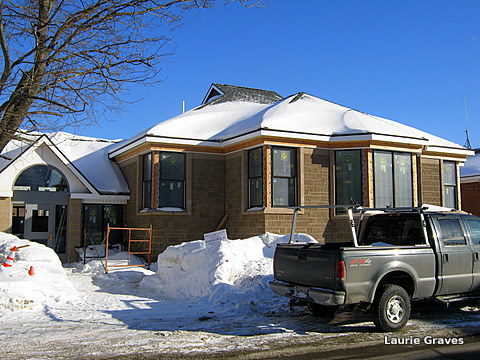
As is usually the case, I had my trusty little camera with me, and I stopped by “old” Bailey to see how the new addition was coming along. As it turns out, it’s coming along just fine. On time and within budget, as Dale Glidden, head of the steering committee, likes to say.

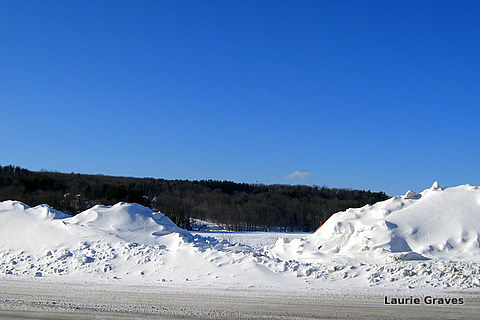
IMG_7762After that, it was a short drive to the public beach, where I hoped to get some pictures of all the ice-fishing shacks. Instead, this is what I got.

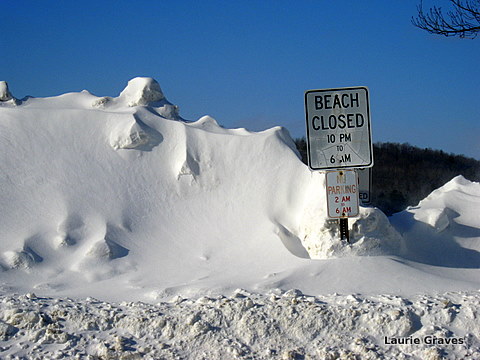
IMG_7767A wall of solid snow. Taller than I am. I could hardly see the lake or the shacks.

I couldn’t resist taking a picture of this sign. I think it’s safe to assume that no one is going to swim between 10 p.m. and 6 a.m. Or any other time as well.

IMG_7765

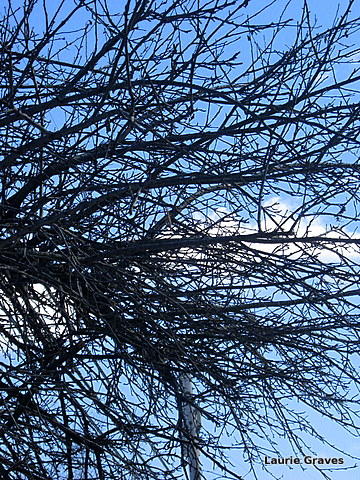
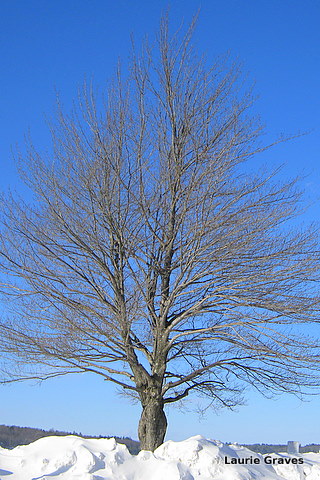
Finally, even though my feet were so cold that I could hardly feel them, I took a picture of this tree, with its bare branches against the bright blue sky. Such a beautiful sight, even in the extreme cold.

IMG_7769My last stop was Hannaford to pick up some groceries. I had a couple of very humorous encounters, the kind you only get in a small town.

But that’s a story for another day.