All posts by Laurie Graves
How I Learned to Roll Pie Dough
Yesterday, as I was rolling the dough for our quiche, Clif said, “You sure do know how to roll pie dough.”
I laughed. “And no wonder. I’ve rolled out dough for hundreds of pies.”
Not because our family eats so much pie—although we like pie as well as the next family—but instead because when I was a young woman, I worked in the bakery in one of the dining halls at Colby College in Waterville. Everything was made from scratch, including the pies, and we would spend entire afternoons rolling dough.
Fran York was the head baker, and she was the nicest boss I have ever had. Soft spoken and cheerful, Fran set a calm but hard-working tone, and there was never an ounce of drama in her bakery. She had that elusive quality that so many bosses don’t have—-in her own quiet way, she made us want to work as hard as we possibly could. But she never badgered, harangued, or scolded us. We just wanted to do our best for Fran.
She came in early and worked until 3:00 p.m., leaving us, her assistants, to finish the work we had started. On one particular day, it was pies.
“We need one hundred and fifty” Fran said. “But if you do seventy-five, that will be fine. We can roll out the rest tomorrow morning.”
Then she left, and there were two of us, one of whom was Fran’s mother. Unfortunately, I can’t remember her name, but she was a lively woman, a southerner, an extrovert—unlike Fran—and oh so fun to work with. “Son a’gun!” was one of her favorite sayings when something surprised her. Like Fran, she was a hard worker.
“What do you say?” she asked after Fran had left. “Let’s see if we can roll out all those pies by the time we leave.”
And so we began. The flour flew, the rolling pins thumped against the big work table, and pie after pie was made. Five, ten, twenty-five, fifty.
Fran’s mother sang, “Can she make a cherry pie, Billy boy, Billy boy? Can she make a cherry pie, charming Billy?”
We were, of course, making cherry pies, and I grinned as Fran’s mother sang.
We reached one hundred. “We’re almost there!” Fran’s mother cried.
More flour flew, and the thumping of the rolling pins grew louder. “One hundred and fifty,” came the triumphant call. “With plenty of time to clean up.”
My apron was covered with flour, and my face had a fair share, too. But I felt triumphant. We had exceeded Fran’s expectations.
The next day when I came in, Fran said, “My, you two did a good job yesterday. Look at all those pies ready to bake.”
I felt as though I had been given a prize—praise from Fran.
“Oh, we worked right along, didn’t we, Laurie?” said Fran’s mother.
We certainly did.
And forty years later, how did my one little quiche turn out?
“Pretty darned good,” my Yankee husband said.
Addendum: About all those cherry pies: I forget to mention that the pie filling and the dough were made ahead of time for us. All we had to do was roll. And, it took us hours. We were working the late shift, and we rolled until the end.
One Cold Valentine
The headlines in the Sunday paper got it just right—“Caution urged as teeth-chattering cold moves in: Wind chill temperatures could hit 35 below in parts of New England.”
The cold has certainly come to central Maine. When we got up this morning, there was ice on the inside of the windows, which melted as Clif stoked the wood furnace and brought the inside temperature up to something approaching warm.
Clif, intrepid soul that he is, still took the dog for a walk up and down the road. When he came back, he snapped a picture of our outside thermometer. As we Mainers might say, it was a little brisk outside.
On such a cold Valentine’s day, we both decided that a special breakfast was in order, and Clif made eggs and toast.
To celebrate Valentine’s Day, we had originally planned to go to a movie and then out for gelato afterwards. But the cold changed our minds. Instead, we decided to stay home, where we could tend the fire in the wood furnace. We do have back-up heat—propane and electric—but nothing warms a cold house the way wood does.
This evening, I’ll be making a quiche with smoked cheddar, a rich dish for special occasions only. We’ll have a couple of rum and cokes and listen to music. We’ll watch a movie at home.
In the next few days, the weather is supposed to be significantly warmer. Then, we’ll venture forth for that movie and gelato.
Until then, we’ll stay in our own snug house.
Creature Comforts in Deep Winter
Yesterday, I wrote about the spiritual comfort that books can bring to us during hard times. Today, my mind is on creature comforts, and no wonder because in Maine, we are in deep winter. The days might be getting longer—it doesn’t get dark now until 5:30—but they are cold, clear, and crisp. Unless it is snowing, of course.
This morning when Clif took the dog for a walk, it was dead calm and zero degrees. (Fahrenheit). At that temperature, the snow squeaks underfoot, and the warmest of winter clothes is needed—heavy coat, heavy gloves, hat, scarf—or neck warmer—thick boots. In deep winter, all sense of fashion is abandoned. The chief thing is to stay warm.
In the house this morning, the temperature was just below 60 degrees. We heat with a wood furnace, and in February it doesn’t quite make it through the night. This is why we sleep with piles of blankets pulled up to our noses so that we have a little tent for warmth.
This cold morning, it was very hard to get out of our warm bed. When we did get up and raised the shades, we found that the windows were frosted.
But soon Clif had the furnace going, and it wasn’t long before the house was a balmy sixty-four degrees. Throughout the day, the wood and the sun will raise the inside temperature to a little under seventy degrees, which is plenty cozy for us.
For this time of year, chicken soup is just the thing. One day, I cook a chicken, and we eat some of the meat. The next day, I make chicken stock using onion, garlic, carrots, whole cloves, peppercorns, a bay leaf, salt, thyme, and sage. Into the stock pot go the bones with the leftover meat. I cover them with water, add the other ingredients, and bring everything to a gentle simmer. I let the stock bubble for hours, until the house is fragrant with the smell, and Clif and I can hardly wait until dinner.
After the stock has simmered for hours, I strain the stock into a big pot, and let the bones cool before picking the meat. More carrots go into the stock, and because we are Mainers, potatoes often go in, too. The vegetables simmer until they are tender, and then I add the picked meat. A variation on this is to leave out the potatoes and instead go with pasta or rice. The pasta and rice and are never simmered into the soup because if they are, whatever is leftover will swell into alarming proportions. Instead, we cook pasta and rice separately, put them into the bottom of our bowls, and ladle the hot soup on top.
What to serve with chicken soup? Homemade bread is good, as are biscuits, but Clif and I seem to prefer cornbread, which from beginning to end takes about thirty minutes to make and bake.
When the soup is ready, when the cornbread is done, we settle into the evening with our steaming bowls of comfort. “Pretty darned good,” Clif pronounces, and he always goes back for seconds.
However, the last word of comfort must go to Sherlock because no creature knows comfort the way a cat does. Unless, of course, it’s a hobbit.
Comfort Me with Reading
In Maine, winter is the perfect time for reading. The days are short, and aside from shoveling, outside chores are few. There are always inside chores, of course, but even so there are plenty of quiet opportunities for reading.
This winter, I have been thinking about the various reasons we read. On a pragmatic level, we read for basic information—manuals, how-to books, tutorials on the Internet. These can be a big help with projects as diverse as cooking to the most cost-effective way to fence in your yard for the dog.
We also read for intellectual ideas, and right now I’m slowly and with great difficulty working my way through Michael Lewis’s The Big Short. At times, I am absolutely stupefied by so much technical information about the workings of Wall Street, but still I read on, figuring that even if I only absorb a fraction of the book, I will know more than I did before I started.
We read for enlightenment and enlargement. For this we usually turn to the great novels—Middlemarch, Pride and Prejudice, Crime and Punishment, Moby Dick. Often these books require effort on our part, but when we are finished, we feel as though we have gained a glimpse of something essential about life and human nature.
Last but certainly not least, we read for pleasure and comfort. The value of this kind of reading cannot (and should not) be underestimated. Life can be joyous, but it can also be hard, and the older a person becomes, the more loss she or he has endured. Loved ones die, illness comes. That is the way of things, and somehow we must cope.
When life becomes hard, I turn to books for comfort, often Miss Read. Somehow, reading about life in an English village in the 1950s has a calming effect on me. I am always absorbed by the descriptions of nature, the sympathetic yet shrewd take on human nature, and the humor.
Lately, I have discovered Gervase Phinn, another English writer. (Do you think there is a trend here?) Phinn writes memoirs of his time as a school inspector in North Yorkshire, beginning in the 1980s. He is not a great stylist, but his books have a wonderful narrative flow, with vivid descriptions of teachers, students, parents, and colleagues. And, he makes me laugh out loud, to the point where my husband looks at me with raised eyebrows as I chortle over a passage in Phinn’s books. How often do books make us laugh? In my experience, not very often, and a book that does is a little gem.
I have been thinking that I should start collecting “comfort” books for my home library. (I already have several Miss Read books.) That way, the books will be right there when I need them, and I can also let friends borrow them when they are going through their own hard times.
Wordless Wednesday: A World of Blue
The Look of Winter
February is back, and how glad I am to see it. Yesterday, we got four inches of light, fluffy snow that will be easy to clear. Readers will be happy to know that Clif and I came home from doing errands just as the first snowflakes started falling. While leftover soup heated, we put away our groceries and other sundry items. Then, as we ate our soup—spicy squash with chicken sausage—we watched the snow come down, down, down. So lovely to watch when you’re snug at home with a bowl of hot soup to eat.
As I have indicated in previous posts, I really like winter—December, January, and February. I was born in central Maine, in September, which means my earliest memories involve snow and cold. I can remember having my picture taken on the mailbox of our new house, the first for my parents, who came from poor families and were rightly proud of their little home. I must have been two or three, and I am bundled in a winter coat, mittens, and a brown fuzzy hat. I remember squinting because the sun was in my eyes, but I don’t remember feeling cold.
In fact, as a child, I do not ever remember feeling cold. My mother, who was very attentive, made sure I was warmly dressed, and out I went to play. I skated, I went sliding, I dug snow caves, and I had snowball fights with other children in the neighborhood. No doubt I came in with red cheeks, but I was never uncomfortable.
Even now, I do not mind the cold, and because of this, I love and appreciate the look of winter. This morning, after the little storm, our yard was filled with blue shadows and glittering snow.
Even our porch had blue-slanted shadows across it.
And, as Clif put it, the car looked like a marshmallow puff.
In the backyard, goldfinches crowded the feeder, and they twittered as they ate.
The clothesline will not be used for another few months, not until April, when I will happily begin hanging out quilts and blankets and the rest of our laundry.
Until then, I will enjoy the beauty of winter, the cold and the quiet and the blue shadows.
One, Two, Three: Liam, Dog of the North
Today is a day of errands. Clif and I will soon be heading to the big city—Augusta, population 19,000. It’s supposed to snow later this afternoon, and the older we get, the less we like driving on snowy roads. So there is not much time to write this morning.
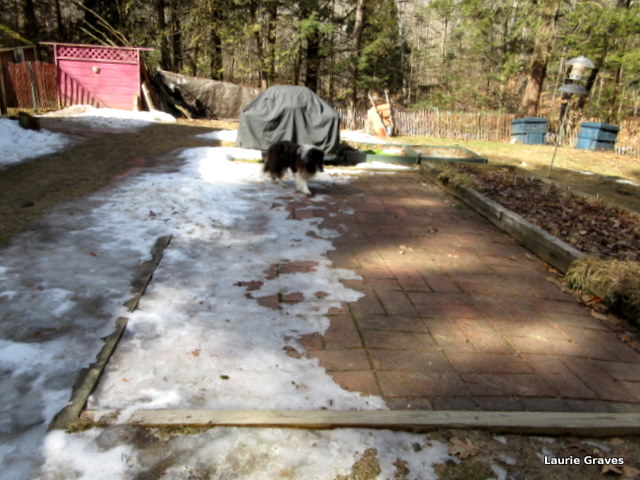
I do, however, want to share these three pictures I took yesterday. Looking at them made me smile. Our Liam loves the snow and the woods. Truly, he a dog of the north.
The Horror of March: The Battle of the Boot and the Mud
Yesterday, the day was so drippy, the road so wet, and the snow so hard packed and dirty that Clif remarked, “Are we going to have two months of March?”


This statement made me catch my breath. For a Mainer, there could be no greater horror than having two months of March, the dreariest, longest, most miserable month of the year. It is the month where we become restless and cranky, and even those of us who love Maine desperately wish we were some place else, where spring was showing its pretty face, where flowers and leaves were beginning to bud, where the air was soft and warm. (Who, oh who, decided that town meeting should be in March? The sour mood makes Mainers quarrelsome, and the meeting stretches for hours and hours.)
Instead, we have our March, a month of endurance. Gone are the brilliant days of January and February, punctuated by soft snow. (All right. I will admit that last year there was a little too much snowy punctuation, an exclamation mark rather than a comma or a period.) In March, the snow melts in fits and starts, and this melting brings something all Mainers have come to dread—mud.
I’m not talking about a bit of mud that clings to the bottom of shoes and can be stamped off when it’s dry. I’m talking about mud so thick that a small boy could get stuck and need some help getting out.
Indeed, such a thing happened one March. I was walking the dog, and I noticed a small boy—Joseph—struggling in the mud in his driveway. One of his boots was stuck solid and would not budge, no matter how hard he pulled his leg.
Naturally, the dog and I went over to help. By then Joseph had yanked his foot out of the boot, and his little stockinged foot gingerly touched the cold ground.
I tugged on the boot with one hand—the other was holding the dog—but the boot remained stuck.
“Could you hold the dog?” I asked. Joseph looked doubtfully at me and the dog. He was, after all, just a little boy.
“I need both hands,” I said, and Joseph nodded, taking the leash. Liam loves children, and he stayed perfectly still as Joseph held him.
With both hands, I gripped the little boot and pulled and pulled. With a loud glucking sound, the mud released the boot, and I triumphantly handed it to Joseph, who in turn gave me the leash and put on his errant boot.
“There!” I said, but I could not resist adding in my best adult voice, “Don’t play in the mud.”
But Joseph didn’t hear the admonishment. He was running toward the house, away from the sucking mud that had taken over his driveway.
And who could blame him? It had been a close call with the battle of the boot and the mud.
So it is no surprise that Clif’s gloomy remark about two Marches filled both of us with dread.
However, overnight, the snow came, and this morning, when I woke up and looked out the window, February was back. How glad I was to see it.

And with any luck, the March-like weather will stay away for a month or so. One Maine March is definitely enough.