
The calendar has flipped to September, the month that brings fall, Maine’s splendid season. In our yard, the goldenrod is abloom by the edge of the woods.
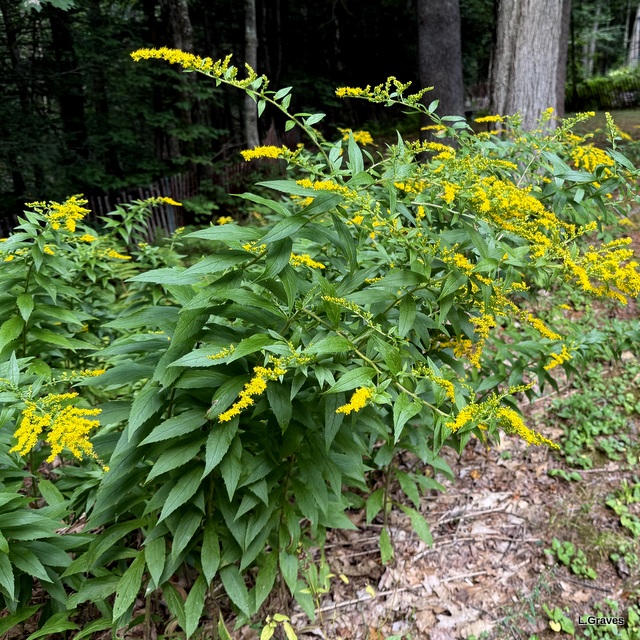
The air has a delicious, nutty smell as plants mature and form seeds. At night, the temperature drops to 50, and I put another blanket on my bed. One evening, it was so chilly that we even had to turn on the heat pump. But during the day, the temperature rises to the mid-70s and sometimes reaches 80, only to cool down at night. I wish we could have a couple more months of this weather, but maybe fall’s fleeting nature is the reason why I love this season so much. I feel very lucky to have a birthday in this beautiful month—as does Clif—and you can bet there will be simple but fun celebrations that I’ll feature on this blog. As longtime readers know, our philosophy is to celebrate early, celebrate often.
My gardens are winding down and are definitely past their best, as this photo of the front yard illustrates.
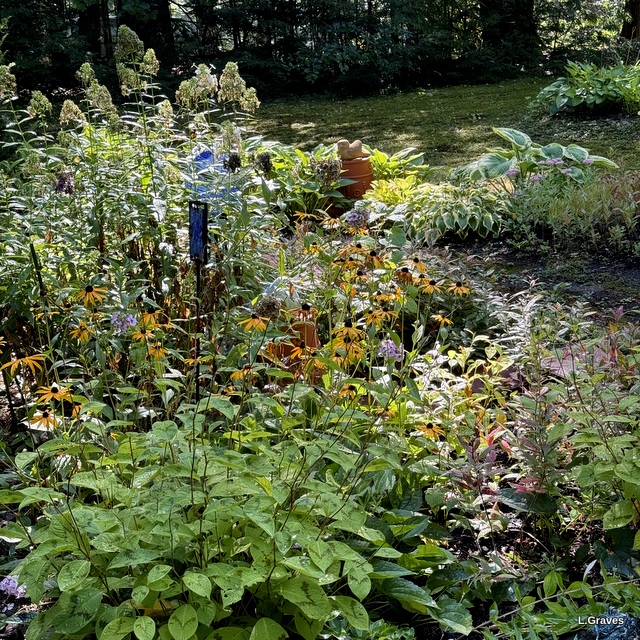
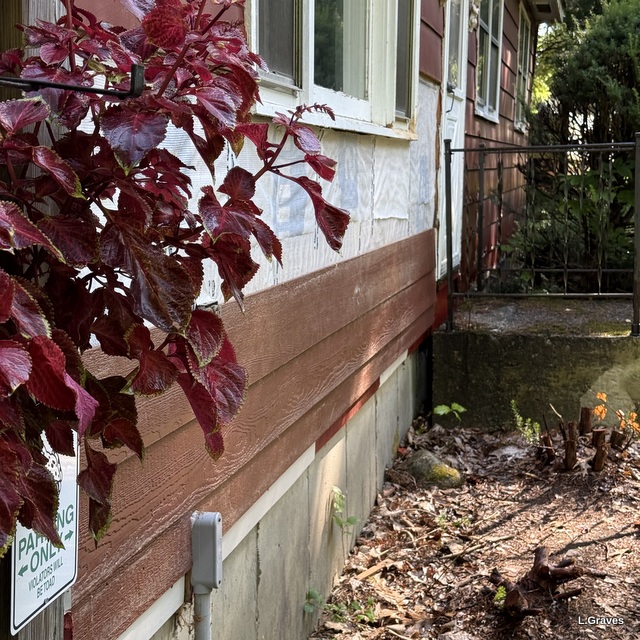
Unfortunately, COVID slowed down Clif’s work on the house, but he’s pushing on, and he should get most of what he needs done before the cold weather comes.
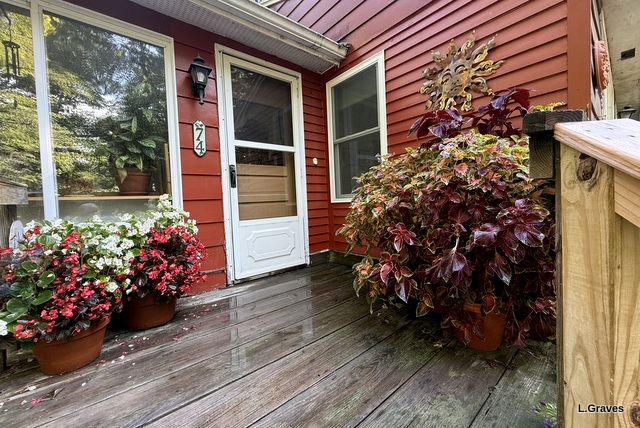
But the plants on the front porch still look glorious and will do so until the first hard frost nips their beauty.
I am glad to be at the beginning of September rather than at the end. I still have most of this month to look forward to, as well as October, surely the most magnificent month in Maine. October is also the birth month of my eldest daughter.
Let the celebrations begin!
******************************************************
One of my blogging friends, Rupali, features a book log every month. I really enjoy her log, so I decided to follow suit and share what I read each month.
Book Log for August
Zone One by Colson Whitehead
I’m a huge fan of Colson Whitehead, especially The Underground Railroad and The Nickel Boys, both of which have deservedly won a Pulitzer Prize. But if I had read Zone One first, I’m not sure I would have read another one of his books. A good lesson in how even very good writers can have a misstep, and not to judge writers by just one book.
Zone One should have been exciting. It features a zombie apocalypse, for God’s sake. The protagonist—call him Mark Spitz—and his cohorts are trying to clear a section of Manhattan, the titular Zone One, of zombies. The book’s action takes place over three days, but there are so many flashbacks to Mark Spitz’s pre-zombie life that the narrative becomes bogged down. The last twenty pages nip along nicely, but by then it’s too little, too late.
The Correspondent by Virginia Evans
Spanning ten years, The Correspondent follows Sybil Van Antwerp, a retired lawyer, through her daily life in Maryland. But rather than tell Sybil’s story in prose, Evans presents the novel in epistolary form—letters Sybil writes and letters she receives. Evans does this in a moving, compelling way, and I found myself saying, “Just one more letter” when I should have been cooking dinner.
Loss and grief inform the story. While Sybil is feisty—she never backs down from a fight or a slight, no matter how small—she is also stuck. Despite being prickly to the extreme, Sybil does care about other people and makes connections in unexpected ways. During the course of the book, these connections help Sybil unfold, and I was with her all the way.
The Things We Never Say by Elizabeth Strout
Born and raised in Portland, Maine, Elizabeth Strout’s style typifies many people’s notion of a New England writer—spare, no-nonsense, and so brisk it borders on abrupt. I’ve read several of her books. There is no fat in them and only a glint of humor here and there. Yet, a sympathy for the characters runs strong in her books, and nowhere is this more evident than in The Things We Never Say.
Artie Dam—teacher, husband, father, and son—is the main protagonist in this story set in Massachusetts. A born teacher who is well-liked, Artie should be happy, but he’s not, and as the story progresses, we find out why. The book wheels through time—past, present, and future—revealing an unhappy childhood and troubles in his own marriage. The title suggests part of his problem: all that is left unsaid. Woven in with Artie’s problems are problems of the United States. But in his own gentle way, Artie makes a big difference in his community. If only there were more Arties in the world.
The Things We Never Say is a quiet story beautifully told.
Sag Harbor by Colson Whitehead
Yes, I gave Whitehead another chance. Such is the strength of The Underground Railroad and The Nickel Boys. Sag Harbor is a semi-autobiographical account of a summer in 1985 spent at Sag Harbor in the Hamptons, in a community built by upper-middle-class Blacks.
The story is told from fifteen-year-old Benji Cooper’s point of view. He and his brother Reggie are left to their own devices during the week while their parents work in Manhattan. Do Benji and Reggie get in trouble? Not really, although Benji comes close to losing an eye during a BB gun battle with his friends. Mostly, though, Benji broods about being a nerd, about girls, about fitting in, and about his alcoholic and at times abusive father.
There’s not much of a plot. Sag Harbor is essentially a slice-of-life story that ruminates on the past and explores the present. Yet there is a forward motion of sorts. At the end of the summer, Benji realizes he is now one of the older kids as he watches younger kids play on the beach.
At times, the book is laugh-out-loud funny. At other times, terrifying as Benji deals with his alcoholic father. I felt both tenderness and exasperation for Benji, exactly the way a parent often feels about their own teenagers.
The Witchmark by C.L. Polk
In a society reminiscent of Edwardian England, magic is reserved for the upper class. Everyone else must hide it or risk being sent to an asylum. Miles Singer is upper class, but his magic has been deemed weaker than that of his more powerful sister, Grace, and he is expected to spend his life assisting her. Not wanting to be in Grace’s thrall, Miles runs away, joins the military, and becomes a doctor, all the while hiding his magic. Miles gets caught up in a murder case, falls in love with a fae named Tristan, and becomes embroiled in his sister’s and father’s plans.
The characters and plot are well done and hold the reader’s interest. Unfortunately, Witchmark is undermined by platitudes and overwriting. Example: “The blood in my veins turned to ice.”
Fans of fantasy would probably enjoy the story. Non-fantasy readers should probably give Witchmark a pass.


September seems to be a reflective month, tipping over into new seasons depending on where you live.
A border season, whether it’s spring or fall.
I loved The Correspondent. Haven’t read the others, and after disliking Olive Kitteridge, (along with everyone else I know who’s read it), I’m not inclined to give Strout another try. Right now I’m reading “Cult of Glory,” a brutal expose of the Texas Rangers, written by a former colleague, Doug J. Swanson. My neighbor is a retired Ranger, so I keep this one to myself.
I loved The Correspondent, too. Colson Whitehead has taught me not to judge a writer by one book. The Things We Never Say is much different from Olive Kitteridge, which I didn’t like either.
I love the autumn too. Really looking forward to October when it might truly cool off. I enjoyed your book log. I read more than usual this past month, and perhaps I’ll join you and Rupali. My favorite read was “The Enchanted” by Rene Denfeld. It was brutal, but oh so beautiful.
Oh, autumn! Hope you join us with your book log. I so enjoy reading about what other people read.
Your porch plants are gorgeous. That coleus, wow. Another month and it will reach the roof.
I’ve read a few of Colson Whitehead’s and enjoyed the Correspondent as well.
Coleus always does well on the porch but this year, my goodness! I guess the weather was just right. Nice that our reading tastes have some overlap.
I like the picture of your fading garden. I hesitate to post them, but I like to capture the process of the plants’ whole life cycle. Nature is fascinating!
Sure is! My garden was lovely until the end of August, but now it has reached that stage it always reaches in the fall.
Our September has come in very gently and is letting us creep into autumn without too much of a shock to the system. All the same, we have put the sitting room fire on once or twice.
And that fire tells a tale of things to come.
Happy September and Happy Birthdays! Wishing you both a great day. Windows open here. 🙂
Same here! We keep our windows open as long as we can. Thanks for the birthday wishes.
Although I don’t miss the heat, I miss the long days. But, as things must, the wheel turns. Enjoy the coming autumn!
Thanks so much! Ready for some crisp weather.
Happy birthdays in fine autumnal weather to both of you . . . and may the green stuff outside the door still give joy awhile! Having watched from the sidelines all the heatwaves and forest fires in the northern hemisphere this year must say I feel quite ambivalently about our summer hellbent arriving with a record el Nino promised . . . fervently hope we don’t follow your climatic horrors . . .
Many thanks! I hope, hope, hope that no fires come your way. Terrifying!
About five years ago my area was besieged from August to February – for about two months late in the period we slept on the floor as a huge area was continuously covered with fire and smoke which was felt less close to the ground . . . the whole coastline of NSW was beset so we could not be evacuated anywhere . . .. a horror story I am now surprised most of us survived in one piece! So I know 😦 !!!
What a glorious , welcoming porch!
Thanks so much! The plants have done very well this year.
I love the look of a fading garden like yours! And is that coleus on the front porch? Whoa! I always enjoy your yard decos and the sun on the porch is wonderful.
Down here, it’s the last of the butter and sugar corn, and on to silver queen….
Thank you, thank you! That coleus is something else, isn’t it?
Wishing you a very happy birthday in advance. The garden and porch looks great.
Many thanks!
I’m glad you are enjoying these early September days and nights (with an extra blanket). Your flowers still look pretty and are likely still much frequented by insects and birds.
The Underground Railroad and The Nickel Boys have been lingering on my TBR pile for years and your book log is a good reminder to move them higher on the pile! As you said: so many books, so little time! 😦
Yes, lots of insects and birds, especially around the golden rod. Move those books higher on the pile. Such good books!
Thank you!
What a lot of celebrations lie ahead for your family! My eldest granddaughter has recommended The Correspondent to me, so I am pleased to read your review of it. I approached The Things We Never Say with caution as readers seem to love it or hate it. I loved it!
How wonderful to have a granddaughter who recommends book! The Correspondent is definitely worth reader. Strout has a clipped New England style of writing, and this doesn’t appeal to everyone. Still, The Things We Never Say is a beautiful book, and I had tears in my eyes by the end.
I hope you enjoy the rest of the month, and that Clif will soon be back to normal. Fascinating book reviews
Thanks, Derrick! Always fun to celebrate special days.
“Celebrate early, celebrate often” is a great philosophy for life. Earlier this week, I met up with a friend from Vienna who turned 50 in April, and she basically treating the whole year as one big celebration. I hope you have a fabulous month of treats ahead!
The new Elizabeth Strout sounds excellent. Am I right in think in it’s a standalone novel, unrelated to the Lucy Barton and Olive Kitteridge universes?
A whole year! Awesome! I do have a plan as I approach my 70 birthday next year —70 books for 70. I normally read between 50 and 60 a year (I bet you read more) so it will be a bit of a challenge for me.
Yes, The Things We Never Say is a standalone. Rather than being set in Maine, as her other novels are, it’s set in Massachusetts.
The changeover from summer to autumn is a fascinating time and always seems disappointingly short. Sorry to hear that Clif has been hindered by COVID. Did you mention it before or is it new news. (Sorry – I am a patchy reader). We were just talking about replacing the summer duvet with a thicker one this morning. Julia thinks it may be time, though I am still sleeping on top of the bedding. I did get into bed at about 6am as I was cold, but it’s still a reasonable temperature.
Yes, too short! I did mention Clif had Covid, but it’s easy to miss things. Today I am wearing a flannel shirt and we even had the heat pump going for a while. Chilly weather!
Sorry, I’m an erratic reader. I hope he is fully recovered. We try to put off using the heating until October. I’m just getting used to non-heatwave weather before it’s time to start complaining about the winter weather. 🙂
I loved the Corespondant. And now I’ll have to go read the Stout book. I love September and October too but wish they were followed by April
Winter is hard on a lot of people. Yes, do read The Things We Never Say. It’s her best, I think.
Yes, the cooler days and nights are most welcome, as are the slowly evolving signs of autumn. May your birthday be splendid, indeed!
Many thanks! It will be a day of rest and simple pleasures.
No goldenrod here, yet. Our nighttime lows are around 80F — your highs! That said, the days clearly are shortening, and while there’s not a hint of coolth in the forecast, it will come. Your coleus and begonias are gorgeous! I finally realized they might do for my patio, which provides constant shade even in our hottest months.
I bet coleus would thrive on your patio. And they sure do add a bright touch. Wearing a flannel shirt today and even had the heat pump on for a while.
Happy early birthday month to both you and Clif! ‘Celebrate early, celebrate often’ is honestly the absolute best philosophy to live by. There really is nothing quite like those crisp 50-degree September nights paired with warm, sunny days. Enjoy every moment of Maine’s splendid season! 🍁🍂
Many thanks! Our celebrations are simple, but we look forward to them and really enjoy them.
Although Laurie, for happy people everyday is a celebration. I really love people who find happiness within themselves. It’s not that hard but some make it hard. Happiness is easy. I hope your simple celebrations make longlasting memories. Thank you for such a good vibe… 😊😊😊
Thanks for the great book reviews!!! I’m bookmarking this for when I need to present my book group with 3 options for them to rank. I think the Virginia Evans book sounds good.
Evans would be perfect for a book group. But be warned:Sybil, the main character, is very prickly. Didn’t bother me, but I have read that some readers didn’t like her.
OK, thanks for the heads up Laurie
Your front porch looks very inviting, and the coleus is growing beautifully. Do you bring the pots indoors for the winter?
I have read many of Elizabeth Strout’s books but not this one. I have ordered The underground railroad and the correspondent. The latter has a long waiting time. I am 33rd in line. Just yesterday, I returned Beloved by Toni Morrison, a story about a formerly enslaved woman.
Thank you, Laurie, for mentioning my name and having a monthly book log.
I received The Underground Railroad today 😊.
I will be interested in hearing what you think of it. The book blew me away.
Enjoy all the beautiful fragrances.
Thank you!
Autumn has arrived here too! And I love it! Thank you for the book reviews.
In Maine, autumn is one of the best months. Glad you liked the book reviews.
Lovely to see the changes and smells this beautiful season brings Laurie, it’s always been my favourite time of year too 🍃🧡🍂 xxx
Such a wonderful time of year!
Your garden and porch evoke a certain nostalgia, Laurie. Thank you for sharing them. I’m glad you still have a full month to predictably enjoy the outdoors. The colors are lovely.
It’s a shame that you both contracted Covid. We were able to get the latest booster along with our flu shots before we travel. I’m relieved.
I’ve always loved Autumn like you. We were married on the first day of fall in 1995. This year we’ll celebrate our anniversary in Chicago.
I look forward to hearing about yoru respective birthdays.
Thanks so much! Clif and I are feeling much better. But even a mild case of Covid is no fun. Happy, happy anniversary and have fun in Chicago.
Thank you, Laurie. We’ve been here since Wednesday night. We had so much fun watching Wait, Wait, Don’t Tell Me. I think you would have loved it, too.
I absolutely would have loved going to a live performance of Wait, Wait. Such a fun show.