First Grilled Bread of the Season

Last Saturday, our friends Beth and John and their cute little dog Bernie came over for lunch. The day was splendid, but unfortunately, the blackflies were out in force, and I had to wear a cap sprayed with insect repellent. There is something in my body chemistry that calls to those biting  blighters. Clif wore a cap, too, but fortunately, the blackflies left Beth and John alone.

Never mind! We spent most of the afternoon outside on the patio. Beth and John brought cheese and crackers, salad, and for dessert, cream-cheese toffee bars. As if that weren’t enough, they also brought a bouquet of flowers. Wow! Such generous guests.

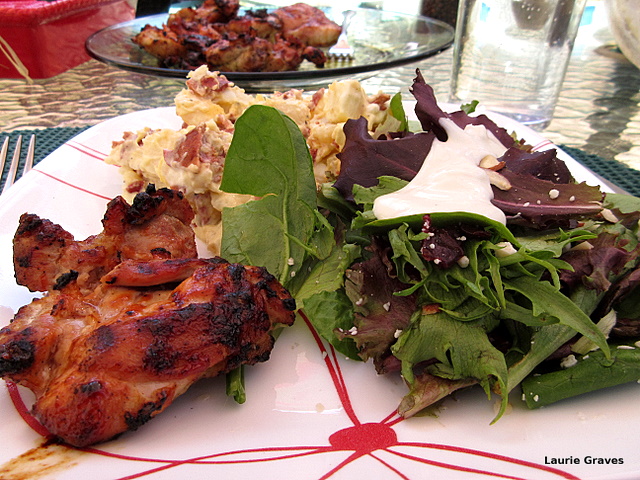
Clif made his legendary grilled bread, the first of the season, and we ate every bit of it. I also made a potato salad, again, the first of the season, and Clif grilled some chicken. By the end, we were completely stuffed.
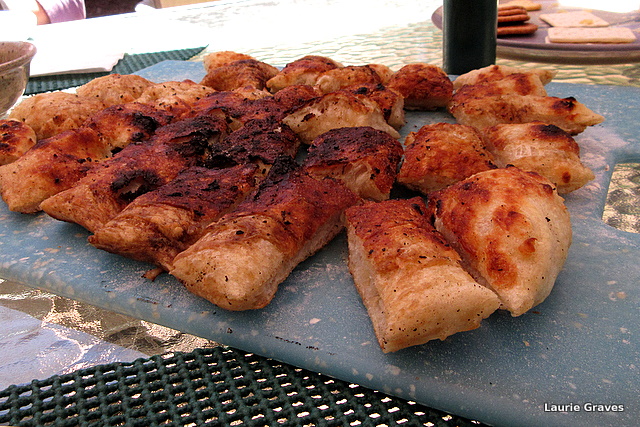
IMG_2175

IMG_2167

But not too stuffed to talk about books, politics, and poverty. Clif and I are watching, for the first time, the excellent HBO series The Wire, and while at first glance, rural Maine seems very different from the ghettos of Baltimore, there are indeed similarities. This is especially true for Beth and John, who live in a small town that is afflicted by extreme poverty, lack of hope, and drug addiction, just as parts of Baltimore are.

“The worst is the lack of hope,” John said. “Young people in my town have nothing to look forward to. Most everything has closed, from the factories to the businesses around town.”

“Do old timers remember a better time, when the factories were booming?” I asked.

“Oh, yeah,” John said. “The town was very different then.”

I could write a whole post about the two Maines, the prosperous coastal communities and the impoverished inland towns where factories once thrived. I could write about how Maine, like too many other states, let communities sink, and as a result, caused an exodus of young people. (Maine has one of the oldest populations in the nation.) And maybe someday I will write about these things because Maine’s tale is the tale of this country, which, in turn, is driving the tone and the rhetoric of this political season.

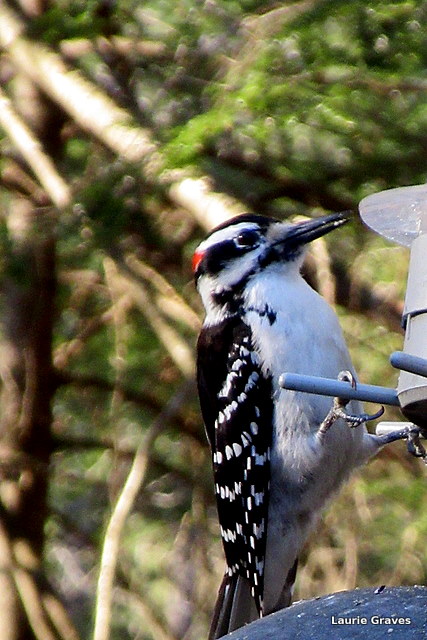
As we talked and ate, the birds came to the feeders, and Beth took some pictures. Both Liam and Bernie begged for bits of chicken, and I slid them a few pieces. Moving away from the issues of poverty, we talked about cameras and funny Maine sayings. John, who grew up not far from the coast, had a wealth of mermaid sayings, none of which I had ever heard. Then there is my fishy favorite: “Numb as a hake.”

“Why are hakes considered numb?” John asked.

None of us knew, and the two dogs didn’t care. They just wanted more chicken to come their way, although no doubt, they would have nibbled on hake, however numb it was.
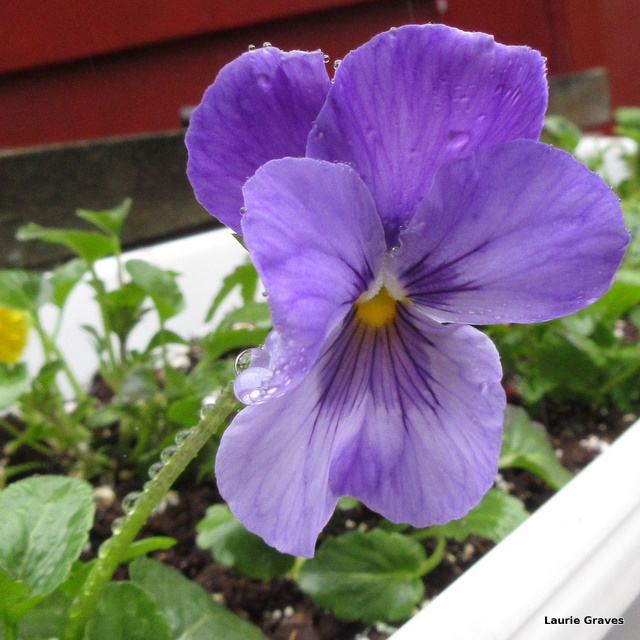
 

May Day, May Day: Jack in the Green

IMG_2181Today is May 2, and while  May 1 is traditionally May Day, I figured the second day of May was close enough to honor the upcoming season of fecundity and the bounty of summer  But I must thank Sophie from Agents of Field for not only bringing May Day to my attention but also for providing additional information of the celebration, information I did not know.

May Day, of course, started as a holiday in many pre-Christian European pagan cultures, and it marked the first day of summer.  May Day was a time for frolicking and folderol, a time to cut loose after winter’s confines and, I expect, its food scarcity. (Let’s just say that in Maine, May 1 is barely the beginning of spring, and between the cool weather and the blackflies, there’s not much inducement for frolicking. Nevertheless, I admire the spirit!)

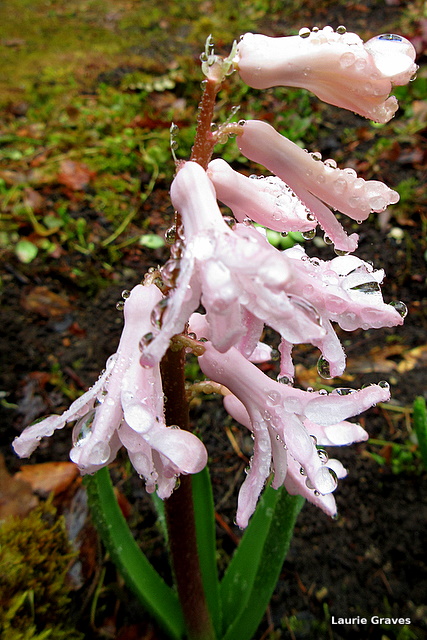
In her post May Day Festivities, Sophie writes about “sprinting onto the lawn in my pjs and smearing May Day dew on my face which, according to ancient folklore, will guarantee lifelong beauty…”  That was a new one for me, and although it’s probably too late, I sprinkled dew—all right, rain drops—from the cedars onto my face after I took a May Day picture of a hyacinth in bloom.

IMG_2185

Then Sophie went on to write about Jack in the Green, a pagan character dressed in a cone of greenery. She tried to get her partner Ade to be Jack in the Green so that she could chase him up a hill and beat him with twigs. Apparently, Ade turned down the role, and after reading more about Jack’s leafy character, whom I knew nothing about, I understood why Ade was reluctant to play this fellow of the foliage.

Ah, the wonders of the Internet. From Agents of Field I skipped to Jack in the Green May Day Festival in Hastings, UK, where I learned about Jack’s dark fate. In Hastings, the Jack in the Green Festival is an annual event and ends with “the slaying of Jack, to release the spirit of summer for this year.”  (Readers, if you have a chance, watch the short video of the parade on the Hastings’s website.  Looks like quite the parade and one worth seeing.)

Oh, the merry month of May! In Maine, even though the weather is not quite as warm as we would like, it is a month of green beauty trimmed with a veil of flowering trees. It is a month in which to rejoice.

My friend Burni sends May greeting cards. What a lovely thing to do! If I can get my  gardening under control, maybe I’ll do the same thing.

And I’ll watch out for Jack in the Green. Perhaps, out of the corner of my eye, I will catch a glimpse of him, streaking through the countryside as he is pursued by a fair woman ready to beat him with twigs.


Arbor Day: Celebrating Trees on a Street

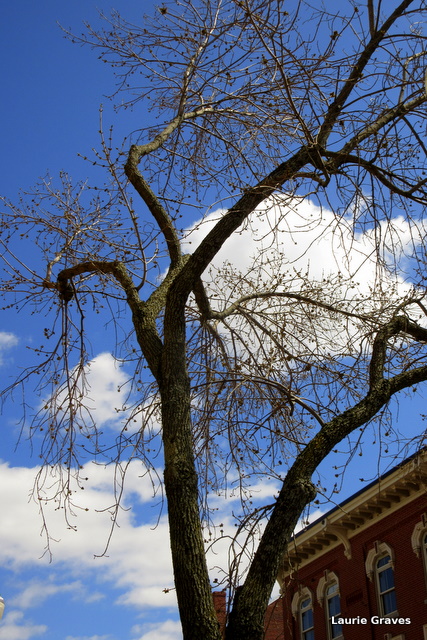
Happy Arbor Day! How fitting that a day should be set aside to honor trees.

According to the website Treehugger, “Arbor Day is generally observed on the last Friday of April.” It comes just one week after Earth Week, and so very appropriate as trees, along with the ocean, are vital for life on this planet.  “Arbor Day in the United States was officially designated in Nebraska in 1872 – pioneers moving to the treeless plains realized they needed trees for things like fruit, windbreaks, fuel, building materials and shade.” Treehugger lists twenty “random” reasons to love trees, from providing food and shelter to giving “us something to look up to, literally.”

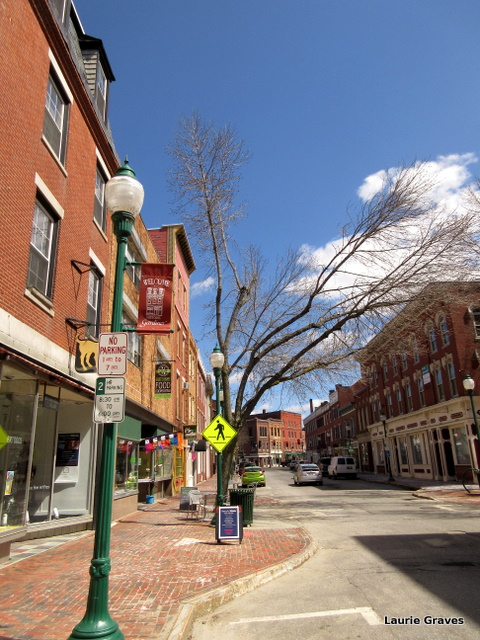
With this in mind, Clif and I headed to Gardiner, to A1 Diner for lunch, and then to take pictures of city trees. We, of course, have trees galore at the little house in the big woods, but I wanted a different aspect of trees.

At A1 Diner, how good the food was, especially those fries. (Readers, I did not eat the chips. To tell the truth, with that platter of golden fries before us, I wasn’t even tempted.)

IMG_2139

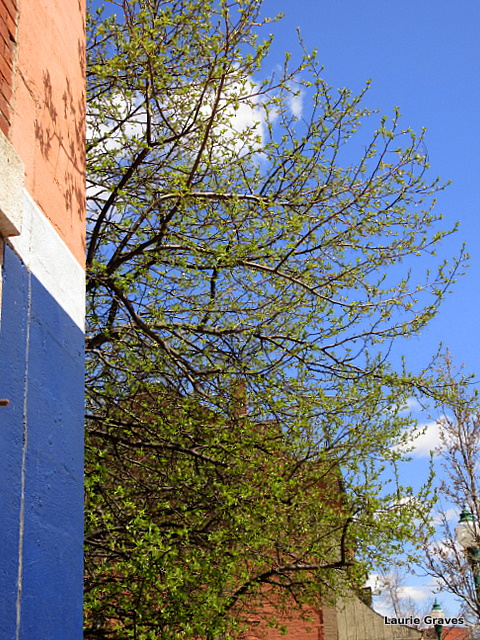
Let’s just say that even without the chips, we were quite full. Nevertheless, Clif perused the beer at Craft Beer Cellar, and while he did that, I photographed some of the trees on Gardiner’s main street. Trees do not exactly dominate the street, but they are present, in their own lovely way.

IMG_2165

IMG_2158

IMG_2145-1

IMG_2149

Trees, trees, trees, with their wood and needles and flowers and leaves. What would we do without them?

Franco-American Gathering: If We Don’t Speak Our Piece, Then Who Will Speak It for Us?

Last Saturday, I went to a Franco-American gathering of artists, performers, writers, thinkers, and friends. It is a yearly event held at the Darling Marine Center in beautiful Walpole, Maine. The center, a branch of the University of Maine, is tucked in the woods, and the ocean glimmers through the trees. In the conference center where we met, there is a great room with a stone fireplace, long tables for eating, and a kitchen off to the side where the staff cooked delicious meals for us.

A glimmer of ocean
A glimmer of ocean

I always look forward to this event, where I get to chat with some of my favorite Franco friends, but this year was especially fruitful for me. Thoughts and ideas were clarified, which in turn has made the way clearer in my personal life. I’ll be exploring one of those ideas in this post, but before I do, I thought it might be good to give a brief history of Franco-Americans in Maine, which, to a large extent, applies to New England as well. Our story is not well known, but more of that later.

In Maine, Franco-Americans are primarily those of French descent who came from Canada. In the mid-1800s, there was a mass migration of families from Québec and eastern Canada’s Maritime Provinces. They left their farms, where they could barely feed themselves, to work in the burgeoning factories that the industrial revolution brought to New England. They were mostly Catholic, and French was their first and often only language.

Another way French Canadians came to Maine was even earlier, in the mid-1700s. During the French and Indian War, there was a mass deportation of French Colonists—Acadians—from Canada’s maritime region. Rather than being deported, some of these hearty Acadians took to the woods and settled in northern Maine.

In my family, I have both Québécois and Acadian ancestors, all coming to Maine from different routes but settling here for many, many years. Indeed, I am a fifth-generation Mainer of Franco-American descent. My great-grandmother never learned to speak English, and my mother didn’t speak English when she started Kindergarten.  Unfortunately, in a sad flip, many of my generation did not learn to speak French at all, but that is a topic for another post.

In Maine, Franco-Americans are the largest single ethnic group, about 25 percent of the population, but for the most part, you’d never know this.  When people think of Maine, if they think of it at all, they think about the coast and lobsters and the taciturn Yankees—the ethnic group, not the baseball team.  The Yankees are here all right—I even married one—and their story deserves to be told.

But so does ours, and all too often it isn’t. Several years ago, when my mother and I visited Waterville’s Historical Society, there was nothing about the city’s Franco-Americans, even though they made up 40 percent of the population. Franco Americans worked in the factories, and they drove the city’s economic engine, but there was no trace of them in Waterville’s historic records. (I hope this has changed, and I plan on checking someday soon.)

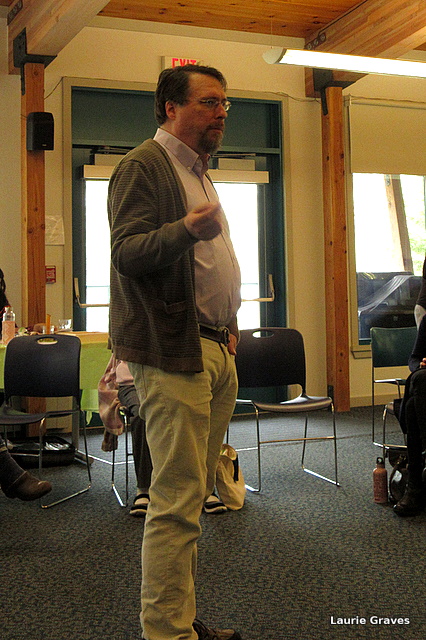
This brings me to a presentation given by David Vermette, whose blog French North America is featured on the sidebar of blogs I recommend. He read from his post Why are Franco-Americans so Invisible?

David Vermette
David Vermette


Well, why are we? David lists various reasons, from “We are associated today with Canada and therefore beneath the notice of most Americans” to “Our Canadien/Acadien ancestors were in North America long before the United States and today’s Canada existed” to “We do not fit into the existing narratives of U.S. settlement history” and finally “Our national character.

I think David, a wonderful speaker and writer, is correct on all counts, but I’ll touch briefly on the last—our national character. Ethnic groups do indeed have a character, and David makes a distinction between generalizations and stereotypes and notes “there are fair generalizations that can be made about coherent cultural groups.”

Among other traits, David spoke of how Franco-Americans value humility: “A Maine Acadian wrote to me, We were taught that you don’t speak well of yourself. You let others speak well of you.In the USA of Donald Trump and Kanye West, this trait is radically counter-cultural.”

David then went on to ask, “If we don’t speak our piece then who will speak it for us?”

Who indeed? It’s long past time for Franco-Americans to speak up, to make a “ruckus,” as David puts it. Our history, our story counts, too, and it should be woven into the narrative of Maine and New England.

I plan to do my little bit, and from time to time I’ll be writing about the Franco-American story on this blog.  I sure wish my mother and grandmother were around to help me.


Let It (Not) Snow

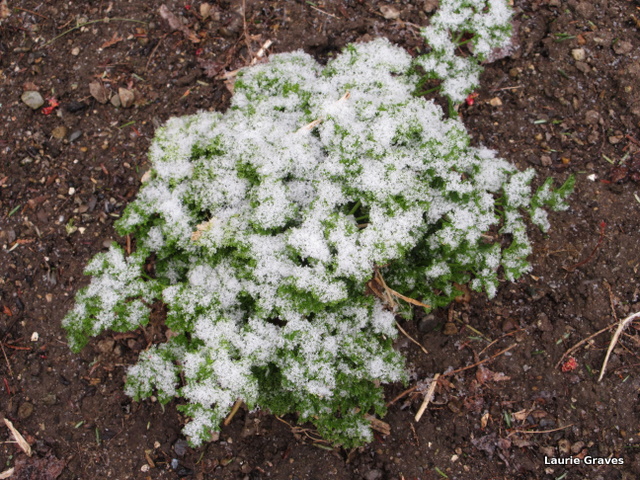
Today, on April 26—the anniversary of my mother-in-law’s birthday (1918) and the town of Winthrop’s incorporation (1771)—at 11:00 a.m., I looked out the window to my backyard. And what should I spy? Snow, snow, and snow. Enough to get my hair wet as I took a picture of the patio table. Enough to frost the herbs and trees.

Snow on the patio table and chairs


Snow on parsley
Snow on parsley


But not enough to stop the cavorting squirrels and their hanky panky. (The female squirrel certainly doesn’t make it easy for the male. You go, girl!)

The snow will not last long, and it will bring much needed moisture to what has so far been a dry spring. But still, snow in April is about as welcome as rain in January. Each in its own time.

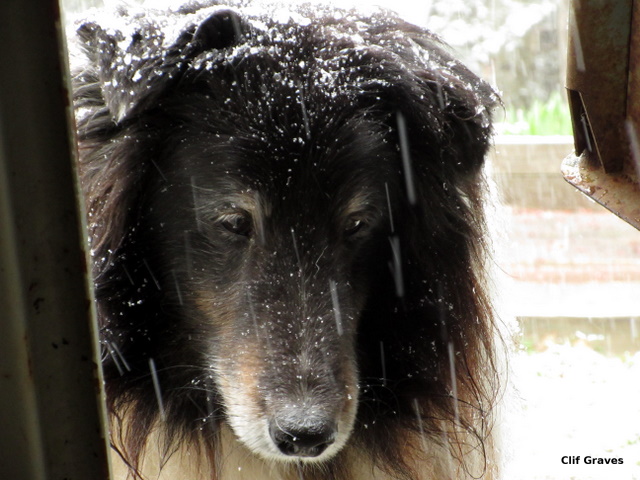
Liam, dog of the north


Poor little pansy
Poor little pansy


For supper, I’ll be making chickpea and chicken sausage soup as well as a batch of biscuits to go with it. As I eat the hot soup, I’ll be thinking, “Snow, snow, go away!”

Our front yard
Our front yard

Earth Day 2016: Time is Getting Short

Today is Earth Day, a special day not only for Earth but also for our family. April 22 is the birthday of our youngest daughter, Shannon. Happy birthday, Earth Day girl!

April 22 is also the anniversary of our friends Mary Jane and Vilis. It is my understanding—correct me if I’m wrong, Mary Jane—that they were married on the very first Earth Day in 1970. Happy anniversary to you, Mary Jane and Vilis!

IMG_1984
A birthday and anniversary flower


Here’s a brief history of Earth Day, taken from the history. com website: “Earth Day was the brainchild of Senator Gaylord Nelson of Wisconsin, a staunch environmentalist who hoped to provide unity to the grassroots environmental movement and increase ecological awareness. ‘The objective was to get a nationwide demonstration of concern for the environment so large that it would shake the political establishment out of its lethargy,’ Senator Nelson said, ‘and, finally, force this issue permanently onto the national political agenda.’ Earth Day indeed increased environmental awareness in America, and in July of that year the Environmental Protection Agency was established by special executive order to regulate and enforce national pollution legislation.”

Since Senator Nelson started Earth Day, there have been big improvements with cleaning up the environment, and I have seen them in central Maine, where I have lived most of my fifty-eight years. I grew up in Waterville, by the Kennebec River, and it was so dank and dirty that no one wanted to even dip his or her big toe in it. I suppose there must have been some hardy wildlife living in and by the river, but to my young eyes the Kennebec River in Waterville seemed to be an empty, foaming mass.

And now oh now there are eagles and ospery and ducks and other birds that live by the river. In Augusta, just down from Waterville, there are sturgeons, ancient-looking fish that appear to have time traveled from the Triassic. People go kayaking on the river, and they even dare to go fishing. In Hallowell, there’s a broad pier by the river and plenty of brightly colored chairs where people can relax and enjoy the water on a fine day.

IMG_1971
Last summer in Hallowell by the Kennebec River


But the dark shadow on the horizon, of course, is climate change, which has turned out to be a huge challenge for humans. Recently, on the radio, I heard an environmentalist say that when it comes to climate change, it is five minutes to midnight. And so it is. Every year Earth gets warmer, bringing us, among other things, droughts, floods, intense storms, dying coral reefs, and rising sea levels.

We are all in this together, and I hope we can all learn to work together to end our dependency on fossil fuels, to lower our carbon output, to stop the world from becoming even warmer.

That is the Earth Day message for now and probably for a very long time to come. And it is one we must carry with us throughout the year.

IMG_1993

Honoring Earth Week: Thursday—The Darling Buds of April and a Nearly Full Moon

Time was when I had both daffodils and tulips in my garden. In short order, the moles voles took care of the tulip bulbs—at the little house in the big woods, little rodents positively abound, even though we have always had cats. So that was that for tulips.

But the daffodils were another matter. Apparently, moles do not care for their bulbs, and for years and years the daffodils’ jaunty blooms brightened an otherwise drab spring garden. But then the bulbs petered out, as bulbs sometimes do, and I must shamefacedly admit that I did not replace them.

Who’s sorry now? I am, that’s for sure, especially after seeing the daffodil pictures on Jason’s wonderful blog Garden in a City. I have vowed to mend my lax ways and plant bulbs this fall so that next spring I can have cheerful yellow in my spring garden. In the meantime, I’ve spotted some daffodils in my neighbor’s garden up the road. Perhaps she’ll let me photograph them.

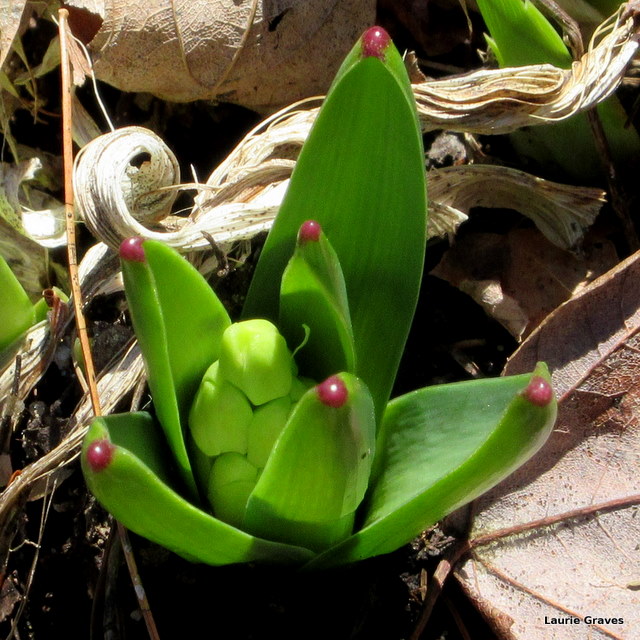
I do have hyacinths coming up, and their bulbs have proved remarkably sturdy. They do not spread much—hyacinths, so sweet and showy, seem to know their value and feel no need to elbow their way through the garden. Over thirty years ago, when we first moved to Winthrop, my mother-in-law bought some bulbs and randomly planted them in bunches throughout the garden. I still love how they pop up here and there, little spring presents to dazzle us with both looks and scent.

Right now, the darling buds are just beginning to form. After taking a picture of various plants, I noticed, for the first time, the little red tips of the leaves.

IMG_1956

“Do the red tips go away as the plant matures?” Clif asked when I showed him the picture.

“I don’t remember,” I answered sheepishly, and I promised to keep a better eye on them.

We have had many days of azure skies and sun. Naturally, there have been fire warnings, but these clear days can’t be beat for working in the yard, for raking and uncovering flower beds. We are making good progress, and in the next week or so I expect the gardens will be free of leaves and ready for wood ash, organic fertilizer, and compost.

Then comes the part I always look forward to—planting flowers in pots. How I love doing this, and I’m always sorry when the last flower is planted.

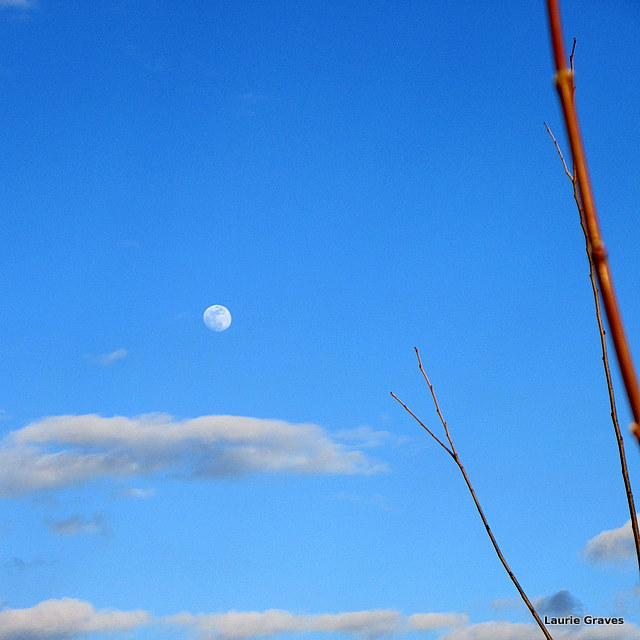
Tonight there will be a nearly full moon. Appropriately, the full moon—the pink moon—is tomorrow, on Earth Day. As the nights have been as clear as the days, the waxing moon fills the evening with a bright, luminous glow that would make a flash light unnecessary on a walk up our dark road.

IMG_1931

On a recent visit our daughter Dee asked, “Where are the street lights?”

My response. “Dee, you’ve been gone too long. We’ve never had them.”

And this is why the full moon is such a treat on our road. For a week each month, weather permitting, we can look out our windows at night and see the yard, the trees, and the road.

Addendum: Eliza Waters kindly pointed out that moles are insectivores, and it was probably voles that ate my tulip bulbs. Thanks for the correction, Eliza!


Honoring Earth Week: Tuesday—April Showers Bring…Pilgrims

Last night we had April showers, and today is a drippy day.

IMG_1902

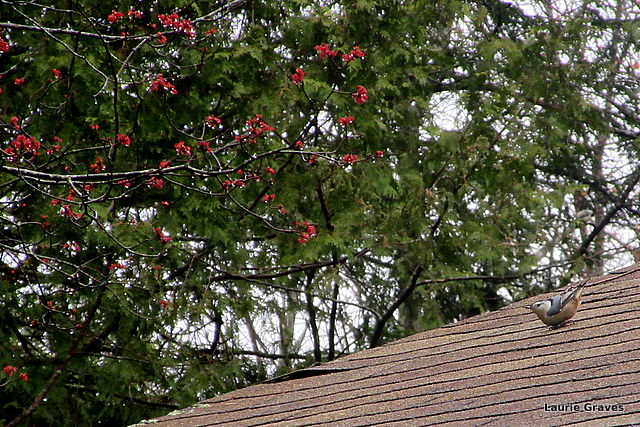
While I was out taking pictures, I heard a nuthatch’s call, and I spotted the little creature on the roof.

IMG_1905

As I was walking around the yard, I thought of  silly little snippet  my daughters liked when they where young.

What do April showers bring?
Mayflowers!
And what do Mayflowers bring?
Pilgrims!

Ah, Pilgrims, those stern settlers of New England. To be fair, they had their good points. With their emphasis on individual choice merged with community, Pilgrims (aka Puritans) were the motivators for yearly town meetings, which to this day is the democratic and sometime contentious governing force in many small towns in Maine. With their desire to create a “Godly society through educated citizens,” Puritans established the school laws of 1642, which encouraged literacy and universal education.  In 1636, Harvard was founded, and in 1711, one of the first public libraries opened in Boston.

It cannot be denied that the Puritans were a bloody bunch in their early days, but no bloodier than any other group. Those were bloody times, both here and in England and Europe.

But now I must be blunt, and I apologize to readers who come from Puritan stock.  The worst thing about the Puritans was that they were party poopers extraordinaire. In fact, they waged a war against Christmas, and found the holiday to be a pagan “abomination” totally unsupported by Scripture. The Puritans referred to Christmas as “Foolstide,” and for a time it was illegal to celebrate Christmas in New England.

Did the Puritans stop with Christmas? They did not. According to Wikipedia, “In his award-winning book Creating the Commonwealth (1995) historian Stephen Innes writes that the Puritan calendar was one of the most leisure-less ever adopted by mankind with approximately 300 working days compared to the 240 typical of cultures from Ancient Rome to modern America. Days of rest in the New England calendar were few, Innes writes, and restricted to Sabbath, election day, Harvard commencement day, and periodic days of thanksgiving and humiliation. Non-Puritans in New England deplored the loss of the holidays enjoyed by the laboring classes in England.”

And May Day, that wild and wonderful celebration of fertility and spring and flowers? No, no, and no. (Nathaniel Hawthorne wrote about this in his short story “The May-Pole of Merry Mount.”)

After wandering around the wet yard and taking pictures and thinking about Pilgrims, I decided it was time to come in for breakfast and for my morning’s work on the computer.

But one last silly thought. In my mind’s eye, when the Pilgrims left England, I see the country collectively waving “Buh-Bye. And don’t let the door hit you on the way out.”

A blog about nature, home, books, movies, television, food, and rural life.