Category Archives: Recipes

A Gray Spring Day: Perfect for a Tomato Soup with Farmer Kev’s Vegetables

IMG_8281Today is a gray day, but I am not sorry for the misty weather because truth be told, I am a little achy from the sudden burst of outdoor activity. Over the past few days I have been sweeping, removing leaves from flower beds, picking up sticks from the backyard, and hauling outside furniture up from the cellar.

Even though I regularly ride the exercise bike and take the dog for a walk almost every day, my body was, ahem, unprepared for all the outside work. So a day of rest is a good thing. When the next nice day comes, I’ll be ready for more outside work, which I really do enjoy. It’s funny how working in the garden is so much more satisfying than, say, dusting or vacuuming. I suppose it’s because I’m outside, with the sun on my face and the birds fluttering and singing in the trees overhead.

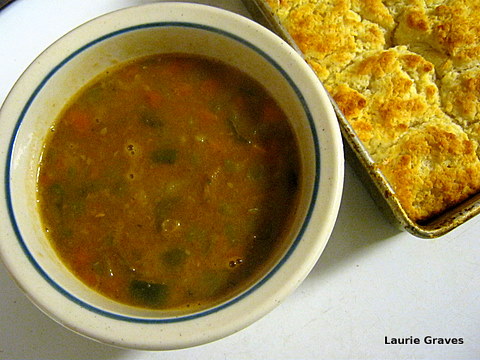
On this cool day, homemade tomato soup is on the menu for supper tonight. I made the soup on Monday, and we’ll be eating the last of it this evening. In fact, we’ve pretty much been eating it all week, but it’s such a good soup that Clif and I haven’t minded the repetition one bit.

Basically, as is the case with so many of my soups, this tomato soup is a variation on a theme, and I’ve made many a minestrone following this template: tomatoes, water, onion, garlic, vegetables, chicken sausage, chickpeas or white beans, spices, and some kind of pasta added to the bottom of each bowl before the soup is ladled on top. (Pasta added directly to the soup tends to swell and swell until it becomes truly alarming.)

However, this time when making the soup, I did something a little different. In my pantry, I had a can of crushed tomatoes with basil—Muir Glenn, a little more expensive but worth it. I also had a can of Muir Glenn diced tomatoes. I often buy fresh basil for my minestrone soup, and I thought, why not try the crushed tomatoes with basil? Somehow, I had never done this before. I’d always just used diced tomatoes.

After tasting the finished soup, I wondered why in the world I hadn’t used the crushed tomatoes sooner. This definitely comes under the category of an old dog learning a new trick. Not only did the basil give the soup a lovely taste, but the crushed tomatoes also gave it a smooth, rich texture. (The diced tomatoes are important, too. They add a satisfying chunk to the soup.)

For vegetables, I used Farmer Kev’s frozen string beans and yellow squash, perfect for this kind of soup and for many other kinds, too. I had two cups of chickpeas in the freezer, so out those came to thaw and go into the soup.

This type of soup is perfect for the slow cooker. Basically, just chop, add, and stir everything in. Bring the ingredients to a simmer, and let them bubble until the flavors have mingled.

Biscuits are always a nice addition to soup. They are quick and easy to put together, and I plan on making some tonight, using a recipe of my mother’s. (Oh, she was quite the biscuit maker.)

As we Mainers might say, biscuits and soup on a cool, rainy spring night make the finest kind of meal.


Smooth and Chunky Tomato Soup

(Note: This makes a lot of soup—10 or 12 generous servings. My large slow cooker was filled to the brim. To make a smaller batch, use small cans of tomatoes and cut back accordingly on the other ingredients.)

1 (28) ounce can of diced tomatoes
1 (28) ounce can of crushed tomatoes with basil
42 ounces of water. (I used the empty cans—1 1/2 cans of water.)
4 cloves of minced garlic
1 medium onion, chopped
1 cup of summer squash, chopped
1 cup of string beans, chopped
1 (12) ounce package of chicken sausage, cut in rounds and then cut in half
2 cups of chickpeas (White beans would work well, too.)
1 teaspoon of dried oregano
1 teaspoon of dried thyme
1/4 teaspoon of red pepper flakes (or more, to taste)
Salt, to taste

Put all the ingredients into your slow cooker, and let ‘er simmer until your house is fragrant with the smell of tomatoes and spices. On high, the soup will take about four hours. On low, seven or eight hours. Cook some pasta, if you like, to go in the bottom of each bowl and then ladle some soup over the pasta.



Southwestern White Bean Soup to Make on a Reluctant Spring Day

IMG_8046
Farmer Kev’s vegetables, frozen then thawed

Clif and I love soup, and living in Maine gives us the opportunity to eat soup nine months of the year. (I’m counting June, which is often rainy and cool.)  Soup has so many things in its favor. A bowl of soup is warm and filling and comforting. It is forgiving and lends itself well to improvisation. Soup is often low in calories and usually can be made in a slow cooker. As if all this weren’t enough, most soups are very economical to make. Yes, indeed. There is a lot to like about soup.

Thanks to Farmer Kev and his winter CSA share, I have packets and packets of frozen vegetables in my freezer. Soups are the perfect way to use frozen peppers, beans, and zucchini, and over the winter, I’ve made quite a dent in those packets.

Last week, I was in the mood for a Southwestern soup. I had everything I needed—dried white beans, Farmer Kev’s frozen vegetables, onion, garlic, spices, tomato paste, and soy sauce, which I put in many soups to give them more of that coveted umami flavor. I also had some chicken sausage and chicken broth.

I seldom use canned beans, which always taste tinny to me. I much prefer the flavor of beans I cook myself, and since I am home all day, I have ample time to soak the beans overnight and then simmer them the next morning. For this recipe, I soaked two cups of white beans, which gave me about six cups of cooked beans. ( If time is of the essence, then by all means use canned beans. The soup will still be good.)

Basically, I chopped the vegetables into small bits, browned the sausage, and threw everything, including beans and spices, into the slow cooker. By the time Clif came home from work, the house was fragrant with the smell of bubbling soup—-another point in soup’s favor that I forget to mention in my opening paragraph.

I made a huge slow cooker full of the soup, thinking I would freeze some if we grew tired of eating it. However, this didn’t happen. We gladly ate the soup for three nights—Clif always has seconds—and didn’t mind one bit.

Soup, soup, soup!

IMG_8114

Southwestern White Bean and Sausage Soup

Makes 9 generous servings

2 cups of water
1 (32-ounce) box of chicken broth
1 cup of diced carrots
1 cup of green beans, chopped small
1 cup of zucchini, chopped small
1 cup of chopped green peppers
1 medium onion, chopped small
4 cloves of minced garlic
1 1/2 tablespoons of chili powder
1 teaspoon of oregano
1 1/2 teaspoons of cumin
1/2 teaspoon coriander
1/4 teaspoon of red pepper flakes
1 teaspoon of salt
6 cups of white beans ( I mashed two cups to give the soup a thicker texture.)
3 tablespoons of tomato paste
Several shakes of soy sauce (Or more depending on taste)

This soup couldn’t be easier. Basically, when everything is chopped and browned, put the ingredients in a slow cooker and let them come to a simmer. On high, this soup takes about four hours. On low, seven or eight hours. When the soup has bubbled for a while, taste it to see if more spices need to be added. Serve with dollops of sour cream, or eat it plain. As you like it.

Biscuits or cornbread make a mighty good accompaniment. If I were serving this to company, I would add chopped cilantro as a garnish.

Bran Muffins and Costa Rica

IMG_8163Yesterday, our friend Diane came over for tea and bran muffins and to tell us about her recent trip to Costa Rica. She brought pictures of lush tropical landscapes, big lizards, sculpture, and buildings with thatched roofs. We learned that Costa Rica has a population of about four million people, with much of the population being clustered in and around San Jose, the country’s capital.

Diane told us that Costa Rica didn’t seem to have the extreme poverty of, say, Mexico. While many of the homes were modest, they were decent, and they all had electricity.

A quick bit of research confirmed Diane’s impressions. According to an article in Wikipedia, Costa Rica has a high literacy rate—well over 90 percent, “with a better record on human development and inequality than the median of the region.” Costa Rica has no military,  and the country is known for “its progressive environmental policies, being the only country to meet all five criteria established to measure environmental sustainability.” Costa Rica plans to be carbon neutral by 2021, and they have banned recreational hunting, which gives them a gold star in my book.

As Diane noted, it is easier to get things done in a country with only four million people, and this is certainly true. The vast population of India or China makes progressive reform and action slow and difficult. Nevertheless, more populous countries could learn from Costa Rica. This country has decided to put much of its resources into education and the environment, which benefits many people rather than just a few. (Even more affluent countries could learn a thing or two.)

No country, of course, is perfect, and while Diane didn’t see much extreme poverty, Costa Rica nevertheless struggles with a poverty rate of 23 percent. Still, it is a country thriving in what could be considered a tough neighborhood—Nicaragua is one of its neighbors.

After Diane finished telling us about her trip, the talk turned to other subjects, to politics, to family, and to one of our favorite topics—movies. Outside, a wet snow fell, making the April landscape look more dreary than it already did. However, when I looked out one of the dining room windows, I saw a crow gathering materials for what must be a nest. So the crows, at least, think spring is coming.

We drank tea, ate bran muffins, and decided we would like to get together once a month to watch a movie together. A perfect frugal activity for Clif and me.

“But we have to plan ahead,” Diane said, “and mark it on the calendar.” Indeed we do. Busy schedules make planning ahead a necessity.

The afternoon passed all too quickly, and it was time for Diane to leave. I sent her home with a couple of bran muffins, which she thought were tasty. It is a good bran muffin recipe. A friend gave it to me many years ago, and it’s a family favorite.

I’ve posted the recipe in my former blog, A Good Eater, but that was a while back. This recipe is so good that it seemed  worthwhile to post it again. These bran muffins go well with tea, with soup, or as an accompaniment to almost any meal. I often add a cup of thawed blueberries to the batter. Somehow, I just love the combination of bran and blueberries, and it’s good for you, too.

Tasty and good for you. A winning combination.

Bran Muffins

1/4 cup of vegetable oil
1/4 cup of brown sugar
1/4 cup of maple syrup or honey
2/3 cup of milk
1 egg, beaten
1 cup of flour
1 cup of wheat bran
1 tablespoon of baking powder
1/4 teaspoon of salt

Heat oven to 400 degrees Fahrenheit. Grease 12 muffin cups.

In a medium-sized mixing bowl, combine the flour, wheat bran, baking powder, and salt. Set aside. In a large mixing bowl, blend the oil and brown sugar. Add the maple syrup, milk, and egg. Mix well. Add the dry ingredients, mixing until the ingredients are just moistened.

Scoop batter into the greased muffin cups. Bake for 20 minutes or until muffins are brown.

From Farmer Kev’s Carrots to Ginger Carrot Soup

From Farmer Kev's carrots...
From Farmer Kev’s carrots…

The other day, I looked in the crisper of my refrigerator and saw that I had carrots—lots of them—from Farmer Kev’s winter CSA. The carrots were all still perfectly good, but I knew the time had come to make a serious dent in them.

Ginger carrot soup came immediately to mind. Clif really likes it, and especially with Farmer Kev’s lovely carrots, which only need to be scrubbed and not peeled, it is an easy soup to make.  A food processor for chopping the carrots makes the soup even easier to put together, and this device, along with an immersion blender, should have pride of place in all frugal kitchens where most of the meals are home cooked.

The following recipe is adapted from a recipe I picked up somewhere—unfortunately all I have is the card with no identifying name. However, I’ve fiddled with the recipe so much that I can safely call it my own. There is as much of my own writing and instructions on the card as there is of the original recipe.

Ginger carrot soup is good anytime, but it is especially good in the spring. Its bright color is matched by an equally bright and spicy taste. Just the tonic for coming out of the long, cold winter. Serve it with a salad, and you have an utterly healthy meal. Add biscuits or bran muffins, and you still won’t be too far over the edge. But any way you serve it, enjoy!

To ginger carrot soup
to ginger carrot soup

Ginger Carrot Soup

2lbs of carrots, peeled (if necessary) and chopped
6 cups of water or stock
1 1/2 teaspoons of salt
Pepper to taste
1 large potato, chopped
3 tablespoons of vegetable oil
1 medium onion, chopped
2 cloves of garlic, large chop or crushed
1 teaspoon of grated ginger or 2 teaspoons of ground ginger

In a very large stock pan, heat the oil and add the carrots, potatoes, and onion. Sauté them for several minutes. Add the garlic and sauté for a minute more. Add the water, the salt, and the pepper, and let simmer for at least  45 minutes, until the vegetables are very soft. Purée the soup and add the ginger. If using ground ginger, add 1 teaspoon, then taste. Add the next teaspoon according to taste. (Clif likes it spicy, so I always add more ginger.)

North African Ragout

IMG_7713Thanks to Farmer Kev and his winter CSA program, I have lots and lots of summer squash and zucchini in packets piled so high there is barely room for anything else in the freezer.

Accordingly, I’ve been making batches of minestrone soup, which not only uses the zucchini and squash but also frozen beans, another item from the CSA.

Minestrone soup is good. We love it, but we also love some variety, and in the nick of time, Farmer Kev sent a recipe for an Italian ragout that used squash and zucchini, along with frozen peppers, yet again another item from the CSA. The recipe involved roasting the vegetables with garlic, blending them, adding tomatoes and spices, and cooking it some more until you have a tasty ragout to serve over rice, pasta, couscous, or whatever.

As much as I love Italian dishes—they are, in fact, a favorite—with this dish my mind somehow turned to North Africa—to cumin, cinnamon, and a little smoked paprika. Chickpeas would be added after the mixture was blended, and toasted almonds on top when the ragout was served over couscous.

So out of the freezer came the squash, zucchini, and peppers and into the roaster they went with garlic and onion.

IMG_7695When they had roasted for about forty-five minutes, I blended them with an immersion blender. However, I made two mistakes: I had not cut the squash, peppers, and zukes into chunks, and I did not let the mixture cool down enough. The result was a hot, splattery mess, where the vegetables more or less had to be mashed with the blender. Next time I make this dish—and there will be a next time—I will be sure to cut everything into chunks before roasting.

IMG_7699After the vegetables were blended, I added chickpeas, the spices, and tomatoes.

IMG_7707I put the cover on the roaster and let the mixture cook in the oven for another forty-five minutes. When the ragout was steaming hot, I served it over couscous and sprinkled toasted almonds on top. The results? “Pretty darned good,” my husband said as he went back for seconds.

Yes, indeed, and somehow the ragout managed to be smooth and spicy at the same time.

Now, I know that not everyone has a freezer full of vegetables, courtesy of Farmer Kev, but I have no doubt that this recipe could be made with fresh vegetables, cut in chunks and roasted longer, until very soft. In the heat of summer, when these vegetables abound, this dish could even be made in the Crock-Pot, starting first thing in the morning, then blending and adding as the day progressed.

Next time I make this dish, I will try the Crock-Pot method, just to see how it turns out. In the meantime, we have several meals of North African ragout, and after having used so many packets of frozen vegetables, there is even room in the freezer for a couple of Ziploc bags of ragout, to be taken out on cold but busy days.

North African Ragout
Adapted from a Farmer Kev Recipe

1lb of zucchini, cut in big chunks
2lbs of yellow summer squash, cut in big chunks
1lb of sweet peppers, cut in big chunks
4 or 5 cloves of garlic, crushed
1 medium onion, cut in big chunks
Olive oil
Salt and pepper

Preheat oven to 400 degrees. In a large roasting pan, combine all the vegetables and sprinkle with olive oil, salt, and pepper. Roast, uncovered for 45 minutes or so until the vegetables are very soft.

Remove the pan from the oven, turn the heat down to 350 degrees, and let the mixture cool. Using an immersion blender, blend vegetables to a consistency you like. (Leaving it a little chunky works just fine.)

In a medium mixing bowl combine:

1 28oz can of diced tomatoes, drained
1 tablespoon of cumin
1 teaspoon of cinnamon
1 teaspoon salt (or more, to taste)
1/2 teaspoon of smoked paprika
1 teaspoon of red pepper flakes (or more, if you like it really hot).
2 cups of cooked chickpeas

Pour over the blended vegetables, mix to combine, cover, and return the roaster to the oven. Bake for another 45 minutes and add more spicing, if so desired.

Serve over couscous or rice. Top with roasted almonds, and pretend you are somewhere warm where the air smells of spices.

Spicy Squash Soup Using Mostly Vegetables Grown by Farmer Kev

For the past several years, Clif and I have bought a summer CSA (community supported agriculture) farm share from Farmer Kev, one of our favorite young farmers. In previous posts, I’ve written about Farmer Kev, so I will be brief: He’s still in his twenties, was bit by the farming bug as a young teenager, but doesn’t come from a farming family. Farmer Kev is a friend of the family and is one of the hardest-working young men that I know.

This year, for the first time, Farmer Kev offered a winter CSA farm share, and Clif and I did not hesitate to buy one. As a result, we’ve been getting vegetables that store well over the winter—beets, carrots, potatoes, garlic, and lots and lots of squash. The time had come, I decided, to make a spicy squash soup.

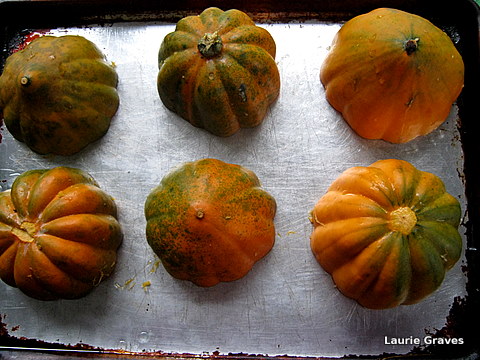
Any squash will do for this soup, but as I had an abundance of acorn squash, that is what I used. The soup is a two-step process because baking acorn squash first is the easiest way to mash it. Even though the hands-on time is minimal, I usually plan to bake the squash one day and make the soup on the following day. This time was no different. I baked the squash on Monday and made the soup on Tuesday.

To bake the squash—I used three—I greased a baking sheet, cut the squash in half, scooped out the seeds, placed the squash face down on the baking sheet, and baked them for an hour or so at 350 degrees.

Ready to be baked
Ready to be baked

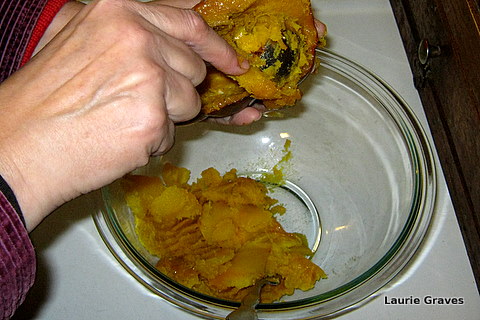
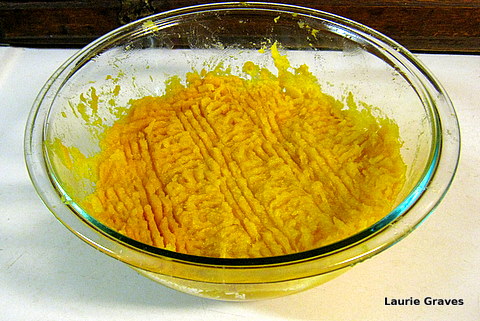
When the squash was very soft—I poked it with a fork to test it—I removed the baking sheet from the oven, let the squash cool, and then mashed it into a bowl, which was then stored in the refrigerator until the next day. Note: If you are an early bird, then the baking of the squash and the making of the soup could easily be accomplished in one day.

Scooping and mashing squash
Mashed and ready for soup

Next came the making of the soup base. For this I used potatoes, carrots, and garlic, all courtesy of Farmer Kev.  (I also used an onion, which, alas, I had to buy at the store.) I sautéed the vegetables, added water and spices, and simmered them for about an hour. When the potatoes and carrots were very soft, I blended the cooked squash into the simmered vegetables.

And then there was soup.

Clif likes his soup to be bulky with either crackers or pasta or some other ingredient to “fill it out,” as he puts it. So I usually cook some pasta to go with puréed soups, and the pasta is added to the bottom of the bowls rather than to the soup itself. That way, the pasta doesn’t swell into something unrecognizable.

I just thought of another reason why I bake the squash the day before. That way, the oven is free for me to make homemade bread to go with the soup.

Hot soup and homemade bread on a cold January night. Pretty darned good, as my Yankee husband might say.

Squash soup and homemade bread


Spicy Squash Soup
Makes six generous servings

4 medium potatoes, cubed
2 small or 1 large carrot, chopped
2 cloves of garlic, roughly chopped
1 medium onion, chopped
6 tablespoons of oil or butter
6 cups of water
1 teaspoon of dried tarragon
1 teaspoon of celery seed
1 teaspoon of cumin
1/2 teaspoon of white pepper
2 teaspoons of salt or to taste
4 cups of cooked, mashed squash (pumpkin could also be used)

In a large stockpot, heat the oil and add the potatoes, carrots, and onion. Sauté for five minutes and add the garlic, sautéing for 30 seconds. Add the water and the tarragon, celery seed, cumin, white pepper, and salt. Simmer for about an hour, until the vegetables are very soft.

Blend the squash into the cooked vegetables. The best way to do this is with an immersion blender. Set the stockpot in the sink, add the squash to the pot, and blend away in one easy swoop. You don’t have to worry about burning yourself, and you don’t have the mess of blending it in several batches. Whoever invented the immersion blended should be pronounced a hero to home cooks everywhere.

If you don’t have an immersion blender, then use a blender with a glass pitcher, do it in batches, and be careful not to burn yourself.

Then, enjoy!

Blue Sky, Perfect Pumpkin Bread, and a Trip to Boston

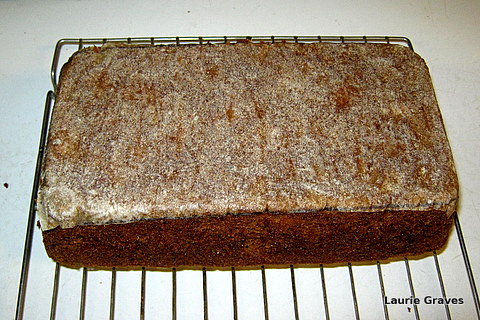
Upside down pumpkin bread with parchment paper on the bottom

The title of this post indicates a perfect pre-Christmas trio—blue sky, pumpkin bread that didn’t stick to the pan, and a trip to Boston to see our Thai student Saranya, who is no longer a student but instead is a lovely woman. As I noted in yesterday’s post, I haven’t seen Saranya in seventeen years, and what a treat it will be to get together with her after such a long time.

All else dims compared with the excitement of seeing Saranya, but I have to admit it was a great feeling to make pumpkin bread that didn’t stick to the bottom of the pans. I lined the bottoms with parchment paper, and out came the bread with no trouble at all. The bread is in the freezer, where it will stay until the day before Christmas.

Then there is the blue sky. There are some clouds, but who cares? The sun is out, and it is not raining. My friend Margy is coming here for tea, and she will be walking from her home, about a mile from the little house in the big woods.

Later, I’ll be taking the dog for a walk in the woods. How nice it will be  not to come back with wet hat and mittens.

Finally, this afternoon I plan to make a double batch of gingersnaps—Rochelle’s gingersnaps as they have come to be called around here.  (In honor of my mom who made them all the time. I still use her handwritten recipe.) The cookies are good keepers, and I plan to give most of them away.

Busy, busy, but what fun!

Cheddar Cheese Soup and a Gathering of Friends

Last Saturday, we had two sets of friends over for dinner, and it was one of those special gatherings that brings a happy glow to the cook. We’ve known these friends for many, many years. Our daughters are the same age and graduated from high school together. So perhaps part of the reason for the glow was that we are all so comfortable together.

Then there was the beer and wine. Clif had an assortment of beer from Craft Beer Cellar in Portland, where our son-in-law works. Craft Beer Cellar sells hundreds of different kinds of beer, which has become as specialized as wine. Not all of our guests are beer lovers, but the ones who do like beer were impressed with Clif’s selection. For the wine lovers, there was a nice bottle of a white wine called Viognier, from Meridians in Fairfield. There’s nothing like good wine and beer to bring a happy glow to a party.

Flickering candles and a tree with blue Christmas lights provided an actual glow in the little house in the big woods. While perhaps they weren’t essential, candles and tree surely set the stage for the food and the wine.

The centerpiece of the meal was cheddar cheese soup—creamy and rich and adapted from a Moosewood recipe. This soup is a  favorite with the family, and it’s one I make for the holidays. For gatherings, I put the soup in a crock-pot, and nearby I have big bowls of cooked broccoli and tortellini so that guests can serve themselves. That way, they can have exactly how much they want of the soup, broccoli, and tortellini.

“Very, very good,” was the consensus about the soup. There were seconds for some of our guests and requests for the recipe. Now that surely brings a glow to the cook’s cheeks because one of the chief delights of cooking is to feed and please people.

To add to the meal there was also the brie appetizer that one friend brought and the chocolate and coconut squares from another friend. Surely they contributed to the happy mood of the party.

In the end, I truthfully I can’t say whether it was the beer, the wine, the candles, the soup, the appetizer, or the dessert that made this gathering such a success. Whatever it was, there were kisses and hugs as everyone left and a promise to get together after the holidays.

All in all, it was some party, as we Mainers like to say.


Cheddar Cheese Soup Recipe
(Six hearty servings by itself; Eight with the addition of broccoli and pasta)

10 medium size potatoes, peeled and diced
2 large carrots, peeled and chopped
1 large onion, chopped
2 tablespoons of oil
2 large cloves of garlic, cut in thirds
6 cups of water
2 teaspoons of dried dill
8 ounces of cream cheese, sliced in four or five segments
2 cups of grated cheddar cheese (Go for a good, sharp brand and please do not buy the pre-shredded cheese. The taste of this soup hinges on the quality of the cheddar.)
Salt and pepper to taste. (I use two teaspoons of salt and liberal grinds of the pepper mill.)

In a large stockpot, heat the oil and sauté the potatoes, carrots, and onion for 5 minutes or so. Add the garlic and sauté for 30 seconds, then add the water and the dill. Let simmer for 45 minutes or an hour, until all the vegetables are really soft.

If you don’t have an immersion blender, buying one before you make this soup would be a very good idea. Immersion blenders are not expensive and are ever so much easier to use than one with a glass container. Directions for an immersion blender: Place the stockpot in the sink and blend the potatoes, carrots, garlic, onion, and water. When this is smooth, add the cream cheese in chunks and blend until smooth. Return the pot to the stove and on a medium heat, add the cheddar, salt, and pepper. At this point, the soup must be kept warm enough so that it is hot but low enough so that it doesn’t boil. No matter how careful you are, it will probably develop a skim on the top. No need to worry. Just stir it into the rest of the soup, and the skim will melt.

Directions for a blender with a glass container: In four batches, blend the potato, carrots, onions, garlic, water with a slice of cream cheese that has been quartered. Be sure not to fill the container too much and to cover the top with some kind of cloth as you blend. This soup is hot, and it will burn you if it spurts out the top and onto your hand. I speak from experience from my pre-immersion blender days.

Any kind of pasta can be added to this soup as well as broccoli. I serve them on the side so that the pasta and broccoli don’t swell or get too mushy in the soup.

Happy holidays and happy anytime that you have this soup.

A Macaroni and Cheese Tale

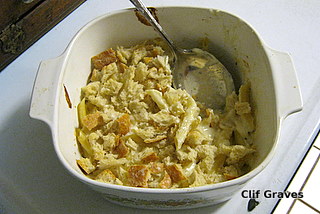
IMG_6982I have a husband who really, really loves macaroni and cheese.  By his own admission, Clif could eat it once a week—twice, actually, if you consider leftovers, which we certainly do at the little house in the big woods. Over the years, I have developed a simple but tasty recipe that includes using a good tangy cheddar, a bit of nutmeg, and a fairly thin cheese sauce that will allow the macaroni to swell and still be saucy. Fresh bread crumbs for the top? But of course!

Because the macaroni and cheese is baked, I seldom make it during the summer. But summer is over, and as soon as fall came, Clif began hinting that he might like macaroni and cheese for supper. Soon, I promised, soon. Somehow, though, when fall came, I made other things for supper, and macaroni and cheese never made it on the menu. Until last night.

Every once in a while, procrastination is a good thing. A couple of weeks ago, from none other than Mario Batali, I picked up a good tip for making a white sauce, which always requires a fair amount of constant stirring. (When you have creaky knees, cutting down on stirring time is a good thing.) His suggestion was so simple that I wondered why in the world I hadn’t thought of it myself. That is, heat the milk so that it is hot before adding it to the flour and butter roux.

Last night, I fulfilled my promise to Clif and made macaroni and cheese for supper. I heated the milk, as Batali suggested, and it worked like a chahm, as we Mainers would say. The heated milk cut the stirring time in half, and my knees were grateful.

When it was done, I said to Clif, “Use some restraint. I want enough mac and cheese for two suppers.”

“Fat chance,” Clif promptly responded. “I have been macaroni-and-cheese deprived for too long.”

I couldn’t argue. After all, I hadn’t made macaroni and cheese since spring. Clif, however, did use some restraint, and we have enough left for our supper tonight.

And the next time I make a white sauce, you can bet I’ll use Mario Batali’s tip of heating the milk first.


Here is my recipe for macaroni and cheese. Although I have posted it a couple of times, I figured that for new readers it would be convenient to post it again.

Macaroni and Cheese

9 oz. of uncooked macaroni
2 1/2 cups of milk, heated
2 cups of grated cheddar
3 tablespoons of butter
3 tablespoons of flour
1/4 teaspoon of nutmeg
1 teaspoon of salt
1/4 teaspoon of pepper

Butter a casserole dish. Cook the macaroni until firm in a big stock pot. Drain when done, and pour the macaroni into the casserole dish. In a big sauce pan, using medium heat, melt the butter, add the four, and whisk until bubbly. Whisk in the hot milk, the salt, pepper, and nutmeg, and then stir until thickened. The sauce is done when it leaves a line across the back of a wooden spoon. Add the cheese and stir until smooth.

Pour the cheese sauce over the macaroni. This mixture will look very thin, almost like a soup, but I promise it will bake into a perfect mac and cheese. I always like to tear up a few pieces of bread into crumbs for the top. Bake at 350° for 30 minutes or until the mixture is bubbly at the edges.


A “Baked Bean” Lentil Dish

IMG_6746One of my favorite cooking and food websites is Food52, where the emphasis is on unfussy food made with inexpensive ingredients that most home cooks have in their kitchens. There are also many vegan and vegetarian dishes, and this goes in the direction in which Clif and I are heading with food. We are both very much concerned with overpopulation, limited resources on our finite planet, and living lightly. (I plan to explore the living lightly concept in future posts, and I am currently reading a book with the apt title Living Lightly.)

Lately, I have become enamoured with red lentils, which are not as, ahem, earthy as the brown lentils. (I have uncharitably referred to the flavor of brown lentils as “muddy,” and Clif is not a fan of them, either.) For our Labor Day get together, I made curried red lentils in my slow cooker—thanks, Susan Poulin, for the terrific recipe!—and they were a big hit. It was the first time I had used red lentils, rather than brown, and I was hooked by their smooth, subtle flavor. Red lentils, I knew, would become a staple at the little house in the big woods as we turn to a plant-based diet.

Therefore when Joe Beef’s Lentils Like Baked Beans recipe was featured on Food52, and I saw the primary ingredient was red lentils, I decided to try it.  I did make some changes. I did not use bacon. No explanation needed, I think. Rather than cooking the lentils on the stove, I cooked them in a slow cooker, which thanks to Shari Burke’s encouragement has become my favorite little appliance. I just tossed everything into the slow cooker, let it come to boil on high, and then turned it down to low so that it could simmer until supper time. I also added more cider vinegar, maple syrup, and ketchup.

Finally, I served it over rice, which is the way I prefer most bean and lentil dishes. While I like lentils and beans, they can set heavy, especially at night, and I find rice lightens the dish. I also sprinkled ground peanuts on top, because, well, nuts and lentils go together like apple and pie.

The results? The lentils did taste a little baked beans, although nobody would ever confuse the two. “Pretty good,” Clif said, going back for seconds. Perhaps not company good—somehow the dish lacked the pizazz I look for when cooking for a gathering—but certainly good enough for a Tuesday night supper. And good enough to make again.

Then there is the price. I figured I used about $2.50 worth of lentils, which were organic. The other ingredients—maple syrup, cider vinegar, dried mustard, oil, onion, garlic, and ketchup—I had on hand, and the small amounts I used certainly didn’t come to more than a dollar or two. There were rice and ground peanuts—again, no more than a dollar or two, and I expect I am estimating on the high side. Even erring on the high side, say, $6 or $7 dollars for the whole meal, which would easily feed six, makes this an extremely economical dish that would fit in with most people’s budgets, even when they are tiny, like ours.

Among foodies, nutritionists, and activists, there has been much talk about the cost of healthy eating in the U.S. , and rightly so. According to the American Institute for Economic Research, food prices have risen 44 percent over the past fourteen years. And salaries? Well, not so much. Nevertheless, in comparison with beef and pork, lentils and other legumes are a great bargain.

For confirmed carnivores, making the transition from meat to legumes is probably not an easy one. However, for those of us with more flexible palates, eating more beans and lentils is a tasty way to eat lower on the food chain. Right now, I have a good supply of black beans, kidney beans, chickpeas, and lentils. I will be adding other beans to my stockpile, and I’ll be experimenting with various meatless recipes so that our diet is varied and satisfying.

Stay tuned!