
There. With the heatwave that started the first of September and shows no sign of abating, it is official. In Maine, September is the new August, with nights warm enough to eat on the patio, and no jacket required. The days are ridiculously hot for mid-September—in the 90s—and while I long to make soup, I will wait for cooler weather.
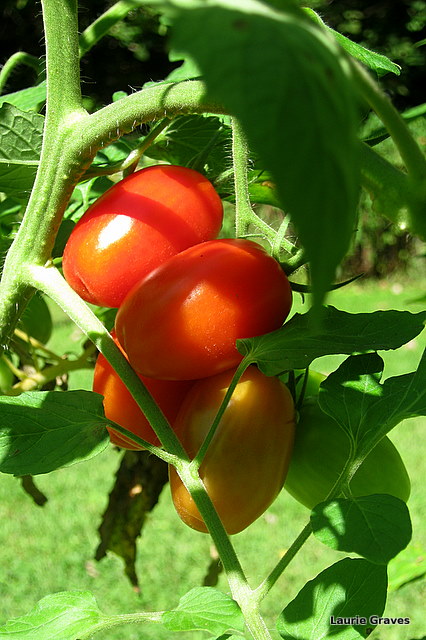
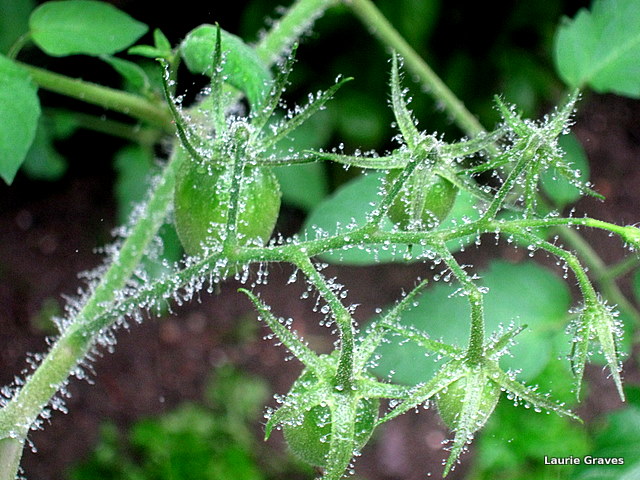
One warm evening a few nights back, as Clif and I were sitting on the patio, I glanced at my little garden and admired the bright red fruit of the fair Juliet. (What a wonderful variety of tomato!) Then I noticed something else not quite as admirable. The top of one of the plants looked as though it had been stripped of leaves.
“Now that looks suspicious,” I said to Clif.
“Maybe it’s just where you picked tomatoes.”
“Maybe,” I replied, but I was not convinced and decided to keep an eye on things.
A couple of nights later, my suspicions were confirmed—more stripped leaves. However, as it was my birthday, and Clif and I were enjoying cocktails on the patio, I was in no mood to go poking around the tomato plants and look for the culprit.
The day after that, I had dental work—at the crack of dawn by my standards—and I wasn’t in a mood to do much of anything, not even have a cocktail.
Today, I decided to take the bull by the horns, so to speak, and look for the munching miscreant. It took me a while to find him (or her) but find him I did, in all his green and striped glory. (Fortunately, he seemed to be solo.)
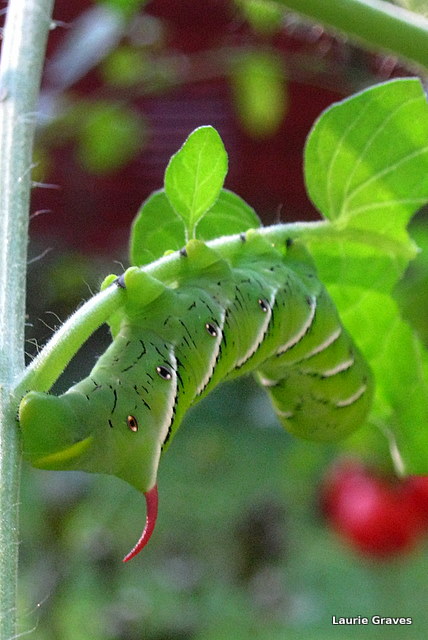
At first, I thought he was a tomato hornworm, but upon doing research, I discovered he is, in fact, a tobacco hornworm. They look similar, but the tomato hornworm has a black “horn” and the tobacco hornworm has a red “horn.” Also, the stripes are a little different, with the tomato hornworn having more of a V pattern. The adult of both species is a large brown moth, again very similar in appearance. I also learned that, as a rule, tobacco hornworms are happy to eat tomatoes but don’t usually come this far north. (I’m convinced it’s that darned hot weather we’ve been having. Lord only knows what else is going to make its way north.)
Naturally, I had to take a picture, and I have to admit that a closer look led to a certain fascination—the red horn, the white and black stripes, and the small “eyes” dotting the side. And with that fascination came some sympathy. After all, the little creature is just trying to make a living, albeit on my tomato plants.
Sentiment, of course, has no place in the garden, and when I went out later to pick tomatoes, I had resigned myself to dispatching him. But, as I picked, I couldn’t find him anywhere, and eventually I gave up looking. I had a nice basket of tomatoes for a roasted sauce. (There will be a recipe tomorrow.)

And not to put too fine a point on it, but the tomato plants are not exactly looking their best. Every year, a late blight hits my tomatoes, and that’s exactly what has happened. Fortunately, the blight always comes after most of the tomatoes have ripened, so it’s not a serious problem. I’ve picked most of the tomatoes, and I’m thinking of pulling the plants.
I know. I shouldn’t let that tobacco hornworm live to create more tobacco hornworms, and I’ll probably go out again with a jar of soapy water.
But for today, anyway, the tobacco hornworm has had a stay of execution.
Addendum: Son of a biscuit! In doing further fact-checking about tobacco hornworms, I found out that the adult moth is no other than the hummingbird moth, which I adore. There’s been one fluttering among the flowers all summer, and I’ve been trying to take a picture of her. Guess I know where the little creature in the tomatoes came from.




















 Notes From the Hinterland