Category Archives: Food for Thought

Be Careful What You Get Rid Of

IMG_6469The gardens have reached that ragged, tattered phase, that end of August look. The snails have had their way with the iris leaves, which are now in shreds. No real harm has been done to the irises—I know this from past experience—but they look worn out, ready to be clipped back for fall. The daylilies—magnificent this year—are pretty much done blooming, and they are all stalks and yellow leaves.

Even the bee balm, a glorious burst of red for well over a month, looks woebegone as petals fall and Japanese beetles feed on them. Still, there is that spicy bergamot smell coming from the bee balm, and true to its name, it attracts every manner of buzzing bee, from bumble bees to smaller bees whose names I don’t know.

Yesterday, as I ate my lunch on the patio, I watched a hummingbird moth work the phlox. Tufted titmice, chickadees, and woodpeckers came to the feeders at the edge of the patio. A few days ago, I saw a black and white warbler, the first ever at the little house in the big woods. If I were the type of person who kept lists, that bird would have been added lickety-split.

Hummingbirds come to their little red feeder, which I keep well stocked with sugar water. They also love the bee balm as well as the jewelweed, which grows at the edge of the lawn, just before the woods. In early summer, I disliked the jewelweed’s leggy look and invasive ways. I didn’t recognize the plant for what it was, and I pulled much of it out, intending to take care of the rest by summer’s end. However, other tasks called, and the plants left behind lost their legginess and matured into a dark shapely green lit up with a myriad of tiny orange blossoms. Bees and hummingbirds love these flowers, and the plants bob beneath the buzzing, hovering activity.

There is a lesson in all of this—be careful what you pull, be careful what you get rid of. What initially looks leggy and ungainly might very well mature into something bright and lovely and beloved.
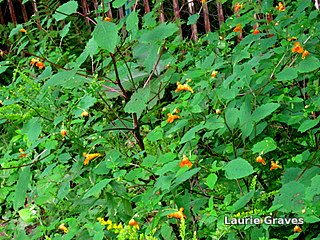

Glowing jewelweed
Glowing jewelweed


Heading Toward Mid-August

We are heading toward mid-August, that sweetest, saddest time of the year when the crickets sing, and summer is winding down. Now it is dark at 8:00 p.m. rather than at 9:00, and to borrow from the writer Susan Cooper, the dark is rising. All around Winthrop, people are rushing to squeeze as much as they can out of the last weeks of summer.  Family and friends from away come to visit. Barbecues are planned. Ditto for bike rides, boat rides, hikes, and swimming.

Little Winthrop, population circa 6,200, has an action-packed weekend coming up. On Saturday, there will be the annual Winthrop Art Fair, and Clif and I have a spot selling photographs and cards. After the fair the Winthrop Rotary will host its annual Family Barbecue & Gumbo to End Hunger. (The proceeds go to various agencies, including the Winthrop Food Pantry.) Clif and I went the year before last, and the food was fantastic. If we’re not too zonked after the Art Fair, then we’ll go this year, too.

On Sunday, the Feather Lungs, a rock band, will be performing at lovely Norcross Point at 2:00 p.m., and featured on bass will be none other than our library director, Richard Fortin. Clif and I are hoping to go to that, too.

In my own backyard, the gardens are starting to look a little tattered, the way they always do this time of year. However, the flox are coming into bloom, and because I am so flower obsessed, I just had to take a picture of them.

IMG_6327I also caught a picture of this woodpecker, and although it is not what you would call a really good photo, it’s not too bad, given I took it with my little Cannon.

IMG_6334

My three main obsessions seem to be flowers, food, and birds, and the Narrows—and indeed nature—could be considered my muses. As always, I can’t help but think how lucky I am to live in Winthrop, with the glittering Narrows just down the road, flowers all around, and the backyard aflutter with birds and insects.

In the next few weeks, as August winds down, I’ll be trying to squeeze as much as I can out of this most lovely month.


Can Everyone Have Forty Acres?

I read a blog called Ben Hewett written by, well, Ben Hewett. He and his wife, Penny, live, farm, and raise their two sons on forty acres of land in Vermont. Hewett’s blog chronicles his rural life, and he does a fair amount of philosophizing as well. Hewett has a strong writing voice, firm and vibrant, that keeps this writer reading.

Sometimes I agree with Hewett, but often I don’t, and this sets in motion a one-sided discussion where I reflect on what he has written. In truth, that is one of the reasons I read his blog because in my solo arguments with Hewett’s take on things, I clarify my own thoughts.

In his latest post, “Something to Chew on,” Hewett writes about poverty and the notion that poor people need more money. On the one hand, Hewett does realize that in our current society, people do need a certain amount of money, but he perceives that the real problem is “that these families simply don’t have the resources to prosper outside the moneyed economy. They don’t have access to land.”

In the piece, Hewett also notes that last year his family officially went below the poverty line, but they do not consider themselves poor because they raise so much of what they need, which is a bit unusual today, but not so much when I was growing up. “We can live this way because we have land and because on that land, we have cultivated both the soil and our skills.”

In one sense, Hewett is right. Being able to produce much of what you eat certainly means you do not have to spend as much money at the store. Hewett and his wife work hard, as do their sons, and they have created a healthy, satisfying life for themselves, even though they are officially poor.

But does this mean that his own solution—farming on forty acres of land—is the catch-all solution for everyone in Vermont, in this country, in this world? It can’t be. There isn’t enough arable land for everyone to have his or her own forty-acre spread. There are simply too many of us on this planet.

According to the World Bank, there are .51 hectares of arable land per person in the United States. This comes to a little over an acre per person. In theory, all families could have between two and four acres on which to grow things, but that wouldn’t leave any arable land for forests or wildlife  or crops that require space. Or livestock.

Let me be clear. I do not begrudge Hewett and his family their forty acres. I am only saying that it is not sustainable for everyone to have this. In fact, it isn’t sustainable for everyone to only have his or her own acre.

Then there is a the matter of temperament.  We are not all the same. Not everyone is suited to be a farmer, and to work at something that doesn’t suit you is a misery.  Some people are keen to teach or be librarians, to be nurses or doctors, to be social workers, to make jewelry, to perform, to dance, to paint, to write code, even to work in a restaurant. The list goes on.

So in principle I agree with Hewett that becoming more self-reliant—cooking, growing your own food, knitting, sewing, home repairs—is a good thing. But I also believe that there are no substitutions for economic justice, for a living wage, for fair taxation, for social services, for all the things that truly do lift people out of poverty.


A Rainy Fourth and the Legacy of Presidents

The Fourth turned out to be rainy, but after the blistering heat of the previous few days, I didn’t mind a bit. Our barbecue beans and hot dogs are good inside or out, and the little house in the big woods can easily accommodate 7 people.

As we gathered around the dining room table, I surveyed the bounty—Jill’s potato salad, Alice’s pasta and greens salad, Shannon’s wheat berry salad—and I mentioned how lucky we are to have family and friends who can cook. I quickly added that we would love them even if they couldn’t, but it’s a real bonus that they are all such fine cooks. Because of this, our feasts are truly feasts.

We ended with homemade ice cream pie drizzled with blueberry sauce and raspberry sauce. Alice said, “If I wasn’t in polite company, I’d lick the plate.” Words to warm a cook’s heart, that’s for sure.

As is our wont, after the meal we stayed at the table for quite a while—two or three hours—and made an attempt to solve the world’s problems. Appropriately for the Fourth, we discussed presidents. Jill is making her way through Robert Caro’s biography of LBJ, and as there are 4 volumes published, with a 5th on the way, this is quite an endeavor.  Our son-in-law, Mike, is reading The Bully Pulpit, Doris Kearns Goodwin’s biography of Teddy Roosevelt.

So we jumped back and forth among the presidents, from Obama to LBJ to Teddy Roosevelt. All presidents want to hold onto power. That we know. But are they ever sincere in their desire to leave a legacy that goes beyond power? In other words, do they want to do something good for the country just because it is the right thing to do?

At the table, we argued about this for some time. LBJ, it seems, was a ruthless politician who used unscrupulous means to gain power. Yet, his Great Society programs and his support of the Civil Rights Act belies the notion that he was in power only for himself and for his cronies. Indeed, the Civil Rights Act cost the Democratic Party dearly, with Southern Democrats leaving en masse to join the Republican Party after the bill was passed. It took grit for LBJ to stand up for two groups of people—the poor and African Americans—who didn’t have much political clout. Certainly LBJ was mindful of his legacy, yet the direction his legacy took must have had something to do with his beliefs and ideals.

The same could be said of Obama and the Affordable Care Act. Obama did something that presidents, starting with Teddy Roosevelt, have wanted to do but have been unable to accomplish—have some kind of national health care system that would guarantee coverage for all people. It has been said that Obama spent most of his political capital on the Affordable Care Act. But who, really, benefits from the Affordable Care Act? Is it rich people who don’t have to worry about how their medical bills will be paid? Of course it isn’t. The ACA benefits people who are struggling to find decent health care coverage, and while these same people might have voted for Obama (or maybe not), they are unlikely to have donated large sums of money to his campaign. Could it be that Obama genuinely thought that affordable health care would be good for the country? I think it’s quite likely.

Good discussions on the Fourth, as the rain came down and night settled over the little house in the big woods.

Food for the Fourth, Rainy or Sunny

Every year, for the Fourth of July, we have a gathering at the little house in the big woods, and we always hope to spend most of the time on the patio in our backyard. Unfortunately, summer in Maine is a hit or miss affair—some days are sunny, and others are rainy, especially in June or July. Naturally, you never know when the rain will come, and this makes it particularly difficult to plan a Fourth of July “barbie,” as the Australians might put it.

Some years, the weather has been fine, and Clif has been able to grill at his leisure, beginning with bread and ending with chicken. Other years, the day starts out sunny, but by midafternoon the clouds gather, and it’s a rush to grill the food and eat before the rain comes. And some years, Clif has been out there with his umbrella, trying to keep things dry as he grills.

Last year, we finally came to our senses and planned food that could be eaten indoors or outdoors. We decided on hot dogs, either grilled or pan fried, and a crock-pot full of beans in barbecue sauce. Our guests brought various side dishes, and we all agreed that this was a very tasty way to celebrate the Fourth.  Clif and I were so pleased with the results that we decided this would be our new tradition for upcoming gatherings on the Fourth.

As I write, two kinds of beans—black and kidney—are simmering on the stove. Tomorrow morning, into the crock-pot they will go along with peppers, garlic, onion, and barbecue sauce. Because Hurricane Arthur is blowing up the East Coast, it is my guess that we’ll have to dig out the cast iron frying pans to cook the hot dogs indoors.

No matter. There will be seven us, a good number for the little house in the big woods, especially when the furniture in the living room is rearranged a bit.

Tomorrow morning, on the Fourth, I expect I’ll wake up hearing the various hosts, reporters, newscasters and commentators on NPR reading the Declaration of Independence. NPR has been doing this for over 20 years, and it is a tradition I have come to love. I am always moved by the language, the style, and the promise of the Declaration of Independence.  The promise, of course, hasn’t always been kept, but it is there, and I believe that, in part, it is this promise that gives the American temperament its optimism, its energy to look ahead, to move forward.

Optimism can at times seem foolish, naive, and misplaced. But optimism can also propel a country through hard, bitter times when it looks as though there is no place for optimism. Solutions to seemingly intractable problems such as climate change can come from optimism.

So happy birthday, United States. May optimism continue to guide us.


Help! They Put Barcaloungers in My Cinema!

For Father’s Day, Clif got a gift certificate for Regal Cinema, which mainly shows blockbusters, silly comedies, and movies that appeal to teenagers. We don’t go to this cinema very often, preferring the more independent movies that are shown at Railroad Square Cinema. (Hint to Railroad Square: Make your gift certificates available on your  website.) However, there are certain blockbusters we do like to see, and Clif has a very soft spot for comic book films. Therefore, the current X-Men movie was calling to him, so to Regal we went on Sunday.

We hadn’t been to Regal Cinema since Christmas, and what a surprise we got when we walked into the theater showing our movie. Gone were the old, quite comfortable seats. They had been replaced with row after row of black Baracloungers, seats wide enough for even the most ample body, seats with little movable trays for refreshments. There were also gigantic cup holders and a special designated holder for popcorn. But the best feature was the footrest, popped up by a lever on the side of the armrest.

It didn’t take long for Clif and me to pop up the footrest and recline. Did it feel strange to be sitting in a recliner at the movies? Yes, it did. But I must also admit that it was very comfortable, especially for someone like me who has restless legs. When I sit, I usually squirm and fidget, and sitting with my legs up is a great help.

As we waited for the movie to start, Clif said, “They did this to make going to the movies feel as comfortable as being in your own living room.”

I agreed that this was probably the case. With movies coming so soon to DVD or to Amazon and with modern television sets being so crisp and clear, staying at home to watch a movie gets better and better.

Then there is the cost. For a family of four to go the movies, the admission is over $30, and that’s the afternoon price. Throw in popcorn, drinks, candy, and the tab comes to over $50, which for many people is a pretty hefty price for a trip to the movies.

Back in the old days, when I was a teenager, the price of a movie and popcorn really wasn’t an issue. I don’t remember what it cost, but I can’t recall ever thinking, “Wow, going to the movies and getting popcorn are just too expensive for me.”

I expect the Barcaloungers aren’t going to entice more people to go to more movies. It’s my guess that cost is the issue. Make it affordable, and more people will come.  It’s that simple, but I don’t foresee cinemas lowering their prices any time soon.

One last comment about the new seats: A woman who sat in the same row as we did brought a blanket and slippers with her. Now that’s really getting into home comfort at the cinema.


A Tale of Two Maines

A month ago, the director of the Winthrop Food Pantry sent board members information about the number of people who came to the pantry from January through April 2014. (Full disclosure: I am on the board.) Four hundred two families came, and this added up to 1,102 individuals. For a city the size of Portland or even Augusta, one thousand people might not seem like very many. However, according to the 2010 census, the population of Winthrop is 6,092, and a realtor I know pegged it at 6,200 for 2014. So my town’s population is 6,000, give or take a couple of hundred, and this year between January and April, 1,000 residents were fed by the food pantry.

I admit it. I was shocked that the numbers were so high. I shouldn’t have been. On days when the pantry is open, the waiting room is crammed with people waiting to get food. But to me, Winthrop seems like a middle-class community, a macaroni and cheese kind of place. Yes, there are some wealthy people, and they tend to live by the many beautiful lakes in town, but there are a larger number of state workers and other folks who earn an average salary.

Until I saw the food pantry numbers, I didn’t realize that there were also so many people in town living on the edge, people who are—let’s be honest—earning so little money that they meet the federal guidelines for poverty, the guidelines the pantry uses. The number of people coming to the pantry has risen since the start of the Great Recession, and those numbers don’t seem to be going down anytime soon.

For a completely different view about how some people eat in Maine, you only have to turn to last week’s Maine Sunday Telegram and its recently added food section, Source: Eating and Living Sustainably in Maine. The article’s headline was innocent enough: “Dinner is nearly ready: Summer brings a slew of opportunities for right-there-on-the-farm eating.”

Sounds lovely, doesn’t it? Bucolic and simple with lots of mouth-watering food fresh from the fields or the creamery at various farms in southern Maine. And I’m sure it is—albeit for a very hefty price. Most of the prices for the farm meals listed were between $110 and $60 per person. Yes, per person. (The Well, at Jordan Farm in Cape Elizabeth, was the only farm listing with what might be considered a reasonable price—between $23 to $20 per entry, with a kids’ menu available.)

I try to reconcile these two Maines—the thousand people in Winthrop who rely on the food pantry for some of their food, and those who can afford to spend $125 per person on a meal at a farm. But I can’t reconcile these two Maines. As the saying goes, it blows my mind to think about the discrepancy. (The idea of farm food being so expensive also blows my mind.)

To borrow yet again from the late writer Tony Judt, ill fares the land when there is such inequality.

What Is Work?

Yesterday, on Yahoo I saw a piece outlining the traits of rich people without trust funds, and one of the traits listed is that such folks “are always on the clock,” where a 40-hour work week is considered part time, and 80 to 90 hours are “the norm.” The implication is that wealthy people work harder than slackers who settle for a 40-hour work week, with the corollary being that rich people deserve to be rich because they work so hard. (I’ve also read many other articles about how hard wealthy people work.)

This, in turn, led me to wonder: What is work? What qualifies as work? Is work only considered work if money is involved? Certainly, labor in exchange for money is one kind of work, and a necessary one at that. All households need at least some money for things such as food, clothing, shelter, and transportation.

But what about making bread, hanging laundry, cooking, cleaning the house, yard work, and home repairs? What about hauling wood, taking trash to the transfer station, and tending the garden? What about raising a family? Helping a child with school work? Teaching her how to ride a bike?

I would argue that all the items listed above are work, albeit unpaid, and if you tack those everyday chores on to a 40-hour work week, then average people’s work load starts approaching the 80-hour work week of wealthy people. I would also add volunteer work to the unpaid work list. According to AARP, “Nearly 27 percent of the U.S. adult population gave 8.1 billion hours of volunteer service worth $169 billion in 2009, according to the Corporation for National and Community Service.”

Rich people, of course, usually hire other people to do everyday chores, thus freeing their time to focus on working for money. As long as wealthy folks pay their fair share in taxes, I’m fine with that. If rich people want to spend 80-hours a week focusing on how to make lots of money, then that is their right.

However, it seems to me that we should expand our notion of work to include all the unpaid chores that fill most people’s lives. (Volunteer service should be included as well.) It is neither healthy nor respectful to regard unpaid labor as inferior to paid labor. A society that thinks this way about work is a society out of balance.

And isn’t that exactly what the U.S. has become?


A Franco-American Doc, Poetry, and Potluck

Yesterday, I went to the Lewiston-Auburn College with my friend Claire Hersom to the third annual Poetry & Peace Potluck. Not only did this event include an abundance of poetry and food, but there was also a documentary called Down by the River’s Edge. The film is about the Otis Paper Mill in Chisholm, the southern end of Jay, and the people who worked in and lived by the mill, which closed in 2009. Not surprisingly, the predominant ethnic group was Franco-American. (By one estimate, Franco-Americans make up 30 percent of Maine’s population.) But Chisholm also had Italian and Slovakian immigrants as well. Who knew there were so many ethnic groups in the Jay/Livermore Falls area? I certainly didn’t.

Down by the River’s Edge is a combination of stills and clips of interviews with people, some of them quite old, who had worked in the mill. The film did a nice job of weaving in the various elements of life in a mill town—the history, the hard work, the big families, the crowded living conditions, the sense of community, the Catholic church, and the fun that people made for themselves.

Susan Gagnon, the writer and director, was on hand for a discussion after the film. She told about how she wanted to expand the stories told about mill towns, which usually included the words “dirty” and “working class.” Growing up in Chisholm, Susan saw a vibrancy and a keen sense of community. She became aware that the story of the workers at the Otis Paper Mill had never been recorded, and Susan had to “beg and borrow but not steal” the many stills featured in Down by the River’s Edge.

The story of Maine is also the story of the Ku Klux Klan, who were a major presence in the state and marched against Franco-Americans and other Catholics. Susan decided not include that segment in her film, and while I understand that her focus was on the people and the community of Chisholm, it seems to me that to not include something about the Klan was a major omission.

Nevertheless, Down by the River’s Edge, four years in the making, is a good film. Not only is it worth seeing, but it also tells the stories of people who for too long have not had a voice.

After the documentary came poetry, and many of Maine’s notable poets were at the Poetry Peace Potluck. Henry Braun, Gary Lawless, Robert Farnsworth, Jeri Theriault, and my personal favorite, Claire Hersom, are just a sample of the fine poets who read yesterday. The general themes were peace, May Day, and workers.

Claire read “In America Dreaming,” which ties in Walt Whitman, the Civil War, and the Vietnam War. She gave me permission to quote from the poem, and here are the last two stanzas, especially lovely and poignant and wistful.

Isn’t that what you wanted, to have a place
and a breeze
blowing against your face.
And when it got too loud to hear the birds,
to hunker down, hold on the the sway of the world?

Sometimes at night, I think I hear you
endlessly calling to the universe.
I see you illumed in the night’s shadows
rambling across the meadows
climbing the old stone walls
searching for a way back.

In the front row, Susan Gagnon is third from the left, and Claire Hersom is fourth from the left.

Decluttering

img_5177 February has turned to March, yet the cold weather continues. This morning, the temperature was zero, and the windows are iced with frost. Last night’s sky was beautiful with its glowing sliver of the moon. The trails in the woods remain hard and frozen, which is good for the dog. He loves his afternoon walks in the woods, and the cold doesn’t seem to bother him at all.

However, his people are longing for warmer weather. This cold has gone on for quite long enough. The knees protest, as well as many other parts of the body. I can’t wait for the days when I don’t have to wear a hat—I am not a hat lover—and gloves are optional.

I will admit that this cold weather is good for one thing—staying inside and working on projects, and this is exactly what Clif and I have been doing. Since we had our yard sale last fall, we have begun the process of decluttering our house, a long overdue project. We have lived at the little house in the big woods for nearly 30 years, and we are not a family that throws things away willy-nilly. In truth, we hate to throw things away. We are very mindful of the fact that all of our stuff came from Earth, and we don’t want to add to the growing landfills that have become the norm.

There is, of course, the option to donate good but unwanted items to Goodwill, and this is exactly what we have been doing with the knickknacks and other odds and ends that have streamed into the house over the past 30 years. Full disclosure: I am someone who loves knickknacks, and when I go into a cute little shop with cute little things, my willpower is often as soft as warm butter.

But lately I have been feeling oppressed—there is no other word—by all the stuff I have. Every shelf, every closet, every nook is crammed full. Some closets are so full that the doors are hard to open. It is all arranged neatly—I hate a messy house—but man-oh-man do I have a lot of stuff.

This past weekend, Clif and I cleaned out a storage closet in our rec room, and now we have room for a small pantry. Oh, happy days! I have been wanting a real pantry for a long time.

For Goodwill, Clif found a box of books that had been cluttering his office. And I did something I have been wanting to do for a long time—I packed away all the little fantasy figures I collected when I was in my 20s. Into a bag went wizards and dragons and fairies. Ditto for the stray bunnies that had been hovering on the shelf above them. Then, to Goodwill we went with the books and knickknacks. Did it give me pang to part with those figures? You bet it did, and once or twice I even considered leaving the bag at home, just in case I changed my mind. But I didn’t. The bag of fantasy figures, along with the books, made it to Goodwill.

Someday, perhaps, Clif and I will leave the little house in the big woods for an even smaller house that is easier to heat and take care of. Or maybe not. Perhaps we will end our days here, tucked in the woods, with the patio to enjoy in the summer and our bright dining room in the winter.

Whatever we decide, it will be good to have an orderly house that is not bulging and stuffed with things we no longer use or care about.

But it sure isn’t easy letting go.