Category Archives: Food for Thought

Looking Ahead with Dread

IMG_7241I wish I could say that I am greeting all aspects of the new year with eager anticipation, but I am not. The political situation, both in Maine and nationally, makes it impossible for me to feel anything but dread.

On the home front, Governor LePage has baldly stated that he intends to do what he can to abolish Maine’s income tax. On the face of it, this idea sounds great. Who doesn’t want to pay less in taxes? But if LePage even has moderate success with gutting the tax system, this means that towns will get less in revenue sharing, or “welfare for towns” as our governor bluntly puts it.

Well, Lepage’s concept of welfare for towns is a major source of income for many communities, including the one I live in. The money goes for schools; the library; garbage disposal—a huge expense; road maintenance; and other essential services. The money is not used frivolously. If revenue sharing is severely reduced, then two things can happen—property taxes will go up or services will be cut. In all likelihood, it will be a combination of the two. (According to the Portland Press Herald, “Property taxes represented 4.9 percent of personal income in 2014, compared to 2.6 percent for income taxes.”)

Winthrop is a pretty bare-bones town. There aren’t a lot of extras here. Over the past few years, as revenue sharing has declined, cuts have been made, but to have a functioning, healthy town, there are limits to what can be eliminated. I can’t help but worry what will happen to Winthrop if revenue sharing is drastically cut yet again.

Nationally, the Supreme Court will be deciding whether it is legal for individuals to receive federal health-care subsidies if their states do not have a state-run exchange. As CNN put it in a recent article, “The legal argument involves a provision in the health care law that says people who obtained coverage through state-run exchanges can get federal subsidies such as tax credits. But the law does not specifically say that those signing up on the separate federal exchange also are eligible.” It seems to Clif and me that the language was intended to make it clear that while the subsides are always available from the federal exchange, this federal benefit is still available if a person purchased his or her coverage from a state exchange. But no one can guess what the Supreme Court will decide.

The Supreme Court’s decision will directly affect Clif and me. He is planning on retiring soon, and we will need affordable health care. Clif could wait until he is sixty-five to retire, when he will qualify for Medicare. This is only a year and a half, and it wouldn’t be a big deal for him. However, I am only fifty-seven, and I won’t qualify for Medicare for another eight years. Because I am a homemaker, my insurance coverage comes from Clif’s policy at work.

Does Maine have a state-run exchange? Of course it doesn’t. It smacks of “welfare,” and LePage turned it down. If the Supreme Court rules against the subsidies, this means that health care will no longer be affordable for millions of people who live on a modest budget. People like me and Clif. When Clif was consulting, we bought our own health insurance, and we know first hand how unaffordable health care can be. Ten years ago, we paid almost $600 a month and that  included a very high deductible. I can only imagine what it would be now, especially since I’ve had breast cancer.

Clif cannot work until he is seventy-two. Somehow we will scrape by if the Supreme Court rules against the subsidies. We will buy insurance for me. But if this is the case, then there sure won’t be anything golden about Clif’s retirement, and our already basic lives will be even more basic. No movies, no eating out, no anything extra.

The Obamacare scoffers might approve. Why should Clif and I have affordable health care that is subsidized by the government? First, I would like to remind the scoffers that in this country, all health care is subsidized by someone—businesses, private charity, hospitals, insurance companies, and, yes, the government. Good health care is neither free nor cheap, and unless we want to be a country that only provides health care to the affluent, then we have to wise up and accept the fact that the money must come from somewhere. And the larger the pool, the easier the burden.

I also want the scoffers to consider the practical effects of denying affordable health care to millions of people.  Think of how this will trickle down to the rest of the economy, to the local businesses who depend on seniors and other folks who have a little extra to spend on nonessential items.

Town budgets slashed. Essential services cut. Affordable health care threatened. What a rosy future! Is it any wonder I feel a sense of dread?
Thank You, Farmer Kev

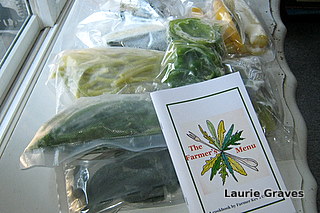
Frozen vegetables and a Farmer's Cookbook
Frozen vegetables and a Farmer’s Cookbook

Thanksgiving might not be here yet, but yesterday felt like Christmas at the little house in the big woods. Our own Farmer Kev has started a winter CSA (community supported agriculture) program, and we received our first delivery yesterday. Oh, the vegetables Farmer Kev brought—garlic; micro-greens and arugula; bean sprouts; romaine lettuce;  broccoli; squash; potatoes; frozen green beans as well as other frozen vegetables. He even included a Farmer Kev cookbook.

Such an abundance, and all grown in the Winthrop area, only miles from where I live. And, to top it off, Farmer Kev delivers.

Last night, Clif and I had fresh salads made with Farmer Kev’s greens. There was such a variety of greens that aside from the bean sprouts and some sunflower seeds, no other ingredients were needed.

I’m going to be honest—Clif and I had to scrape to come up with the money for the winter CSA, but yesterday’s delivery confirmed that this was money well spent. Not only are we getting vegetables that are fresh, fresh, fresh, but we are getting them close-by from a region not plagued by drought.

Best of all, perhaps, is that we are supporting a hard-working young farmer who is trying to make a go of it. Farming is not an easy way to make a living, and the high price of land makes it especially difficult for young farmers. With climate change bringing many, many challenges to this country, to this world, Maine needs a lot more farmers like Kevin.  In the years ahead, they might be instrumental in feeding the state.

Farms and farmers don’t spring up over night. They take years to develop, and along the way, those farmers need our support. Our own contribution may be small, but Clif and I are doing what we can to help local farmers.

This Thanksgiving my gratitude goes to Farmer Kev, to his parents,  and to everyone else who has picked, weeded, cleaned, and frozen.

Fresh lettuce and other veggies

Problem Solving 101: Shannon’s Buffet

A while back, Shannon and I were discussing cooking. I went on, as I frequently do, about how cooking is one of the best skills a person can have. (Notice I didn’t write “woman.”) Not only is it healthier to make most of your meals from scratch, but it is also much, much cheaper than eating out, even at places such as McDonald’s or Burger King.

Shannon agreed, but she mentioned how hard it was to cook in her long, narrow kitchen, where counter space is practically non-existent.  She added that in such cramped quarters it was hard to get excited about cooking.

Shannon does, however, have a buffet in the kitchen. What about working on that?

“It’s too low,” Shannon replied. “It would hurt my back.”

I could see her point. Shannon does indeed have a touchy back, and after our visit, I continued to think about ways the buffet could be improved and thus used.

“What if we put something under it to make it higher?” I asked my husband, Clif, who not only is a geek extraordinaire but is also very handy. (Lucky me!)

“Sure,” he said. “I could make little risers for it. Have her send me a picture so that I can make the risers blend with the buffet.”

Shannon sent Clif a picture of her buffet, and Clif picked up a 2 x 4, cut eight little blocks, glued them together in twos to raise the buffet by four inches, sanded them , stained them a dark color to match the buffet, and gave them a coat of polyurethane.

Last weekend when we went to visit Shannon and Mike, we brought the finished blocks with us. Mike was at work, and with great difficulty the three of us moved the very heavy buffet closer to the sink and stove. Then, we lifted the sucker—as a Mainer might say—and slid the four blocks underneath the buffet. Clif had done such a good job matching the stain that it almost looked as though the blocks were part of the buffet.

But best of all was the height, which was exactly right for Shannon, and the additional working space it added to her kitchen. When Shannon first got the buffet, she had had a long glass top made to protect the surface. Unfortunately, this glass is not heat proof, but no matter—trivets and pads can be used.

That very night, the benefits of this project were immediately apparent. I was actually able to help Shannon with dinner and not be in her way.

“What a difference!” I said. “This is going to make it so much easier for you to work in this kitchen.”

Shannon concurred, and we all felt pretty pleased with ourselves. Now, lest readers think we became too swell-headed by our ingenuity, I do want to add that it took us three years to come up with this project. Fast thinkers we are not, and we all humbly acknowledged that the blocks should have been added years ago.

Nevertheless, even though we are slow thinkers, the risers for the buffet illustrated how for some problems, especially for home improvements, the solutions can be rather simple. But first the problem must be defined. Then solutions can be considered.

Today, I called Shannon to see if she still liked using the buffet for counter space.

“I sure do!” she said. “And even though it makes the kitchen more narrow by the stove, the gain in workspace is more than worth it.”

Another good lesson. Sometimes compromises must be made, but if the overall results are better, then the project really is worth while.

Shannon will be hosting Thanksgiving this year, and the additional counter space will come in very handy. Now, on to those shelves that we have been talking about for the past couple of years.


An Apple Crisp Kind of Weekend

This weekend was a busy one where we visited with friends and family on Friday, Saturday, and Sunday. And with each visit we had apple crisp—two that I made and one that our friend Judy made.

“Too much apple crisp?” I asked Clif before making the second one to bring to Shannon and Mike’s home.

“I could eat apple crisp every day,” Clif promptly replied.

Quick as can be, out came the apples, cinnamon, cloves, butter, sugar, and flour. I use a recipe from an old New York Times cookbook, and it has a pleasing ratio of crunch to spiced apples.

Judy, on the other hand, used oats in her topping, and Clif and I concurred: When it comes to apple crisp, it’s all good.

On all three visits, we talked about the election, and everyone was as broken hearted as we were about the results. This post, I hope, will be one of the last where I dwell on the election. I much prefer writing about rural life and environmental issues. The people in this country and this state have voted, and I have to regain my balance. Moping and being depressed serve no purpose.

Still, I am moping, and I am depressed. Last night I even dreamed that Winthrop had been captured by Nazis, and that I was a prisoner. What a relief to wake up!

Now, I know it is a cheap shot for my unconscious to equate the current political situation to Nazi Germany. But the unconscious is not subtle, and it goes where it will.

Soon, I hope, this country, this world, will wake up to the fact that we are running out of resources, that climate change makes the situation even worse, and that we are heading for some very rough times if we don’t learn to work together, on both a personal level and on a political level. Once upon a time—say, two hundred years ago—there might have been some merit in the rugged individual pulling himself (or herself) up by the bootstraps. But those days are gone, and many of the problems we face are too big for individuals to tackle on their own. From medical care and research to public transportation to alternative energy—to name a few—we need an active government leading the way and providing subsidies for worthwhile projects that will help people and the planet.  (On the other hand, do the oil companies, which make huge profits, really need tax breaks? )

As Kurt Vonnegut might say, “So it goes.”

And so it does.


A Gray Day After the Election

IMG_6972Today, the gray skies exactly match my mood. For a liberal and a progressive, yesterday’s elections brought little to cheer about. Come January, the U.S. Senate will be controlled by Republicans, and Republican governors were re-elected in far too many states, including Maine. I was so hoping that Mike Michaud, the Democratic candidate, would win. While Michaud is neither as progressive nor as liberal as I would like, he certainly beats the alternative, and one of his campaign platforms was to increase funding for alternative energy.

Instead, we got Paul LePage, who, among other things, seems to be a real fossil-fuel enthusiast.  If Maine were an oil-producing state, I expect LePage’s mantra would be drill, baby, drill.

The really depressing thing is that 47.9 percent of the state voted for LePage. In my own town of Winthrop, a majority voted for him. I’m not sure whether I feel as though I live among a group of aliens who have been hoodwinked by our bully of a governor, or if I am the alien who has been dropped in. Either way, it is not a good feeling.

You would think that at fifty-seven, I would be used to these upsets. After all, they happen with depressing regularity. A friend even called to tell me that the last three presidents who were in office two terms had the same thing happen to them in their sixth year. But somehow I never get used to it, and I have to let the despair burn through me like a fever.

In a day or two, I’ll regain my equilibrium. I’ll be thinking of ways to be part of the solution to the terrible problems the world is facing. Because I am not a political animal, it will probably be through reading, writing, lifestyle, and community involvement. Perhaps these things aren’t as effective as political involvement, but it’s just not in my nature to become a gung-ho political activist. I see too many things wrong with the Democrats to be that kind of ardent supporter.

This afternoon, I’m going to make chocolate chip cookies to sweeten this bitter day. Tomorrow, Clif will bring most of them to work—Megan, I haven’t forgotten you—and we’ll keep a few to munch on. Tonight, Clif and I will watch something light and fun—no dystopian movie for us.

Onward if not upward! And by gum, the sun even seems to be coming out.

Gunshots and Voting

This morning, I woke up to gunfire. Hunting season began last Saturday, and today in the woods a hunter was getting an early start. This is not my favorite time of year, when people—mostly men—dress in orange and carry loaded rifles in the woods. It is always a relief to me when hunting season is over.

I, too, wear orange when I work in my yard during hunting season, and I usually have a radio with the volume turned up very loud so that hunters will be aware they are near a house.  In November I am grateful that Liam is such a noisy dog who will bark at everything and nothing. More noise to alert hunters.

Today is also election day, in Maine as well as in the rest of the country. Clif and I voted early—a little after 8 a.m.—and already the parking lot was full, with cars lined up on both sides of the drive leading to the town office.  Upon putting my ballot in the machine, I was told I was voter 51, and between all the cars in the lot and the people inside the town office, I was not surprised. Winthrop not only cooks, but it votes, too, it seems.

Normally, I don’t write very much about politics in this blog. I prefer to focus on nature, people, food, the environment, libraries, and other small-town matters. But as someone who freely and proudly admits to being both a liberal and a progressive, I feel as though I must stray, at least a little, from my usual topics. Simply put, today is a real nail-biter day for me and my family. In varying degrees, several family members have been adversely affected by the state’s current administration—I’m not going to go into details—and four more years with the same people in charge is a discouraging thought.

The bigger picture is no better. From health care to the environment to social services to the economy, it feels as though Maine has taken many, many steps back. Nowhere is this clearer than with alternative energy. Because of Maine’s location by the sea, we are in an ideal position to not only produce our own electricity, carbon-free, but to also export it to other states thereby reducing their carbon footprints. Unfortunately, we seem to be no closer to accomplishing this than we were four years ago. Given the state of our planet and the warming climate, this cannot be counted as merely being stalled in one place. This has to count as regression.

And for those who think that Maine’s recent spat of cold winters disproves climate change, think again. Apparently, the melting Arctic ice affects the jet stream, which, in turn, has made our winters colder. Yes, it’s complicated, but it’s a clear case of a warmer world and climate change.

But I digress. All over Maine, people are going to the polls, and if Winthrop is any indication, then voter turn-out should be quite high.

My day began with a bang. Let’s hope it ends with a bang and a new direction.


A “Baked Bean” Lentil Dish

IMG_6746One of my favorite cooking and food websites is Food52, where the emphasis is on unfussy food made with inexpensive ingredients that most home cooks have in their kitchens. There are also many vegan and vegetarian dishes, and this goes in the direction in which Clif and I are heading with food. We are both very much concerned with overpopulation, limited resources on our finite planet, and living lightly. (I plan to explore the living lightly concept in future posts, and I am currently reading a book with the apt title Living Lightly.)

Lately, I have become enamoured with red lentils, which are not as, ahem, earthy as the brown lentils. (I have uncharitably referred to the flavor of brown lentils as “muddy,” and Clif is not a fan of them, either.) For our Labor Day get together, I made curried red lentils in my slow cooker—thanks, Susan Poulin, for the terrific recipe!—and they were a big hit. It was the first time I had used red lentils, rather than brown, and I was hooked by their smooth, subtle flavor. Red lentils, I knew, would become a staple at the little house in the big woods as we turn to a plant-based diet.

Therefore when Joe Beef’s Lentils Like Baked Beans recipe was featured on Food52, and I saw the primary ingredient was red lentils, I decided to try it.  I did make some changes. I did not use bacon. No explanation needed, I think. Rather than cooking the lentils on the stove, I cooked them in a slow cooker, which thanks to Shari Burke’s encouragement has become my favorite little appliance. I just tossed everything into the slow cooker, let it come to boil on high, and then turned it down to low so that it could simmer until supper time. I also added more cider vinegar, maple syrup, and ketchup.

Finally, I served it over rice, which is the way I prefer most bean and lentil dishes. While I like lentils and beans, they can set heavy, especially at night, and I find rice lightens the dish. I also sprinkled ground peanuts on top, because, well, nuts and lentils go together like apple and pie.

The results? The lentils did taste a little baked beans, although nobody would ever confuse the two. “Pretty good,” Clif said, going back for seconds. Perhaps not company good—somehow the dish lacked the pizazz I look for when cooking for a gathering—but certainly good enough for a Tuesday night supper. And good enough to make again.

Then there is the price. I figured I used about $2.50 worth of lentils, which were organic. The other ingredients—maple syrup, cider vinegar, dried mustard, oil, onion, garlic, and ketchup—I had on hand, and the small amounts I used certainly didn’t come to more than a dollar or two. There were rice and ground peanuts—again, no more than a dollar or two, and I expect I am estimating on the high side. Even erring on the high side, say, $6 or $7 dollars for the whole meal, which would easily feed six, makes this an extremely economical dish that would fit in with most people’s budgets, even when they are tiny, like ours.

Among foodies, nutritionists, and activists, there has been much talk about the cost of healthy eating in the U.S. , and rightly so. According to the American Institute for Economic Research, food prices have risen 44 percent over the past fourteen years. And salaries? Well, not so much. Nevertheless, in comparison with beef and pork, lentils and other legumes are a great bargain.

For confirmed carnivores, making the transition from meat to legumes is probably not an easy one. However, for those of us with more flexible palates, eating more beans and lentils is a tasty way to eat lower on the food chain. Right now, I have a good supply of black beans, kidney beans, chickpeas, and lentils. I will be adding other beans to my stockpile, and I’ll be experimenting with various meatless recipes so that our diet is varied and satisfying.

Stay tuned!


Monday Bike Ride: The Virtues of Goofing Off Plus a Library Update

IMG_6742In my previous post, I extolled the virtues of work and how being absorbed by work can make for a satisfying life. Today I’m going to extol the virtues of goofing off.  As the saying goes, “All work and no play makes Jack a dull boy.” And Jackie a dull girl, too.

Yesterday, the afternoon was so sunny and fine that even though there was much yard work to do, Clif and I decided to go on a bike ride. “After all,” Clif reasoned, “we won’t have many more days like this.”

No, we won’t. When the temperature dips below 50 degrees, biking is mighty uncomfortable. At least for me.

So off we went, leaving a yard full of leaves to be raked, gardens to be clipped, and wood to be stacked. Our first stop was the library, where we took pictures of the addition. So exciting to see the walls going up!

IMG_6731IMG_6727I also went into the library to pick up a book that I had ordered through interlibrary loan. While I waited in line—Bailey Library is one busy place, that’s for sure—I chatted with Pam, who is on the expansion committee, and we both spoke enthusiastically about the addition’s walls.

On the way out, I found a May 2014 Smithsonian on the discard shelf, and I scooped it up. Both the book and the magazine went into the pack on my bike, and off Clif and I went down Memorial Drive.

Along the way, I had to stop and take a picture of Joan’s mums, which are growing so profusely in her garden that at first I couldn’t believe they were actually mums. But Joan was in her yard, and she assured me that they were indeed mums, started from one pot of plants.

IMG_6734“Have you ever seen anything like that?” I asked her.

“No,” she answered. “Never.”

Neither have I. Must be just the right spot, and how welcome those mums are this time of year when most of the other flowers have gone by.

Down Memorial Drive we went, by shimmering Maranacook Lake. We dodged the water-pipe construction and stopped by the little marsh to take a few pictures. Not much color yet, but the marsh is lovely anyway, whatever the season.

IMG_6735At the end of the road, after going about five miles, we turned around and headed home, stopping to take pictures of the Inch-by-Inch Garden at the grade school.

IMG_6743IMG_6740When we got home, it was still warm enough to have drinks on the patio. “After all,” I said, “we won’t be able to do this much longer.” By the end of October, it’s too cold to sit on the patio, and the furniture must come in.

After drinks, we did do a bit of work. Clif hauled in some wood, I took in the laundry, and we made pancakes and home fries for dinner.

Work and play. The best life, I think, is a mix of the two, where one complements the other, leaving a person both fulfilled and refreshed.


Sustainable Seafood?

On Wednesday, on MPBN’s show Maine Calling, the subject was sustainable seafood. While I made an apple pie, I listened with interest because lately I’ve been wondering if there is such a thing as sustainable seafood, and I was curious what the gist of the show would be. The program was hosted by Keith Shortall, and the guests were Jen Levin, Sustainable Seafood Project Manager, Gulf of Maine Research Institute, and Barton Seavor, chef and author of four cook books.

Shortall began the program by acknowledging that we “know some of the most popular fish are in trouble because of overfishing,” and much of the show revolved around encouraging people to turn to “underutilized fish” such as dogfish, Atlantic pollock, and whiting, all species that, according to Jen Levin, are flourishing.

When the question arose of what exactly sustainability meant in terms of seafood, Barton Seavor did recognize that one aspect involved promoting thriving, resilient species. But, and it’s a big but, he went on to state that “ultimately the measure of sustainability must fundamentally be measured by the ability of human beings to thrive.” Levin did add that a growing population needed to live within its means.

Now, I’m distilling an hour show into a post for a blog, and as such, I can only include snippets of what the guests discussed. Readers who are interested in this subject—sustainability and seafood—should listen to the podcast for a longer, more complete version of what Shortall and his guests actually said.  However, not once during that hour-long show did I hear about the importance of abundant fish to the vast, interconnected chain of life in the ocean or of how quickly humans can change abundance to scarcity, even when fish seem to be plentiful.

For this we must turn to Sylvia Earle, author, marine biologist, former chief scientist of NOAA, and “National Geographic explorer in residence.” As Sylvia Earle eloquently puts it, “[T]he ocean is the cornerstone of Earth’s life support system, it shapes climate and weather. It holds most of the life on Earth. It is the blue heart of the planet.” (I must admit that I was surprised to learn that most of the oxygen in Earth’s atmosphere is generated by life in the sea. I thought that trees and plants had a much larger role.)

I am currently reading Earle’s book The World is Blue, where she clearly and beautifully explains the importance of the abundance of fish and other creatures to the health of the ocean and indeed the planet.  Earle writes, “There is no surplus in a natural, healthy system. What appears to be overabundance to human observers is a natural insurance policy against population reduction by diseases, storms, ups and downs of predators and food supply…” and “[S]pecies do not live in isolation. They are integrated into exceedingly complex systems…the first fish to be taken from an unexploited population are the largest…the ‘old timers’…They are also the ones that produce the most offspring.”

So here are my questions: Does anyone know what a truly sustainable harvest of dogfish, Atlantic pollack, and whiting would be? Are we viewing them as so abundant that we think we can eat them on a regular basis? If so, is this a correct assumption?

Sylvia Earle indicates this is not the case at all. On NPR’s The Bob Edwards Show, Earle said that she doesn’t eat fish and instead eats a plant-based diet. In a recent interview in The Guardian, Earle was asked, “What about eating fish sustainably? For instance, trading top predators for smaller fish?”

Earle replied, “I think that’s disastrous, really…. The large fish have to eat the small fish. We have choices; they do not….  And there’s another aspect as well. All fish are critical when you think of them as middlemen, because they consume phytoplankton and zooplankton, the little guys that the big fish cannot access….we shouldn’t take fish on a large-scale basis; there’s simply no capacity left to do this.”

Except for island nations that don’t have much of a choice, Earle believes that fish are wildlife that should be left in the ocean, Earth’s “blue heart,” from which most of our oxygen comes and has developed over hundreds of millions of years.

So, two opposing views. The first, espoused by Keith Shortall’s guests was that even though fish such as cod have been overfished, there are plenty of overlooked and underutilized fish in the sea to eat. And we should do so eagerly. The second, put forth by Sylvia Earle, is that the oceans are in such peril that we shouldn’t be eating fish and seafood on any kind of regular basis. Once in a great while, at the most.

Even though I love seafood and could eat it several times a week, I’m casting my lot with the marine biologist. Sylvia Earle has been studying the ocean for decades and has lived long enough to see the terrible degradation of the world’s oceans as we humans eat our way through the fish and other creatures that live in the sea.

For me and for my husband Clif, it will be mostly plants that we eat.


A Winthrop Food Pantry Supper: A Compelling Story of our Times

IMG_6637Last night, Clif and I went to a Winthrop Food Pantry supper for volunteers. Clif has taken pictures for the food pantry, and I have volunteered in various ways since 1997. Seventeen years! A long time, and I think there was only one other volunteer—Lee Gilman—who has been at the pantry longer than I have.

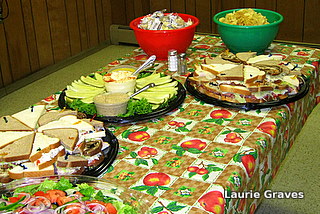
There was a good turnout—about thirty came to the supper. Unfortunately, the batteries in my camera went, and I didn’t think to bring extra batteries. Therefore, I only got a few shots of the event. Ah, well!

After we ate sandwiches, salad, and soups, JoEllen Cottrell, the executive director, and Mike Sienko, the president, spoke about the food pantry. Naturally, they thanked everyone for their hard work, which, astonishingly has come to 2,360 hours so far this year. (The food pantry has about fifty volunteers, and there is a sign up sheet so that the hours can be tracked.)

But there were more astonishing numbers to come. When JoEllen took over as executive director in 2011, there were about forty families per month that came to the food pantry. The sessions were leisurely, and often the volunteers had time to sit and chat between taking people around.

In three years, that number has tripled, and on average, 120 families come to the food pantry each month. The volunteers no longer sit and chat, and often the pantry stays open long past its closing time of 2:30 p.m.

As far as I know, there has been no increased publicity or effort to encourage more people to come to the food pantry, and it’s my guess that more people are coming because it has become increasingly difficult to make ends meet after the Great Recession. In Maine, good paying jobs are far and few between, and many people are still looking for work. While it’s great that the food pantry is around to help people in need, it’s sad that there are so many more people that need the help.

And here’s another number: Rick Dorey and his wife Sheila get food for the pantry at the Good Shepherd Food Bank in Auburn. Last year, they brought 70, 000 pounds of food to the Winthrop Food Pantry, and Rick told me that he expects to exceed that number this year.

The Winthrop Food Pantry provides food for Winthrop (population 6,200) and Wayne (population 1,189). Wayne is a more affluent community than Winthrop, but neither is what you would consider poor. Yet so many people qualify for receiving food from the food pantry.  (The food pantry uses the federal guidelines.)

Numbers are one way of telling a story, and the numbers at the Winthrop Food Pantry certainly tell a compelling story of our times.