Category Archives: Community

A Victory Party

Last night, Clif and I went to a victory party to celebrate the expansion of the Charles M. Bailey Library. It was a potluck—my favorite kind of party—hosted by Pearl and George Ames, two members of the campaign team.

The lovely backyard where the party was hosted.

The food, of course, was delicious, and I ate way more than I should have. I even indulged in a hamburger, and I can’t remember the last time I ate beef.  We don’t eat it at home, but if we go to somebody’s house, and beef is served, then we will eat it. I must admit that hamburger tasted mighty good.

But better than the food—and you can bet this foodie never thought she’d be writing that anything could be better than food—was the spirit of the campaign team. There are about fifteen people in the core group, women and men who not only love the library but who have been willing to work hard to make the addition a reality. And it was very hard work. To raise a million dollars in a town of six thousand people is not easy, especially when the town is a middle-class community—a macaroni-and-cheese kind of town, as I like to call it.

In the process of working together for over three years, of facing and overcoming setbacks, something rather wonderful happened. We have bonded together as a team and have become completely comfortable with each other. It doesn’t always work that way, and what a blessing when it does. It also goes to show what people can do when they work together, when they put time and energy into a project. This energy can be such a force of good when directed toward the right cause.

And the library expansion was most definitely a right cause. The other day, when I returned a movie, I looked around. In the reading area with its blue chairs and barn-board table, a man was reading the paper, and a woman was reading a book. Nearby, at the computer tables, there were few empty seats. People talked quietly together, and the library was filled with a happy sound. In the stacks, patrons looked for books. Bailey Library has always been an important part of this community, but now, with the expansion, it is truly the center of the community.

At the party, I chatted with various team members. I learned that Roger had been in the Peace Corps, and French was Bob’s first language. I talked about painting and art with Penny while my husband discussed biking with her husband.

As Mary Jane, the chair of the trustees, put it, “Along with helping to raise money for the new addition, I also made such good friends.”

How glad I am that I have come to know and work with these people, to call them friends. And how proud I am of what we have achieved together.

The entrance to our expanded library


Starting the Weekend with Shakespeare

IMG_0263On Friday night, Clif and I went to the annual Friends of Bailey Library book sale. This was a special preview night—tickets cost $10 per person—and the actual sale was on Saturday. Clif and I are what might be called “frugal weirdos”—to borrow a term from the blog Frugalwoods, but we considered the $20 money well spent.

First and foremost, the money went to a very good cause. The Friends do so much to help the library. Thanks to the Friends, the children’s section of our library is a magical place filled with soaring wooden planes and giant stuffed animals. And this is just one example of the many things this group does for the library.

Second, and nearly as important, it was much less hectic to look at books on the preview night. In Maine, book sales are usually mobbed, and as I am claustrophobic, these sales are not always a pleasant experience. It is hard for me to look for books when I am hemmed in by people.

The preview sale was pleasantly full. There were people, many of whom I knew (this was another plus), but not so many that it was impossible to look at books.

Because we are frugal weirdos, Clif and I view book sales as an ideal place to shop for Christmas and birthday presents. We do have strict guidelines. Unless the book is rare or special in some way, it must be in mint condition. This brings us to another advantage of going to the preview sale—the books had not yet been picked over, and there were lots of good finds. We bought presents for five people, and even with the price of the tickets, we spent only $28.

Naturally, along with looking for presents for those we love, I did a teensy bit of looking for myself, and I am happy to report I hit pay dirt. I found A Year in the Life of William Shakespeare by James Shapiro.

Along with being a frugal weirdo, I am also a fool for Shakespeare and have been since seventh grade, when my English teacher had us read The Merchant of Venice. I can still remember how dazzled I was by the language. I couldn’t believe anyone could write so beautifully, and while there was much I didn’t understand, I understood enough to know I would be hooked on Shakespeare for life.

Accordingly, I have a collection of books about Shakespeare, and I am always glad to find another one to add to the shelf, especially when I get that book—a hard cover—for $1.  A Year in the Life is in very good condition, and the cover price is $27.95.

In the library’s new conference room, iced tea, lemonade, brownies, and cookies were served. As I drank iced tea and ate a brownie, I spread my books on one of the long conference tables so that I could decided which books to buy and which books to leave for someone else. People I knew came in to have refreshments, and naturally we chatted. Some people I didn’t know came in, and being a friendly introvert—yes, it is possible to be both—I chatted with some of them, too.

All in all, a terrific night. Next year, Clif and I will definitely be going to the book sale on preview night.

Carless Sunday: We Take to the Roads on Our Bikes

For Clif and me, one of the great pleasures of summer is riding our bikes around Winthrop. We feel extremely fortunate to live in such a beautiful town of lakes, fields, and forests. When we leave our driveway, no matter which way we turn, we have a choice of scenic rides.

Usually we begin riding our bikes in May, perhaps even late April if the weather is warm enough. However this year, because of library brouhaha and gardening, we have gotten a late start and have just begun riding our bikes. But better late than never, and eight slow miles will eventually lead to ten, fourteen, perhaps even twenty miles covered in less time. (I do want to add that speed is never our goal. Clif and I are what might be called steady riders rather than speedy ones.)

One of the reasons that Clif and I like biking so much is that we are very concerned about our carbon footprint. When we bike, the only carbon emissions come from us, a big improvement over our belching car. In the summer, especially, we try to reserve Sunday for a carless day, and we take to our bikes for an outing. We can even stop at a convenience store along the way to pick up the Sunday paper, which is then tucked into my trusty bike bag.

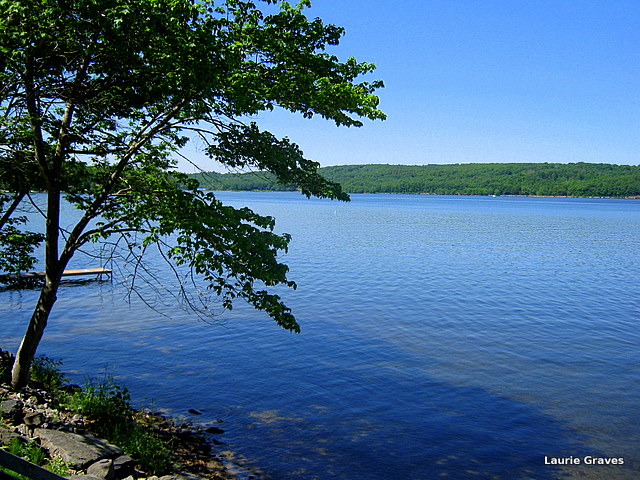
This Sunday, Clif and I went for a bike ride along shimmering Maranacook Lake. Aside from the beauty, we like this ride for a number of reasons—the road is relatively flat, there are lots of other bikers and walkers, and the traffic is slow.

On this ride, there is even a sign to encourage car and truck drivers to watch out for bikers and walkers.

IMG_9376

There is Maranacook Lake, gleaming beside us as we ride.

IMG_9366

IMG_9362

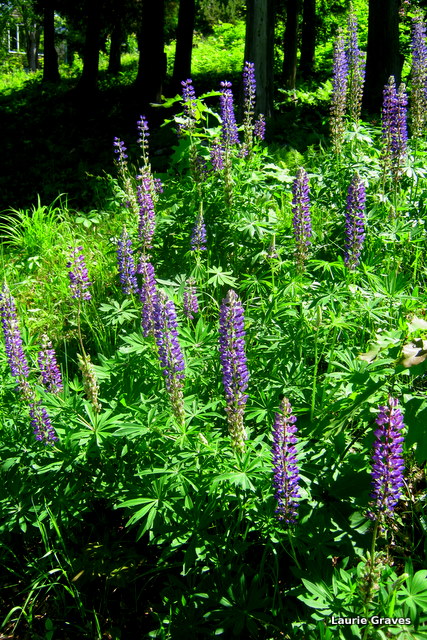
This time of year the lupines are in bloom. Such a cheery burst of purple.

IMG_9355

In Maine, the gardens aren’t in full bloom yet, but Joan’s peonies have started to blossom, and although they are not my favorite flower, I couldn’t resist taking a picture of one of them. (Yes, yes, I will admit it. They are lovely. I don’t know why I’m such a grump about peonies.)

IMG_9371

Whatever the season, there is always something to notice on this bike ride. My friend Cheryl has observed that a person riding a bike can achieve a perfect speed—faster than walking but slower than a car. On a bike, a rider can cover quite a few miles while still observing the land, the sky, the water, people, and animals.

Even though we are late this year, Clif and I still have many months ahead of us for biking. Let the season commence.

Library Open House

IMG_9053On Friday,  there was an open house for the  newly expanded and refurbished Charles M. Bailey Public Library. Books were shelved, pictures were hung, and toys were in their places. All the packing boxes had been spirited away, and as Shane, the adult services librarian put it, the library looked presentable. It certainly did.

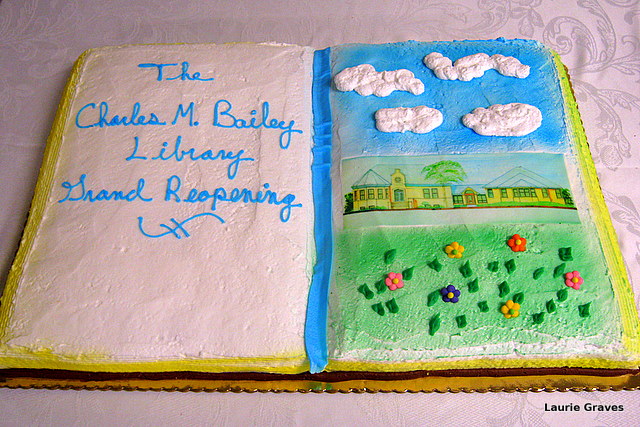
In the new events room, we had a table set up with cake, cupcakes, and bottled water. I wondered, “Would there be enough cake for everyone?” This was followed by the terrible thought, “What if hardly anyone came and there was too much cake?”

IMG_9046
A book cake

I needn’t have worried at all. When the doors opened at 4:00 p.m. , there was a rush of people. Shane was keeping count, and by 4:20 p.m., fifty people had come to the open house. And people just kept coming.

The library was duly admired and fussed over. Children, upon seeing the new children’s wing, didn’t want to leave.
The day was a smashing success, but there were three highlights for me. The first was when a woman whom I hadn’t seen for a while—she is part of our book group—said hi and then asked, “So what are you reading?” Was there ever a better question? I told her I was reading The Bone Clocks by David Mitchell, and for five minutes or so, we had some great book talk.

The second was a conversation I had with a bright teenage girl. She had taken out two graphic novels of The Flash, and we had a fun time talking about the Flash and Daredevil and their television shows.

Finally, and best of all, so many people thanked me for the work I had done as a trustee and a campaign volunteer for the library expansion. A simple thank you costs nothing at all and means so much.

The final count? Over 150 people came to the open house, and we all decided it was a rousing success.

On Monday, there will be a ribbon cutting, and the doors will open at 10:00 a.m. After being closed for several weeks, Bailey Public Library will be back in business.

Onward to the next hundred years!

IMG_9068

Library Chainsaw: W-H-O-O-O’S Reading?

IMG_8984
Dan Burns unloading his truck

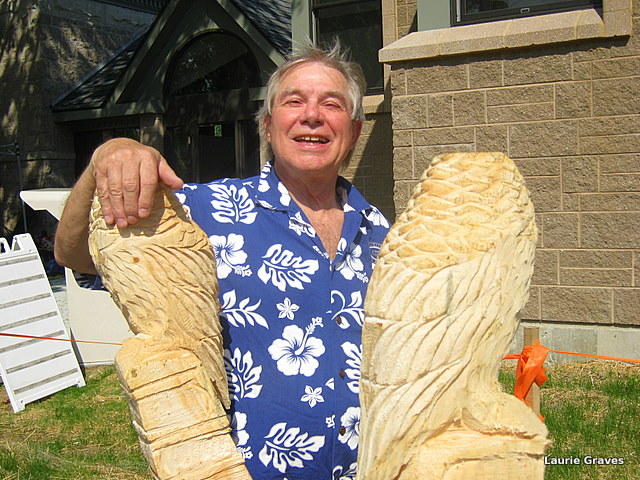
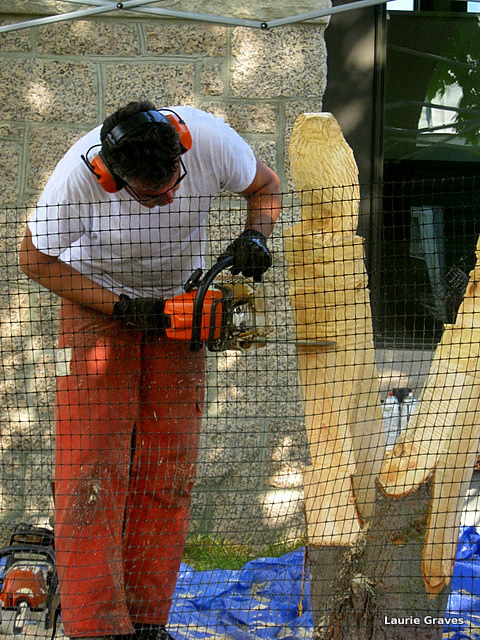
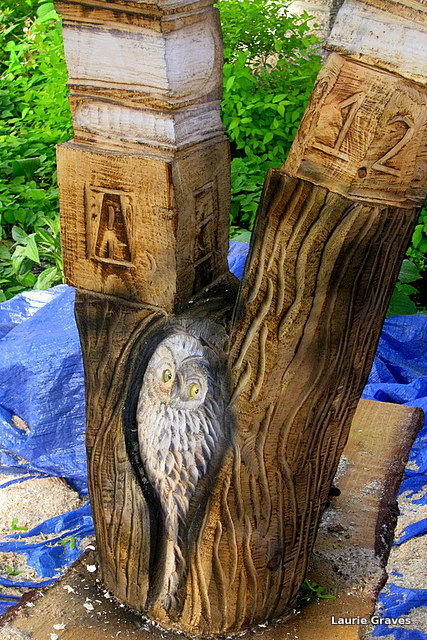
Yesterday, we had a chainsaw man—aka Dan Burns—come to Bailey Public Library. But don’t worry—nothing was destroyed or cut down. Instead something beautiful and unique was created. Dan Burns, of Burns Bears, is not kidding when he calls himself a “Pro Chainsaw Carver.” How Burns manages to coax various animals—bears, eagles, and in this case, owls for the library—out of stumps and branches will remain a mystery to most of us. But coax them he does, and Bailey Library now has a charming sculpture of three owls surrounded by books.

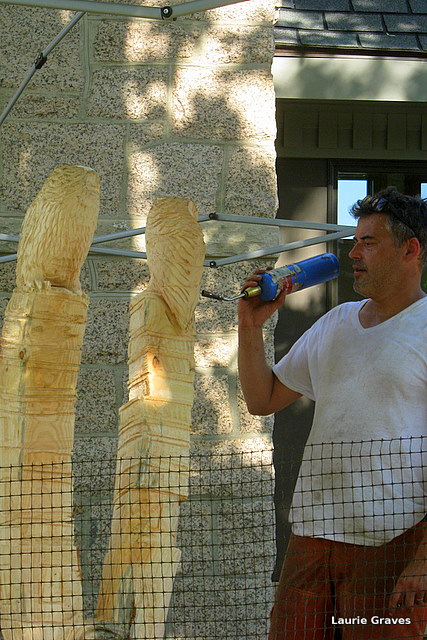
Burns brought the sculpture partially finished and added books, letters, numbers, and another owl. For two hours he took his chainsaw to the pine branch, used various flames to give the wood depth, and did a bit of spraying as well. The finishing touches were eyes for the three owls.

I was there with my trusty wee camera—what a wonder it is—and I took pictures of the process. What a fine addition those owls will be in our newly expanded library. One more gem in a gem of a library.

Mike Sienko, a library volunteer, posing with the unfinished sculpture.
Mike Sienko, a library volunteer, posing with the unfinished sculpture
Dan Burns setting up
Getting started
Getting started
At work
At work
Finishing touches
Finishing touches
More finishing touches
Almost done
Almost done

Our three owls.

IMG_9036IMG_9037IMG_9038

Library Week: An Evening of Firsts

A guardian of the library

Last night was an evening of firsts at the Charles M. Bailey Public Library. It was the first time the newly expanded library was open to the public. It was the first time the new events room was used, and it was the first time for the new blue folding chairs, quite an improvement over the old wooden ones. It was the first time our new town manager—Peter Nielsen—came to an event. (He’s promised to come to all of them.) Firsts, firsts, firsts.

What a wonderful feeling to walk through this library and admire the wood, the layout, even the light. One man said, “Bravo, bravo!” as he wandered through the stacks in the adult section. After all the hard work—and, yes, the setbacks and the criticisms—how good it was to hear this.

IMG_8914
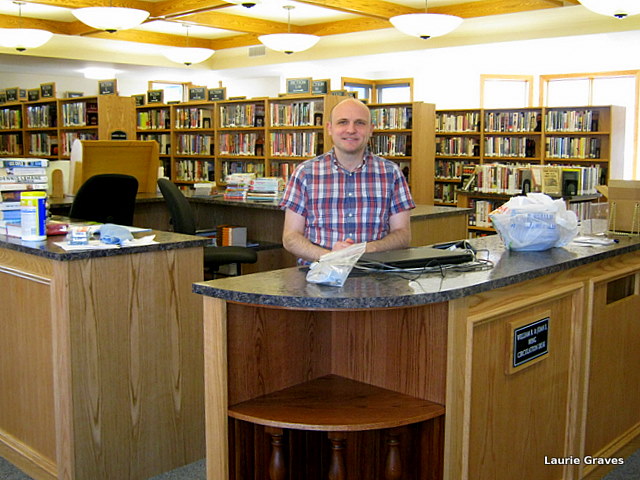
Shane at the grand new circulation desk in the adult section


IMG_8919
The teen section

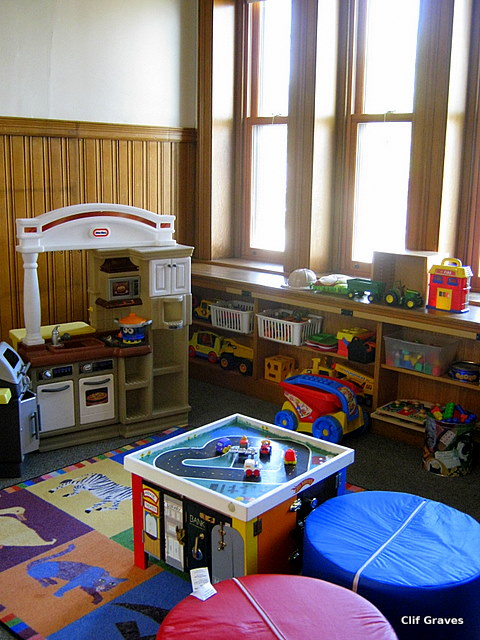
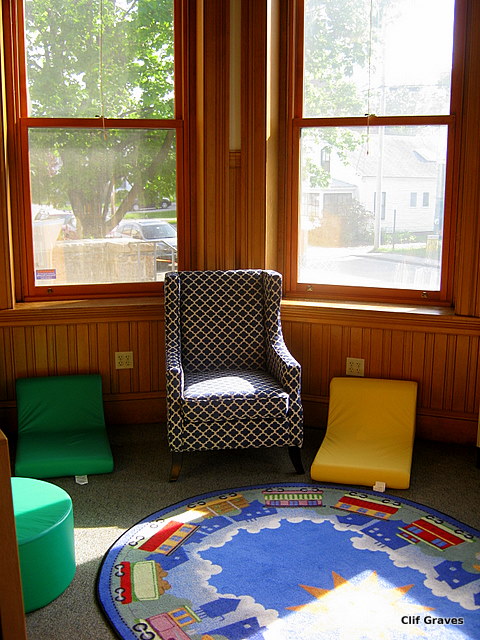
The children’s section, once housed in the basement, is now on the first floor, and simply put, it is a magical place. I know. Magical is a word that can be overused, but the children’s area is now so delightful that no other word will do. It has everything that children and the young at heart will love—large stuffed animals, giant planes, a play area, a reading nook, and lots and lots of books. Lucky Winthrop children!

A place to play
A place to play
A cozy nook
A cozy nook
A giant plane
A giant plane

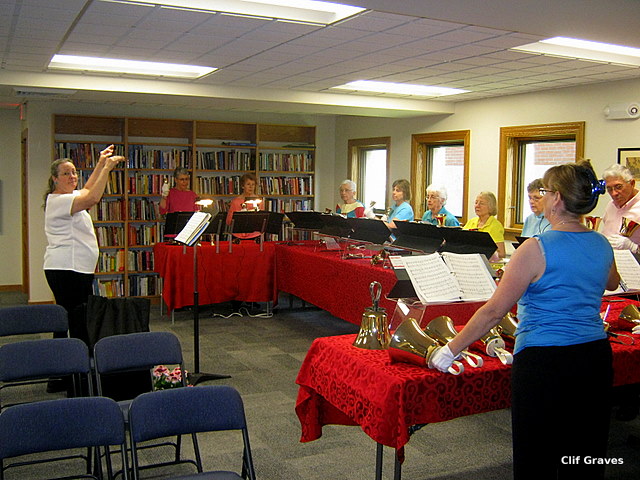
The first event of last night was a concert by the Winthrop Handbell Ringers. The bells’ tinkling, ethereal notes seemed like a welcome and a benediction.

The Winthrop Handbell Ringers

After the concert, Earle Shettleworth, the state historian, spoke about the history of the Blaine House, the governor’s mansion in Augusta. Shettleworth was articulate, informative, and funny. He spoke for an hour, but I could have listened to him for even longer.  Along with his talk, there was a media presentation—what would have once been called a slide show—of stills about the Blaine House and its occupants through the years. Best of all, Shettleworth was quick to name the various dogs in the photos, and he apologized when he didn’t know a dog’s name. He also praised the design of the new addition and noted how well it tied in with the original building. (Thank you, thank you, Phil Locashio, architect extraordinaire!)

Earle Shettleworth
Earle Shettleworth

What an auspicious way to begin the second hundred years in our newly expanded library.

Another guardian of the library


Gardening and Library and Dogs. Oh, My!

IMG_8890-1
The patio is ready for Memorial Day. Now, if only those dratted black flies would go away.

The end of May is just around the corner, and what a busy time it is for the residents of the little house in the big woods. Gardening and planting have reached a fever pitch, and as I am someone who does not like to hurry, that along with writing and other household chores would be plenty to keep my days full.

However, next week our library will be having all sorts of events to celebrate the grand opening of the new addition—a speaker on Tuesday; on Wednesday a chainsaw carving of an owl for the children’s room; and on Friday a true open house where a “book” cake will be served.

To add to the jolly chaos, we will be babysitting our granddogs, Holly and Somara. I am praying for good weather so that the dogs can spend much of the day outside in the backyard.

In addition, we’re having friends over for a barbecue on Sunday, to celebrate Memorial Day. I’ll be making the first potato salad of the season, and we’ll be having the first grilled chicken, too. And grilled bread, of course.

Next week on the blog, I might focus more on images than words. Naturally, I’ll want to write a little something about the library’s grand opening. Just a little something.

And in honor of Memorial Day, as I work in the yard, I’ll remember family and friends who have passed. They are missed and are certainly not forgotten.


National Library Week: My Library, My Lifeline

IMG_8059This week is National Library Week. I know. It seems that every week, indeed every day, celebrates something or other, from popcorn to donuts to libraries. But it’s my guess that National Library Week, first sponsored in 1958 by the American Library Association (ALA) and the American Book Publishers, got the jump on most of the current weekly and daily celebrations. In a few years National Library Week will be celebrating its sixtieth birthday.

And how did National Library Week come about in that faraway time before computers, mobile phones, and the Internet? According to the ALA website, “In the mid-1950s, research showed that Americans were spending less on books and more on radios, televisions and musical instruments. Concerned that Americans were reading less, the ALA and the American Book Publishers formed a nonprofit citizens organization called the National Book Committee in 1954…In1957, the committee developed a plan for National Library Week based on the idea that once people were motivated to read, they would support and use libraries.” The theme for the first National Library Week was “Wake Up and Read.”

As a child, nobody had to tell me to wake up and read. Books were an integral part of my life, and lucky child that I was, my parents took me to two libraries—a tiny one in East Vassalboro, which served all of Vassalboro, where we lived, and a larger one in Waterville, the small city nearby. Every week, books came into the house, and books went out of the house. While I grew up in a comfortable, middle-class family, there was no way my parents could have afforded to buy me all the books I wanted to read. For a child who lived in a small, rural town, those libraries were a lifeline, giving me access to the broader world of stories and ideas.

Today, fifty years later, the library continues to be a lifeline for me. I still live in a small rural town—Winthrop rather than North Vassalboro—and both could certainly be considered the hinterlands of the hinterland. My husband and I live on a modest budget, and, as was the case when I was young, there is no way we could afford to buy all the books I want to read. Thanks to the library and interlibrary loan, I can get nearly any book I’m interested in, from classics such as Middlemarch by George Elliot to newer books such as Our Kids: The American Dream in Crisis by Robert D. Putnam.

As the ALA likes to remind people, libraries are more than books, and all the DVDs Clif and I watch come from the library. The DVDs range from the highbrow—Shakespeare—to the lowbrow—television series such as The Americans. As with books, pretty much anything we want to watch is available to us.

Winthrop’s library is supported primarily through town taxes, and I expect this is true for most town libraries in Maine. Not surprisingly, I consider it money very well spent, and I don’t begrudge one penny of  property tax money that goes to the library. Our library is open to all residents, and it doesn’t matter who your family is or how much money you make. As long as you return the books you borrow, you are welcome to take out more books.

A friend of mine is moving to a small seaside town in Ireland that doesn’t have a library. (She will have access to a library in a larger town nearby.) She is a reader, and she says she is up to the challenge of living in a town with no library.

I have thought of this off and on for the past couple of days. Which would I choose, a town with a library or a town by the sea? This would not be an easy choice for me because I love the seaside nearly as much as I love books and libraries.

It would be a tough call, but I know that in the end, books and libraries would win.

Our Library’s Beautiful New Addition

The new adult section with its beautiful shelves and lights
The new adult section with its lovely shelves and lights

As long-time readers of this blog know, for the past few years, I have been part of a campaign team that has been working oh so diligently to raise money for a new addition for the Charles M. Bailey Public Library, our town’s library.  (Full disclosure: I am also a library trustee.) The budget is one million dollars, which sounds modest enough, but in fact it has been quite a challenge for a town with a population of 6,000.

Late last summer construction began, and all through the winter workers have been busy pounding, hammering, and sawing.  (Or sawring, as we Mainers would say.) Now the workers are coming down the homestretch. The new addition is nearly complete, and good progress is being made getting the original library spiffed up so that it won’t be totally overshadowed by its new sibling.

Yesterday, after doing our civic duty and paying our property taxes, Clif and I went over to Bailey Library to check on the progress. Oh, how beautiful Bailey is, even partially finished, and how wonderful it will be for the town to have this expanded library. The original library, built when the town was half the size it is now, was bursting at the seams, and there was no room for new books, not enough space for events, and hardly any place for the staff to work.

Now, we have a spacious new events room that will hold 130 people, greatly expanded children and adult sections, a meeting room, and an honest-to-God little staff room. The expanded library, in the center of town, will truly become even more central than it is now.

I want readers to know that while Bailey Library hosts events, has computers, and offers a wide range of DVDs, real books, made of paper, are still the thing, with thousands being checked out each month. And I’m happy to report that this book trend doesn’t seem to be changing anytime soon.

Right now, volunteers are busy shelving books that had to be stored during construction. (The library is in temporary quarters in the Commerce Building in town.) In late spring or early summer, Bailey Library will reopen, and there will be a grand celebration.

I’ve written this before, and I’ll write it again. It’s not every day that ordinary people get to work on a project that will be around long after they are gone. One hundred years from now, Bailey Library will be there for the people of Winthrop. It’s been a true pleasure to be a part of this project.

The beautiful lobby, with original stone work
The view from the lobby of the adult section
The view from the lobby of the new adult section
Wainscotting from the Masonic Building that had to be torn down to make way for the new addition.
Wainscotting from the Masonic Building, which had to be torn down to make way for the new addition
A view of "old" Bailey, still under renovation
A view of “old” Bailey, still under renovation
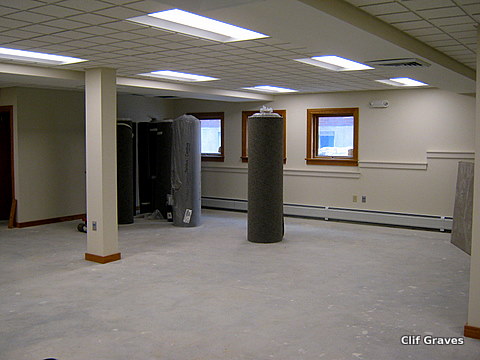
The spacious new events room

Those From Away

IMG_8026In Maine there are two classes of people—natives and those from away. As is the case with many rural states, in Maine there is a tension between these two groups. The natives sometimes resent those from away, who are often more affluent and bring new and outlandish ideas to the state. The latter was especially true in the 1970s, when hordes of young people came here to go “back to the land.” It has also happened more recently with the foodie movement, where so many chefs and cooks have flocked to Maine that many places—especially Portland—have developed quite the foodie reputation.

Those from away often feel as though they will never truly belong, no matter how long they live here, no matter how hard they might work for their communities. A friend of mine once asked in frustration, “How long do I have to live here before I’m accepted as a native?” I wisely refrained from answering. To qualify as a Maine native, you have to go back at least two generations. As Mainers like to say, just because the cat had kittens in the oven don’t make them biscuits.

My husband and I are natives, and we both go back at least five generations. Maine is in our blood and in our bones. We have a history with the state, and this is reflected in the way we speak, think, and even dress. (Oh, yeah! We dress like a couple of Mainers, that’s for sure.)

As natives, Clif and I believe that those from away bring a much-needed vitality to Maine. Any state, any country that is closed becomes inbred, both literally and figuratively. Nevertheless, we understand why there is resentment. To someone who has sold a house in, say, Massachusetts or New York or even New Hampshire, houses in Maine are quite the bargain. For Mainers, not so much, and in some coastal communities, people can barely afford to pay taxes on property that has been in their family for several generations.

Several years ago, I was at a gathering where those from away commented gleefully about how unsophisticated the Maine food scene was when they first moved here.  One woman observed, “Mainers didn’t even know there was such a thing as square plates.”

This might be true, but I winced a little when I heard her say that. Did she really have to speak so condescendingly and unkindly? Of course not.

Fortunately, at least with the people I know, this attitude is rare. Most people from away come here because they love Maine and its unpretentious ways. They rejoice in not having to keep up with the Joneses or anybody else. Often those from away become very involved with their communities, donating time, energy, and money  to various organizations.

Recently, I read a book called The Hollow Land by Jane Gardam. It’s set in Yorkshire, England, and the interconnected short stories revolve around natives and those from away. Over a span of twenty years, a Yorkshire family forms a tight bond with a family from London. The London family rents a house called Light Trees from the Yorkshire family, and while there are tensions at first, they are soon smoothed over by the children, Bell and Harry. Bell grows up to have a child of his own, and at the end of the book there is a conversation between, Anne, Bell’s daughter, and Harry, who is considerably younger than Bell. They are discussing the possible sale of Light Trees and whether people should stay put.

Harry states, “We always knew we didn’t own it [Light Trees]…. Maybe people should stay where they were first put.”

Anne replies, “You great daft thing…What sort of a world would this be if people had stayed where they was born? What sort of a country this? There’d have been no Vikings bringing bees and honey…and no Celts with bronze and jewels and no Romans fixing up roads and laws and no Saxons with books and paintings…”

What sort of country, indeed? And what sort of state would Maine be if people had stayed put? As a native Mainer whose long-ago ancestors didn’t stay put, I can emphatically agree with Anne’s sentiment. Maine would be a much poorer state without the influx of those from away.