Category Archives: Books

Apple Crisp and Stories

IMG_0513

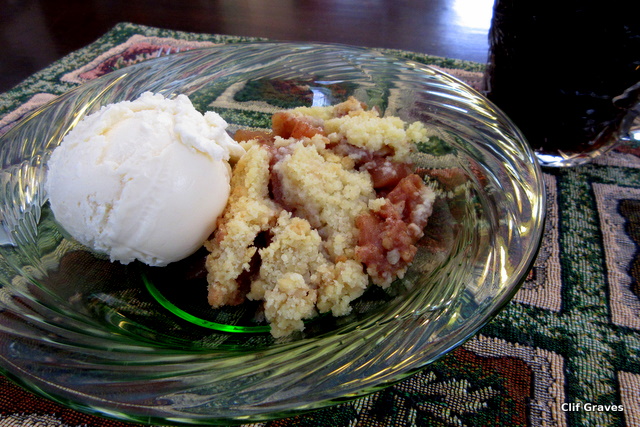
On Sunday, our friends Cheryl and Denny and Judy and Paul came over for homemade apple crisp and talk. As I’ve noted in a previous post, I really love hosting afternoon get-togethers with friends. We have a good-size dining room with an old Victorian table—the original chairs, long gone, were filled with straw—that can easily be expanded to accommodate eight to ten people. However, for me, six is the perfect number for good conversation.

Apple crisp must surely be one of the best desserts to serve at a gathering. It can be made ahead of time, tucked in the refrigerator, and baked forty-five minutes or so before guests arrive. Old apples, a little wrinkled, taste perfectly good, and my blast-furnace oven does a fine bubbling job of baking the crisp. The recipe I use comes from a Craig Claiborne New York Times Cookbook, and I just follow his instructions. If I had made enough  modifications to call the recipe mine, then I would happily share it. But I haven’t.

Then there is the smell of apples, cinnamon, and cloves as they blend and bake. It wafts from the kitchen and drifts to the dining room, and I expect this smell stimulates the appetite. (Let’s just say that it’s a good thing I made plenty for seconds.) So you have warm spiced apples and a crunchy, buttery topping. Perfect, right? Almost. It needs a scoop of vanilla ice cream to slowly melt into the warm mixture. Whipped cream is all right, but to my way of thinking, ice cream is the jewel in the crown, so to speak.

As we sat around the dining room table, we talked about many things, but one topic in particular stuck with me because I’ve been thinking about it lately—the importance of stories and how we all have them.

Judy told of how one day, when her mother was young—this would have been in the 1930s—she came home to find her mother (Judy’s grandmother) sobbing as she did the ironing.

“What’s wrong, what’s wrong?” Judy’s mother asked.

As Judy’s grandmother ironed, she listened to the radio, to an afternoon soap opera, and something sad had happened to one of the characters. Hence the tears.

After hearing this story, I replied, “I think the story gene runs strong in humans. Whatever the medium, we will always have stories. I’m sure of it.”

Everyone nodded, and Cheryl recounted how one Christmas her book group listened to a recording of A Child’s Christmas in Wales read by the great man himself, Dylan Thomas. All the lights were turned off except for the ones on the Christmas tree, and by the sparkling lights they listened to this fine writer read his own words.

“Sounds wonderful,” I said, thinking that I might like to do this next year, but with just Clif and me. (My book group meets at the library, and somehow, it just wouldn’t be the same to do it there.)

“It was,” Cheryl said, smiling as she remembered.

Warm apple crisp, friends around the table, shared stories. Another finest kind of way to spend a winter’s afternoon.

 

Christmas with Miss Read

During this busy time of year, especially when I have a cold—as I do now—I inevitably turn to Miss Read (aka Dora Saint) for some peace, common sense, and just plain fun. I am lucky enough to own Miss Read’s Christmas: Village Christmas and The Christmas Mouse, and how nice it is to just take it from the bookshelf.

What do I like so much about Miss Read? First, there are her depictions of nature. This description of rain is from the first two paragraphs in The Christmas Mouse: “The rain began at noon. At first it fell lightly, making little noise. Only the darkening of the thatched roofs, and the sheen on the damp flagstones made people aware of the rain. It was dismissed as ‘only a mizzle’….But by two o’clock…[t]he wind had swung round to the northwest, and the drizzle had turned to a downpour. It hissed among the dripping trees, pattered upon the cabbages in cottage gardens and drummed the bare soil with pock marks.”

When I read that description, I could feel, hear, and see the rain. Such lovely, evocative writing.

Then, there is what the The New Yorker called Miss Read’s “beery sense of humor.” In The Christmas Mouse, the story revolves around three generations—Mrs. Berry, the grandmother; Mary, her widowed daughter; and Frances and Jane, Mary’s two young daughters. It is Christmas Eve, and the children are beside themselves with excitement. (Thank goodness that never changes!) Frances and Jane have just bounded from their bath into their mother’s bedroom.

“‘The water’s all gone. Frances pushed out the plug—‘

‘I never then!’

‘Yes, you did! You know you did! Mum, she wriggled it out with her bottom—”

They began to giggle, eying each other.

‘Let’s go down and frighten [Gran], all bare,” cried Jane.

‘Don’t you dare now!’ said their mother, her voice sharpened by the thought of the [girls’] slippers being wrapped below.”

Finally, there is Miss Read’s great respect for work and home. Here she describes Mrs. Berry and her husband: “Amelia and Stanley were true homemakers….She could make frocks for the children, curtains, and rag rugs as competently as she could make a cottage pie or a round of shortbread….Stanley saw to it that any stonework or woodwork was in good repair. They shared the gardening, and it was Mrs. Berry’s pride that they never needed to buy a vegetable.”

In Maine, I’ve known many a Franco-American and many a Yankee who would fit the description of Amelia and Stanley.  And I still do.

Perhaps that’s why Miss Read never grows stale for me. Her observations about human nature, work and home, and the natural world continue to ring as true now, in 2015, as they did when she wrote in the 1960s and 1970s,

IMG_0013

Bright Colors for a Gray Day

Yesterday was all golden light in central Maine. Today, just the opposite—gray, chilly, and rainy. Clif has started the first fire of the season in the wood furnace in our basement. (In the winter, we mostly heat our house with wood. In the fall and spring, we use either electric or propane.)

Today would have been a perfect day to make the first apple pie of autumn. Indeed, that is what I had planned to do, and I had invited our friends Judy and Paul to come share pie with us. However, along with the gray weather, we have an uninvited guest—a cold. Right now it is visiting me, and I have no doubt that it won’t be long before it visits Clif. Couples are good at sharing such things.

Therefore, this morning I called Judy to cancel our pie get-together, and I promised to reschedule when the coast was clear, so to speak. A cold is a minor illness, but why spread germs when you don’t have to?

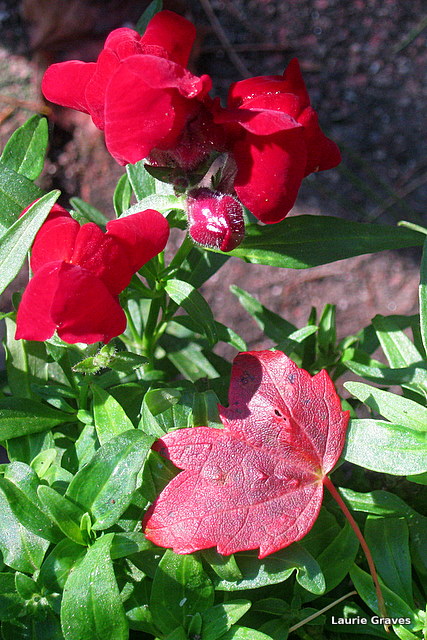
To make up for the gray day and the cold, both inside and out, here is a picture of red dwarf snap dragons—such a plucky flower!—and a red leaf.

IMG_2526

I am reading Gladys Taber’s The Book of Stillmeadow, and I’ll conclude with the opening passage of the October section: “The special gift of frosty gold days comes now; time to lay down the household tasks and shut the door on routine. For every October, when I see the trees over the meadow, I think, ‘I shall not look upon her like again.’ And every October is different, strange with new beauty.”

This was true nearly seventy years ago, when the book was published. And no matter the weather or where the cold is, inside or out, it is true today in New England.

At least in Maine.

Another Look at Squirrels: From An American Year by Hal Borland

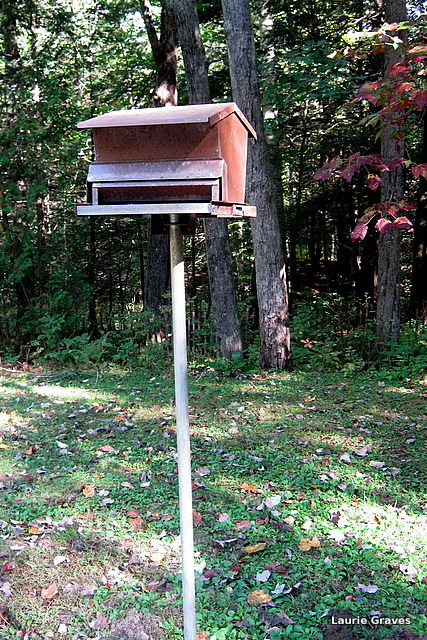
The bird feeder, sans squirrels

If you feed birds, chances are that you consider squirrels to be nothing more than a nuisance.  Indeed squirrels eat so much seed that it is often difficult to keep a feeder filled, especially a small one.  While I have no particular grudge against this furry animal who, after all, is just trying to make a living, I am very mindful about the cost of sunflower seeds. Our budget simply does not allow for replacing the seeds that the squirrels whip through with such astonishing speed. I compromise by spreading seed on the ground—some for the squirrels as well as crows, mourning doves, and, yes, mice.

Recently I came across a writer—Hal Borland—who also had some sympathy, and even empathy, for squirrels. According to Wikipedia, Hal Borland “was a well-known American author and journalist. In addition to writing several novels and books about the outdoors, he wrote ‘outdoor editorials’ for The New York Times for more than 30 years, from 1941 to 1978.”

In An American Year Borland writes about baby squirrels by his home. “Our baby squirrels were down on the ground today, for the first time. After that initial venture from the nest, they came out each morning, gaining confidence by the minute….But even on the fourth day they still descended the tree tail downward, in the manner of a black bear cub.”

Borland then goes on to describe how gradually the babies learned to go down head first and how cautious and frightened they were when they were on the ground. But Borland concludes, “From now on they’ll be coming and going many times a day. The mystery is broken. They have found the ground. The world is theirs—for a time.”

Even though I have lived in the woods for over thirty years, I have never been lucky enough to see baby squirrels venture to the ground for the first time. How I would love to see this!

Borland, with his beautiful, precise prose, reminds me yet again what an observant layperson can bring to nature writing. But better still, he reinforces my belief that when you look closely at the natural world, you can gain not only knowledge but also sympathy for the creatures who are struggling to earn their keep.

To my way of thinking, this sympathy can only be a good thing, especially when you consider how quickly we humans are driving so many animals to extinction.

For now, anyway, the squirrels are thriving. Next spring I’ll be on the lookout for baby squirrels leaving the nest.

And I’ll definitely be reading more of Hal Borland, who was introduced to me by Gladys Taber, in one of her books.

It Hardly Needs to Be Said

IMG_9804First and foremost, a very happy fifth wedding anniversary to my daughter Shannon and to my son-in-law Mike.  It hardly needs to be said that they are my favorite couple, but sometimes it is good to state what is so obvious. They will be coming over on Sunday for a special meal, and we are even going to grill steak for them, a rare treat as we seldom eat beef. We’ll also have grilled bread, Farmer Kev’s red potatoes, Stevenson’s corn on the cob, and cake, of course. An August meal. And such a lovely month in which to be married.

****************************************************************************

I am reading Glady’s Taber’s Stillmeadow Seasons, published in 1950. For years, Taber lived in Stillmeadow, a 1690 farmhouse in Connecticut.  Gladys Taber wrote many nonfiction books that followed the seasons at Stillmeadow, and her writing revolved around nature, home, food, dogs, and family. Sometimes she would add a dash of social commentary, mostly progressive: “There are many things we cannot do—we cannot make all people rich, or intelligent, or noble—but all people should be fed.” Is it any wonder that she is one of my favorite writers?

Here is a link to the Gladys Taber entry in Wikipedia, and it provides a bibliography of her work.

In the summer, I usually read on the patio when I have my afternoon tea, and that is where, appropriately enough, I am reading Stillmeadow Seasons. As always, my reading is interrupted by all that is going on. I watch mourning doves patrol the lawn until Liam chases them, and they fly away. I watch the trees, in summer deep green, move as the wind blows. Above them, is a bit of bright blue sky.

A bit of bright blue sky above the patio

The grasshoppers seem to know it’s August and have begun their buzzing song. I have come to associate this sound with August, and I look forward to hearing it every year.  At night, the crickets, with their high, sweet song, take over. I have heard some acorns drop—not many—just enough to remind me that fall is around the corner.

Along with the falling acorns, there are other reminders that fall is coming—the gardens are starting to look a little ragged, but along the edge of the woods, the jewelweed twinkles like tiny lanterns. Jewellweed can be fairly invasive, and I have to pull it back to give the other woodland plants some space. But what a welcome glow it is in August.

A little jewelweed lantern

Then there was this: The other day, in Rite Aid, I was looking for Hershey bars to tuck away for s’mores for when Dee comes to visit in a couple of weeks. A woman, who was also eyeing the candy, said to me, “They’ve got Thanksgiving decorations out.”

“Get out of here,” I replied.

“Look up,” she said.

Sure enough, along the top shelf above the candy, was a row of ceramic pumpkins, scarecrows, and other fall decorations.

“I don’t know about you,” I said. “But I’m not thinking about Thanksgiving yet. No way.”

She laughed. “Me, neither.”

No, no, and no. We still have half a month of beautiful August to enjoy, and after that, September, which in recent years is nearly as nice as August.

Autumn and Thanksgiving will come soon enough. No need to rush them.


Starting the Weekend with Shakespeare

IMG_0263On Friday night, Clif and I went to the annual Friends of Bailey Library book sale. This was a special preview night—tickets cost $10 per person—and the actual sale was on Saturday. Clif and I are what might be called “frugal weirdos”—to borrow a term from the blog Frugalwoods, but we considered the $20 money well spent.

First and foremost, the money went to a very good cause. The Friends do so much to help the library. Thanks to the Friends, the children’s section of our library is a magical place filled with soaring wooden planes and giant stuffed animals. And this is just one example of the many things this group does for the library.

Second, and nearly as important, it was much less hectic to look at books on the preview night. In Maine, book sales are usually mobbed, and as I am claustrophobic, these sales are not always a pleasant experience. It is hard for me to look for books when I am hemmed in by people.

The preview sale was pleasantly full. There were people, many of whom I knew (this was another plus), but not so many that it was impossible to look at books.

Because we are frugal weirdos, Clif and I view book sales as an ideal place to shop for Christmas and birthday presents. We do have strict guidelines. Unless the book is rare or special in some way, it must be in mint condition. This brings us to another advantage of going to the preview sale—the books had not yet been picked over, and there were lots of good finds. We bought presents for five people, and even with the price of the tickets, we spent only $28.

Naturally, along with looking for presents for those we love, I did a teensy bit of looking for myself, and I am happy to report I hit pay dirt. I found A Year in the Life of William Shakespeare by James Shapiro.

Along with being a frugal weirdo, I am also a fool for Shakespeare and have been since seventh grade, when my English teacher had us read The Merchant of Venice. I can still remember how dazzled I was by the language. I couldn’t believe anyone could write so beautifully, and while there was much I didn’t understand, I understood enough to know I would be hooked on Shakespeare for life.

Accordingly, I have a collection of books about Shakespeare, and I am always glad to find another one to add to the shelf, especially when I get that book—a hard cover—for $1.  A Year in the Life is in very good condition, and the cover price is $27.95.

In the library’s new conference room, iced tea, lemonade, brownies, and cookies were served. As I drank iced tea and ate a brownie, I spread my books on one of the long conference tables so that I could decided which books to buy and which books to leave for someone else. People I knew came in to have refreshments, and naturally we chatted. Some people I didn’t know came in, and being a friendly introvert—yes, it is possible to be both—I chatted with some of them, too.

All in all, a terrific night. Next year, Clif and I will definitely be going to the book sale on preview night.

Those From Away

IMG_8026In Maine there are two classes of people—natives and those from away. As is the case with many rural states, in Maine there is a tension between these two groups. The natives sometimes resent those from away, who are often more affluent and bring new and outlandish ideas to the state. The latter was especially true in the 1970s, when hordes of young people came here to go “back to the land.” It has also happened more recently with the foodie movement, where so many chefs and cooks have flocked to Maine that many places—especially Portland—have developed quite the foodie reputation.

Those from away often feel as though they will never truly belong, no matter how long they live here, no matter how hard they might work for their communities. A friend of mine once asked in frustration, “How long do I have to live here before I’m accepted as a native?” I wisely refrained from answering. To qualify as a Maine native, you have to go back at least two generations. As Mainers like to say, just because the cat had kittens in the oven don’t make them biscuits.

My husband and I are natives, and we both go back at least five generations. Maine is in our blood and in our bones. We have a history with the state, and this is reflected in the way we speak, think, and even dress. (Oh, yeah! We dress like a couple of Mainers, that’s for sure.)

As natives, Clif and I believe that those from away bring a much-needed vitality to Maine. Any state, any country that is closed becomes inbred, both literally and figuratively. Nevertheless, we understand why there is resentment. To someone who has sold a house in, say, Massachusetts or New York or even New Hampshire, houses in Maine are quite the bargain. For Mainers, not so much, and in some coastal communities, people can barely afford to pay taxes on property that has been in their family for several generations.

Several years ago, I was at a gathering where those from away commented gleefully about how unsophisticated the Maine food scene was when they first moved here.  One woman observed, “Mainers didn’t even know there was such a thing as square plates.”

This might be true, but I winced a little when I heard her say that. Did she really have to speak so condescendingly and unkindly? Of course not.

Fortunately, at least with the people I know, this attitude is rare. Most people from away come here because they love Maine and its unpretentious ways. They rejoice in not having to keep up with the Joneses or anybody else. Often those from away become very involved with their communities, donating time, energy, and money  to various organizations.

Recently, I read a book called The Hollow Land by Jane Gardam. It’s set in Yorkshire, England, and the interconnected short stories revolve around natives and those from away. Over a span of twenty years, a Yorkshire family forms a tight bond with a family from London. The London family rents a house called Light Trees from the Yorkshire family, and while there are tensions at first, they are soon smoothed over by the children, Bell and Harry. Bell grows up to have a child of his own, and at the end of the book there is a conversation between, Anne, Bell’s daughter, and Harry, who is considerably younger than Bell. They are discussing the possible sale of Light Trees and whether people should stay put.

Harry states, “We always knew we didn’t own it [Light Trees]…. Maybe people should stay where they were first put.”

Anne replies, “You great daft thing…What sort of a world would this be if people had stayed where they was born? What sort of a country this? There’d have been no Vikings bringing bees and honey…and no Celts with bronze and jewels and no Romans fixing up roads and laws and no Saxons with books and paintings…”

What sort of country, indeed? And what sort of state would Maine be if people had stayed put? As a native Mainer whose long-ago ancestors didn’t stay put, I can emphatically agree with Anne’s sentiment. Maine would be a much poorer state without the influx of those from away.


Louise Dickinson Rich: The Virtue of Being Useful

IMG_7289Lately, thanks to my friend Mary Jane, I have been on a binge of reading Louise Dickinson Rich, whose We Took to the Woods was a back-to- the-land anthem well before the 1970s, when the movement became a trend in Maine. (And what a welcome trend it was. Thanks to all the young people who moved here in the 1970s, we have a flourishing organic gardening community that nurtures young farmers.)

In We Took to the Woods, Louise Dickinson Rich wrote a meandering but lively account of living in the backwoods of Maine with her husband Ralph Rich. Conditions were basic—no running water, no electricity—and money was often tight as Rich and her husband scrambled to earn a living through writing and various jobs associated with the backwoods. What comes through in We Took to the Woods is not only a zest for life but also a great desire to be useful.  Living as she did, with her husband and children, Rich felt that she was essential to the well being of her family, that her work and effort, along with that of husband’s, kept the little family afloat.

After reading We Took to the Woods, I wanted to learn more about Louise Dickinson Rich. Therefore, I turned to Alice Arlen’s biography of Rich—She Took to the Woods—where Arlen not only writes about Rich’s life but also includes some of the author’s essays and letters.

Louise Dickinson Rich lived a long life—she died when she was eighty-seven—and in a letter to her friend Hortense, she writes movingly about one of the greatest losses that comes with old age. That is, of not being useful anymore. “Growing old is not easy, I have found. I, too, have twinges of regret when Dinah [Rich’s daughter] and her family take off on an expedition leaving me home alone….Alice [Rich’s sister] and I were talking the other day and both agreed that one of the hardest things about being old is that one feels so useless, with nothing to offer. But I guess that nothing can be done about that except to try to learn to adjust and accept gracefully. Which—for me at least—is damned difficult.”

Being useful, much like the freedom to be weird, sounds like faint praise. There are so many other things we could be: beautiful, kind, rich, athletic, artistic, good with our hands, a good cook. If someone said, “Laurie, you are so useful,” I might first wonder if the speaker was being ironic and then wonder if that was the nicest thing that could be said about me.

But if we think about it a little more, it doesn’t take long to realize that while being useful might be a modest, homely virtue, it is indeed a  virtue. When a person is useful it means she is contributing something essential to home, work, or community. She is needed. Her usefulness means the work gets done and because of this there is less chaos, less stress. Being useful often means you can work as part of a team, where even more can be accomplished, especially if others on the team are also useful. (Unfortunately, I have had the misfortune of working on committees with people who, to put it mildly, were not useful. It was a real misery.)

Being useful also brings meaning to a life. I am convinced that one of the reasons why teenagers in this country have such a hard time is that they are not useful, and they know it. They are stuck in a sort of limbo—no longer a child, not yet an adult—with no sense of purpose to order their days. The very rich can have this problem, too, with day after boring day stretching ahead of them.  Is it any wonder that drugs and alcohol are often used to relieve the tedium?

So lets hear it for being useful, and may we be useful for as long as we can.

IMG_7389


Keeping My New Year’s Resolution

IMG_7760We are just two months into 2015, and I’ve accomplished something I’ve never done before—I am half-way through my New Year’s resolution. Normally, my resolutions start out with a bang, and I make a strong showing in January. Then comes the cold of February, and my enthusiasm begins to flag. By the end of the month, as I desperately long for spring, all those lofty goals I made on New Year’s Eve have fizzled.

But not this year, and with any luck, in a few months, my New Year’s resolution will be fulfilled. Readers are no doubt wondering what my secret is, and being a generous soul, I will share it. The trick is to resolve to do something pleasant rather than something unpleasant. If I had discovered this simple trick years ago, I would have saved myself from a long string of broken resolutions and the resultant guilt.

Here is what I did for this year’s resolution. For our New Year’s Eve gathering, I asked family and friends to make lists of best books and movies read and watched in 2014.  This they did, and I resolved to pick one item—either a book or a movie—from each person’s list to read or watch.

I started with a book Clif recommended—Buddy Holly is Alive and Well on Ganymede by Bradley Denton. Clif owns the book, which made it an easy one to get started with. I must admit that I never would have read this book if not for my New Year’s resolution. Clif has a weakness for Sci-Fi, the quirkier the better. Me, not so much. However, I absolutely loved this romp of a novel that is a wild blend of Philip K. Dick, Elmore Leonard, and Loony Tunes. At the same time, the central mother-and-son relationship is warm and difficult and moving. In short, it felt real.  And, yes, Buddy Holly was indeed alive and well on Ganymede.

I was off to a great start, and for my second book I chose one from my friend Alice’s list–-Shores of Knowledge by Joyce Appleby. This nonfiction book couldn’t be more different from Buddy Holly. In Shores of Knowledge, Joyce Appleby explores how the discovery of the new world not only brought ill-gotten gains to European countries but how it also expanded them intellectually. New cultures and new species shook a narrow world view that had been carefully cultivated by the Catholic church. In the Shores of Knowledge,  Appleby draws a line from Columbus to Darwin and in between she fills in with journalists and naturalists and what would come to be known as the scientific community.

Last weekend, I read a book  from my son-in-law Mike’s list—Train Dreams by Denis Johnson. This novella follows its main character, Robert Garnier, who comes of age in the early 1900s in Idaho. In the course of  116 pages, Garnier must cope with tragedy, loss, and the wilderness all twined with a touch of the supernatural. Trains, of course, figure heavily in the story. It’s a haunting tale that somehow manages to be both aloof and moving.

Three books down, one book and two movies to go. Earlier, I made light of this resolution, calling it pleasant, and certainly it is giving me pleasure to fulfill this resolution. But it is also doing something else—broadening my horizons and encouraging me to stretch beyond the books and movies I would normally read and watch.

Maybe, just maybe, even though this resolution is pleasant, it is also worthwhile.


Book Review: Mrs. Appleyard’s Year

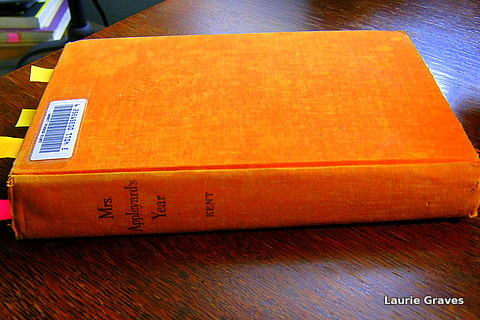
IMG_7685I follow a blog called Letters from a Hill Farm, and Nan, the author, writes a lot about the books she reads. Our tastes are fairly similar—we both love Miss Read—and when Nan suggests a book, I take note. Recently she recommended Mrs. Appleyard’s Year by Louise Andrews Kent, and as the title suggests, the book follows Mrs. Appleyard through the seasons—in  Massachusetts and on a farm in Vermont. I love books that do this, and immediately requested it through interlibrary loan, not paying much attention to when the book was written or anything else about it.

This inattention, along with the book’s unique voice, led to some merry confusion. In short, I thought I was reading a novel. Published in 1941, the book begins in January, and lists some of Mrs. Appleyard’s faults—impulsively buying antiques, “a fondness for looking up things in the dictionary during meals,” and telling the same story over and over.  But Mrs. Appleyard is philosophical about her faults. “Since she has had most of her defects for over half a century, she is well acquainted with them. Some of them, indeed, have become enjoyable simply because she has had them so long.”

With nary a plot in sight, next comes February, where Mrs. Appleyard notes she likes the month’s “uncertain temper.” The month brings illnesses that give the young Appleyards time to make homemade Valentines. In February, it is Mrs. Appleyard’s turn to host the Pinball and Scissors club. For this event, so much food is prepared that Mr. Appleyard compares the leftovers to the seven years of plenty in Biblical Egypt. Fortunately, Mr. Appleyard likes leftovers.

By now, I think I’ve made it quite clear that the book meanders, and this is true not only for the months but for time as well. Mrs. Appleyard’s Year moves between the present, when Mrs. Appleyard is in her fifties, and back to when her children were young. This book is so gently paced that it makes a Miss Read novel seem like a John le Carré story.

I almost gave up on Mrs. Appleyard’s Year, but then I came to March and “No matter how often she encounters this month, she doesn’t think she’ll live through it. Sometimes she doesn’t care whether she does.” And I was hooked. Anybody who felt that way about March—surely the longest and dreariest month of the year—deserved more of my time.

I also decided to do a little research about this book, and I discovered that Mrs. Appleyard’s Year really isn’t a novel at all. It’s more like a memoir, or semi-autobiographical fiction, told in third person and written in a wry, humorous tone that reminded me of James Thurber. Some of Kent’s descriptions were so funny that I laughed out loud, and when I read to Clif the episode of the revolving door at Christmas time, he laughed out loud, too.

I also found out that Kent’s pen name was Mrs. Appleyard, and she wrote cookbooks and food pieces for Vermont Life. Through interlibrary loan, I’ve already requested The Summer Kitchen. (Whatever would I do without interlibrary loan?)

Mrs. Appleyard’s Year is not great literature. There is no sex, violence, alcoholism, abuse, or dysfunction. The book is gentle and funny, yet well written and wise in its own way. While I certainly wouldn’t want to turn my back on darker literature—we need writers who examine humanity’s shadow side—I do wish there were contemporary writers like Louise Andrews Kent.

Readers, if you know of any, then please let me know.