All posts by Laurie Graves

I write about nature, food, the environment, home, family, community, and people.

When, What to My Wondering Eyes Should Appear…But Snow, Snow, and More Snow

IMG_8216Last night, as a plane flew overhead, I could tell from the sound that it was snowing outside. It’s hard to describe exactly what this sound is, but I would have to say that it has a muffled quality that is missing during  clear weather.

A little later, Clif let the dog out, noted the snow, and confirmed my suspicions. Unconcerned, we went to bed. This is April, after all.

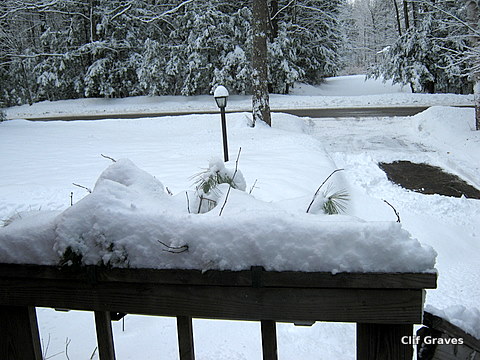
Imagine our surprise, then, the next morning when we looked out the window and saw that at least four inches of heavy snow had fallen during the night. It was enough so that Clif had to haul out Little Green and clean the driveway before he went to work. And here we were thinking that it was just about time to bring Little Green down cellar for the season and time to bring out the bikes. Not yet, that’s for sure.

IMG_8215

A little while ago, the plow went by, and the road is a mucky mess. No walk for the dog today. He’ll have to make do in the backyard. However, as I write, the snow is sliding off the branches of the trees. A few days of mild weather will bring us back to where we were before this mess, and the dog and I can walk on dry roads.

It has been a cold, hard winter in Maine, with lots of snow. Spring is officially here, but it is coming oh so slowly in fits and starts. Meanwhile, California suffers the worst drought in recorded history, and yesterday the temperature in Georgia was 90 degrees, which must be hot even for Georgia in April.

In Maine Lakes Tell Tale of Climate Change, a recent piece on MPBN, Susan Sharon addresses the issue  of global warming and writes, “While the Northeast may have experienced a bitterly cold and snowy winter in 2015, the average temperature on the planet last year was the warmest in 135 years of record keeping. In Maine the state climatologist’s research indicates that by 2050 the annual temperature in Maine will rise another 3 to 5 degrees.”

But what bothers Zach Wozich, an Ice fisherman interviewed in Sharon’s piece, is the extreme unpredictability of the weather over the past ten years, “the big variations in temperatures and snowfall.” This year, he’ll probably have two more weeks than usual to fish. A few years ago, the ice was out before the end of March. That year Clif and I actually went for an anniversary bike ride—on March 19—and Maranacook Lake looked like a huge, gray slushy. Not long after, there was open water.

There is some indication that as the Arctic melts, the jet stream is affected, bringing colder weather to the North East and warmer weather, along with drought, to the West. Only time and observation will tell if this is true. One or two cold winters do not a trend make, and there are other factors that affect the jet stream.

Nevertheless, for next winter, Clif and I will be sure to have a good supply of wood. (We ran out midwinter.) We will have a stockpile of food in our pantry as well as plenty of propane cannisters for our camp stove. Lamp oil is also a necessity and so is stored water in big buckets. For us, no power means no water.

Being prepared cannot change the weather, but it can certainly make fierce storms and power outages easier to deal with.


Bran Muffins and Costa Rica

IMG_8163Yesterday, our friend Diane came over for tea and bran muffins and to tell us about her recent trip to Costa Rica. She brought pictures of lush tropical landscapes, big lizards, sculpture, and buildings with thatched roofs. We learned that Costa Rica has a population of about four million people, with much of the population being clustered in and around San Jose, the country’s capital.

Diane told us that Costa Rica didn’t seem to have the extreme poverty of, say, Mexico. While many of the homes were modest, they were decent, and they all had electricity.

A quick bit of research confirmed Diane’s impressions. According to an article in Wikipedia, Costa Rica has a high literacy rate—well over 90 percent, “with a better record on human development and inequality than the median of the region.” Costa Rica has no military,  and the country is known for “its progressive environmental policies, being the only country to meet all five criteria established to measure environmental sustainability.” Costa Rica plans to be carbon neutral by 2021, and they have banned recreational hunting, which gives them a gold star in my book.

As Diane noted, it is easier to get things done in a country with only four million people, and this is certainly true. The vast population of India or China makes progressive reform and action slow and difficult. Nevertheless, more populous countries could learn from Costa Rica. This country has decided to put much of its resources into education and the environment, which benefits many people rather than just a few. (Even more affluent countries could learn a thing or two.)

No country, of course, is perfect, and while Diane didn’t see much extreme poverty, Costa Rica nevertheless struggles with a poverty rate of 23 percent. Still, it is a country thriving in what could be considered a tough neighborhood—Nicaragua is one of its neighbors.

After Diane finished telling us about her trip, the talk turned to other subjects, to politics, to family, and to one of our favorite topics—movies. Outside, a wet snow fell, making the April landscape look more dreary than it already did. However, when I looked out one of the dining room windows, I saw a crow gathering materials for what must be a nest. So the crows, at least, think spring is coming.

We drank tea, ate bran muffins, and decided we would like to get together once a month to watch a movie together. A perfect frugal activity for Clif and me.

“But we have to plan ahead,” Diane said, “and mark it on the calendar.” Indeed we do. Busy schedules make planning ahead a necessity.

The afternoon passed all too quickly, and it was time for Diane to leave. I sent her home with a couple of bran muffins, which she thought were tasty. It is a good bran muffin recipe. A friend gave it to me many years ago, and it’s a family favorite.

I’ve posted the recipe in my former blog, A Good Eater, but that was a while back. This recipe is so good that it seemed  worthwhile to post it again. These bran muffins go well with tea, with soup, or as an accompaniment to almost any meal. I often add a cup of thawed blueberries to the batter. Somehow, I just love the combination of bran and blueberries, and it’s good for you, too.

Tasty and good for you. A winning combination.

Bran Muffins

1/4 cup of vegetable oil
1/4 cup of brown sugar
1/4 cup of maple syrup or honey
2/3 cup of milk
1 egg, beaten
1 cup of flour
1 cup of wheat bran
1 tablespoon of baking powder
1/4 teaspoon of salt

Heat oven to 400 degrees Fahrenheit. Grease 12 muffin cups.

In a medium-sized mixing bowl, combine the flour, wheat bran, baking powder, and salt. Set aside. In a large mixing bowl, blend the oil and brown sugar. Add the maple syrup, milk, and egg. Mix well. Add the dry ingredients, mixing until the ingredients are just moistened.

Scoop batter into the greased muffin cups. Bake for 20 minutes or until muffins are brown.

A Quiet but Nice Easter: On the Rail Trail in Augusta

Clif and I had hope to host an Easter brunch for our family, but for various reasons this didn’t happen. Therefore, we were on our own. We had planned to go to the ocean if the weather was warm enough, but, alas, it wasn’t. When the temperature is a brisk 39 degrees in central Maine, there is no telling what it will be like on the beach, where the wind can blow hard and cold. As it is a three-hour round trip to the ocean and back, we just didn’t dare risk it.

Time to move on to Plan C—a walk on the Rail Trail in Augusta, a fifteen-minute drive from where we live. Although the day was brisk, it was sunny. Because of the cold weather we’ve had this winter and spring, the ice still isn’t out on the Kennebec River.

IMG_8122As we walked on the Rail Trail, we met many other walkers who were enjoying this fine, chilly day by the river.  I grew up by the Kennebec, in Waterville, when the river was dark and dirty and used primarily for dumping. In the I960s, nobody would have thought to walk by the river on Easter Day. But the Clean Water Act, passed in 1972, changed all that, and slowly, slowly the Kennebec came back to life. Now there are eagles and ducks and fish. And walkers.

“This just shows how the right kind of regulation can be a very good thing,” I said to Clif as we caught glimmers of the Kennebec on the Rail Trail. He agreed. He, too, is old enough to remember how dirty and polluted rivers were in Maine.

A glimpse of the blue Kennebec

Liam loves walking on the Rail Trail. So many things to sniff and explore.

Liam on the trail
Liam on the trail

It is not a lovely time of year, but there were some visually interesting things to notice.

A bench in need of repair.

IMG_8131

A rusty bridge.

IMG_8127

A purple fence through the trees.

IMG_8133

After our walk, we treated ourselves to ice cream at the Dairy Queen, just down the road from the Rail Trail. As we seldom go out for ice cream, it truly was a treat for us. (We had hoped to go to Fielder’s Choice in Manchester, but they were closed for Easter.)

That night for supper, Clif made pancakes, and I cooked home fries. We might not have been able to host brunch, but we could still enjoy Clif’s delicious pancakes.

Have I ever mentioned that Clif’s pancakes are the best? I think I have.

Alice’s Magic Trick: How to Make Delicious String Beans from Frozen Ones

Magic beans
Magic beans

I have a confession to make: I am not a fan of frozen string beans. Oh, how slimy they are and how I hate their texture. I would take a can of string beans any day over frozen ones, with fresh, of course, being the best.

However, this year in Farmer Kev’s winter CSA I got packets of frozen string beans. Lots of packets. (I completely understand why Farmer Kev would prefer to freeze the beans rather than can them. I would make the same decision if I were in his situation.) I’ve been using the string beans, diced small, in various soups, and this hides their slimy nature. In fact, the frozen beans are very good in soup.

Then not long ago, when my friend Alice was visiting, she told me what she had done with part of a packet of frozen string beans I had given her. “I stir fried them with garlic and oil until the beans were blistered and well cooked. They were delicious.”

Alice is a good cook, and I trust her judgement. Despite my aversion to frozen beans, I resolved to try her method. Not long after her visit,  I whipped out my trusty cast-iron frying pan, added some oil, heated it, then added some thawed beans. I let them sizzle for quite a while, say, five minutes or so, until they were nicely blistered and more than a little brown. I added the garlic during the last minute—I didn’t want the garlic to be as brown as the string beans.

And the results? Readers, the beans were utterly delicious. The slimy texture was gone, gone, gone to be replaced by a crisp, garlicky one. The beans were so good that I gobbled them up before I ate my potato and chicken, and I wished I had more when the beans were gone.

I see other possibilities for these stir-fried string beans. They are terrific with just the garlic, but soy sauce and sesame oil could also be added. The beans are great as a side, but cut a little smaller, and they would also be delicious in stir-fried rice, one of Clif’s favorite dishes and a staple in our house.

How nice for this old cook to learn a new trick, to take a vegetable I was not excited about and to turn it into something that I eagerly eat.

Many thanks, Alice!


Early Spring in Maine: But It Still Feels Like Winter

IMG_8104
On the lookout for spring

This year spring has come reluctantly to Maine. I’m tempted to say it isn’t even here yet. Yesterday, when I went to check the mail, there was such a stiff, cold wind that I couldn’t bring myself to take the dog for a walk after lunch. I thought time spent in the backyard would be enough for him. A big mistake. At ten, Liam is still an energetic dog, and late in the afternoon he pestered me as I tried to watch Shakespeare Uncovered and Ethan Hawke’s take on Macbeth.

I finally did take Liam for a walk—as supper was heating in the oven—and luck was on my side. The wind had stopped blowing, and the air was crisp rather than biting. The sky at dusk was a deep blue, and the rising moon glowed high over the horizon. A lovely walk, good for me as well as for the dog.

Even though spring might be late, progress has been made with the melting snow. Every day it goes down more, and the snow has pulled completely away from the road.

IMG_8098

In sunny yards, there are bare patches of tan grass. Even in our yard, which is the last to lose snow on Narrows Pond Road, the driveway is bare, and the backyard has its own patch or two of tan grass.

On branches by the road, pussy willows have begun showing their soft little heads.

IMG_8089

And tree buds are now easy to see against the blue sky.

IMG_8096

Soon, I hope, the little swamp up the road will be free of ice, and the full-throated song of spring will swell at night. This cycle of renewal is always fresh and stirring, and every year I wait eagerly for the emergence of the peepers and the frogs.

Ah, printemps!


April 1, 2015: My Garden in Bloom

Last night, when I went to bed, there was snow on the ground. But when I woke up, everything had changed.

In front, the elegant irises were in bloom.

IMG_5889

The hostas were bright and green, with an errant daisy right in the middle.

IMG_5897

The little ferns had unfurled.

IMG_5900

In my backyard, the bee balm was bright and tall.

IMG_6204

And the daylilies looked as fetching as only daylilies can.

IMG_6196

Could all of this have happened overnight? No, it couldn’t. This is what my front yard really looked like this morning.

IMG_8107

And my backyard.

IMG_8109

Happy April Fools’ Day!

Our Library’s Beautiful New Addition

The new adult section with its beautiful shelves and lights
The new adult section with its lovely shelves and lights

As long-time readers of this blog know, for the past few years, I have been part of a campaign team that has been working oh so diligently to raise money for a new addition for the Charles M. Bailey Public Library, our town’s library.  (Full disclosure: I am also a library trustee.) The budget is one million dollars, which sounds modest enough, but in fact it has been quite a challenge for a town with a population of 6,000.

Late last summer construction began, and all through the winter workers have been busy pounding, hammering, and sawing.  (Or sawring, as we Mainers would say.) Now the workers are coming down the homestretch. The new addition is nearly complete, and good progress is being made getting the original library spiffed up so that it won’t be totally overshadowed by its new sibling.

Yesterday, after doing our civic duty and paying our property taxes, Clif and I went over to Bailey Library to check on the progress. Oh, how beautiful Bailey is, even partially finished, and how wonderful it will be for the town to have this expanded library. The original library, built when the town was half the size it is now, was bursting at the seams, and there was no room for new books, not enough space for events, and hardly any place for the staff to work.

Now, we have a spacious new events room that will hold 130 people, greatly expanded children and adult sections, a meeting room, and an honest-to-God little staff room. The expanded library, in the center of town, will truly become even more central than it is now.

I want readers to know that while Bailey Library hosts events, has computers, and offers a wide range of DVDs, real books, made of paper, are still the thing, with thousands being checked out each month. And I’m happy to report that this book trend doesn’t seem to be changing anytime soon.

Right now, volunteers are busy shelving books that had to be stored during construction. (The library is in temporary quarters in the Commerce Building in town.) In late spring or early summer, Bailey Library will reopen, and there will be a grand celebration.

I’ve written this before, and I’ll write it again. It’s not every day that ordinary people get to work on a project that will be around long after they are gone. One hundred years from now, Bailey Library will be there for the people of Winthrop. It’s been a true pleasure to be a part of this project.

The beautiful lobby, with original stone work
The view from the lobby of the adult section
The view from the lobby of the new adult section
Wainscotting from the Masonic Building that had to be torn down to make way for the new addition.
Wainscotting from the Masonic Building, which had to be torn down to make way for the new addition
A view of "old" Bailey, still under renovation
A view of “old” Bailey, still under renovation
The spacious new events room

The Things We Say in Maine

Last Saturday, our friends Dawna and Jim invited us over for dinner, where we deliciously jump-started spring and summer by drinking Dawna’s  homemade margaritas. (Hers are the best!) We also had chicken tacos and a tasty rice dish. What a way to celebrate the end of March and the beginning of what we hope will finally be spring.

IMG_8055

After dinner, we settled in the living room and talked about this and that. During the course of our conversation, Jim described someone as being “tough as a bag of hammers.”

That was a new one to me, but when we got home and I asked Clif about it, he said he had heard this before. (Both Jim and Clif are from the Bangor area. Maybe it was a common saying up there.) As Clif and I discussed “tough as a bag of hammers,” one saying led to another, and we came up with a short list of things we say in Maine:

  • Happy as a clam at high tide. This seems like a rather ubiquitous expression that might be said by anyone who lives in a coastal state.  Nevertheless, Clif and I grew up hearing it quite a lot.
  • A few logs short of a cord. Around this time of year, that’s pretty much the way most Mainers feel, but usually it refers to people who aren’t clever.
  • Numb as a hake. This tells you how Mainers feel about hake.
  • The whole of it, rather than all of it. Why we say it this way, I don’t know, but I catch myself using this expression all the time.

Then, of course, there is the way we say or don’t say our Rs, and Clif and I are guilty as charged. We drop them, we add them, and most of the time we don’t even realize we’re doing this.

When my daughters went to college, they both were ribbed about the way they pronounced drawing. I know. It only has one R, but we Mainers pronounce it with two RsDrawring. Somehow, teasing be damned, that word just doesn’t sound right to us without the second R.

We add Rs. I often refer to my friend Dawna as Dawner. We drop Rs in Mainer so that it sounds like Mainah. Or, it works like a chahm rather than a charm.

I realize most people don’t speak this way, and on Public Radio, people mostly say their Rs the way they should. But every once in a while someone from New England is interviewed, and he or she drops and adds those Rs just the way it is done in Maine.

And when I hear this, it always warms—or rather wahms— my heart.


Those From Away

IMG_8026In Maine there are two classes of people—natives and those from away. As is the case with many rural states, in Maine there is a tension between these two groups. The natives sometimes resent those from away, who are often more affluent and bring new and outlandish ideas to the state. The latter was especially true in the 1970s, when hordes of young people came here to go “back to the land.” It has also happened more recently with the foodie movement, where so many chefs and cooks have flocked to Maine that many places—especially Portland—have developed quite the foodie reputation.

Those from away often feel as though they will never truly belong, no matter how long they live here, no matter how hard they might work for their communities. A friend of mine once asked in frustration, “How long do I have to live here before I’m accepted as a native?” I wisely refrained from answering. To qualify as a Maine native, you have to go back at least two generations. As Mainers like to say, just because the cat had kittens in the oven don’t make them biscuits.

My husband and I are natives, and we both go back at least five generations. Maine is in our blood and in our bones. We have a history with the state, and this is reflected in the way we speak, think, and even dress. (Oh, yeah! We dress like a couple of Mainers, that’s for sure.)

As natives, Clif and I believe that those from away bring a much-needed vitality to Maine. Any state, any country that is closed becomes inbred, both literally and figuratively. Nevertheless, we understand why there is resentment. To someone who has sold a house in, say, Massachusetts or New York or even New Hampshire, houses in Maine are quite the bargain. For Mainers, not so much, and in some coastal communities, people can barely afford to pay taxes on property that has been in their family for several generations.

Several years ago, I was at a gathering where those from away commented gleefully about how unsophisticated the Maine food scene was when they first moved here.  One woman observed, “Mainers didn’t even know there was such a thing as square plates.”

This might be true, but I winced a little when I heard her say that. Did she really have to speak so condescendingly and unkindly? Of course not.

Fortunately, at least with the people I know, this attitude is rare. Most people from away come here because they love Maine and its unpretentious ways. They rejoice in not having to keep up with the Joneses or anybody else. Often those from away become very involved with their communities, donating time, energy, and money  to various organizations.

Recently, I read a book called The Hollow Land by Jane Gardam. It’s set in Yorkshire, England, and the interconnected short stories revolve around natives and those from away. Over a span of twenty years, a Yorkshire family forms a tight bond with a family from London. The London family rents a house called Light Trees from the Yorkshire family, and while there are tensions at first, they are soon smoothed over by the children, Bell and Harry. Bell grows up to have a child of his own, and at the end of the book there is a conversation between, Anne, Bell’s daughter, and Harry, who is considerably younger than Bell. They are discussing the possible sale of Light Trees and whether people should stay put.

Harry states, “We always knew we didn’t own it [Light Trees]…. Maybe people should stay where they were first put.”

Anne replies, “You great daft thing…What sort of a world would this be if people had stayed where they was born? What sort of a country this? There’d have been no Vikings bringing bees and honey…and no Celts with bronze and jewels and no Romans fixing up roads and laws and no Saxons with books and paintings…”

What sort of country, indeed? And what sort of state would Maine be if people had stayed put? As a native Mainer whose long-ago ancestors didn’t stay put, I can emphatically agree with Anne’s sentiment. Maine would be a much poorer state without the influx of those from away.