

All posts by Laurie Graves
All Part of the Continuum
As I sit here typing this post, it is the sweetest summer morning in Maine that anyone could ask for. The air is warm and dry. Next door, a hen clucks as she lays an egg. The grasshoppers buzz an August song. By my desk, the window is open, and a soft breeze, which rustles the leaves on the trees, comes in.
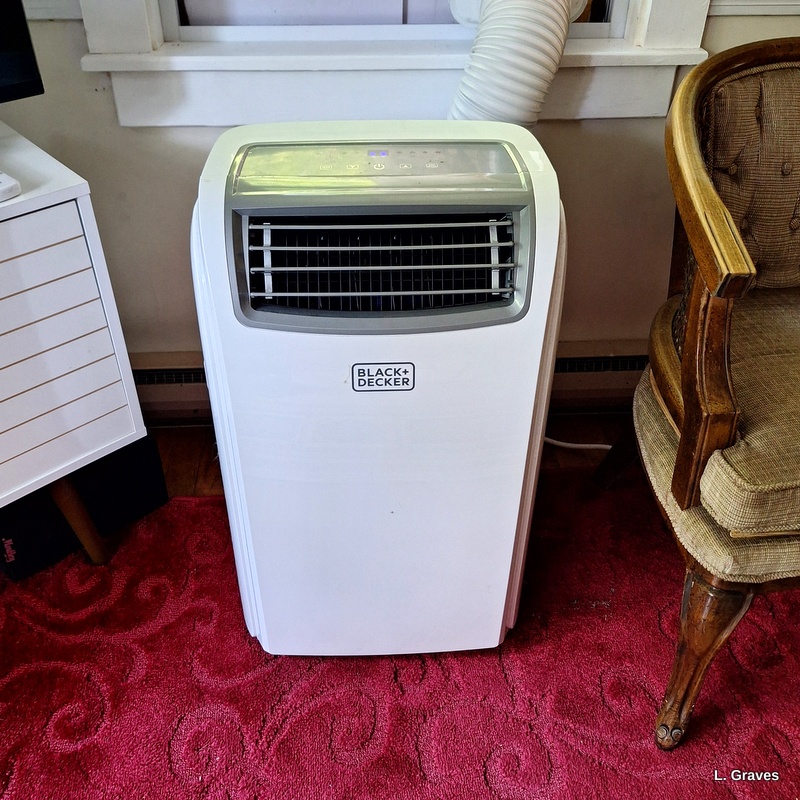
Quite a change from last week, which once again flipped to high humidity and high temps. There was another heat advisory, and we had to stay inside, cooled by our trusty air conditioner, Eva. On Friday, our friend Joel came over for drinks and appetizers, and it was too humid and hot to sit on the patio. Instead we had to gather in the living room, made comfortable by Eva.
But today, all is forgiven. If I were in charge, I would order 26 more days just like this one, with enough rain thrown in at night to water the plants. Like Goldilocks, I always want things to be just right.
Outside, the plants have thrived in the heat and humidity. Even though my gardens are at their best in June and July, there are still some things to admire.
This striking double daylily,

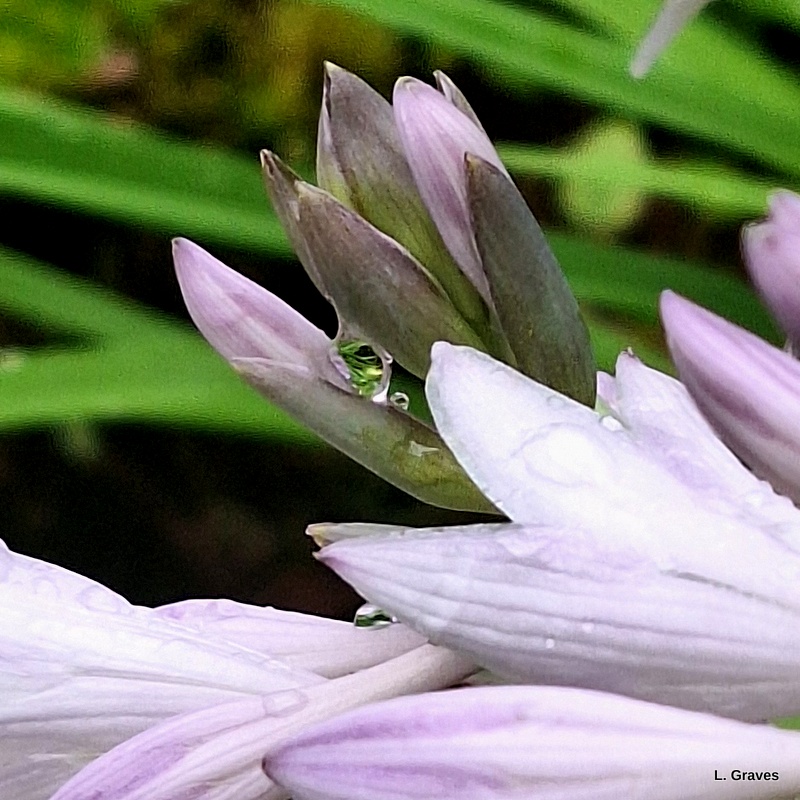
a modest but lovely hosta blossom,

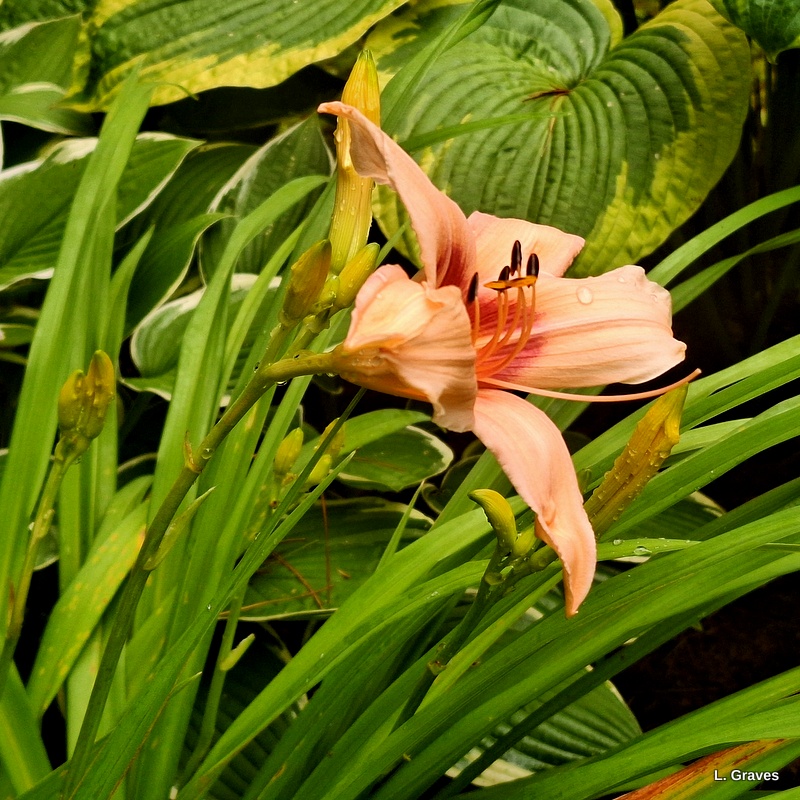
and a delicate single daylily. I can’t decide whether its color is peach or salmon. I’m tending toward peach.
Because this is not thankful Thursday, I’m going to gripe just a little about the damage done to my hostas by slugs and snails

With all the rain and humidity, it’s been a good year for those slimy little nibblers. Time was when I did my best to keep the slugs and snails at bay, and I would patrol the yard with a jar of soapy water to drop them in. But in my old age, I have given up what seemed like a futile battle. No matter how many slugs and snails I caught, more would come. Fortunately, all that chewing doesn’t cause permanent damage. Still, I wish the slugs and snails would stay in the woods and find their meals elsewhere.
On the other hand, there are some visitors we don’t mind. One night, before going to bed, when I shut off Eva and opened the windows, I spied this little creature clinging to the screen. Attracted by the light, I suppose. Or rather, after some insect that was attracted by the light. By morning, our little visitor was gone.

When you live by the edge of the woods, you know you are going to share your yard with other creatures. Some you enjoy. Others not so much. But this morning as I watched some crow fledglings pester their parent for food, I thought about how we are all part of the continuum, the rich web of life in northern New England.
Thankful Thursday: Electric, At Last!
This post is part of a series called Thankful Thursday, where I list some things to feel thankful for. To some extent, focusing on what is wrong appears to come naturally to most people, who tend to complain, complain, complain when they get together with family and friends. (I’m no exception, that’s for sure.) So focusing on things to feel thankful for seems like good spiritual practice, a way to counterbalance the tendency toward negative thinking.
On last week’s Thankful Thursday’s post, my first one, I started with a humdinger—a new driveway and steps. As someone whose life is mostly filled with small, simple pleasures, I didn’t think it would be possible to top this. But, holy cats, was I ever wrong!
Last Friday, after over a month of waiting, our daughter Dee’s new electric car, a Tesla Y, was delivered to our home by the woods. (Tesla sells directly, and because there are no service centers in Maine, this one was shipped from New Jersey.)
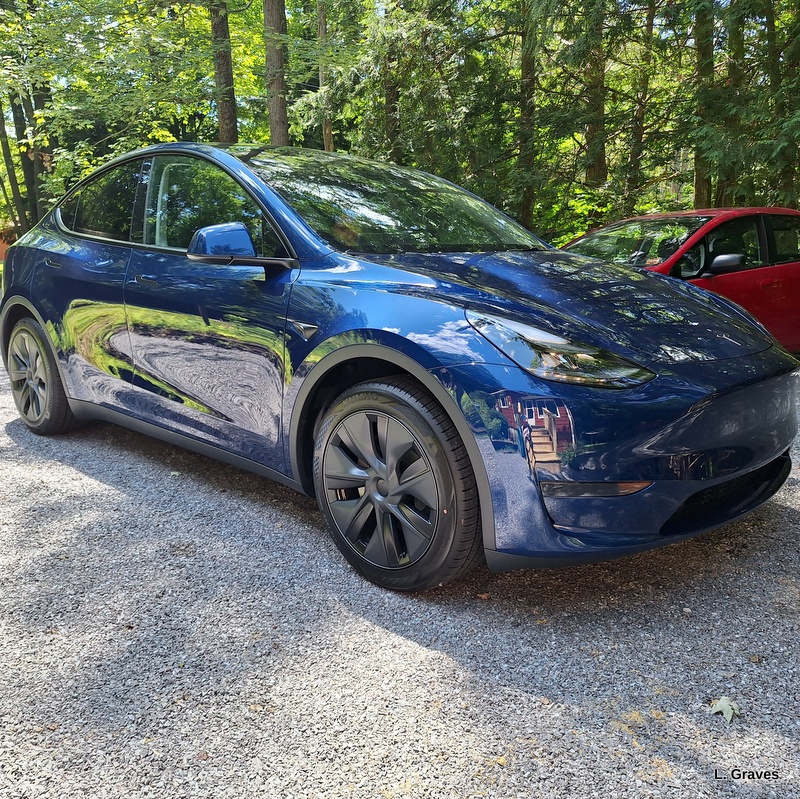
Isn’t it a beauty? And isn’t it great that our new driveway was ready to welcome the new car?
Obviously, an electric car needs a charger, and we had one ready and waiting.
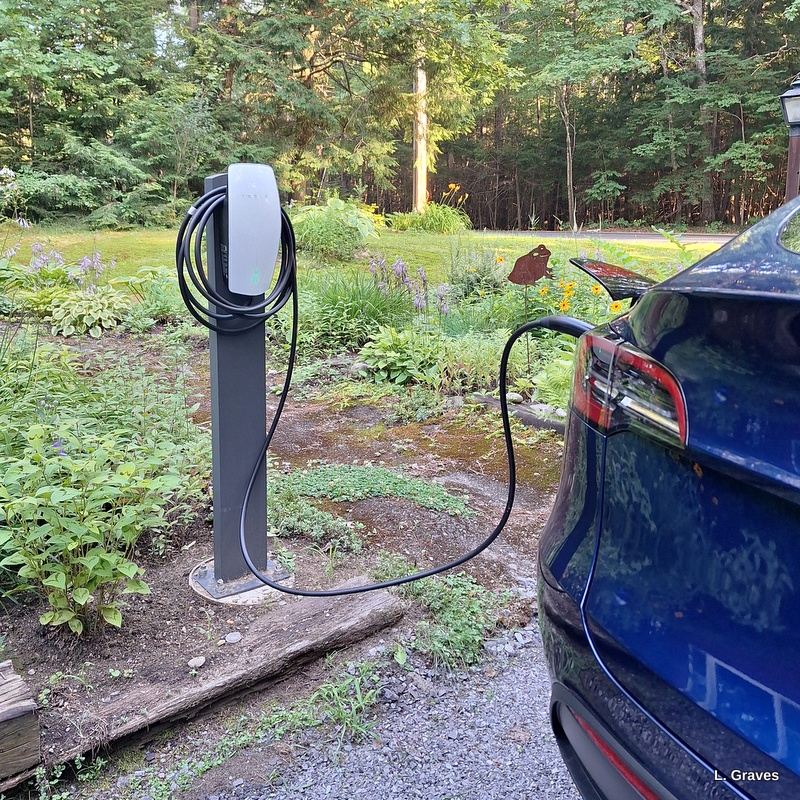
Now, this is Dee’s car, not ours, but she will be staying with us for a few more years while she saves money to buy a house. This means we will get the benefit of her electric car when we drive here, there, and everywhere. (Actually, we don’t go too far, and the car’s 320 miles per charge will be just fine for us.)
For dirty trips to, say, the transfer station (formerly the dump), we will use our Honda Fit, which is 14 years old and has seen its share of wear and tear. When the Fit no longer runs, we hope to buy an electric car, a used one.
So hot diggity dog! Here we are, an electric-car family, at least for now.
I can’t imagine anything will top this for the next Thankful Thursday.
But you never know.
Addendum: My blogging friend Eliza asked where the Tesla will be serviced. Fortunately, we won’t have to take it to New Jersey. There’s a dealership in a nearby town that services Teslas.
In Which I Write about August As Well As the Classic Film Alexander Nevsky

For the first part of July, the heat was terrible in Maine—at least for Mainers. The heatwave coincided with the Maine International Film Festival, and Clif, Dee, and I were more than happy to sit in air-conditioned cinemas as we watched movies.
Then, around July 18, it was as though the weather gods flipped a switch, and suddenly we were in August. Black-eyed Susans and Queen Anne’s lace, not normally July flowers, were in full bloom. Crickets, another August treat, were singing at night, and during the day, grasshoppers buzzed.

And the weather? Delicious as only a traditional Maine August can be: hot and dry during the day and wonderfully cool at night. The windows are open all the time, and the air inside the house smells so fresh.
What will true August bring us, I wonder? More of the same would be nice, but in this time of climate change, who knows? Whatever the case, Clif, Dee, and I are enjoying this weather. We are spending as much time as possible in our screen house on the patio.
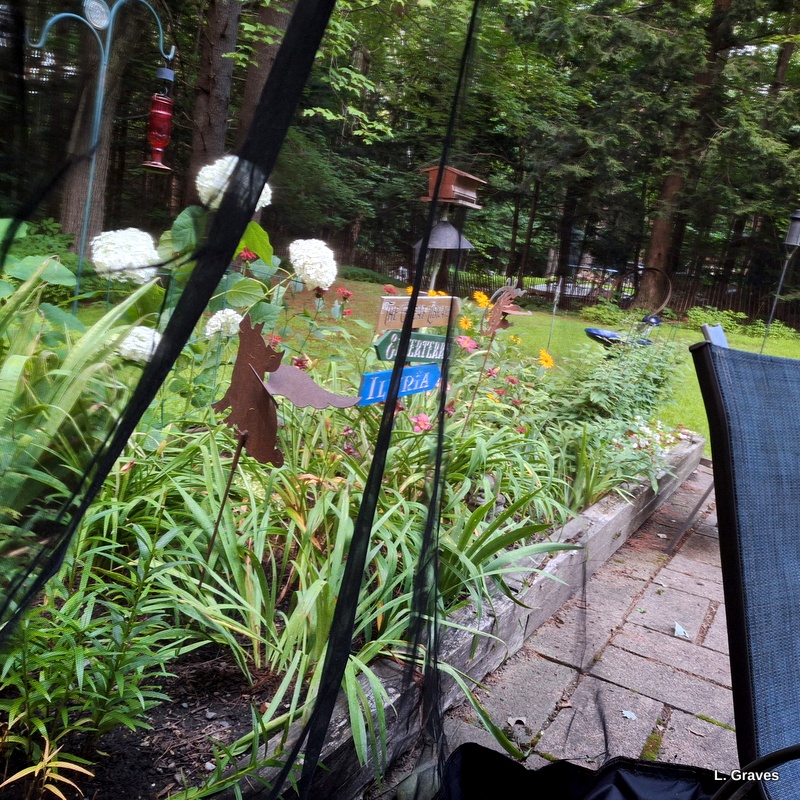
As we chat about this and that—often movies—we sip our drinks, and listen to the noises from the woods and yard. Gold finches twitter at each other as they vie for spaces on the feeders. A fledgling blue jay calls to its parents. Nearby, crickets sing their sweet song of summer, and in the far distance, in the woods, we catch the ethereal song of a hermit thrush.
Magical might be a word that is overused, but magical is what this time is.
**************************************************************************
Watching: World Cinema
Alexander Nevsky directed by Sergei Eisenstein
In my previous post, I wrote about how much I like foreign movies, and that our daughter Dee has a huge DVD collection of them. To be more specific, the major part of her collection is Essential Art House: 50 Years of Janus Films released by the Criterion Collection. Janus Films is a film distribution company founded in 1956 in Cambridge, Massachusetts, and they helped bring world cinema to the United States with such classics as The Seventh Seal, one of my absolute favorites.

There are 50 movies in the set, and this should keep us busy for a while. (Don’t worry. I don’t plan to write about all of them. Only the ones that catch my attention.) The DVDS are in alphabetical order by title, and this is how we will work our way through the collection, starting with the first one, Alexander Nevsky, a 1938 Russian film directed by Sergei Eisenstein.

Alexander Nevsky is billed as a historical film, and strictly speaking, this is true. The movie is set in the thirteenth century, centering on the real-life conflict between Teutonic Knights and Prince Alexander. But really it’s a Russian propaganda film, featuring Russia against Germany, a reflection of the situation between the two countries in 1938.
As a result, the characters are stiff and one dimensional, with Prince Alexander being all virtue and valor and the Teutonic knights being a rotten bunch. Indeed, one of the bad guys even looked like an evil sorcerer, as though he had just slithered in from a fantasy movie. As someone who prefers character-driven movies, whatever the genre, this should have been a deal killer.
But it wasn’t. Alexander Nevsky has such a crazy energy that it carried me along. The battle scenes between the Teutonic Knights and Prince Alexander’s forces are nothing short of jaw-dropping, with hundreds and hundreds of extras and horses rushing toward each other. I don’t suppose there were many retakes of these battle scenes, and this was well before the time of CGI and special effects.
In addition, the movie is in black and white, and the cinematography captures everything in crisp detail.
So, in the end, who wins? Prince Alexander or the Teutonic Knights? No spoilers here. Watch for yourself and see how a propaganda film can still be a marvel of early cinema.
July 31, 2024
Addendum: Yikes! I forgot to mention the rousing score and the composer, Sergei Prokofiev. The music certainly added energy to an already energetic movie.
Thankful Thursday: A New Driveway and New Steps

A couple of the blogs I read—notably Cimple: A Curious Introvert’s Musing & Photos about Life and Enjoyment—have Thankful Thursday posts, where each week they list a few things they are thankful for. I really enjoy these posts and have decided to follow suit.
It hardly needs to be said—but I will say it anyways—that life is not all sweetness and light. There is much that is wrong with the world, both globally and locally. From the climate crisis to my creaky knees, I can dwell on the negative with the best of pessimists. To some extent, focusing on what is wrong seems to come naturally to most people, who tend to complain, complain, complain when they get together with family and friends. (I’m no exception, that’s for sure.)
So focusing on things to feel thankful for seems like good spiritual practice, a way to counterbalance the tendency toward negative thinking.
I’m not advocating toxic positivity, pretending everything is hunky-dory when it isn’t. Far from it, and in other posts I will feel free to crab about things large and small. (Hot weather, I’m looking at you.) But on Thursdays, I’ll step away from that to give my thanks for the good things in my life. Like everyone else, I have my struggles, but I also have so much to be grateful for.
And this week, I have two humdingers, thanks to the generosity of our daughter Dee, who lives with us, and our neighbor Bob Smart, who lives next door.
First, our driveway. Truly, we had one of the worst driveways in our town. Long ago, it been paved, but over time it had heaved because of underground rocks and roots. Then this year, a big truck for pumping our septic system crushed one side of our driveway into a valley.
After the truck fiasco, Dee took one look at the driveway and said, “I’ll pay for a new one.”
Clif and I, who have a budget as big as a minute, were oh so grateful.
I don’t have any pictures of the old horror of a driveway, or at least not ones I could readily find. But here is our new one, beautiful and flat and made from pea stone and gravel, one that will drain and can easily be repaired.

For days after the driveway was installed, Clif and I would stare out the window and gaze lovingly at it.
Our neighbor, Bob Smart, who owns his own construction company, Building Smart, oversaw the project, which involved moving our front steps. Unfortunately, the steps were rotten and were smashed during the process. Without charging extra, Bob rebuilt and installed the steps, and now we have brand new steps to go with our brand new driveway.

Woo-hoo! make that double woo-hoo.
A Return to Blogging with the Maine International Film Festival

After a horrible two-week heat wave and the Maine International Film Festival (MIFF), I have returned to blogging. I’ve certainly missed you all, and I’m happy to be back.
First, the heatwave. Hot and humid, then hotter and even more humid, complete with heat advisories. Heat advisories? In Maine? With the heat index, some days the temp was close to 100°. The best that can be said is that the heatwave is over for now, and today it’s rainy and cool, with the temperature being 67°. I’m wearing a long-sleeved shirt, and I’m as happy as only a Mainer can be in cool summer weather.
Now on to the Maine International Film Festival. Dee, Clif, and I have not been to MIFF since before the pandemic, and we were so happy to be back. The Film Festival features over 100 movies. Naturally, we couldn’t see them all, but we made a good effort, seeing 31 films in 9 days.
This might sound kind of silly, but it really is exhausting seeing that many films in such a short time. But it’s also fun and stimulating. We reconnected with old friends and met a few new ones. We talked about the movies we liked and the movies that left us cold. When you see that many movies, there are bound to be a few duds.
As the name suggests, the Maine International Film Festival features lots of movies from around the world, and part way through the festival, I realized how much I love foreign films. Thanks to MIFF, I went all around the globe—to Spain, France, Uganda, Mexico, South Korea, Hungary, and Russia. I heard many languages, visited different cultures, and saw people who didn’t look like me. Yet, the concerns—the fears and hopes and feelings—were really not that different from mine. We are all human with similar needs and wants.
As it turns out, my daughter Dee has a huge DVD collection of foreign films, and MIFF has motivated me to start watching them, one a week. Even though MIFF is over, I can still go around the world.
Here are three movies that really caught my attention at the Maine International Film Festival:
- Close Your Eyes (Cerrar los ojos): A Spanish film about an actor who disappears during the filming of a movie. His disappearance haunts family and friends, and while the story revolves around the central mystery of what happened to the actor, Close Your Eyes is also a poignant look at aging and memory. This is a leisurely film that takes its time unfolding. If action films are you thing, this is not the movie for you.
- The Midwives (Sage-femmes): This French movie follows two young midwives, Louise and Sofia, as they begin their first job in a hospital that is understaffed. The Midwives is by turns touching and harrowing as Louise and Sofia struggle in different ways to adapt to the stress of delivering babies under circumstances that are less than ideal. This movie is a lot more graphic than the BBC series Call the Midwife, but it never seemed inappropriate. Let’s face it: childbirth is a bloody, messy business.
- The Echo (El eco): A slice-of-life documentary about a farming family in a remote village in Mexico. The director, Tatiana Huezo, captures the rhythm and the beauty as well as the limitations and the hardships of living a life close to the land. Warning: There is a brutal scene of a goat being slaughtered, and I averted my eyes. Fortunately, this is the only scene of an animal being killed, and despite this violence, The Echo is very much worth watching.
**********************************************************************
Readers might be wondering about the picture at the beginning of this post. It is a close up of an enchanting installation in the park next to the Maine Film Center and the Opera House, which hosted MIFF.
Here are some other photos of the Installation, a magical addition to terrific film festival.


And the Break Continues
How time does fly. I had planned to return to blogging in June, but then the days slipped by until it was July. Now comes the Maine International Film Festival (July 12-21), and let’s just say that when you plan to see 32 movies in 10 days, there won’t be much energy left for blogging.
So now I’m shooting for the end of July or the beginning of August. I’ve missed the blogging community, and I’m looking forward to returning. As time has allowed, I’ve checked in on blogging friends, and I will be much more diligent when I return full time.
So what’s been happening? I’ve been working on my novel Darcy Dansereau, but have yet to finish it. We had a wonderful Fourth of July holiday with our daughter Shannon and her husband Mike.
It’s been horribly hot—for Maine—in the 90s with high, high humidity. If I wanted heat like this, I’d move south. As it is, I’m looking longingly at northern Maine, where the temps are 10 to 7 degrees cooler.
But the biggest news is that our daughter Dee will soon be getting an electric car, a Tesla, and our electrician Steve Wight, has installed the charger. A very exciting time for us. Before long, we will be tooting here and there in an electric car.
Unlike the humans, the flowers have liked this heat and humidity. It has rained enough to keep them and this gardener happy. The astilbes were especially lovely, and I’ll end this post with photo of these pink beauties.
Until the end of July or the beginning of August.

An Extended Break until June
Spring is always a busy time. In Maine, gardeners have approximately one month—May—to get everything in order. For me, this includes clearing the leaves from my flower beds, no small task when you live on the edge of the woods. Then, there is the adding of compost and fertilizer, and with my creaky knees, it’s a challenge to get this done before sweet June arrives.
Also, I am working hard to finish my next YA fantasy, Darcy Dansereau, and for various reasons, completely separate from creaky knees, the progress is oh so slow. But I still plan to have the book published in fall of 2024. Onward, ho!
All this is a roundabout way of saying that I will be taking an extended blogging break from May well into June. I’m not exactly sure when I will return. When time allows, I will pop in to read other blogs, but this will not be on a regular basis.
Spring is a beautiful time in Maine, and I leave you with these red-tipped branches against a bright blue sky. I took the picture when I was sitting on our patio, one of my favorite places.

Farewell until June!
A Meeting of Opposites
Life is certainly exciting in Maine. On Thursday, April 4, we had a Nor’easter that brought us twelve inches of wet snow and widespread power outages. By, Monday, April 8, most of the snow was gone, and it was warm enough—60°F!—to sit on the patio and watch the solar eclipse. While we weren’t on the edge of the path of totality, we were close enough for a fascinating view of the moon meeting the sun.
Because the eclipse was, well, an event, we decided it would be all right to have drinks even though we don’t usually drink in the afternoon. Clif had gotten special glasses at our library, which meant we could safely watch the sun as the moon covered it. Nothing like burnt retinas to spoil an eclipse.
Clif swept the patio—the first sweeping of the season—and brought up two chairs and a little table. Here is Clif in his groovy sunglasses, toasting the eclipse.

The yard was a mess—downed branches everywhere courtesy of the nor’easter.

Still it was fine to be sitting on the patio and not need a heavy jacket. In the back woods, I could hear the little stream rushing to the Narrows Pond. A male cardinal sang his spring song, claiming his territory, our yard. Mourning doves cooed, and chickadees called to each other.
The eclipsed started at about 2:48, with the edge of the moon sliding over the sun. First a quarter of the sun was covered and then a third. The light from the sun grew dimmer. As Clif put it, the sun looked like a fat crescent. As the moon continued to slip over the sun, the crescent looked less fat until it resembled a crescent moon.
By 3:05, two-thirds of the sun was covered, and it felt chillier. But the birds were still calling and tweeting. It was not dark enough for them to stop. It was more like dusk. Except it was a little past 3:00, and even in the winter, dusk doesn’t come that early. By then the sun was a sliver, but even a sliver of sun throws quite a bit of light. (Solar power, baby, I’m looking at you.)
One of the loveliest aspects of the eclipse was the way the sun shadows danced on the patio. Over the years, I have seen the patio in shadow and shade, but never like this.

As I watched the eclipse, I thought about how poetic it was for the sun and the moon to come together. One is bright and extroverted; the other cool and introverted.
A meeting of opposites.
**************************************************************************
Listening
Here Comes the Sun by the Beatles
Because, what else?
**************************************************************************
A Wee Break
For the next two weeks, I’ll be taking a short break from blogging. Lots to do, including a trip to Boston to celebrate my daughter’s birthday.
See you all on April 29.
One Heck of a Nor’easter
Last Thursday, the predicted nor’easter hit Maine, and it was every bit as bad as the meteorologists had anticipated—lots and lots of wet, heavy snow, the kind that breaks branches, which, in turn, fall onto power lines. The storm blew in early Thursday morning, and by 5:00 a.m., our power was knocked out.
Up came the folding table and the camp stove. We might not have had power, but gosh darn it, we did have hot tea, a soothing drink in a cool house. Temperature: 55°F. Clif started a fire in the wood furnace down cellar and brought up a bucket of water for the toilets.
It was chilly, even with the wood furnace, but at least it was up to 60° by midmorning. Settling on the couch, I wrapped up in a blanket and read the delightful A Vicarage Family written by Noel Streatfeild. Published in 1963, A Vicarage Family is a semi-autobiographical novel about, well, growing up in a vicarage in an English village in the early 1900s. Teenage Vicky, a stand-in for the author, is difficult, moody, and intense, a writer in the making, and the episodic novel revolves around the challenges, many of them self-inflicted, that she faces. As the snow fell, I read, glancing up occasionally to stare out the picture window at the white landscape.
Dee, who works from home, is prepared for power outages, which have been all too common this winter. She bought a big battery, which allows her to use her computer for the whole day. In this era of weird weather, those who telecommute must be prepared.
Fortunately, the high winds that came with the nor’easter did not make it inland, but Facebook friends who live on the coast reported that the wind was gusting at 50 mph. Because of the heavy snow, along with the wind at the coast, there were widespread power outages from central Maine to the midcoast to southern Maine. By 1 p.m., half of Central Maine Power Company’s customers were without power—330,000 out of 675,000.
When it came time for lunch, we were all chilly and ready for canned soup and grilled cheese sandwiches, which Clif prepared on the camp stove.
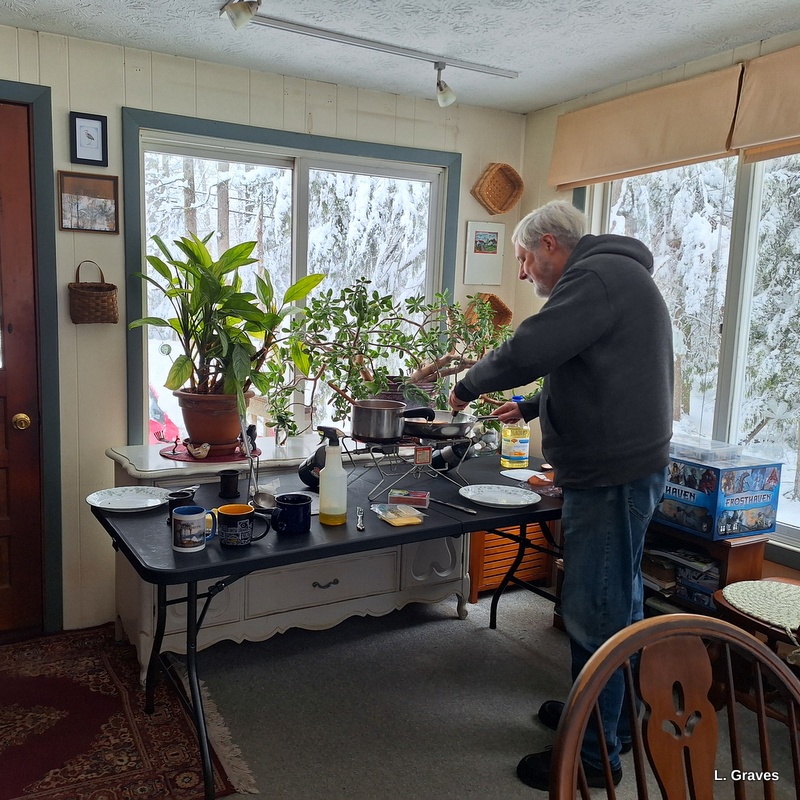
Even though it was canned soup, it tasted pretty darned good as my Yankee husband would say. (A shameless self-promotion photo, I know, featuring a mug advertising my third book.)

Here are more pictures of this snowy April day.
Behold our driveway. It was beginning to look a lot like Christmas, don’t you think? We got about twelve inches of snow.

A closeup of the trees.

Now to the backyard.
My poor clothesline took a beating. Clif had already repaired it once, and the way he bolted it now prevents us from being able to fold it down for the winter. Clif feels confident he can repair it again. Fingers crossed.
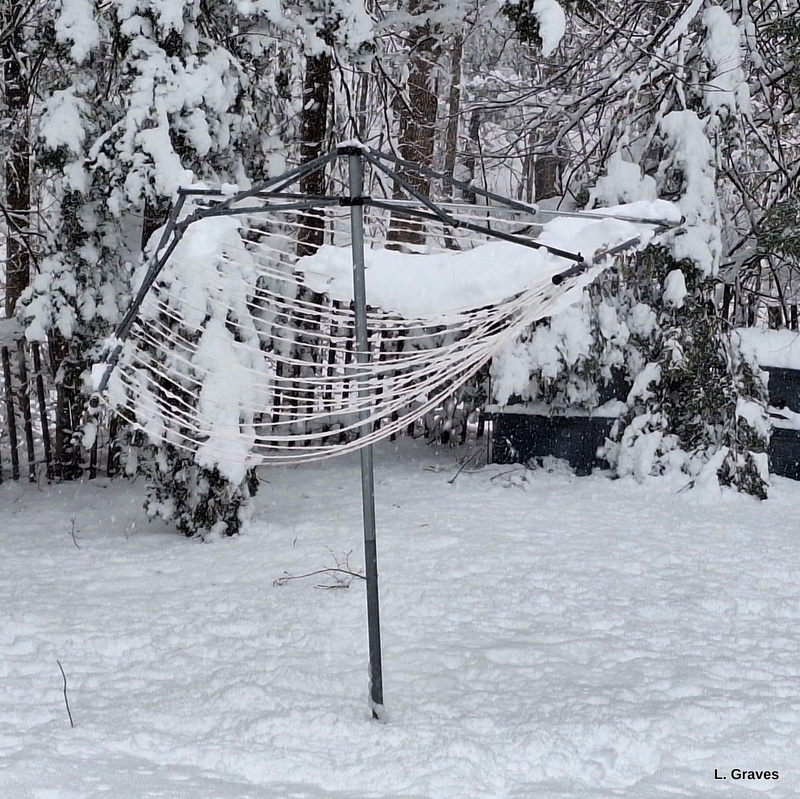
With such widespread power outages, we were sure we were going to go for days without power, but we were one of the lucky ones. Our power came back on at 2:15 p.m. on Thursday, and it stayed on. Oh, were we happy.
Other folks have not been so lucky. Despite the crews working tirelessly since Thursday, there are still 9,000 customers without power this Monday morning on April 8. As the title states, this was one heck of a storm.
*************************************************************************
Snow-Gauge Clif
All this snow provided Snow-Gauge Clif with opportunities to measure snow. (Was it only a few weeks ago when we foolishly wondered if we were done with snow?)
By Sunday, when the pictures were taken, the weather had become so warm that much of the snow had melted. Snow-Gauge Clif measured three inches of snow.
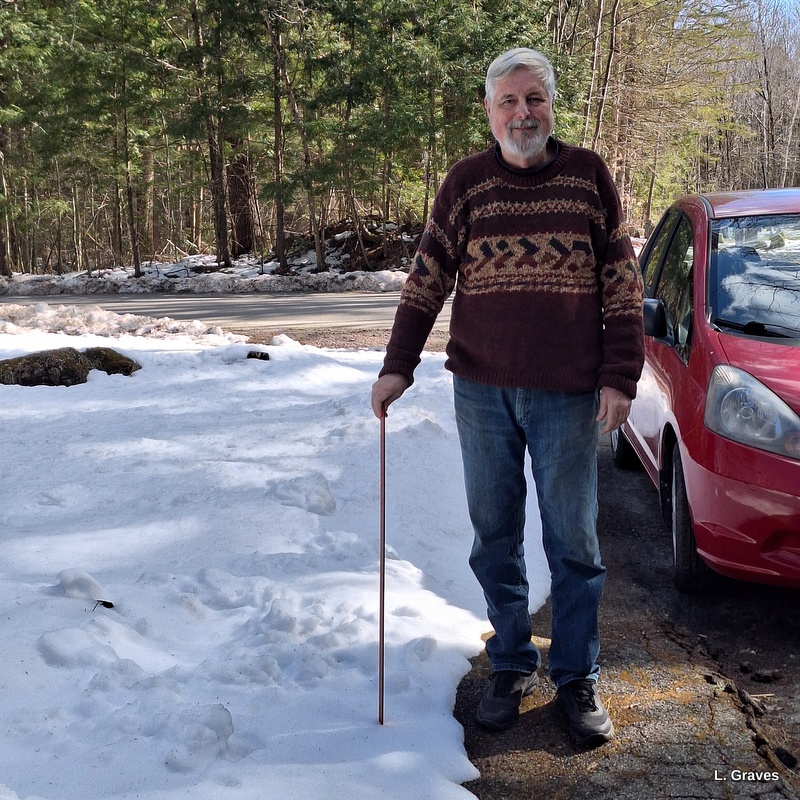
For readers who live in places where there is little or no snow, here is the giant curl of dirty snow plowed by our kind neighbor next door. When the town’s snowplow goes by, it leaves a wall o’snow at the end of the driveway, a formidable barricade when the snow is deep and heavy, the way it was after this nor’easter.
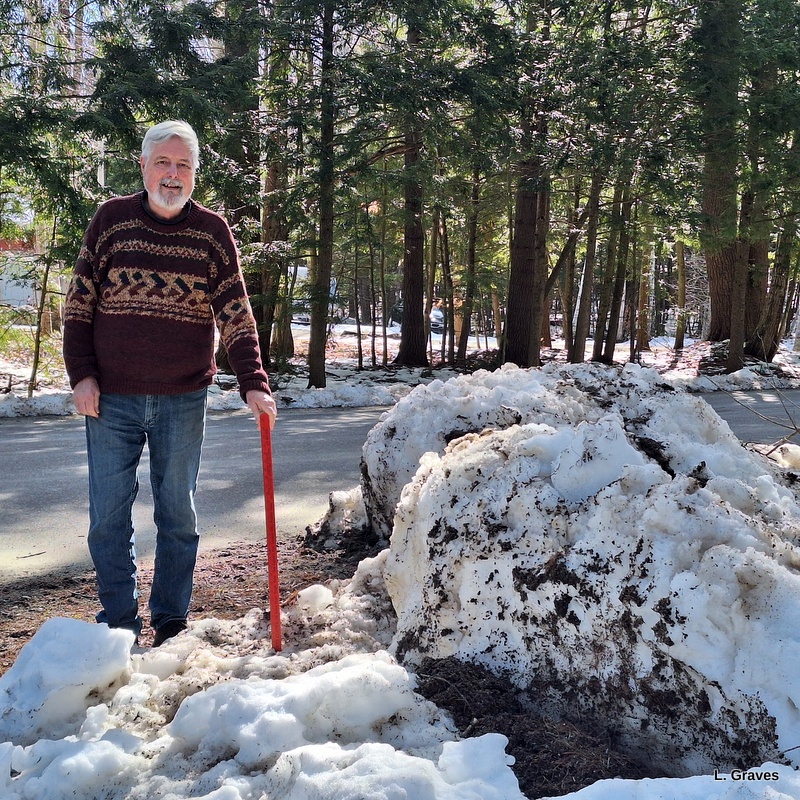
Now, let’s hope the weather gods are done playing tricks on us. Please, no more snow until next winter.
*************************************************************************
Listening
Moon Shadow by Cat Stevens
In honor of the solar eclipse, whose path goes right over Maine today, here is a classic by Cat Stevens. I listened to “Moon Shadow” many, many times when I was a teenager. Somehow, the song seemed appropriate for today.
 Notes From the Hinterland