Abracadabra: The Strange Case of the Disappearing Snow

I have lived in Maine for fifty-seven years, and never have I seen a spring like this. Until last week, we were still in the grip of winter. The little house in the big woods was surrounded by snow, and while the weather in April wasn’t as cold as it was in, say, February, it was mighty brisk. Even though it was officially spring, I had to push myself to take the dog for a walk.

Then there was the little surprise we got last Thursday—a snowstorm that left four inches of snow. Clif actually had to take out Little Green to clean the driveway before he went to work. In the morning, when I looked out my front door, I saw a winter wonderland. This made Clif and me a little grumpy. How tired we both were of snow and winter.

Then something miraculous happened, and it could be compared to the miracle of the loaves and the fish, only in reverse. Last Saturday, a wild wind blew into central Maine, and apparently it chased away the cold weather. On Sunday, the temperature reached 60 degrees and on Monday, 70 degrees. The snow shrank and shrank, so much that it was as though I were looking at time-lapse photography, only in real time.

Yesterday, the temperature was in the mid-60s, and it was warm enough for me to turn off the heat in the house for the afternoon. A great feeling, after the heating bills of the winter.

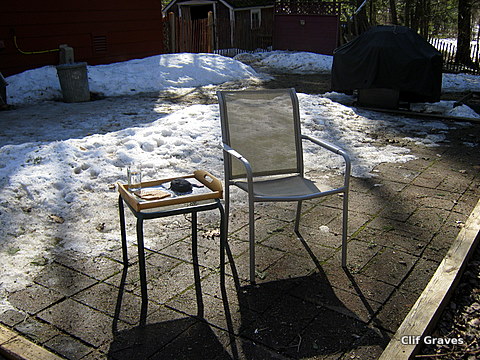
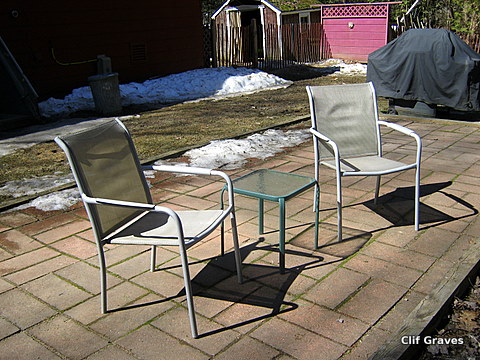
However, most exciting was the progress made on the patio. On Sunday, the snow had melted enough so that I could bring a chair and a little table outside. By Monday, the snow receded even farther, and yesterday—Tuesday—I swept the patio for the first time this season. There was just the barest edge of snow.

On Monday, Clif and I made predictions about when the patio would be completely snow free. In a burst of optimism, I said Wednesday (today). Clif, who tends to be more cautious with his pronouncements—he is a Yankee, after all—chose Friday.

Well, as the clichéd saying goes, a picture is worth a thousand words. In this case a series of pictures. (Many thousands of words?)

Here was the patio on Monday, April 13.
IMG_8262

Here it is today, Wednesday, April 15.
IMG_8274

I’m tempted to go out this afternoon and shovel off that last bit of snow. But that wouldn’t be fair, would it?

Here are two more pictures that illustrate how fast the snow is disappearing.

The view from the front porch on Thursday, April 9.
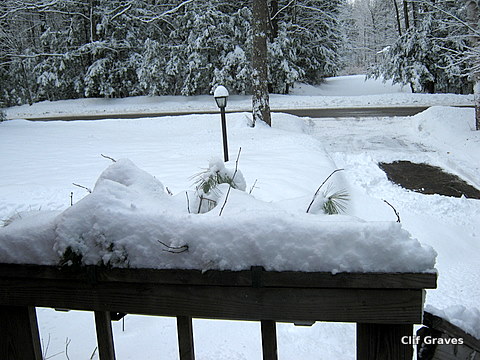
IMG_8215

The view from the front porch today, April 15, less than a week later.
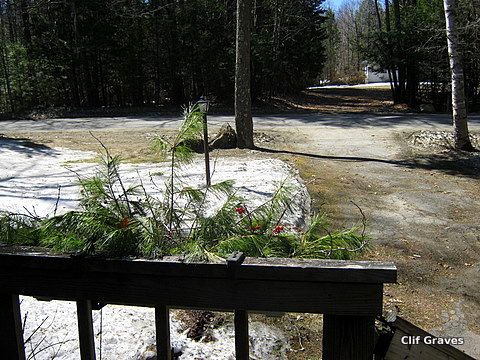
IMG_8277

I rest my case.

National Library Week: My Library, My Lifeline

IMG_8059This week is National Library Week. I know. It seems that every week, indeed every day, celebrates something or other, from popcorn to donuts to libraries. But it’s my guess that National Library Week, first sponsored in 1958 by the American Library Association (ALA) and the American Book Publishers, got the jump on most of the current weekly and daily celebrations. In a few years National Library Week will be celebrating its sixtieth birthday.

And how did National Library Week come about in that faraway time before computers, mobile phones, and the Internet? According to the ALA website, “In the mid-1950s, research showed that Americans were spending less on books and more on radios, televisions and musical instruments. Concerned that Americans were reading less, the ALA and the American Book Publishers formed a nonprofit citizens organization called the National Book Committee in 1954…In1957, the committee developed a plan for National Library Week based on the idea that once people were motivated to read, they would support and use libraries.” The theme for the first National Library Week was “Wake Up and Read.”

As a child, nobody had to tell me to wake up and read. Books were an integral part of my life, and lucky child that I was, my parents took me to two libraries—a tiny one in East Vassalboro, which served all of Vassalboro, where we lived, and a larger one in Waterville, the small city nearby. Every week, books came into the house, and books went out of the house. While I grew up in a comfortable, middle-class family, there was no way my parents could have afforded to buy me all the books I wanted to read. For a child who lived in a small, rural town, those libraries were a lifeline, giving me access to the broader world of stories and ideas.

Today, fifty years later, the library continues to be a lifeline for me. I still live in a small rural town—Winthrop rather than North Vassalboro—and both could certainly be considered the hinterlands of the hinterland. My husband and I live on a modest budget, and, as was the case when I was young, there is no way we could afford to buy all the books I want to read. Thanks to the library and interlibrary loan, I can get nearly any book I’m interested in, from classics such as Middlemarch by George Elliot to newer books such as Our Kids: The American Dream in Crisis by Robert D. Putnam.

As the ALA likes to remind people, libraries are more than books, and all the DVDs Clif and I watch come from the library. The DVDs range from the highbrow—Shakespeare—to the lowbrow—television series such as The Americans. As with books, pretty much anything we want to watch is available to us.

Winthrop’s library is supported primarily through town taxes, and I expect this is true for most town libraries in Maine. Not surprisingly, I consider it money very well spent, and I don’t begrudge one penny of  property tax money that goes to the library. Our library is open to all residents, and it doesn’t matter who your family is or how much money you make. As long as you return the books you borrow, you are welcome to take out more books.

A friend of mine is moving to a small seaside town in Ireland that doesn’t have a library. (She will have access to a library in a larger town nearby.) She is a reader, and she says she is up to the challenge of living in a town with no library.

I have thought of this off and on for the past couple of days. Which would I choose, a town with a library or a town by the sea? This would not be an easy choice for me because I love the seaside nearly as much as I love books and libraries.

It would be a tough call, but I know that in the end, books and libraries would win.

The Baby, Spring, and Other Things

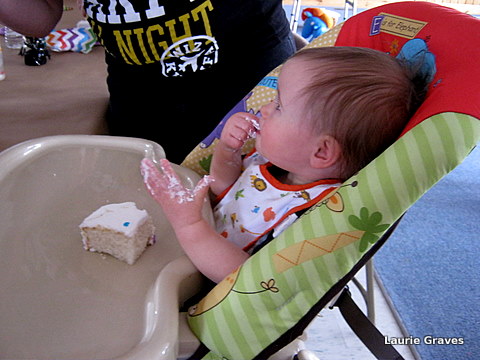
Last weekend was quite the eventful weekend. On Saturday, I went to Piper’s—aka Darling Baby—first birthday party.  I know all babies are cute, but it seems to me that Piper is especially cute, and she had a wonderful time being the center of attention. She even led the guests on a round of birthday claps.

Here she is with her auntie,

Piper with her auntie

and with her birthday cake.

First birthday cake

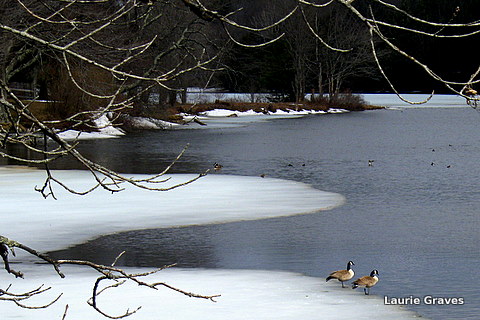
After a couple of fun hours, I bid the birthday girl adieu and headed home. On the way back, I spotted Canada geese on the ice and stopped to take pictures.

IMG_8240

Then, on Sunday, spring finally came to the little house in the big woods, and for the first time this year, I was able to hang laundry on the line.

IMG_8247

The receding snow has revealed things both good and bad—a forgotten pot and emerging irises.

IMG_8253

IMG_8266

By mid-afternoon, the temperature in the backyard was 65 degrees, and even though there was still snow, I decided to haul out a chair and a little glass table so that I could have afternoon snack on the patio.

IMG_8261

I know. I’m rushing the season. But what a sweet end to a sweet weekend.

Southwestern White Bean Soup to Make on a Reluctant Spring Day

IMG_8046
Farmer Kev’s vegetables, frozen then thawed

Clif and I love soup, and living in Maine gives us the opportunity to eat soup nine months of the year. (I’m counting June, which is often rainy and cool.)  Soup has so many things in its favor. A bowl of soup is warm and filling and comforting. It is forgiving and lends itself well to improvisation. Soup is often low in calories and usually can be made in a slow cooker. As if all this weren’t enough, most soups are very economical to make. Yes, indeed. There is a lot to like about soup.

Thanks to Farmer Kev and his winter CSA share, I have packets and packets of frozen vegetables in my freezer. Soups are the perfect way to use frozen peppers, beans, and zucchini, and over the winter, I’ve made quite a dent in those packets.

Last week, I was in the mood for a Southwestern soup. I had everything I needed—dried white beans, Farmer Kev’s frozen vegetables, onion, garlic, spices, tomato paste, and soy sauce, which I put in many soups to give them more of that coveted umami flavor. I also had some chicken sausage and chicken broth.

I seldom use canned beans, which always taste tinny to me. I much prefer the flavor of beans I cook myself, and since I am home all day, I have ample time to soak the beans overnight and then simmer them the next morning. For this recipe, I soaked two cups of white beans, which gave me about six cups of cooked beans. ( If time is of the essence, then by all means use canned beans. The soup will still be good.)

Basically, I chopped the vegetables into small bits, browned the sausage, and threw everything, including beans and spices, into the slow cooker. By the time Clif came home from work, the house was fragrant with the smell of bubbling soup—-another point in soup’s favor that I forget to mention in my opening paragraph.

I made a huge slow cooker full of the soup, thinking I would freeze some if we grew tired of eating it. However, this didn’t happen. We gladly ate the soup for three nights—Clif always has seconds—and didn’t mind one bit.

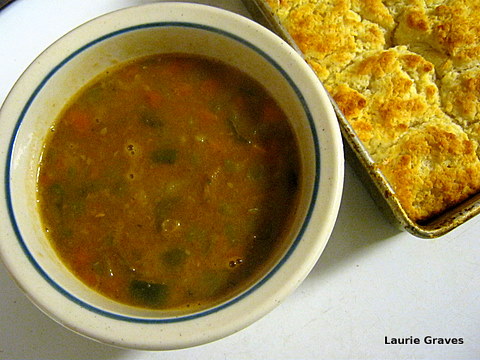
Soup, soup, soup!

IMG_8114

Southwestern White Bean and Sausage Soup

Makes 9 generous servings

2 cups of water
1 (32-ounce) box of chicken broth
1 cup of diced carrots
1 cup of green beans, chopped small
1 cup of zucchini, chopped small
1 cup of chopped green peppers
1 medium onion, chopped small
4 cloves of minced garlic
1 1/2 tablespoons of chili powder
1 teaspoon of oregano
1 1/2 teaspoons of cumin
1/2 teaspoon coriander
1/4 teaspoon of red pepper flakes
1 teaspoon of salt
6 cups of white beans ( I mashed two cups to give the soup a thicker texture.)
3 tablespoons of tomato paste
Several shakes of soy sauce (Or more depending on taste)

This soup couldn’t be easier. Basically, when everything is chopped and browned, put the ingredients in a slow cooker and let them come to a simmer. On high, this soup takes about four hours. On low, seven or eight hours. When the soup has bubbled for a while, taste it to see if more spices need to be added. Serve with dollops of sour cream, or eat it plain. As you like it.

Biscuits or cornbread make a mighty good accompaniment. If I were serving this to company, I would add chopped cilantro as a garnish.

When, What to My Wondering Eyes Should Appear…But Snow, Snow, and More Snow

IMG_8216Last night, as a plane flew overhead, I could tell from the sound that it was snowing outside. It’s hard to describe exactly what this sound is, but I would have to say that it has a muffled quality that is missing during  clear weather.

A little later, Clif let the dog out, noted the snow, and confirmed my suspicions. Unconcerned, we went to bed. This is April, after all.

Imagine our surprise, then, the next morning when we looked out the window and saw that at least four inches of heavy snow had fallen during the night. It was enough so that Clif had to haul out Little Green and clean the driveway before he went to work. And here we were thinking that it was just about time to bring Little Green down cellar for the season and time to bring out the bikes. Not yet, that’s for sure.

IMG_8215

A little while ago, the plow went by, and the road is a mucky mess. No walk for the dog today. He’ll have to make do in the backyard. However, as I write, the snow is sliding off the branches of the trees. A few days of mild weather will bring us back to where we were before this mess, and the dog and I can walk on dry roads.

It has been a cold, hard winter in Maine, with lots of snow. Spring is officially here, but it is coming oh so slowly in fits and starts. Meanwhile, California suffers the worst drought in recorded history, and yesterday the temperature in Georgia was 90 degrees, which must be hot even for Georgia in April.

In Maine Lakes Tell Tale of Climate Change, a recent piece on MPBN, Susan Sharon addresses the issue  of global warming and writes, “While the Northeast may have experienced a bitterly cold and snowy winter in 2015, the average temperature on the planet last year was the warmest in 135 years of record keeping. In Maine the state climatologist’s research indicates that by 2050 the annual temperature in Maine will rise another 3 to 5 degrees.”

But what bothers Zach Wozich, an Ice fisherman interviewed in Sharon’s piece, is the extreme unpredictability of the weather over the past ten years, “the big variations in temperatures and snowfall.” This year, he’ll probably have two more weeks than usual to fish. A few years ago, the ice was out before the end of March. That year Clif and I actually went for an anniversary bike ride—on March 19—and Maranacook Lake looked like a huge, gray slushy. Not long after, there was open water.

There is some indication that as the Arctic melts, the jet stream is affected, bringing colder weather to the North East and warmer weather, along with drought, to the West. Only time and observation will tell if this is true. One or two cold winters do not a trend make, and there are other factors that affect the jet stream.

Nevertheless, for next winter, Clif and I will be sure to have a good supply of wood. (We ran out midwinter.) We will have a stockpile of food in our pantry as well as plenty of propane cannisters for our camp stove. Lamp oil is also a necessity and so is stored water in big buckets. For us, no power means no water.

Being prepared cannot change the weather, but it can certainly make fierce storms and power outages easier to deal with.


Bran Muffins and Costa Rica

IMG_8163Yesterday, our friend Diane came over for tea and bran muffins and to tell us about her recent trip to Costa Rica. She brought pictures of lush tropical landscapes, big lizards, sculpture, and buildings with thatched roofs. We learned that Costa Rica has a population of about four million people, with much of the population being clustered in and around San Jose, the country’s capital.

Diane told us that Costa Rica didn’t seem to have the extreme poverty of, say, Mexico. While many of the homes were modest, they were decent, and they all had electricity.

A quick bit of research confirmed Diane’s impressions. According to an article in Wikipedia, Costa Rica has a high literacy rate—well over 90 percent, “with a better record on human development and inequality than the median of the region.” Costa Rica has no military,  and the country is known for “its progressive environmental policies, being the only country to meet all five criteria established to measure environmental sustainability.” Costa Rica plans to be carbon neutral by 2021, and they have banned recreational hunting, which gives them a gold star in my book.

As Diane noted, it is easier to get things done in a country with only four million people, and this is certainly true. The vast population of India or China makes progressive reform and action slow and difficult. Nevertheless, more populous countries could learn from Costa Rica. This country has decided to put much of its resources into education and the environment, which benefits many people rather than just a few. (Even more affluent countries could learn a thing or two.)

No country, of course, is perfect, and while Diane didn’t see much extreme poverty, Costa Rica nevertheless struggles with a poverty rate of 23 percent. Still, it is a country thriving in what could be considered a tough neighborhood—Nicaragua is one of its neighbors.

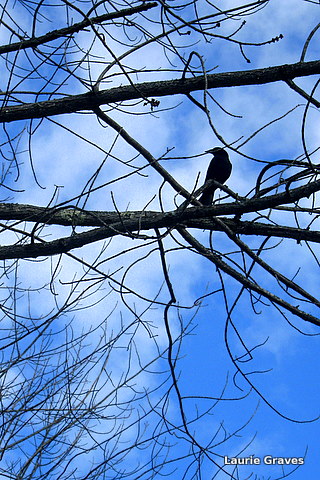
After Diane finished telling us about her trip, the talk turned to other subjects, to politics, to family, and to one of our favorite topics—movies. Outside, a wet snow fell, making the April landscape look more dreary than it already did. However, when I looked out one of the dining room windows, I saw a crow gathering materials for what must be a nest. So the crows, at least, think spring is coming.

We drank tea, ate bran muffins, and decided we would like to get together once a month to watch a movie together. A perfect frugal activity for Clif and me.

“But we have to plan ahead,” Diane said, “and mark it on the calendar.” Indeed we do. Busy schedules make planning ahead a necessity.

The afternoon passed all too quickly, and it was time for Diane to leave. I sent her home with a couple of bran muffins, which she thought were tasty. It is a good bran muffin recipe. A friend gave it to me many years ago, and it’s a family favorite.

I’ve posted the recipe in my former blog, A Good Eater, but that was a while back. This recipe is so good that it seemed  worthwhile to post it again. These bran muffins go well with tea, with soup, or as an accompaniment to almost any meal. I often add a cup of thawed blueberries to the batter. Somehow, I just love the combination of bran and blueberries, and it’s good for you, too.

Tasty and good for you. A winning combination.

Bran Muffins

1/4 cup of vegetable oil
1/4 cup of brown sugar
1/4 cup of maple syrup or honey
2/3 cup of milk
1 egg, beaten
1 cup of flour
1 cup of wheat bran
1 tablespoon of baking powder
1/4 teaspoon of salt

Heat oven to 400 degrees Fahrenheit. Grease 12 muffin cups.

In a medium-sized mixing bowl, combine the flour, wheat bran, baking powder, and salt. Set aside. In a large mixing bowl, blend the oil and brown sugar. Add the maple syrup, milk, and egg. Mix well. Add the dry ingredients, mixing until the ingredients are just moistened.

Scoop batter into the greased muffin cups. Bake for 20 minutes or until muffins are brown.

A Quiet but Nice Easter: On the Rail Trail in Augusta

Clif and I had hope to host an Easter brunch for our family, but for various reasons this didn’t happen. Therefore, we were on our own. We had planned to go to the ocean if the weather was warm enough, but, alas, it wasn’t. When the temperature is a brisk 39 degrees in central Maine, there is no telling what it will be like on the beach, where the wind can blow hard and cold. As it is a three-hour round trip to the ocean and back, we just didn’t dare risk it.

Time to move on to Plan C—a walk on the Rail Trail in Augusta, a fifteen-minute drive from where we live. Although the day was brisk, it was sunny. Because of the cold weather we’ve had this winter and spring, the ice still isn’t out on the Kennebec River.

IMG_8122As we walked on the Rail Trail, we met many other walkers who were enjoying this fine, chilly day by the river.  I grew up by the Kennebec, in Waterville, when the river was dark and dirty and used primarily for dumping. In the I960s, nobody would have thought to walk by the river on Easter Day. But the Clean Water Act, passed in 1972, changed all that, and slowly, slowly the Kennebec came back to life. Now there are eagles and ducks and fish. And walkers.

“This just shows how the right kind of regulation can be a very good thing,” I said to Clif as we caught glimmers of the Kennebec on the Rail Trail. He agreed. He, too, is old enough to remember how dirty and polluted rivers were in Maine.

A glimpse of the blue Kennebec

Liam loves walking on the Rail Trail. So many things to sniff and explore.

Liam on the trail
Liam on the trail

It is not a lovely time of year, but there were some visually interesting things to notice.

A bench in need of repair.

IMG_8131

A rusty bridge.

IMG_8127

A purple fence through the trees.

IMG_8133

After our walk, we treated ourselves to ice cream at the Dairy Queen, just down the road from the Rail Trail. As we seldom go out for ice cream, it truly was a treat for us. (We had hoped to go to Fielder’s Choice in Manchester, but they were closed for Easter.)

That night for supper, Clif made pancakes, and I cooked home fries. We might not have been able to host brunch, but we could still enjoy Clif’s delicious pancakes.

Have I ever mentioned that Clif’s pancakes are the best? I think I have.

Alice’s Magic Trick: How to Make Delicious String Beans from Frozen Ones

Magic beans
Magic beans

I have a confession to make: I am not a fan of frozen string beans. Oh, how slimy they are and how I hate their texture. I would take a can of string beans any day over frozen ones, with fresh, of course, being the best.

However, this year in Farmer Kev’s winter CSA I got packets of frozen string beans. Lots of packets. (I completely understand why Farmer Kev would prefer to freeze the beans rather than can them. I would make the same decision if I were in his situation.) I’ve been using the string beans, diced small, in various soups, and this hides their slimy nature. In fact, the frozen beans are very good in soup.

Then not long ago, when my friend Alice was visiting, she told me what she had done with part of a packet of frozen string beans I had given her. “I stir fried them with garlic and oil until the beans were blistered and well cooked. They were delicious.”

Alice is a good cook, and I trust her judgement. Despite my aversion to frozen beans, I resolved to try her method. Not long after her visit,  I whipped out my trusty cast-iron frying pan, added some oil, heated it, then added some thawed beans. I let them sizzle for quite a while, say, five minutes or so, until they were nicely blistered and more than a little brown. I added the garlic during the last minute—I didn’t want the garlic to be as brown as the string beans.

And the results? Readers, the beans were utterly delicious. The slimy texture was gone, gone, gone to be replaced by a crisp, garlicky one. The beans were so good that I gobbled them up before I ate my potato and chicken, and I wished I had more when the beans were gone.

I see other possibilities for these stir-fried string beans. They are terrific with just the garlic, but soy sauce and sesame oil could also be added. The beans are great as a side, but cut a little smaller, and they would also be delicious in stir-fried rice, one of Clif’s favorite dishes and a staple in our house.

How nice for this old cook to learn a new trick, to take a vegetable I was not excited about and to turn it into something that I eagerly eat.

Many thanks, Alice!


Early Spring in Maine: But It Still Feels Like Winter

IMG_8104
On the lookout for spring

This year spring has come reluctantly to Maine. I’m tempted to say it isn’t even here yet. Yesterday, when I went to check the mail, there was such a stiff, cold wind that I couldn’t bring myself to take the dog for a walk after lunch. I thought time spent in the backyard would be enough for him. A big mistake. At ten, Liam is still an energetic dog, and late in the afternoon he pestered me as I tried to watch Shakespeare Uncovered and Ethan Hawke’s take on Macbeth.

I finally did take Liam for a walk—as supper was heating in the oven—and luck was on my side. The wind had stopped blowing, and the air was crisp rather than biting. The sky at dusk was a deep blue, and the rising moon glowed high over the horizon. A lovely walk, good for me as well as for the dog.

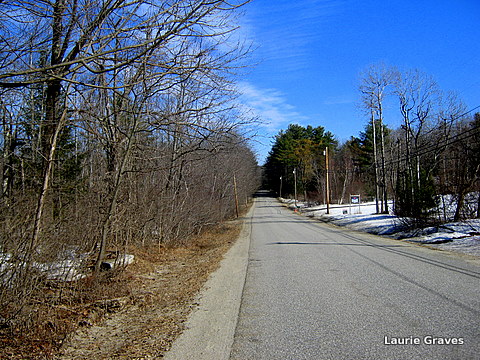
Even though spring might be late, progress has been made with the melting snow. Every day it goes down more, and the snow has pulled completely away from the road.

IMG_8098

In sunny yards, there are bare patches of tan grass. Even in our yard, which is the last to lose snow on Narrows Pond Road, the driveway is bare, and the backyard has its own patch or two of tan grass.

On branches by the road, pussy willows have begun showing their soft little heads.

IMG_8089

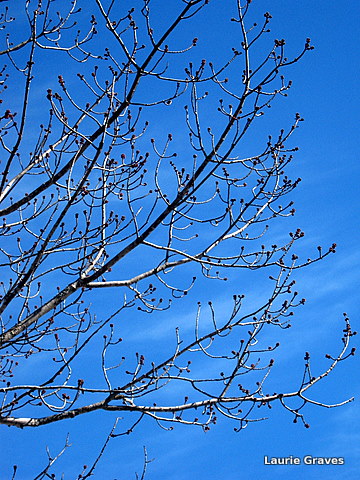
And tree buds are now easy to see against the blue sky.

IMG_8096

Soon, I hope, the little swamp up the road will be free of ice, and the full-throated song of spring will swell at night. This cycle of renewal is always fresh and stirring, and every year I wait eagerly for the emergence of the peepers and the frogs.

Ah, printemps!