

Category Archives: Politics Friday

Politics Friday: Now It’s Getting Personal—Cutting Support to Libraries

Winthrop’s Bailey Public Library


For many people in the United States, the Federal government seems like an amorphous entity that doesn’t do much good. Years ago, when I was working at our town’s food pantry, I overheard a volunteer say in a vehement voice, “The government doesn’t do anything right.”

Turns out, that woman was wrong, very wrong. (I will be returning to this woman’s assertion in a future post.) With some agencies, such as Social Security, it’s easy to see how folks benefit from the federal government. Checks deposited in bank accounts have a way of attracting attention. Elon Musk and DOGE take note: checks not deposited in accounts also attract notice but of a very different kind. However, in other ways, the Federal government is so entwined in our lives that it’s often hard to see  exactly what it does.

For example, consider libraries, institutions that are dear to my heart. In Maine, libraries are mostly supported by their communities through property taxes. (As far as I’m concerned, it’s money well spent.) What, exactly, does the federal government have to do with town libraries?

As it happens, quite a lot. There’s a federal agency called the Institute of Museum and Library Services (IMLS) that gives grants to states for library and museum projects. In Maine, some of that money goes to help finance our state’s interlibrary loan system, the jewel in our literary crown. This means that an avid reader with eclectic tastes—that would be me—can go online and request books from libraries large and small from around the state. The books are then transported to the reader’s town library, where she picks them up at her convenience. For avid readers in a small town such as Winthrop, this a vital service . The world of stories and ideas opens beyond what one little library in a town of 6,000 can offer.

I’m sure you can guess what’s in the works for the Institute of Museum and Library Services. Last month, President Trump signed an executive order to dismantle the IMLS, and if he is successful, this could be the end of Maine’s interlibrary loan system. Across the state, most libraries run on a tight budget. (For six years, I was on the board of our town’s library, and I speak from personal experience.)  It’s hard for to me envision how libraries will be able to make up the money that came from the IMLS grant.

But all is not lost. In a PBS article, I read, “Since the IMLS was created through…congressional legislation, it cannot simply be eliminated by an executive order. Congress would need to pass a law to repeal or defund it.”

Unfortunately, so far anyway, the Republican House and Senate have pretty much agreed with whatever Trump has come up with. I have let my representative and senators know that I oppose this executive order, but I don’t know if it will make any difference.

What will I do if our interlibrary loan system is eliminated? I don’t know. What a terrible thought to consider as we head into spring.
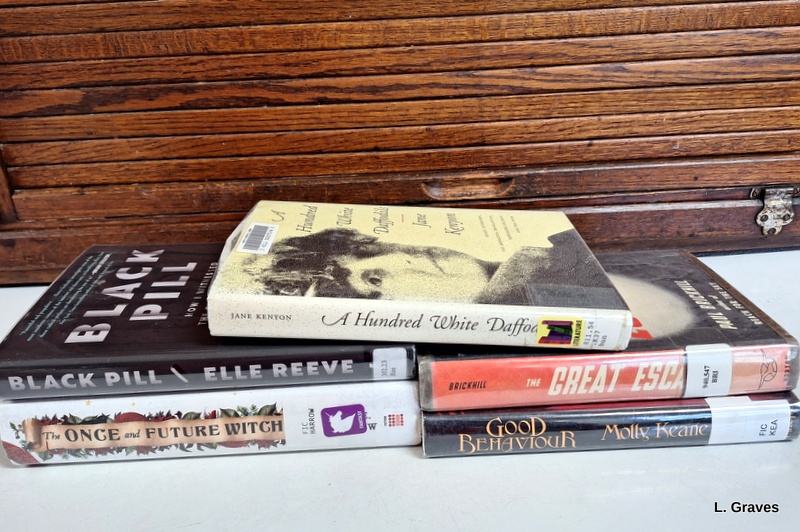
A recent haul from my library. All the books were requested through interlibrary loan.


Politics Friday: SignalGate

I’ve got to hand it to the Trump Administration—it provides plenty of fodder for writers. So much, in fact, that it’s hard to settle on one subject. Do I long for the boring days of the Biden presidency when it seemed as though there were long stretches of time when not much happened? Indeed I do. I’ve started writing a new book, Iris Starmoss: Elf Detective, and that novel is pulling at me the way all new stories do.

If I had a choice, I would not be living in these times, but as Gandalf noted in The Lord of the Rings, “So do all who live to see such times; but that is not for them to decide. All we have to decide is what to do with the time that is given to us.”

Therefore, onward to Trump and his not-so-merry Band of Incompetents. Already, many of their actions are harming Maine—cutting funding to libraries, cutting funding to food banks, denying an approved grant to our own Farmer Kev. The effects of this presidency are not abstract, happening to other folks in other states. Instead, they have come home to roost, and I expect this is true across the country.

However, for some reason, I keep coming back to what has become known as SignalGate, when Trump’s team, with a messaging app named Signal, used their phones to discuss an attack on Yemen. While Signal is considered reasonably secure for private use, it is not considered secure enough for governmental/military use. But there was Trump’s team, using Signal to discuss military strikes in Yemen. Who was on that Signal chat? Among them, Pete Hegseth, Secretary of Defense; J.D. Vance, Vice President; Marco Rubio, Secretary of State; Tulsi Gabbard, Director of National Intelligence; and Michael Waltz, National Security Advisor. You know, the big guys. The ones we trust to protect our country. And better yet, while in Moscow, Ukraine and Middle East envoy Steve Witkoff joined the discussion to bomb Yemen.

There was also somebody else included in that chat, none other than Jefferey Goldberg, editor-in-chief of The Atlantic, a magazine I subscribe to and like very much. You might be wondering why Jefferey Goldberg was added to that chat list.  I know I was. Goldberg and The Atlantic are no friends of the Trump Administration, and even if they were, it is unlikely that Goldberg would be involved in plans for an imminent military strike in Yemen.

It’s no surprise, then, that on March 13, when Goldberg discovered he had been included in a group chat with Trump officials, he at first thought it was a hoax. A reasonable suspicion. Then, on March 15, when Goldberg read the sensitive military operations being discussed, he stayed on for another two hours to see if what he was reading was correct. Yes, it was. Bombs and drones started attacking Yemen. Thereupon, Goldberg left the chat.

Of all the journalists and editors to pick for an unplanned leak, Trump’s team of Incompetents couldn’t have chosen anyone better—or worse from their point of view—than Goldberg. He, along with David Remnick from The New Yorker, are two of this country’s great editors leading two of the country’s best magazines. Not easily intimidated, they are erudite and confident. Best of all, they both have something that is sorely lacking in this administration—integrity.

Also, within journalistic circles, both are so well known that as soon as the story broke, all the major news outlets wanted to talk to Goldberg about the Signal farrago. And last week, Goldberg certainly made the rounds, explaining in his clear way what had happened.

To borrow from my British friends, that certainly set the cat among the pigeons. Trump and Co. have been spinning furiously—lying, denying, and trying to pin the blame on Goldberg. At one point, they even called him a spy. But as it turned out, on March 11, Goldberg had received a Signal connection request from Michael Waltz, which meant that the spy accusation lost its fizz.

Now they are trying to minimize the event, maintaining that since the results were good—Yemen was successfully bombed—this is all that matters in the end.

But somehow, at least for the moment, Trump and Co. have not been able to slither out of this one. Perhaps they will, but right now they are feeling the sting of their carelessness, and they look like fools.

I’m going to end with a famous quotation from F. Scott Fitzgerald’s The Great Gatsby.

“They were careless people, Tom and Daisy—they smashed up things and creatures and then retreated back into their money or their vast carelessness or whatever it was that kept them together, and let other people clean up the mess they had made.”

That about describes it.


Politics Friday: Laying My Cards on the Table

I think bloggers are an effective way of disseminating independent news (with known limits of individual confirmation bias) across the world unlimited by geography.”

The above quotation came from one of the comments left by the blogger Forestwood. What really caught my attention was “known limits of individual confirmation bias.” According to britannica.com, confirmation bias is “a person’s tendency to process information by looking for, or interpreting, information that is consistent with their existing beliefs.”

Ah, yes. I suspect most of us are guilty of confirmation basis. I know I am drawn to publications and podcasts that have a particular slant. And what is that slant? I suspect long-time readers already know, but before going further with my Politics Friday posts, I thought it would be important to lay my cards on the table, as the saying goes, so that readers know exactly what my perspective is.

To begin…the United States is a two-party system with the Democrats and the Republicans vying for political office.  The winner is the winner, and there are no coalitions the way there are in most democracies, which seem far superior to our two-party system. But that is what we have, and wishful thinking won’t change it.  (There are Independents, who sometimes have success on a state-wide level. One of our senators, Angus King, is an Independent who caucuses with the Democrats. But Independents are an extreme minority. Currently there are only two in congress out of hundreds of senators and representatives.)

When I was young, way back in the 1960s, Democrats were considered the party of the working class and Republicans were thought to be the party of businesses and the upper class. However, this is an oversimplification as some Democrats were very conservative and some Republicans were liberal. (Richard Nixon, a Republican president, created the Environmental Protection Agency. Impossible to think of Republicans doing so today.)

Often, there were friendships and collaborations between  senators and representatives. Two Maine senators, George Mitchell, a Democrat, and William Cohen, a Republican, co-authored a book, Men of Zeal, A Candid Story of the Iran-Contra Hearings. Again, impossible to think of this happening today.

Then a split occurred, sometime in the 1990s with Republican Newt Gingrich’s scorched-earth politics, and the divide has only continued to grow.  Now, at least on camera, the two parties can barely contain their contempt for each other, and as far as I know, there are no books planned with Democrats and Republicans as co-authors.

This is a very simplified explanation of politics in the United States and is in no way complete. For those interested in our system, I would advise further reading.

Now, time to reveal my cards. I grew up in a working-class family and come from a long line of Democrats. Not that we didn’t jump parties occasionally when there were moderate Republicans running. My parents and I voted for William Cohen a number of times. But Democrats were who we were, my parents fairly conservative and me quite liberal. After all, I came of age in the 1970s, and they came of age in the 1950s. Still, we bumped along, and I don’t remember any political blow-outs.

As the years have progressed, I have grown ever more liberal. I believe there is a role for a strong central government whose mission should be to help those who are struggling and to provide services. I believe in capitalism, but I also believe it needs a lot of guardrails to prevent it from becoming exploitive. I read The New Yorker and The Atlantic. I listen to Ezra Klein and Pod Save America.

However, I have a strong respect, almost bordering on reverence, for facts, and I promise, despite my liberal bias, to stick to the facts. If I make a mistake, I will issue a correction. I will never lie to prove a point.

Finally, despite my aversion to Trump and Musk and to the rest of this administration, I strive always to come from a place of compassion. They are human beings, and while I wish they would leave this country alone, I do not wish for anything bad to happen to them or to their followers. Or their families.

So there it is. You now know my perspective.

Next week, onward to issues of the day.

For Czeslawa: Introducing Politics Friday

Ever since Trump was elected, I have been floundering with this blog as I debate whether or not I should write about politics. I did not conceive of Notes from the Hinterland as a blog to be centered on politics. Instead, I wanted it to be focused on rural life as well as what I listened to, read, and watched. I was afraid that writing about politics after so many years of blogging—over ten  years, I think—would be jarring. From reading the comments, I know that many of you follow Notes from the Hinterland for its calming effects as I record the changing of the seasons and the goings-on in central Maine. Because of this, when I returned to blogging after an extended break, I decided it would be business as usual with my blog.

Except it’s not business as usual in this country. Far from it. Even readers who don’t live in the United States understand the chaos and down-right cruelty of the Trump administration. Good friends of the United States, such as Canada, have been insulted and threatened with tariffs. In Maine, this hits particularly hard as the state has a 611-mile border with Canada. Many Mainers are of Canadian descent. Indeed, all of my immediate ancestors, going back five generations, come from Canada—Québec on my mother’s side, Prince Edward Island on my father’s. In northern Maine, there are families that span both sides of the border.

In the face of all this chaos, I have been going back and forth. Should I write about politics and thus change the vibe of this blog? Or stick with what I have been doing?

But then yesterday, in Timothy Snyder’s Substack—Thinking About…—I read an essay by Laurie Winer. In “What to Expect When You’re Expecting Catastrophe”, she writes:

The debate about whether or not we should bring Hitler or Nazism or fascism into a contemporary political debate is obsolete. Now it is crucial that we take seriously the warnings gathered for us by survivors and writers. When you look at a photo of a Jew about to be arrested or shot and he or she is staring straight into the camera, remember that it is you they are looking at.

That paragraph certainly caught my attention. Coincidentally, I just took out a book, The Rest is Memory, from the library. This novel, by Lily Tuck, imagines the life of a real Polish girl named Czeslawa Kwoka who in 1942 was transported to Auschwitz and photographed. Fourteen years old on arrival, she was dead three months later.

Here is Czeslawa’s picture featured on the book’s jacket.

Polish photographer Wilhelm Brasse, who was also a prisoner at Auschwitz, took this photo.

Yes, it does seem as though she is looking at me. The fact that Czeslawa was Catholic rather than Jewish matters not at all. She was killed in a murderous rampage that stretched across Europe and took millions of lives of people deemed inferior—Jews, Catholics, Romas, gays, the elderly, and handicapped folks.

Winer’s words coupled with Czeslawa’s picture tipped the scales. Even though I am the tiniest of fish in a vast ocean, I can read, and I can write. In these times, not to write seems wrong somehow. so write I will—on my blog, on Facebook, to politicians.

Going forward, my blog will have two posts each week. On Mondays, I’ll write about the seasons and the Maine hinterland. On Fridays, it will be politics. Those who prefer not to read about politics can skip Friday’s post.

This decision feels right. Politics Friday is dedicated to Czeslawa, who never had a chance to grow up, whose sad, wan face stares out at us—at me—from across the years. A message and a warning.

To Czeslawa.