Yesterday was all golden light in central Maine. Today, just the opposite—gray, chilly, and rainy. Clif has started the first fire of the season in the wood furnace in our basement. (In the winter, we mostly heat our house with wood. In the fall and spring, we use either electric or propane.)
Today would have been a perfect day to make the first apple pie of autumn. Indeed, that is what I had planned to do, and I had invited our friends Judy and Paul to come share pie with us. However, along with the gray weather, we have an uninvited guest—a cold. Right now it is visiting me, and I have no doubt that it won’t be long before it visits Clif. Couples are good at sharing such things.
Therefore, this morning I called Judy to cancel our pie get-together, and I promised to reschedule when the coast was clear, so to speak. A cold is a minor illness, but why spread germs when you don’t have to?
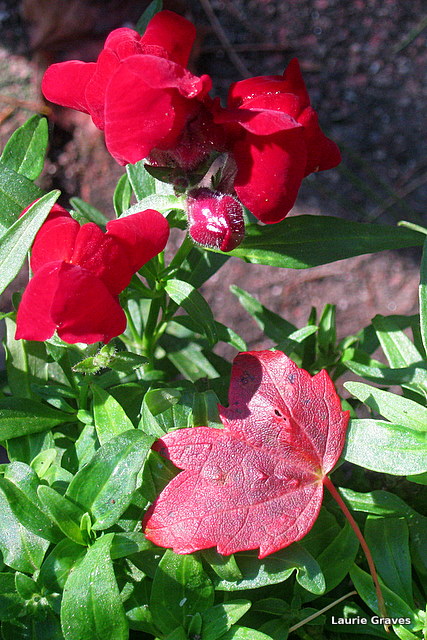
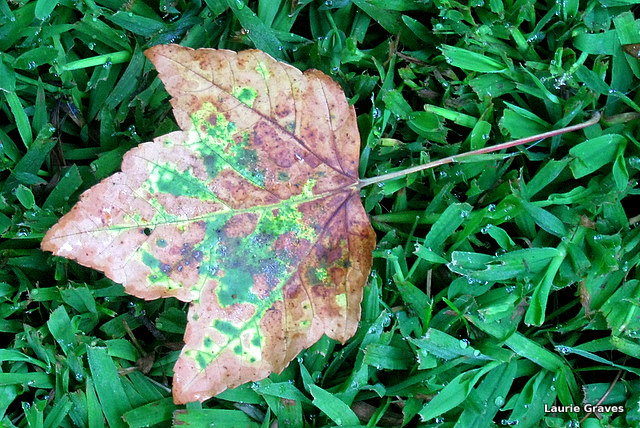
To make up for the gray day and the cold, both inside and out, here is a picture of red dwarf snap dragons—such a plucky flower!—and a red leaf.
I am reading Gladys Taber’s The Book of Stillmeadow, and I’ll conclude with the opening passage of the October section: “The special gift of frosty gold days comes now; time to lay down the household tasks and shut the door on routine. For every October, when I see the trees over the meadow, I think, ‘I shall not look upon her like again.’ And every October is different, strange with new beauty.”
This was true nearly seventy years ago, when the book was published. And no matter the weather or where the cold is, inside or out, it is true today in New England.
If you feed birds, chances are that you consider squirrels to be nothing more than a nuisance. Indeed squirrels eat so much seed that it is often difficult to keep a feeder filled, especially a small one. While I have no particular grudge against this furry animal who, after all, is just trying to make a living, I am very mindful about the cost of sunflower seeds. Our budget simply does not allow for replacing the seeds that the squirrels whip through with such astonishing speed. I compromise by spreading seed on the ground—some for the squirrels as well as crows, mourning doves, and, yes, mice.
Recently I came across a writer—Hal Borland—who also had some sympathy, and even empathy, for squirrels. According to Wikipedia, Hal Borland “was a well-known American author and journalist. In addition to writing several novels and books about the outdoors, he wrote ‘outdoor editorials’ for The New York Times for more than 30 years, from 1941 to 1978.”
In An American Year Borland writes about baby squirrels by his home. “Our baby squirrels were down on the ground today, for the first time. After that initial venture from the nest, they came out each morning, gaining confidence by the minute….But even on the fourth day they still descended the tree tail downward, in the manner of a black bear cub.”
Borland then goes on to describe how gradually the babies learned to go down head first and how cautious and frightened they were when they were on the ground. But Borland concludes, “From now on they’ll be coming and going many times a day. The mystery is broken. They have found the ground. The world is theirs—for a time.”
Even though I have lived in the woods for over thirty years, I have never been lucky enough to see baby squirrels venture to the ground for the first time. How I would love to see this!
Borland, with his beautiful, precise prose, reminds me yet again what an observant layperson can bring to nature writing. But better still, he reinforces my belief that when you look closely at the natural world, you can gain not only knowledge but also sympathy for the creatures who are struggling to earn their keep.
To my way of thinking, this sympathy can only be a good thing, especially when you consider how quickly we humans are driving so many animals to extinction.
For now, anyway, the squirrels are thriving. Next spring I’ll be on the lookout for baby squirrels leaving the nest.
And I’ll definitely be reading more of Hal Borland, who was introduced to me by Gladys Taber, in one of her books.
Today is my birthday, and what a beauty it is. I decided to give myself the day off—more or less—so that I could take pictures, have lunch at a Chinese restaurant a couple of towns over, and later have drinks on the patio with Clif.
Birthdays, especially as you get older—and at 5758, I certainly qualify as older—are often a time of reflection. This birthday is especially significant as five years ago, almost to the day, I had surgery for breast cancer. I was lucky. My cancer was lazy—a good thing for cancer to be—and not aggressive. And here I am five years later, feeling ever so grateful to be writing and taking pictures, to be living in Winthrop at the little house in the big woods. Better still, I have a wonderful family and terrific friends.
This is not to say I don’t have worries and troubles. Of course I do. Everybody does. But all in all, I am one lucky woman.
Yesterday was what might be called A Very Good Day. When I went to the town office to pay the registration for the car, I discovered I only had to pay $96, almost half of what I expected to pay. After that, it was on to the library, where I received a little money from card sales. (Clif and I have developed a line of library cards, where half the money goes to the library and half to us. It’s not a huge fundraiser, but it helps promote the library, near and far. )
Finally, the cherry on the sundae, so to speak, was when a missing library book I had borrowed was found, right on Shane’s desk. The book’s barcode is old and faulty, and the book wouldn’t scan into the system. I had put the book in the library’s book bin, which meant Shane had no idea who had returned the book. But now he knows, and my record is clear, Such a relief!
In the afternoon, my friend Barbara came over for coffee, and she brought chocolate peanut butter cupcakes. Among other things, we talked about the women’s suffrage movement and Elizabeth Cady Stanton and Susan B. Anthony, two leaders of the movement. They both died before women got the right to vote in 1920 with the passage of the Nineteenth Amendment. Stanton died in 1902, and Anthony died in 1906.
It made me a little a teary-eyed to think of how they didn’t live long enough to see the results of their hard work. It’s also a lesson to the rest of us. The improvements to society that we work on, big or small, might not happen in our lifetime, but that doesn’t mean we should give up on them.
Sometimes, I think, we are too impatient. We want results, and we want them now. When there are great injustices, this point of view is completely understandable, but the “arc of the moral universe” can be very long indeed. Martin Luther King Jr., who wrote those words, would not live to see the first African-American president. Yet he worked timelessly for civil rights that would allow for the possibility of the first African-American president.
We can’t all be great leaders like Elizabeth Cady Stanton, Susan B. Anthony, or Martin Luther King Jr. But we can work in our own communities and do what we can to improve them. I feel that my work on behalf of the library makes Winthrop a better town. Last month, the library’s circulation was 5,764. Not bad for a town of 6,000. (The population does increase in the summer because of our beautiful lakes.)
For other people, it might be some other work that benefits the community. I think of Jason, of the blog Garden in the City, and his lovely gardens, a gift of beauty to those who live in his neighborhood. There’s Bill, of Practicing Resurrection, who grows and sells organic vegetables. For that matter, there is our own Farmer Kev, who does the very same thing in Winthrop, and his partner Kate, who will be teaching art in middle school this year. This list could go on and on.
I’m gong to end with a Gladys Taber quotation: “I cannot influence the world. I can only live every day as well as I can, keeping my home, cherishing my neighbors, helping the community in a small way.”
And in Gladys Taber’s case, her wise words, written in the 1950s, do, in fact, make the world a better place.
Yesterday was quite the day for little Winthrop. Our own Bailey Library hosted a poetry reading by Richard Blanco, who describes himself as “[m]ade in Cuba, assembled in Spain, imported to the U.S.A.” And now Blanco lives in Bethel, Maine, which is not that far from Winthrop. Lucky us!
Blanco, you will recall, read at President Obama’s second inauguration, and his poem “One Today” emphasizes the bonds that connect us, a message this divided country needs to hear over and over again: “One sun rose on us today, kindled over our shores,” (Donald Trump, are you listening?)
As Richard Blanco is only one of five poets to have read at a presidential inauguration, I think it’s fair to call him the Mick Jagger of the poetry world. Not surprising, then, that the auditorium at the high school was packed. The estimate was between three and four hundred people. I’d put it closer to four hundred. By the time Blanco started his presentation—part personal history, part slide show, part poetry reading—there were no good seats left.
Blanco’s theme—or obsession, as he calls it—is home. He maintains that his obsession began in the womb, when his family left Cuba, “that land that is near yet so foreign.” He was born in Spain, and while he was still a baby, his family came to Miami—so close to the United States, he joked—and as far as Blanco was concerned, everyone in Miami was Cuban. (He also joked that he and his partner moved to Maine for the diversity.)
Television brought the non-Cuban world to Blanco, and from an early age, he realized that he and his family were outside the cultural norm. Blanco yearned to be in America, and for him, the grocery store Winn-Dixie symbolized everything that America represented. And ate. All the food Blanco and his family ate came from small Cuban grocery stores. Nowadays, of course, we think it is cooler to go to small shops rather than chains, but in the 1970s, when Blanco was a child, that was not the case.
Blanco’s grandmother, who sounds like quite the force of nature, refused to shop at Winn-Dixie. It was too expensive, she said, and they didn’t belong there. But when she saw a flyer advertising chicken at a great price, she relented. Blanco went to Winn-Dixie with his grandmother, and “I was finally in America.” I suppose, in a way, he was. Or at least one version of it.
As Blanco grew older, he learned the value of his own culture, but like anyone who is born outside the cultural norm, it takes a while. Indeed, his experience sounds so much like the experience my generation of Franco-Americans had. Many of us, at some point, rejected our heritage, only to come back to it as adults, to realize that there was an incredible richness in being Franco-American.
But I understood the embarrassment he felt when going on vacation with his parents, who, lets face it, didn’t really fit in outside their small Miami circle. Their budget was tiny, their suitcases were battered, and they brought their own food, which definitely did not come from Winn-Dixie. My inner child cringed along with Blanco as he described the experience.
Blanco also had to come to terms with being gay and with a grandmother who was not exactly accepting, shall we say. This, combined with being Cuban American, is very rich material for a poet. As the writer Geoffrey Wolff has put it, a good story is a hell of a gift.
For over an hour, the audience sat in rapt, silent attention as he read poetry and charted his journey to find home. “America is still a work in progress. It is our duty to contribute to that narrative.” Then, “The question of home is a global one.” Also, ” Nature is the universal home.” (This is one of the reasons he was drawn to Maine. Along with the diversity.) And finally, “We are always home.”
When he finished, Blanco received a standing ovation, which he certainly deserved. As a poet, as a speaker, he is warm, funny, sad, and wise. His use of language is both beautiful and down-to-earth. Blanco is a true artist, and after listening to him, I felt enlarged.
When you work at home, you have to establish some kind of routine. If you don’t, then it is easy to fritter away the time so that the hours pass, and the laundry is not done, the bread is not made, the blog post is not written, and the pictures are not taken. My usual routine is to write and work on photography in the morning and focus on household chores in the afternoon.
But today is very hot, very humid, and I decided to flip things so that I would be active during the coolest part of the day and at my desk in the afternoon. My little schedule has been turned upside down, and it feels odd. Nevertheless, I did everything I wanted to do, just not in the usual order. When it’s 90º in the shade—and the relative humidity nearly that high—it’s important to plan activities, especially when you don’t have air conditioning.
So far, this August has felt like July. In fact, for the past five years or so August in Maine has felt more like July. Time was when August was hot and dry during the day and cool at night. The lawns stopped growing, and those who mowed them to an inch of their lives had a brown stubble rather than a green carpet. Not anymore. In central Maine, everyone’s lawn looks as lush in August as it did in June, and I can count the times on one hand when I’ve had to water the potted plants outside. I was not surprised to read in the Boston Globe that rainfall in northern New England has increased by ten percent in recent years.
Despite the heat and the rain, I am counting my blessings. A friend who recently moved to Portland, Oregon, wrote, “The heat this summer out here has been stunning, way, way out of the normal, like exponentially…. I heard that some of the big CA redwoods are showing signs of stress. I don’t even want to HEAR this. Some are 3,000 years old. Scientists are in the groves now doing some testing, also flying over to see which ones are looking stressed. We have so many fires in OR and WA now that I don’t remember the number. Not near us and not on the northern coastal area. But not far inland. Eastern OR is desert and scrub country, ranches and grasslands and some ranches are burned.”
Dare we call this climate change? Yes, I think we should. Those of us who have lived in Maine a long time have seen many changes, some of which, like the cardinals, actually seem pretty good. Other things— such as ticks and lily beetles—not so much. The heat and the rain lure these creatures farther north.
But climate change or not, the gardens at the little house in the big woods have that ragged look they always get at the end of summer. Still, there are interesting things to photograph.
The ragged bee balm nonetheless keeps attracting the bees
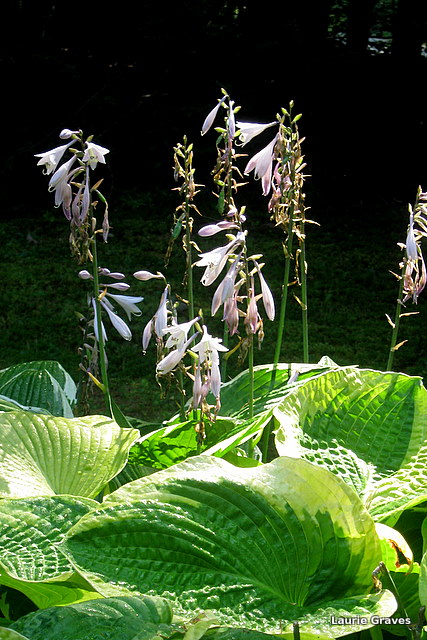
The hostas don’t look too bad
Beautiful but droopy phlox
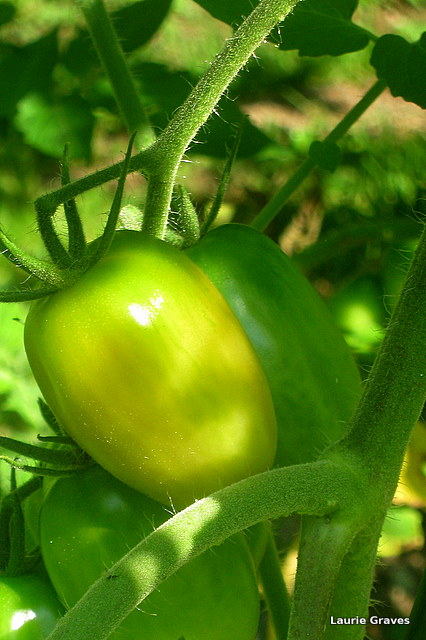
A tomato beginning to ripen
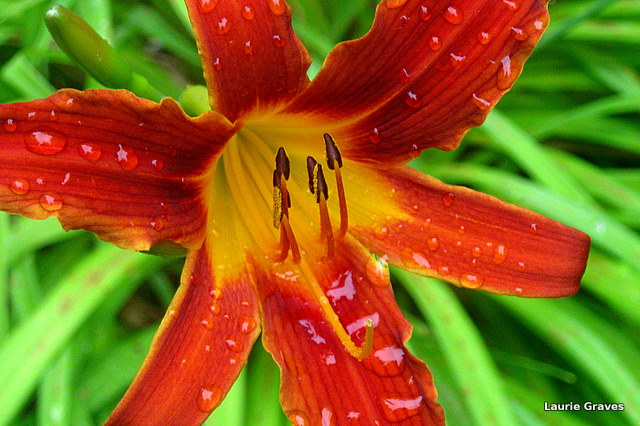
The last red lily of the season
A sign of things to come, despite the heat
Will tomorrow be another topsy-turvy day? That all depends on the heat.
Yesterday, Clif, the dog, and I went for a Sunday walk up the Narrows Pond Road. It was one of those beautiful August days that was so perfect—so warm, dry, and sunny—that I wished I could hold onto that day and just keep it for use whenever the weather is bad, which it often is in Maine. But alas, good weather, like good times, cannot be held.
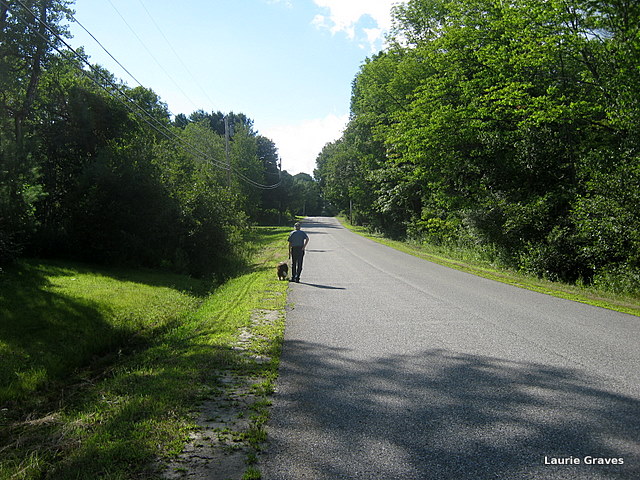
Clif and Liam walking up the Narrows Pond Road
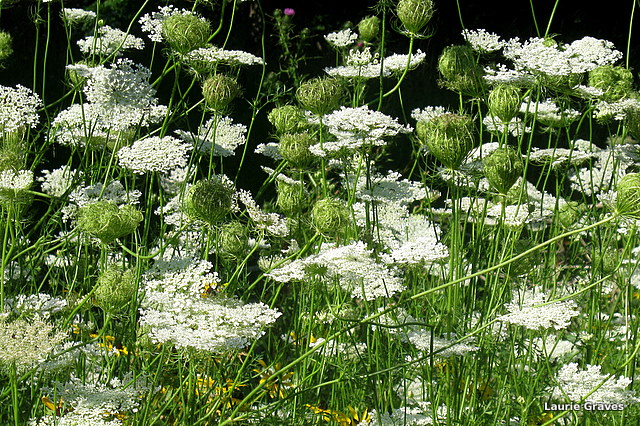
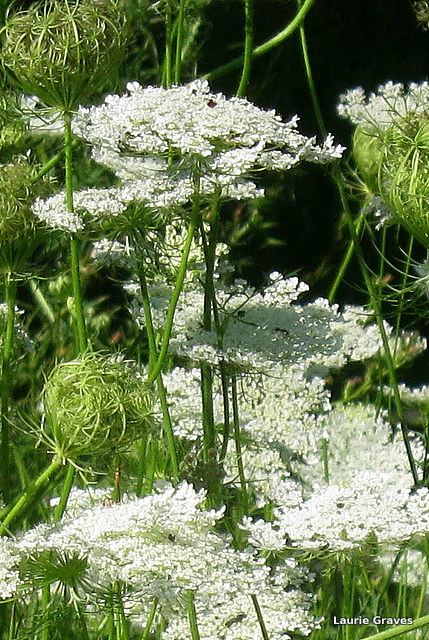
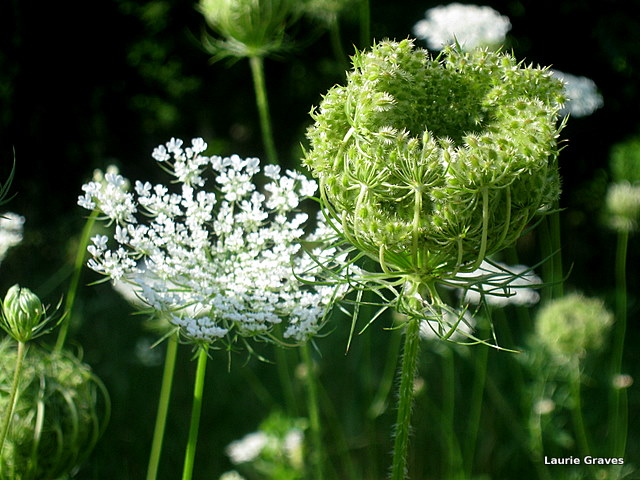
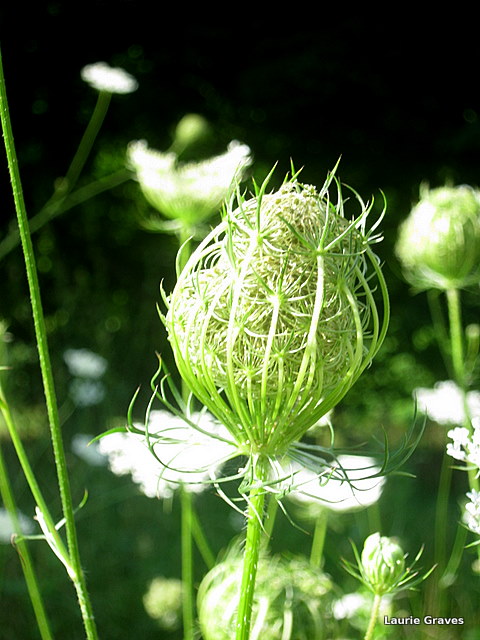
Up the road, on the right, there is a small meadow that is full of August wild flowers—black-eyed Susans, purple loosestrife, golden rod, and Queen Anne’s lace. I knew the light would be good, and I brought my camera along. When I go for walks and take pictures, quite often I am alone with the dog, and I have to put the retractable leash between my legs while I take pictures. I must say, it is much easier to take pictures when Clif has the dog.
I came to the little meadow, abloom with flowers. Clif and Liam continued walking while I took pictures.
The other day, I was taken by Susan. On this walk, I was taken by Anne. I didn’t plan this, and I was reminded of Gabriel Orozco’s “The poetic happens when you don’t have expectations.” I’m not sure if my fascination with Queen Anne’s lace was poetic, but I certainly didn’t have any specific expectations on this walk. There was only a general sense that I wanted to take pictures of the wild flowers. But on this day, Queen Anne’s lace took center stage.
On another walk, it might be something else.
It seems to me that one of the best gifts we can give us ourselves is the freedom to notice. And from this noticing, who knows what will happen?
Last night, Clif and I went to a victory party to celebrate the expansion of the Charles M. Bailey Library. It was a potluck—my favorite kind of party—hosted by Pearl and George Ames, two members of the campaign team.
The lovely backyard where the party was hosted.
The food, of course, was delicious, and I ate way more than I should have. I even indulged in a hamburger, and I can’t remember the last time I ate beef. We don’t eat it at home, but if we go to somebody’s house, and beef is served, then we will eat it. I must admit that hamburger tasted mighty good.
But better than the food—and you can bet this foodie never thought she’d be writing that anything could be better than food—was the spirit of the campaign team. There are about fifteen people in the core group, women and men who not only love the library but who have been willing to work hard to make the addition a reality. And it was very hard work. To raise a million dollars in a town of six thousand people is not easy, especially when the town is a middle-class community—a macaroni-and-cheese kind of town, as I like to call it.
In the process of working together for over three years, of facing and overcoming setbacks, something rather wonderful happened. We have bonded together as a team and have become completely comfortable with each other. It doesn’t always work that way, and what a blessing when it does. It also goes to show what people can do when they work together, when they put time and energy into a project. This energy can be such a force of good when directed toward the right cause.
And the library expansion was most definitely a right cause. The other day, when I returned a movie, I looked around. In the reading area with its blue chairs and barn-board table, a man was reading the paper, and a woman was reading a book. Nearby, at the computer tables, there were few empty seats. People talked quietly together, and the library was filled with a happy sound. In the stacks, patrons looked for books. Bailey Library has always been an important part of this community, but now, with the expansion, it is truly the center of the community.
At the party, I chatted with various team members. I learned that Roger had been in the Peace Corps, and French was Bob’s first language. I talked about painting and art with Penny while my husband discussed biking with her husband.
As Mary Jane, the chair of the trustees, put it, “Along with helping to raise money for the new addition, I also made such good friends.”
How glad I am that I have come to know and work with these people, to call them friends. And how proud I am of what we have achieved together.
On Sunday, we had cocktails on the patio with Jim, an acquaintance who lives nearby. He’s a regular reader of this blog, and for quite a while, we’ve been wanting to have him over for drinks and a chat.
We talked about many things, but I had to laugh when he noted that on my blog, I can get so much material from a walk down the road to the Narrows. This was an interesting coincidence because lately I have been reflecting on my little territory, and how I map it with observation, words, and pictures.
But first things first: I am an extreme homebody. For me, home is best. When the weather is warm, my backyard is one of my favorite places to be. Even though we only own an acre of land, our home abuts a watershed for the Upper Narrows Pond, and this watershed comprises 2, 729 acres, or 4.26 miles. This land is protected, closed for development, which means nobody can build on it. While we do have neighbors, we are essentially surrounded by woods. (I don’t call this place the little house in the big woods for nothing.)
The front yard, surrounded by trees
The backyard, even more surrounded
So my prime territory is my own yard, an acre that seems much larger because of the watershed. Almost every day, with camera in hand, I patrol the yard. No matter the season, something is always going on, and it never gets old for me. From the budding trees to the blooming flowers to the falling leaves to the snow—and sometimes we are positively buried in it—it is a cycle that fascinates and delights me.
Flowers, flowers, flowers
Then there is the Narrows Pond Road. From my driveway, if I turn left, I will walk to the Upper and Lower Narrows, two bodies of water large enough to be considered lakes and lovely any time of year. The walk to the Narrows is a wooded walk, and through the trees I can see remnants of old stonewalls, a reminder that once upon a time, this land had been cleared of trees and was open farmland.
The road to the Narrows
If I turn right, I walk up to the fork, and there are still plenty of trees, but farther up the land is more open, with fields, houses, and a few apple trees leftover from when there were orchards on this road. There’s also a little swamp, quite near our house, and in the spring the peepers’ song is loud and beautiful.
The road to the fork. The swamp is just beyond the clump of trees on the left.
From the Narrows to the fork it is about one-half mile, and this, combined with my acre yard, is my usual territory. Four days a week, I am home without a car, so it’s a good thing I am fascinated and absorbed by the plants, the birds, the insects, the water, the fields, the sky, and the weather. I feel as though I could live here for a hundred years and never really know this acre, this half mile of road.
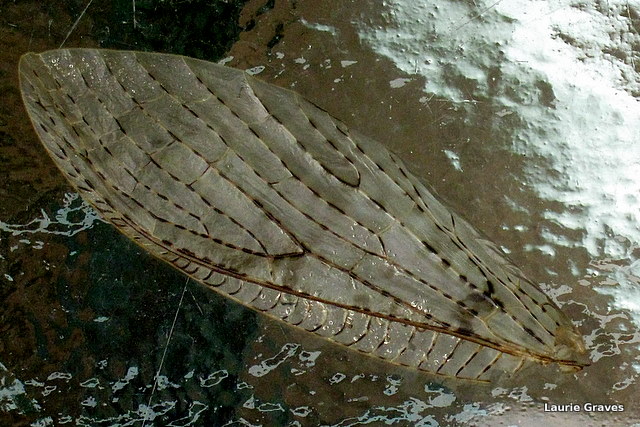
A wing found in the backyard
Sometimes, of course, I venture farther. Once or twice a week I go to the library in town, about a mile away. My husband and I go on five-mile bike rides. We go to potluck dinners, usually in town. Occasionally, we visit a friend in Brunswick or our daughter and son-in-law in Portland. Once in a while, we even visit our daughter in New York.
But mostly I stay home.
Always, it seems, qualifications are necessary, and so I will qualify. There is value in seeing and photographing areas far from home. The road calls to many people, and traveling can be broadening. As my mother might have said, it changes the mind. (French was her first language, and this is a literal translation from a French phase. I expect it really means that travel broadens the mind.)
But I also think there is value in charting your own little territory, observing what happens in your yard, on your road, in your town. It seems to me that through this close mapping, a deep love can develop for the place that you live, whether it’s town, city, or country.
When you come to love a place and become intimate with it, then the chances are high that you will work to take care of it, to preserve it. Or, as in the case of Winthrop’s expanded library, even work to improve it.
So far, in Maine, this summer has been nearly perfect. Warm and hot during the day, cool at night, and just enough rain for the plants and flowers to flourish. Oh, I could take nine months of this. I know. I live in Maine, where it is downright cold much of the year. Perhaps that’s why summer here is so sweet?
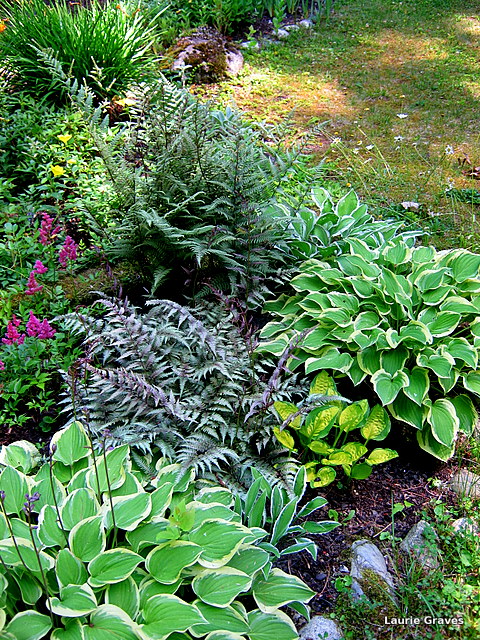
My front gardens, with their profusion of evening primroses, come into their own the end of June and the beginning of July, when everything is an exuberant burst of yellow. However, all good things must come to an end, and so it is with the evening primroses, which are nearly done blooming. There are other flowers to look forward to—black eyed Susans and daylilies—and the hostas and ferns hold everything together, but for the front yard, the peak is over.
It is now up to the hostas and ferns to hold everything together.
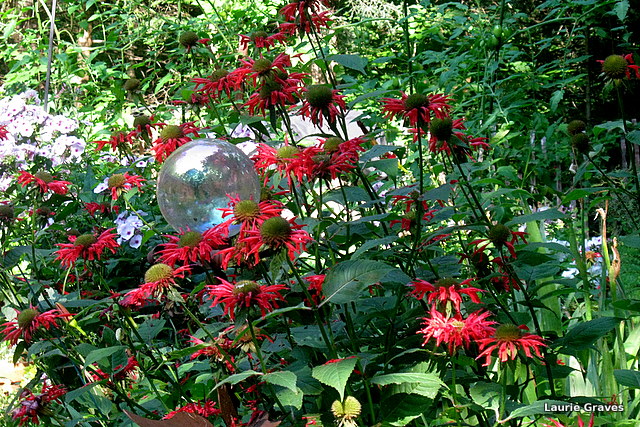
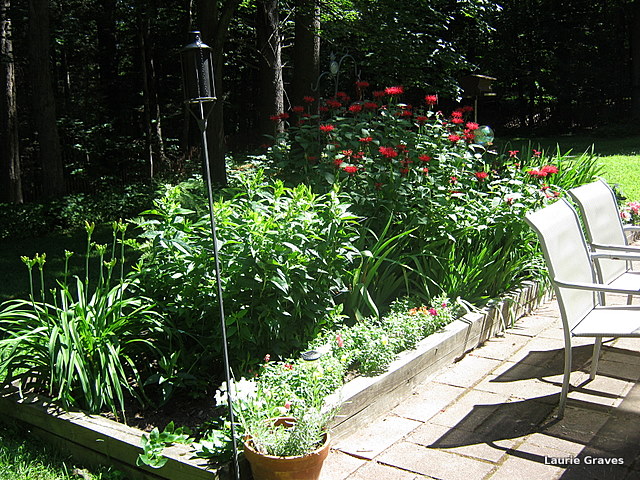
On the other hand, the back garden is just coming into its own. The Bee balm is in glorious red bloom—I can’t stop taking pictures of it—and soon there will be a profusion of especially lovely daylilies to join them. There will, of course, be more pictures.
The backyard coming into bloom.
I like to joke—well, maybe it’s not such a joke—that I have the worst yard in Winthrop in which to garden. There is shade galore, and much of it—especially in the front yard—is dry. Thirty years ago, we bought this house for other reasons—the price, the woods, the roominess despite its small size. It was our first house, and I hadn’t yet been bitten by the gardening bug.
However, after a couple of years here, I was bitten. Hard. I was young, I was strong, and I began digging like a fool. I planted willy-nilly, with little regard for the conditions. Let’s just say that there was plenty of heartbreak and loss. What I wanted was a blooming cottage-style garden. My yard had other ideas, and I wasted a lot of time, energy, and money before I came to my senses. In retrospect, I realize that I should have put raised beds in the front, which would have helped with the dry shade.
But, as the saying goes, we grow too soon old and too late wise. The gardens are dug, and I don’t have the energy or the resources to replace them with raised beds.
I have finally followed the advice of a friend who is an accomplished gardener. “For God’s sake, Laurie, plant some hostas.” This I have done. They are thriving in the dry shade, and they look cool and elegant until the slugs munch them to ribbons. I’ve also planted ferns, which are lovely. But, oh, my heart aches for hollyhocks and roses.
In the backyard, I am happy to report that I learned from my mistakes in the front yard, and the large garden along the patio is indeed a raised bed. There are only six hours of sun in that garden, but I can grow irises, bee balm, and daylilies. Phlox does well, too.
This might sound a little woo-woo—to borrow from my friend Susan Poulin—but the garden has taught me lessons. That is, conditions are not always ideal. We might want hollyhocks and roses, but instead we get evening primroses and hostas. Yet, in what we get, there can be creativity, value, and even beauty.
More photos from my mid-July garden.
A winged visitorAnother little guardian of the garden.Oh, bee balm!Black and white against green.
A blog about nature, home, books, movies, television, food, and rural life.














 Notes From the Hinterland