Category Archives: Food for Thought

Introducing Résonance, A Franco-American Literary Journal

Along with writing novels and pieces for my blog, I am an assistant editor for Résonance, which as the title of this piece indicates, is a Franco-American Literary Journal.

For readers unfamiliar with Franco-Americans, here is a brief history: from the mid-1800s to the 1930s, there was a huge migration—almost a million from Québec— of French Canadians to the United States. They came to farm and to work in the factories and forests and settled primarily in New England. On my mother’s side, my great-great grandparents, Prudent and Demerise Jacques, bought land in northern Maine and grew potatoes.

Many of the French Canadian immigrants were dark haired and had olive complexions. They all spoke French—indeed French was my mother’s first language—and by and large, they were Catholic. In short, they were foreigners and were looked upon with hostility by the dominant Yankee culture in New England. One newspaper described Franco-Americans as “a distinct alien race.”

In Maine in 1919, a law was passed outlawing French in public schools except during formal language classes. In the 1920s, the Ku Klux Klan was a huge presence in Maine, and they marched against the Franco-Americans.

It wasn’t until 1960 that the 1919 law was repealed, and by then the damage had been done. Franco-Amercians had effectively been silenced, forced to abandon French so that their children wouldn’t be punished at school. A Franco acquaintance, who was caught speaking French on the playground, told me how she had to stay after school and write “I will not speak French at school”  on the chalkboard. Until the day my mother died, she maintained that she spoke “bad French.”

This silence extended to other areas of life. For the most part, Franco-Americans kept their heads down and worked hard, very hard, and were perhaps too passive, as one elder Franco-American put it. Outside of family circles, stories were seldom told. We were dubbed “The Quiet Presence,” a source of ridicule and jokes about how stupid we were. (Unfortunately, I have heard more than my fair share of dumb Frenchmen jokes.)

Then came my generation. We were sick of being quiet, of keeping our heads down, of feeling as though we were congenitally stupid. We have organized into groups celebrating our heritage, sometimes through performances. Slowly, slowly, books, articles, poetry, and essays have been written.

And under the auspices of the University of Maine at Orono, we have our very own journal, Résonance, which features “creative works by established and emerging writers, primarily by and/or about the Franco-American communities of the United States.” The newest issue, Volume 7, has just been published.

I help edit the creative non-fiction pieces. In this volume, there are a variety of essays, ranging from an account of the author’s ancestor arriving in Canada in 1662 to a humorous piece about a mouchoir (a handkerchief) to a reflection of nature and trauma to a reckoning of how French is spoken in Maine rather than in France.

In addition, there is artwork, poetry, fiction, and an interview with Susan Poulin, a Franco-American performer. If you have time, I hope you will check out Volume 7 of Résonance.

And for readers interested in submitting pieces to the journal, please check out the guidelines.

As we would say in French, à bientôt!

Jury Duty: The Importance of Technology

Last week I was on jury duty, and what a week it was, both riveting and emotionally draining. The case involved a man in his late thirties who was accused of Gross Sexual Assault and Unlawful Sexual Contact with an eleven-year-old boy.

Right from the start, the evidence was against the defendant. On the first day of jury duty, we saw a video taken by a police officer—who was wearing a bodycam—when he went to the defendant’s home to collect his phone. As soon as the defendant, who was outside, saw the policeman get out of the cruiser, the defendant booked it inside. Then, the defendant made the police officer wait outside for five minutes before letting him in.  After which, the defendant proceeded to tell lie after lie about how he didn’t have his phone and couldn’t remember the number. When the police officer informed the defendant that his home would be torn apart if he didn’t produce the phone, the defendant finally took the police to where the phone was hidden, in a vent in the bedroom.

The second video we saw was filmed the day after the alleged assault when a councilor at a local sexual assault unit interviewed the boy. I will not go into any details except to say the boy looked as though he wished the floor would open up and swallow him. He wore sneakers with Velcro straps, and during a particularly tense part of the conversation, the boy ripped the straps back and forth, back and forth. I want to add that the councilor was very respectful and kind, using different approaches to put the boy at ease.

The third compelling piece of evidence came from DNA testing and the testimony of forensic experts. The morning after the alleged assault, the boy told his mother what had happened, and fortunately there had been no shower to wash the evidence away. The mother immediately brought the boy to the local sexual assault unit, where DNA swabs were taken, and the boy was interviewed. Only two DNA profiles were found under the clothes on the boy’s body, his own and the defendant’s.

The defense lawyer brought in his own forensic expert, who maintained that DNA could travel in many ways from person to person, with sneezing being a prime example. This would turn out to be the defense lawyer’s main argument, that his client’s DNA profile under the clothes on the boy’s body could have come from anywhere.

When all the evidence had been presented, when all the witnesses had been called, and the closing arguments made, the jurors went to the jury room, and it was the court’s turn to wait for us.

As it turned out, the court only had to wait for a little under an hour. We discussed all the evidence presented and the various testimonies, including what we had seen in the videos. It didn’t take us long to agree that the defendant’s DNA profile under the boy’s clothes didn’t get there by way of sneezing or through any other route that DNA might take. We found the defendant guilty of both Gross Sexual Assault and Unlawful Sexual Contact.

This, of course, is an abbreviated version of what happened in court. Out of respect for both the boy and my readers, I have avoided using the upsetting language that I heard. I expect you will be able to read between the lines.

In conclusion: I was so impressed with the judge, who was cool and even during the whole trial;  with the passionate prosecuting lawyer, whom one juror described as a pit bull; with the defense lawyer, who had a thankless job; and with my fellow jurors, who listened intently  and closely to both sides. We took our job seriously. Finally, I was also impressed with the way that technology was used as evidence by the prosecution. The DNA profiles and the videos made the picture much clearer.

Next week, I will return to more pleasant subjects—Clif’s birthday, fall coming to Maine. But as my jury duty indicated, life is not always rosy in the hinterlands, where people commit serious crimes, just the way they do anywhere else.


Flight of the Hummingbird

One of the delights of summer is the return of the hummingbirds, whose delicate and ethereal appearance belies their fierce territorial nature.

When we sit on the patio, we can hear the buzzing of their frantically beating wings and their high-pitched twitters as they try to drive each other away from the feeders and flowers. Often, one sits guard on the feeder, keeping a sharp eye out for any hummingbird intruders. With other birds, all of whom are larger, the hummingbird is more circumspect. As Falstaff once noted, the better part of valor is discretion.

Silly little things. If I could speak hummingbird, I would tell them that there is plenty of food for all, that they waste more energy chasing each other away than they would if they just settled down to drink the sugar-water we provide.

But, alas, I don’t speak hummingbird, and I doubt they would listen to me even if I could. And, really, who am I to criticize? Do humans, as a group, listen any better to good advice, to pleas to share resources with those who have too little? Some do, yes, but all too many don’t, especially those at the top who have so much. I won’t mention any names. I’m sure readers will know whom I’m referring to.

But back to hummingbirds. Nowadays, I use the camera in my phone to take photos, and it is not easy to catch a picture of hummingbirds as they zip from feeder to flower. But I am persistent, and I have a couple that aren’t too bad, which I’ve used for this post.

In about a month, the hummingbirds will leave Maine for their long trek south, to Mexico and Central America. How can such little birds make such an arduous journey? Somehow they do, and perhaps their fierce nature helps them.

In the meantime, we will enjoy the buzzing of their wings and the twittering sounds hummingbirds make as they zoom in and around the garden, over the house, and into the woods.


I’m Back. Sort of.

What a difference a presidential election makes. Before November, I was full of enthusiasm for my blog, especially for my Thankful Thursday posts, where I wrote about the good things in my life.

Now, I have little enthusiasm and energy for my blog. I am just so sad, and the hose of sewerage coming from the first two weeks—has it only been two weeks?— of Trump’s presidency doesn’t help. In the face of such malevolence, writing about life on the edge of the woods seems trivial, my thankful posts naive.

And yet I have missed the blogging community. I’ve intermittently kept track of blogging friends’ posts, but it’s not the same as reading and posting regularly. So here I am. This piece is a tentative first step in returning to something approaching a normal blogging schedule.

Despite my heavy heart, I have still been reading novels, listening to podcasts, and watching television series and movies.

For reasons that shouldn’t be too hard to figure out, I have become obsessed with World War II. (No, I am not comparing Trump with Hitler. Bad as Trump as, he doesn’t reach the horrible evil of Hitler.)

A French television series I have become particularly engrossed with is Un Village Français (A French Village.) Covering the years from 1940 to 1945 (and beyond), the series centers on Villeneuve, a fictional French village, and how the various inhabitants cope with the German occupation of France. Some villagers just try and live their lives, no easy thing to do when the Germans are occupying your community. Others collaborate. Some join the resistance, an uneasy coalition of Communists, Socialists, and Gaullists, among others.

There is a huge cast in A French Village, with the focus on a group of main characters, all of whom are vivid. Because this a French production, there are affairs aplenty, but they never sink the show or get in the way of the central issue: who resists and who collaborates? Warning: main characters do get killed. Don’t get too attached.

As I watched the show I asked myself, what would I do? Would I resist, or would I keep my head down? I think of Marie, one of the main characters in the show and a hero of the Resistance. In one scene, she is biking madly down the road on some important Resistance business. Her expression is resolute, and the camera focuses briefly on her shapely legs. (Back then women biked in skirts.) I hope I would be like Marie, but in all honesty, I can’t say for sure that I would.

The series is not without its flaws. There are plot contrivances and jumps that don’t always make sense. Nevertheless, A French Village is a monumental achievement and very much worth seeing.

How to watch it? Here’s the rub. Some of the seasons—but not all—can be viewed on Amazon. The missing seasons are important, and I don’t recommend watching it this way. For those who get Kanopy, a library streaming service, all seven seasons are available. Our library system also has the seven seasons available on DVD. Yours might, too. Finally, the series can be watched via the streaming service MHz Choice, which costs 7.99 a month.

And for those who like podcasts, The Bulwark offers an excellent French Village series with Sarah Longwell and Benjamin Wittes.

Vive la France! They made it through hard times. I’m hoping that we can, too.


A Not Very Thankful Thursday

Fair Warning: This post will not feature a gentle, upbeat piece about nature and life at our house by the edge of the woods. Instead, it is a lament about the choice too many voters made on Tuesday. If this isn’t your thing or doesn’t match your politics, feel free to skip it.

On Tuesday, the votes were cast, and I am still reeling over the results. I was convinced Harris would win. Silly me in my blue bubble with like-minded friends.

However, a week ago, I did see an ominous sign that should have warned me of what was to come on Tuesday. When Clif and I went to Lowe’s to pick up a few things for the house, we parked behind a huge pick-up truck with the most vulgar, obscene array of anti-Harris/Biden bumper stickers that I have ever had the misfortune to see. I just sat there and gaped, reflecting on how I would never, never have similar bumper stickers about Trump on my car. Never.

Hostility and anger radiated from that truck, and I thought about how I wouldn’t want to meet the driver, a man, in a dark alley. In fact, I would probably cross the street to avoid him.

I am betting, that Trump,  a fulcrum of crude resentments, was the candidate of choice for that driver. Naturally, I did not ask him.

And on Tuesday, all across the country, even in blue zones, voters chose a man whose daily diet consists of anger and resentment, who has an enemy list, who has threatened “to toss reporters in jail and strip major television networks of their broadcast licenses as retribution for coverage he didn’t like.”

Does Trump mean this? Who knows? I guess we will find out.

I am heartbroken that so many voters—almost 73 million across the country—went for this man who is such a threat to the United States. Will he drag this country down? Is this it for democracy?

Again, we will find out.

I am taking a couple of weeks off from blogging. I need time to recover and regroup. And to figure out how to resist in my own creaky-kneed way.

I’ll end with grandfather of grunge, the great Neil Young. Let’s keep Rockin’ in the Free World.


A Haunting Tale

To a large degree, we are all here because of chance. If my mother had married another man, there would be no me. The same is true for my brother. Another daughter or another son, perhaps, but not the two of us with our exact genetic inheritance.

However, for my friend Ed Vigneault, the story of his existence is even more weighted by chance, a tragic, improbable tale that started sometime around 1815 in the waters off the Magdalen Islands, a small archipelago in the Gulf of Saint Lawrence. The archipelago is part of the province of Québec, and its French name is Îsles de-la-Madeleine. Population: 12,781.

According to Wikipedia, the territory once belonged to the Mi’kmaw Nation, and they named this cluster of islands Menquit, which means “battered by waves.” Later, it would be called Menagoesenog, or “battered by the surf. ” Both names give a vivid description of the rough waters that pound the Magdalen Islands, and through the years there have been over 400 shipwrecks. Some of the islanders are descendants of the survivors. And even though he isn’t an islander, this brings the story back to my friend Ed and the year 1815, long before Ed was born.

A ship from Europe, probably from the British Isles, was sailing to Canada. But before the ship reached port and was somewhere near the Magdalen Islands, a terrible storm blew in, a tempest. The ship was obviously in trouble, but the storm was so bad that none of the fisherman from the islands dared go out to rescue the passengers.

As the islanders feared, the shipped crashed against the rocks, throwing passengers into the ocean.  On a beach near Dune du Sud on the island Havre aux Maisons, bodies washed onto the sand. As the islanders searched for survivors, they found a heartbreaking sight: A  dead woman clutching a baby, who, incredible as it might seem, was alive. That baby was Ed’s great-great-grandmother, and a family—the Cummings—on Havre aux Maisons adopted her, naming the baby Sophie Peine. Because of her tragic beginning, Sophie was also known as “La Petite Misère,” which I’m sure needs no translation even for those who don’t speak French.

I first heard this story, told by Ed in broad outlines, at a gathering at a friend’s house, and I was immediately gripped by it. In my mind’s eye, I could see dead bodies—some face up, some face down—washed on a sandy beach. Waves break over them, pushing them farther up the beach and then rolling them back a little. With resignation, the islanders come to the beach, searching for survivors. Dead, dead, dead. Then they hear an infant cry and find baby Sophie in her dead mother’s arms. I think of the force of will it must have taken for that mother—Ed’s great-great-great grandmother—to hold on to that baby, to not let go as the ocean threw them toward the rocks and the sand. If the mother had loosened her grip just once, the baby would have been swept away to drown, and there would have been no Ed.

Knowing I was interested in hearing more, Ed and his wife Becky invited me over for tea one morning so he could fill in the details. He told me that when his niece and his sister started doing genealogy, she discovered the sad story of Sophie Peine. He spoke of how Sophie lived to be a woman and married a man named Bénoni Arseneau. They would have many children together, and eventually they moved to Natashquan, in the Province of Québec. The community is so remote that until 1996, it could only reached by either plane or boat. Ed’s great-grandmother would be born in  Natashquan, and it was in Natashquan, on dry land, that Sophie, La Petite Misère, died.

When he was done talking about his family, Ed brought out a small plastic container. Inside was sand, scooped from the beach on the island where Sophie and her mother washed up. On top of the sand was a little piece of driftwood.

Ed said, “I like to think this piece of wood came from the ship Sophie was on.”

I just nodded. Such a lovely thought that connects Ed to his great-great-grandmother, the improbable survivor of a storm that took so many lives, including the life her own mother.


River of Change

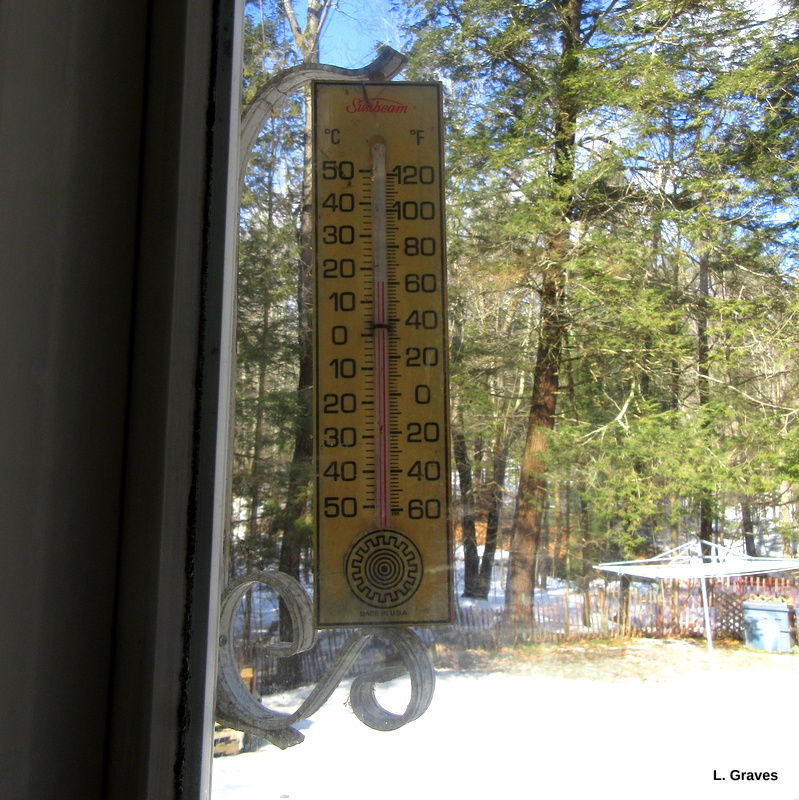
Last Wednesday the weather was so warm for February in Maine that it broke records.

The driveway was filled with puddles and melting ice.

On that warm February day, Clif and I went on a rare outing where we got take-out from the Red Barn in Augusta, about ten miles from our town. Mostly we cook and eat at home, and our meals are vegetarian. However, while we will not eat mammals or birds, we do, from time to time, eat shrimp, clams, and scallops.

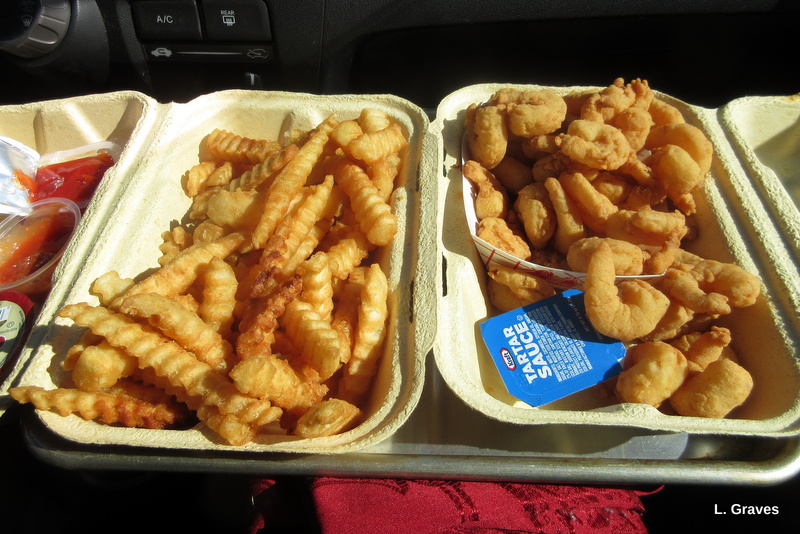
At the Red Barn, we ordered fries and the Barn’s delectable shrimp. Then we headed down the road to Hallowell, to the parking lot that overlooks the Kennebec River, which is neither wide nor mighty but is nonetheless dear to us.

As we ate, we watched the river. It was iced over, but because of recent rain and the warm weather, there was a skim of water on top. A strong wind blew the water this way and that, as though it were sand.

When we were done, we headed to another spot on the Kennebec, where there’s a turnout with a deck, and you can look down the river into Augusta, our state’s capital. In the distance, a little to the right, is the white dome of the capitol building.

The cropped picture reveals a small black smelt shack, also in the distance. If the thaw continues, the owner will have to remove it lest the shack be carried downriver.

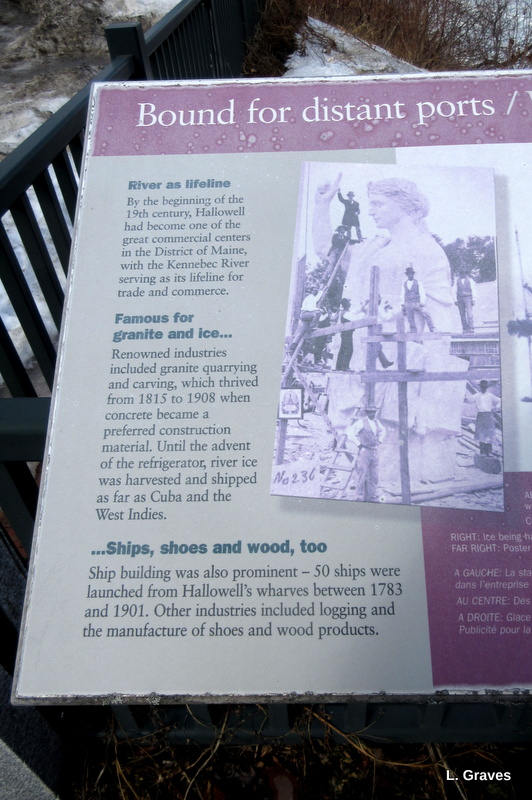
On the deck are posters, in both French and English, that describe how important the Kennebec River was when goods were moved by boats and ships. Back in the day, rivers were superhighways. Because of  this, Hallowell was once a bustling community, and there are many fine old homes that are remnants of a more prosperous time.

But times change. Trains and trucks displaced river ships, cement displaced granite, and refrigerators displaced ice. The Kennebec is no longer a superhighway to and from the Atlantic Ocean. Deprived of a vital economy, Hallowell fell on hard times, and in the 1960s and 1970s, it was a dumpy, depressed place. The river, too, fell on hard times, becoming dark and dirty, polluted by the many factories lining the banks.

But all is not gloom and doom. Thanks to the Clean Water Act of 1972, wildlife now thrives on the river, and the Kennebec is a place of recreation and rejuvenation for humans. Artists and creative types, drawn by affordable homes, moved to Hallowell, and the once depressed town has become funky and vital.

The Kennebec River and Hallowell are object lessons in how change can be both good and bad. Sometimes change is out of our control, and we just have to cope with it as best we can.

But sometimes it’s not. And to borrow from the Serenity Prayer, it’s up to us to have the wisdom to know the difference.

*******************************************************

Nifty Posts from Some of the Lovely Blogs I Follow

Ju-Lyn, of Touring My Backyard, featured the fascinating bat flower.

Despite these turbulent times, small pleasures abound in this post from Thistles and Kiwis.

Tootlepedal’s blog always features fabulous photos, but in a recent post, with some help from his son-in-law, he outdid himself

In a timely post on Robby Robin’s Journey, Jane provides maps of Ukraine that really clarify the geography of the area.

Katie, of the Cozy Burrow, never fails to amaze with her beautiful creativity. Sew on, Katie!

On Retirement Reflections, Donna does her bit to spread peace with with three travelling copies of The Little Book of Inner Peace. What a wonderful idea!

*******************************************************

This is more than a little Christmasy, but I couldn’t resist sharing Aimee Mann’s cover of Joni Mitchell’s The River. The song is so lovely, and it fits beautifully with my own river post.


When World Events Dominate

Most of the time, the posts on this blog avoid the political, and world events are seldom mentioned. Instead, the focus is on life in the hinterlands of central Maine. I’m a homebody who seldom travels more than twenty miles from my town. I dwell in the particular, on the edge of a small forest where the wind moves through the tops of the pines and a snake sometimes suns itself on my patio and a bear once smashed flat our bird feeder.

However even in central Maine—far from the center of things—world events can dominate. With Russia invading Ukraine, now is such a time. If there is one thing the pandemic has taught me is that there is no “there.” What happens across the globe ripples outward, touching all countries, no matter how far apart they are. Once upon a time, what happened in a Neanderthal village might have stayed in a Neanderthal village. But those days are gone, and the United States is now inextricably linked to the rest of the world, from Africa to China to Russia to Europe. And as the twentieth century has illustrated, especially to Europe.

What will happen next with Russia, Ukraine, and the world? Naturally, no one can know. But Clif observed that while Afghanistan felt like Vietnam, Ukraine feels more like Poland. I hope this impression springs more from a sense of unease than from any kind of foresight. A world war with an authoritarian leader who has nuclear weapons is terrible to contemplate.

Amidst the gloom, there is a glimmer of hope. In the New York Times, I read, “Thousands of protesters took to the streets and squares of Russian cities on Thursday to protest President Vladimir Putin’s decision to invade Ukraine…Many Russians, like people across the world, were shocked to wake up and learn that Mr. Putin had ordered a full-scale assault against a country often referred to as a ‘brotherly nation.’ At the protests, many people said they felt depressed and broken by the news of Russian military action.”

But this is just a glimmer. Unfortunately, as we have seen in our own country, tribalism and nationalism are always lurking, and authoritarian leaders know how to whip up a frenzy for conflict and war.

Frank Bruni, also in the New York Times, gives this sobering assessment of Putin and Ukraine: “Embarrassment, vanity, viciousness: History never moves on or gets past these forces, which drove invasions and conquests in centuries past and will drive invasions and conquests in years to come. There should be no great shock about Russia’s audacious attack on Ukraine — only profound sadness and painstaking thought about what to do and what’s to come.”

When I shared Bruni’s quotation on Facebook, I got some pushback from a friend who wrote “As long as most people say war and destruction are inevitable, just part of life, it will be.”

I sympathize with that sentiment. How nice it would be to say war and destruction are not inevitable, and then have no more war.

If only it were that easy.

Scenes from a Recent Snowstorm

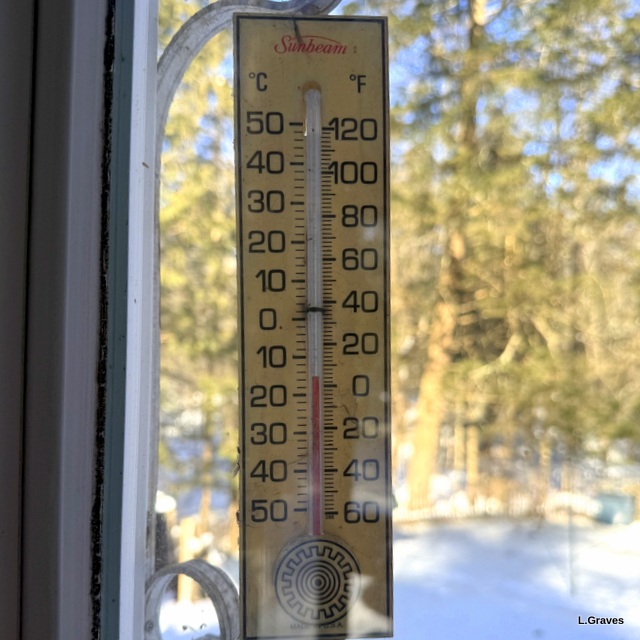
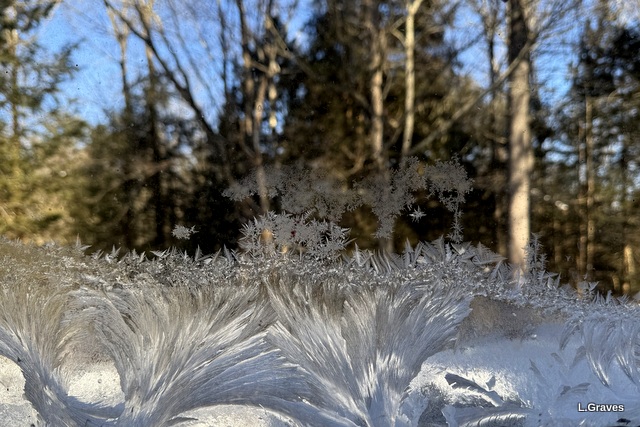
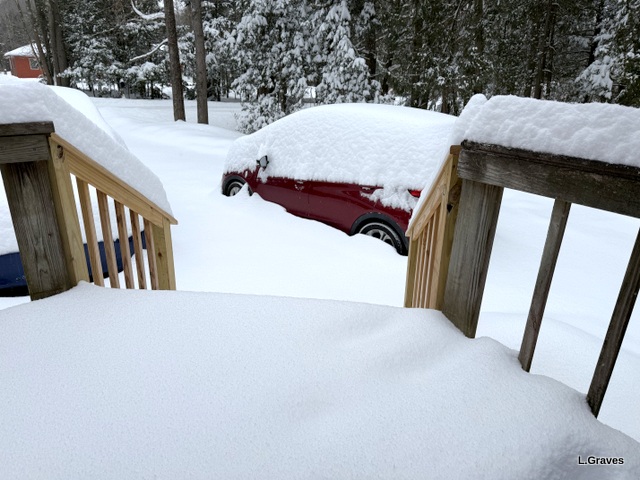
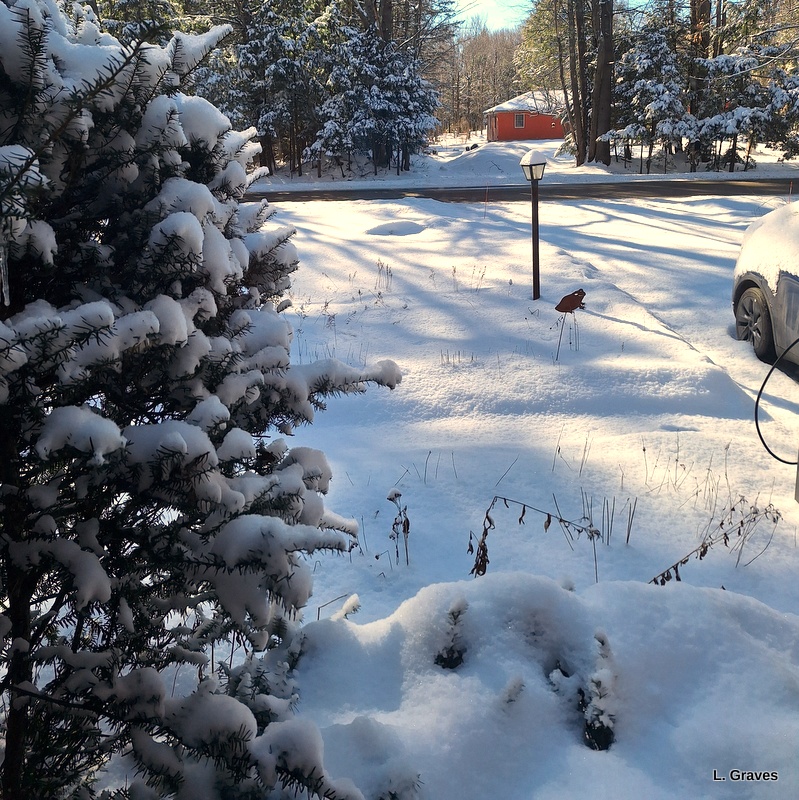
Northern woman that I am, I love the look of the landscape during a snowstorm, the way it is pared down to its essence in color, not quite monochrome but certainly muted. When there is a snowstorm—and to a certain extent in the winter in general—the landscape has a soothing quality that provides me with a much-needed rest from the exuberance of spring, summer, and fall. Yes, by the time dreary March rolls around, I am more than ready for the glorious burst of spring. However, from somber November through frozen February, I am grateful for the quiet that comes in late fall and winter.

Here are scenes from a recent snowstorm:

On a less soothing note…COVID is ripping through Maine, and the positivity rate is 18 percent, the highest it has ever been. (And to think that last June the rate was below 1 percent. Those halcyon days.) The hospitals are overwhelmed, and I’ve heard that beds with patients are lining the halls.

Clif, Dee, and I are hunkering down, grateful we’re in a position to do so. We are well aware not everyone is as lucky as we are. Also, we’re aware there is a high likelihood that we’ll all eventually come down with COVID, which probably will be circulating around the world pretty much forever.

However, we want to give the hospitals time to recover from the onslaught of patients. If I’m unlucky enough to have to go to the hospital because of COVID, I want a bed in a room. I do not want to be in the hall, tended by folks who are completely frazzled. I’m also hoping that sometime soon antiviral drugs will be readily available for an effective treatment. Finally, I am hoping that COVID will mutate to something that is more like a cold, unpleasant but not an unpredictable killer. In the meantime, I’m sticking close to home and wearing my KN95 mask when I go out.

Despite the nastiness of COVID, things could be worse. On a recent episode of the podcast Radiolab, I learned about the year 536 AD, when there was “A supervolcano. The disappearance of shadows. A failure of bread. Plague rats.” Holy cats, that’s a lot of bad things to deal with all together.

************************************************

Now, on to something more upbeatNifty posts from some of the lovely blogs I follow:

What could be better than a winter scene? How about one with a sunset and the red splash of a cardinal? On Cimple, a fabulous photo provides all three. 

From Whippet Wisdom, different kinds of listening and music. This post certainly made me smile.

For the biggest, most fabulous sticky bun, check out Touring My Backyard.

Thistles and Kiwis features gorgeous beaches and mouthwatering food. Oh, New Zealand!

Judy, at New England Garden and Thread, makes an excellent case for going south for the winter.


************************************************

I haven’t shared any music videos lately, and here’s a beauty—Yasmin Williams: Tiny Desk (Home) Concert

I’m an anxious person who lives in an anxious world. Williams’s soulful, cascading music never fails to make me feel tranquil, and lately I have started my day by listening to her. Also, note how Williams uses tap shoes for percussion. Clever, clever!

Grateful Not to Have Broken My Nose or Anything Else

Several days ago, when I went shopping with my daughter Dee, I fell flat on my face outside of Kohl’s.  I mean this quite literally. One minute I was upright, and the next minute I had pavement pressing against my forehead and mouth. The fault was mine; I wasn’t paying attention. When I came to the curb, I walked along as though it weren’t there. But it was there, and down I fell.

A woman came rushing over. “Are you all right?”

Was I all right? As Dee helped me to my feet, I tasted blood, but miraculously no teeth seemed to be broken. I felt my nose. That, too, was fine. As far as I could tell, nothing was broken.

“I think I’m all right,” I said. “Thank you.”

“That darned curb!” the woman said, making me feel a little less stupid.

Yeah, that darned curb! Why the heck is it there, right in front of the entry way?  What purpose does it serve? In the end, of course, I should have noticed the curb and stepped over it, but I appreciated the woman’s kind words.

Dee and I went shopping in Kohl’s. I was in a bit of a daze, but I followed her around, giving her advice for Christmas presents.

Afterward, we went grocery shopping, a grim event as my right knee was really starting to ache. By the time I came home, I could hardly walk. It seems I had sprained my knee.

Ever since, I have been one with the living room couch, where I can sit with my legs outstretched. I do have a cane, which has been a big help, and every day my knee continues to improve. Today I even feel well enough to sit at my desk and write this post of my woes. (Never fear. If my knee hadn’t improved, I would have gone to the hospital for X-rays.)

In the United States, we celebrate Thanksgiving tomorrow, and it is a time for feeling grateful. You can bet I am feeling grateful that when I fell on the pavement, I didn’t break anything. It still amazes me that all my teeth are in my mouth and that my nose wasn’t broken. And I feel nothing but gratitude for having such a sturdy body.

You can also bet the next time I go anywhere, I will be on the lookout for curbs.