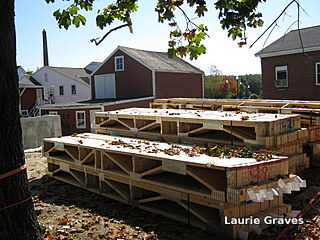
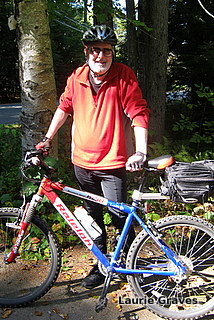
I took these pictures on Sunday, September 28 when Clif and I were out for our morning bike ride. The progress with the library addition is slow but steady and still very exciting to those of us who have worked hard on this project.
By spring, the new addition should be done. By spring, the library will have breathing room. I can almost hear old Bailey saying, “Ahhh!”
Last Saturday was Clif’s sixty-third birthday. This year, we decided rather than exchange presents for our birthdays—mine is in September, too—we would do special, fun things on each birthday.
The day of Clif’s birthday just happened to be such a beautiful, warm, sunny day that we could hardly believe it. By midmorning, the temperature was over sixty degrees, and by afternoon it was so warm that records were broken. As soon as we got up, we knew what we would do in the morning—go for a bike ride.
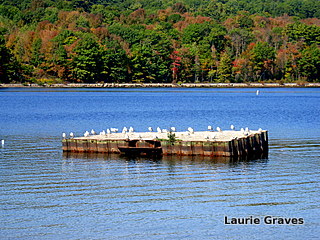
We went on our favorite ride by Lake Maranacook, where the sky was a deep, deep blue, and below it the lake shimmered in response. Across the lake, the trees were in their first blush of fall, and purple asters bloomed by the side of the road. There is not much traffic on Memorial Drive, the road that goes by the lake, and this, along with the beauty of the lake, is one of the reasons we like the ride so much.
Across the lake
We pedalled, pedalled, pedalled with the sun warm on our face. The miles just seemed to slide by without any great effort on our part. It was one of those “zen” rides where you are completely in the moment and in the landscape, with all thoughts of chores and what to do next pushed firmly aside.
In the afternoon, we met our friends Joel and Alice at the local cineplex to see The Boxtrolls, a stop-motion animated movie about, well, boxtrolls, little scavenging creatures that live below ground and come out at night to raid the trash that humans leave behind. They wear boxes—recycled, of course—and are despised and feared by the humans, who falsely consider the boxtrolls to be a dangerous threat. This fear and loathing leads to an eradication program—now that’s never happened in real life, has it?—and a boy whom the boxtrolls adopted must find a way to save them.
In The Boxtrolls, the animation is terrific, the characters are well done, and the storyline resonates with both children and adults. Two side characters—Mr. Pickles and Mr. Trout—nearly steal the movie. They come from a long tradition of sad-sack comedic tramps who question the meaning of life and the universe. Readers, if you go to this movie, do stay until the credits are over to see and hear one of the funniest exchanges in movie history. In fact, the four of us were laughing so hard that we missed some of the dialogue between Mr. Pickles and Mr. Trout, and we all agreed that we would need to see the movie when it came out on DVD so that we could watch the scene again.
We were probably the only adults in the cinema without children, but it didn’t bother us one bit. There were plenty of children in the audience to laugh loudly in all the right places, to make pointed comments about what was going on in the movie, and to even console one another when the action grew a little too scary.
After the movie, we all went to the pub The Liberal Cup, one of Hallowell’s hotspots, for some tasty, hearty food. Because it was Clif’s birthday, we even ordered dessert.
When we were done eating, Clif and I returned to our home, and it was still warm enough to have drinks on patio. As we sipped our rum and Cokes, we listened to the crickets sing, and on the nearby Narrows, loons called to each other.
“We won’t have many more nights on the patio this year,” I said, a little sadly.
“No, we won’t,” Clif agreed.
But we had that night, and we both enjoyed it very much. In fact, Clif pronounced that the whole day had been a very good birthday filled with simple pleasures.
On Wednesday, on MPBN’s show Maine Calling, the subject was sustainable seafood. While I made an apple pie, I listened with interest because lately I’ve been wondering if there is such a thing as sustainable seafood, and I was curious what the gist of the show would be. The program was hosted by Keith Shortall, and the guests were Jen Levin, Sustainable Seafood Project Manager, Gulf of Maine Research Institute, and Barton Seavor, chef and author of four cook books.
Shortall began the program by acknowledging that we “know some of the most popular fish are in trouble because of overfishing,” and much of the show revolved around encouraging people to turn to “underutilized fish” such as dogfish, Atlantic pollock, and whiting, all species that, according to Jen Levin, are flourishing.
When the question arose of what exactly sustainability meant in terms of seafood, Barton Seavor did recognize that one aspect involved promoting thriving, resilient species. But, and it’s a big but, he went on to state that “ultimately the measure of sustainability must fundamentally be measured by the ability of human beings to thrive.” Levin did add that a growing population needed to live within its means.
Now, I’m distilling an hour show into a post for a blog, and as such, I can only include snippets of what the guests discussed. Readers who are interested in this subject—sustainability and seafood—should listen to the podcast for a longer, more complete version of what Shortall and his guests actually said. However, not once during that hour-long show did I hear about the importance of abundant fish to the vast, interconnected chain of life in the ocean or of how quickly humans can change abundance to scarcity, even when fish seem to be plentiful.
For this we must turn to Sylvia Earle, author, marine biologist, former chief scientist of NOAA, and “National Geographic explorer in residence.” As Sylvia Earle eloquently puts it, “[T]he ocean is the cornerstone of Earth’s life support system, it shapes climate and weather. It holds most of the life on Earth. It is the blue heart of the planet.” (I must admit that I was surprised to learn that most of the oxygen in Earth’s atmosphere is generated by life in the sea. I thought that trees and plants had a much larger role.)
I am currently reading Earle’s book The World is Blue, where she clearly and beautifully explains the importance of the abundance of fish and other creatures to the health of the ocean and indeed the planet. Earle writes, “There is no surplus in a natural, healthy system. What appears to be overabundance to human observers is a natural insurance policy against population reduction by diseases, storms, ups and downs of predators and food supply…” and “[S]pecies do not live in isolation. They are integrated into exceedingly complex systems…the first fish to be taken from an unexploited population are the largest…the ‘old timers’…They are also the ones that produce the most offspring.”
So here are my questions: Does anyone know what a truly sustainable harvest of dogfish, Atlantic pollack, and whiting would be? Are we viewing them as so abundant that we think we can eat them on a regular basis? If so, is this a correct assumption?
Sylvia Earle indicates this is not the case at all. On NPR’s The BobEdwards Show, Earle said that she doesn’t eat fish and instead eats a plant-based diet. In a recent interview in The Guardian, Earle was asked, “What about eating fish sustainably? For instance, trading top predators for smaller fish?”
Earle replied, “I think that’s disastrous, really…. The large fish have to eat the small fish. We have choices; they do not…. And there’s another aspect as well. All fish are critical when you think of them as middlemen, because they consume phytoplankton and zooplankton, the little guys that the big fish cannot access….we shouldn’t take fish on a large-scale basis; there’s simply no capacity left to do this.”
Except for island nations that don’t have much of a choice, Earle believes that fish are wildlife that should be left in the ocean, Earth’s “blue heart,” from which most of our oxygen comes and has developed over hundreds of millions of years.
So, two opposing views. The first, espoused by Keith Shortall’s guests was that even though fish such as cod have been overfished, there are plenty of overlooked and underutilized fish in the sea to eat. And we should do so eagerly. The second, put forth by Sylvia Earle, is that the oceans are in such peril that we shouldn’t be eating fish and seafood on any kind of regular basis. Once in a great while, at the most.
Even though I love seafood and could eat it several times a week, I’m casting my lot with the marine biologist. Sylvia Earle has been studying the ocean for decades and has lived long enough to see the terrible degradation of the world’s oceans as we humans eat our way through the fish and other creatures that live in the sea.
For me and for my husband Clif, it will be mostly plants that we eat.
Last night, Clif and I went to a Winthrop Food Pantry supper for volunteers. Clif has taken pictures for the food pantry, and I have volunteered in various ways since 1997. Seventeen years! A long time, and I think there was only one other volunteer—Lee Gilman—who has been at the pantry longer than I have.
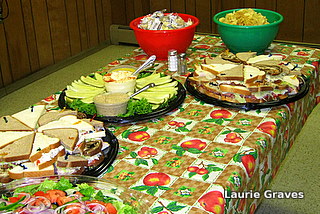
There was a good turnout—about thirty came to the supper. Unfortunately, the batteries in my camera went, and I didn’t think to bring extra batteries. Therefore, I only got a few shots of the event. Ah, well!
After we ate sandwiches, salad, and soups, JoEllen Cottrell, the executive director, and Mike Sienko, the president, spoke about the food pantry. Naturally, they thanked everyone for their hard work, which, astonishingly has come to 2,360 hours so far this year. (The food pantry has about fifty volunteers, and there is a sign up sheet so that the hours can be tracked.)
But there were more astonishing numbers to come. When JoEllen took over as executive director in 2011, there were about forty families per month that came to the food pantry. The sessions were leisurely, and often the volunteers had time to sit and chat between taking people around.
In three years, that number has tripled, and on average, 120 families come to the food pantry each month. The volunteers no longer sit and chat, and often the pantry stays open long past its closing time of 2:30 p.m.
As far as I know, there has been no increased publicity or effort to encourage more people to come to the food pantry, and it’s my guess that more people are coming because it has become increasingly difficult to make ends meet after the Great Recession. In Maine, good paying jobs are far and few between, and many people are still looking for work. While it’s great that the food pantry is around to help people in need, it’s sad that there are so many more people that need the help.
And here’s another number: Rick Dorey and his wife Sheila get food for the pantry at the Good Shepherd Food Bank in Auburn. Last year, they brought 70, 000 pounds of food to the Winthrop Food Pantry, and Rick told me that he expects to exceed that number this year.
The Winthrop Food Pantry provides food for Winthrop (population 6,200) and Wayne (population 1,189). Wayne is a more affluent community than Winthrop, but neither is what you would consider poor. Yet so many people qualify for receiving food from the food pantry. (The food pantry uses the federal guidelines.)
Numbers are one way of telling a story, and the numbers at the Winthrop Food Pantry certainly tell a compelling story of our times.
My actual birthday was last week, and at the beginning of the month, Shannon hosted a party for Clif and me. (His birthday is this Saturday.) However for the past five or six years, the tradition has been to have lunch in Portland with Shannon for a little extra birthday celebration, and we were joined by our friend Kate. (Naturally, we did the same for Shannon’s and Kate’s birthdays.)
Alas, our friend Kate moved to Pennsylvania and can no longer join us. (Thanks, Kate, for the delicious raspberry tea, which I am drinking as I write.) However, Shannon and I decided we would still like to meet for our birthdays, even though we will miss Kate very much.
Yesterday was the day that worked best for both Shannon and me, and our original plan was to have lunch at The Green Elephant, a Portland restaurant that specializes in tasty vegetarian food. But the forecast was so fine, so warm and sunny, that Shannon suggested, “How about if you come up a little early, and we’ll go for a walk on the beach?”
Now, there’s nothing this inland girl loves more than a walk on the beach, and I readily agreed. As it turned out, the day was as perfect as the forecast predicted, and as I was driving to Portland I thought, “Why not grab sandwiches somewhere and spend the whole time at the beach? There will be plenty of time for lunch indoors.”
“Sounds good,” Shannon said, when I suggested this to her at her apartment.
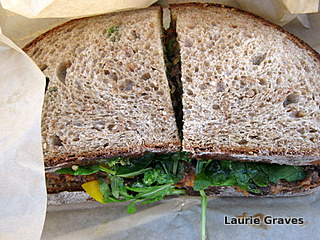
Unfortunately, we had to leave the dogs behind because Crescent Beach doesn’t allow dogs on the beach until October 1. But, we went to Scratch Baking Company, not far from where Shannon lives, and bought everything good that we needed for a picnic—sandwiches made with a spicy black bean spread, roasted peppers, a sunflower seed pesto, and mixed greens; drinks; chips; and a brownie and short bread. (That sandwich was especially good! I can still taste it.)
That black bean sandwich!
When we got to Kettle Cove, which has benches and is adjacent to Crescent Beach, there was a bit of wind. Actually, there was a lot of wind, and I parked the car so that it overlooked the ocean, just in case we had to eat inside.
“Shall we eat in the car?” I asked, watching the wind whip over the grass.
“No, let’s eat outside,” Shannon said. “We’re in all winter.”
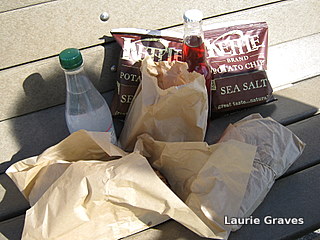
True enough. We set up on one of the benches, and the wind lifted our hair. It also tipped over Shannon’s drink and spilled some of it on the ground. No sooner had she righted the drink, then our chips flew off the bench, and our pastries followed not long afterwards.
The line-up, before the wind created havoc
“Do you want to eat in the car?” I asked again.
“That might be a good idea,” Shannon said, and we both laughed as we thought about the flying chips and pastries and the spilled drink.
In the warm, wind-free car, we ate our lunch, watched the waves curl and break on the rocky shore, and talked about many things, including the excellent Ken Burns documentary about the Roosevelts.
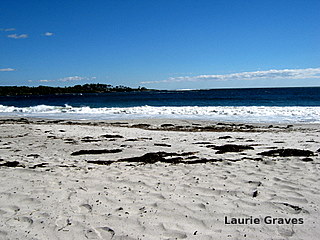
After lunch, we went for a walk on the beach, where the wind was only a gentle breeze, and the sun was so warm we had to take off our jackets and tie them around our waists. We walked to the state park, where we sat on a log on the beach, watched more curling waves, and, of course, talked about matters large and small.
The view from the log
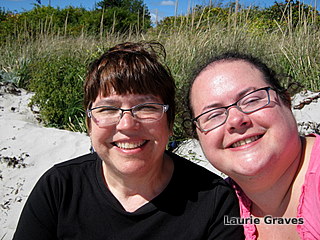
As is our tradition on birthday outings, we took a selfie.
The two beach lovers
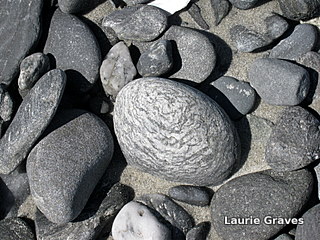
Such a lovely day of simple pleasures—I found a round rock speckled with mica to add to my collection on the kitchen window sill. In fact, it was a finest kind of day, and I want to do exactly the same thing next year, if the weather allows.
Today, in New York City thousands and thousands of people walked in the People’s Climate March, a coming together of organizations and individuals to protest the inaction on climate change. Oh, how Clif and I wanted to go, but for a variety of reasons we had to stay put at the little house in the big woods. In our opinion, climate change is the biggest issue of our times, and while the world heats up, our leaders fiddle and fiddle. Instead of putting money, energy, and resources into solar and wind power, the powers that be foolishly and destructively continue their quest to extract as much fossil fuel as they can from rocks, from tar sands, from mines, and from the ocean.
Clif and I might not have been able to participate in the People’s Climate March, but we watched some of it live, courtesy of Amy Goodman andDemocracy Now! As Goodman noted, this is the largest climate march in history, with “people as far as the eye can see.” And indeed there was an incredible stretch of people up and down the street. Many of the people looked like everyday folks—running the gamut from very young to quite old. Of course, there were some exotic folks, too, dancing in gauzy costumes and doing their best to look like Stevie Nicks in her younger days. U.N. Secretary-General Ban Ki-moon marched, and so did the actor Mark Ruffalo. Ditto for Al Gore and Leonardo DiCaprio.
To get to this historic march, people walked across the country or took the Climate Train. Some even biked. Bus loads came from Maine, and, I expect, from other parts of the country that were vaguely within driving distance of New York City. Meanwhile, there were similar events in England, Germany, and many other countries.
Amy Goodman, normally quite reserved, had clearly caught the spirit of the climate march. “Something is coalescing,” she said, and there was a decided sparkle in her voice. “There is a turning of the tide.”
Oh, we hope so. This problem is so big that it needs to be addressed at all levels—from government policy to individual action. Clif and I try very hard to do our part—by buying as much local and organic as the budget will allow, by combining errands so that we don’t drive unnecessarily, by not overconsuming. But there must be structural changes as our society turns from using fossil fuels to using renewable energy, and our leaders must initiate those changes.
In honor of the People’s Climate March, we decided that today would be a no-car day. We took the dog for a walk to the Narrows, where I snapped some pictures of leaves just beginning to turn. The day was overcast, with the sun breaking through here and there, making the water glimmer.
I was reminded of a sign we saw in the People’s Climate March: “A good planet is hard to find. Let’s save this one.”
Yes, yes.
Addendum: According to an article from Reuters, posted after the event, there were 310,000 people at the Climate March in New York. No wonder Amy Goodman was so enthusiastic!
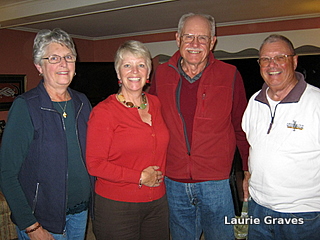
Pearl Ames, Lisa Jepson Wahlstrom, George Ames, and Billy Wing
Last night, the library expansion team gave a farewell party for Lisa Jepson Wahlstrom. She is the founder and principal of Ovation Fundraising Counsel, an organization that works “with nonprofit organizations throughout Maine helping them to increase their fundraising capacity, engage their constituencies, and strengthen their volunteer base.”
For the past few years, Lisa has worked with us on the library’s expansion campaign, and it’s no exaggeration to state that we couldn’t have run a successful expansion campaign without Lisa’s expertise, organization, firm guidance, and good cheer. We have had our ups and downs, but Lisa was always upbeat and encouraging, patiently leading us toward our goal—the addition.
However, the time has come for the expansion team to strike out on its own. As Lisa put it last night, we have about $150,000 left to raise, and we know what to do—more grant writing, more fundraising events, more appeals for donations. We also have a wonderful campaign team, and as we said our sad goodbyes to Lisa, I got a strong sense from the other team members that they would continue to help with the campaign, and a good thing, too. We certainly need them.
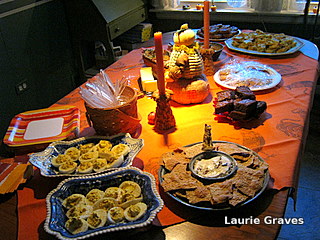
Where there is a party, there is food, of course, and the campaign team not only loves libraries but tasty food as well. We put on a pretty good spread, if I do say so myself, and there were lots of yummy tidbits—deviled eggs, artichoke squares, spinach balls, a hot cheese dip, and other good things to eat. I brought my homemade crackers and a rosemary-olive cream cheese spread.
Joan and Bill Wing generously agreed to host the party at their home overlooking the lake. They have a large living room with a lovely view of the water, and while we ate and talked, the water rippled and sparkled as the sun set.
Naturally, the conversation revolved around libraries—their importance in today’s society despite the dominance of computers, big and small. As I mentioned in a previous post, people are still reading books. The love of story runs deep in our species, and while I hope paper books endure—nothing can replace their feel and smell—I have no doubt that as long as there are people, there will be stories.
And there will be libraries—the repositories of information, ideas, and stories—available to all who live in a town, area, or city. You don’t have to be rich to have a library card. You don’t have to come from a prominent family. Libraries are for everyone, and as such they couldn’t be more vital to our society.
The picture for this post was taken on Sunday, September 14. With all the blue, the library’s new addition reminds me of a huge, very deep pool.
I’ll be biking into town today to do several errands, and one of them will be stopping by the library to see how the addition is progressing. If there are any changes, I’ll take pictures and post them in a day or two.
Last night, I went to book group, where we discussed Louise Erdrich’s The Round House, a story about Joe, a young Native-American teenager, and how he deals with his mother’s rape. (For readers who haven’t read this book, I don’t want to give too much away, but I do want to note that there was a lively discussion about Joe’s solution.)
There were eighteen (or so) of us at book group, and for an hour and a half, we discussed The Round House. There was some disagreement, especially with me as I argued that I thought Joe and his friends were too young to do some of things they did. This was hotly contested by those in the group who have sons. Even though I remained unconvinced, it was fascinating to hear the various points of view.
Also, what a thrill that so many people read The Round House and came to book group. Another example of the power of story and books, which despite what some people might think, have not gone the way of the dodo. Despite all the distractions of modern life, people are still reading books. Last Sunday, on NPR’s WeekendEdition, there was even a piece about the millennial generation—those under thirty—and their love of reading. Here’s how the story, by Lynn Neary, starts: “As it turns out, the generation that has grown up in the age of technology has a fondness for a very old-fashioned habit – reading.” A story to warm my heart, that’s for sure.
But back to book group…the leader—Shane-Malcolm Billings, the adult services librarian at Bailey—is also very important. Shane sets the tone, giving background information about the author, making sure that everyone has a chance to talk about the book, and generally keeping the group on track. His love of books is so strong that it just shines forth, warming everyone in the group.
Last night was the fourth anniversary of book group, and I have been a part of this group from the beginning. Shane compiled a list of all the books we have read in the past four years, and what an impressive list! The titles include The Lonely Polygamist, Cutting for Stone, GreatHouse, Major Pettigrew’s Last Stand, When We Were the Kennedys, Home, and The Good Lord Bird.
Many thanks to Shane for leading this group, for all his hard work, and especially for his deep love of books.
Yesterday, Farmer Kev delivered the last of the summer CSA vegetables, which were actually fall vegetables—potatoes and a variety of squashes, all things Clif and I really love. However, my heart was not too heavy over this last delivery as Farmer Kev, for the first time, is expanding his CSA into the fall and winter.
Kevin and his trusty band of workers—some paid, some just helping out because they want to see Farmer Kev make a go of it—have been busy blanching and freezing vegetables for the winter CSA. In addition, there will be root vegetables—carrots, potatoes, beets, and squash—delivered until February.
Clif and I are signing up for the winter CSA, and we are doing it for a number of reasons. First, and foremost, Farmer Kev is one of our favorite farmers. We’ve known his family since he was very young, and what a pleasure it has been to see Kevin become a dedicated and hard-working farmer. This reason alone would be enough.
However, close behind comes the value of Farmer Kev’s CSA. His vegetables are fresh and organic and delivered. There is no way I could buy the equivalent for the same price at a farm stand. Again, this reason alone would be enough.
Finally, there is the larger picture—where our vegetables come from and the miles they travel. In grocery stores, many of the fruits and vegetables come “from away,” really far away, as in California, which over the years has become the country’s agricultural hub. Now, I am grateful for all the bounty that comes from California, and I am especially grateful for the labor of the underpaid workers who harvest the fresh vegetables and fruit.
But there is the little problem of climate change—actually, a big problem, one of the biggest yet. It takes a great deal of energy to transport those vegetables across the country, and there is a lot of carbon spewed into the air as a result.
However, there is something equally alarming to consider, and that is the drought in California. According to that state government’s website, “With California facing one of the most severe droughts on record, Governor Brown declared a drought State of Emergency in January and directed state officials to take all necessary actions to prepare for water shortages.” (For some horrifying pictures of before and during the drought, click here.)
No one can see the future, of course, but what if the drought continues? What if California stops producing so much bounty? How will we eat? What will happen to prices, which have already risen 40 percent over the last fourteen years? These questions should worry all of us.
Maine and indeed New England is blessed with abundant rainfall. Sometimes too abundant, as those of us who want to be outside in the summer like to grumble, but really we have no cause to complain. Most of the time we get the right amounts of rain to produce bountiful crops, and this year, in particular, is bursting with tomatoes, one of my favorites.
With careful, mindful, and prudent land management, Maine could grow a lot more of its food. (Once upon a time, in the mid-1800s, Maine was even considered the breadbasket of New England.) Sometime soon, if the drought in California continues, we might very well have to grow more of what we eat. But—and it’s a big but—the infrastructure to do this can’t happen overnight. Fields must be cleared, soil must be fertilized, and people need to learn the art of farming. One isn’t born a farmer. It requires years of study—formal or informal—and lots of hard work.
Supporting Farmer Kev, and other farmers as well, feels like, well, an investment in the future of food in Maine and New England. This might sound like overstatement, but I don’t think it is. In the years to come, we might be extremely grateful that so many young farmers have decided to settle in Maine, and right now, we should support them in whatever way we can.
And, that readers, is reason enough to join Farmer Kev’s CSA or any other CSA, or that matter.
A blog about nature, home, books, movies, television, food, and rural life.






 Notes From the Hinterland