All posts by Laurie Graves

I write about nature, food, the environment, home, family, community, and people.

Vegetables with Peanut Sauce over Rice—and a Blooper

Before I launch into a description of this week’s recipe using Farmer Kev’s delicious vegetables, I thought I would describe a little blooper I made in the kitchen last night. All right, it was actually a big blooper. I am sharing this because I believe it’s good to admit that even those who have been cooking for a very long time can still make mistakes. (So take heart, beginning cooks!)

Here’s what happened. I had marinated tofu. I had pea pods courtesy of Farmer Kev.  Why not stir fry them together, put them on rice, and drizzle a homemade peanut sauce over it all? Then, of course, sprinkle with crushed peanuts. This I did, and how nice it all looked.

IMG_0610

There was just one teensy-weensy problem, which Clif and I discovered as we started eating.

“Wow!” I said. “These pea pods are tough.”

“I was thinking the same thing,” Clif admitted.

“And they don’t have much taste,” I added.

Then it immediately came to me what the problem was. These weren’t sugar snaps; these were peas to be shelled. Oh, how we laughed at Laurie’s mistake as we stopped eating to shell the slimy pods. Miraculously, even though the pods had only been lightly blanched, the peas inside were cooked enough to eat.

After the peas were shelled, the dish was pretty darned good, as my Yankee husband observed. So good that there weren’t any leftovers, even though there should have been. (Clif is what you might call a good eater, especially when peanut sauce is involved.)

Blooper aside, this dish, like fried rice, is wonderfully versatile. A variety of summer vegetables could be used: Broccoli, zucchini, summer squash, green beans, carrots. Shelled peas or sugar snaps, but probably not both.

I marinated extra-firm tofu in a homemade teriyaki sauce, baked it for 45 minutes, then cut it in cubes to stir-fry. This might be one extra step that a busy home cook would rather not take. Although the marinated tofu adds a nice texture and taste to the dish, it is not an essential element. Just vegetables could be used. Leftover chicken could be added.

The vegetables could be steamed or stir-fried. If stir-fried, then chopped garlic or onion could be added for additional flavor.

So this week, I’m not going to give a recipe per se. Just cook up some rice, steam or stir-fry some vegetables, drizzle with peanut sauce, and sprinkle with crushed peanuts. And for goodness’ sake, don’t confuse sugar snaps with shell peas.

Here is a recipe for the peanut sauce. It’s adapted from a recipe from Miserly Moms: Living Well on Less in a Tough Economy.

Ingredients

  • 1/2 cup of peanut butter
  • 1/2 cup of warm water (Use less for a thicker sauce)
  • 3 tablespoons of soy sauce
  • 1 tablespoon of vinegar—wine, cider, or rice
  • 1/4 teaspoon of hot pepper flakes (More could be added for those who like it hot.)

Directions

  1. Whisk together the peanut butter and water until smooth.
  2. Add the soy sauce, vinegar, and hot pepper flakes. Whisk again.
  3. Drizzle over vegetables and rice. Drizzle over vegetables and noodles. Use as a dipping sauce for chicken. This simple but tasty sauce can be used in a number of ways


Jurassic Park in My Front Yard

IMG_0448“Hostas can be difficult to work into a garden because they have a tendency toward pride, a self-assertion that can be offensive….they seem so much more physical than other plants, muscular: the heavy-weight champions of the garden.”
—Stanley Kunitz, The Wild Braid

I know what Stanley Kunitz means. I have a patch of hostas that have gotten so out of hand that it looks like Jurassic Park in the front yard. The hostas are elbowing the daylilies, which aren’t exactly slouches, and I have to pull back the hostas from time to time to give the daylilies some breathing room. I should divide the hostas, but I’m not sure where I’d put the divided plants, and I’d hate to just throw them out. Kunitz decided not to plant anything else with his hostas. That way, they could muscle each other. A smart decision, I think.

IMG_0460
Jurassic Park in the front yard

************************************************************************

When I’m sitting on the patio, I always sit closest to the bee balm, right now in glorious bloom. Bees are indeed buzzing among the flowers, and I try to take a picture of them with my little point-and-shoot camera. I am not very successful. They’re not called busy bees for nothing. Bumble, bumble, yellow and black. They seem so slow yet they never really rest. (That might be a description of me as well.)

Not too bad but not in focus
Not too bad but not really in focus

Hummingbirds are also drawn to the bright red flowers, and it’s even harder to get a picture of them. I’m not sure why I keep trying. I know the limitations of my camera, wee wonder that it is. But when those tiny will o’ the wisps are thrumming almost within arm’s length of me, somehow I can’t resist. A couple of times, a hummingbird has stopped in mid-flight to consider me, but only for a few seconds. Not long enough for me to get a good picture.

Fortunately for me, the flowers and plants stay in one place unless there is a brisk wind.

*************************************************************************

Right now, my backyard garden is in peak bloom, and we had friends over for cocktails on Saturday. The weather was good enough for us to spend the entire time on the patio, where they could admire the flowers. Clif made his legendary grilled bread, and I made Maine mules.

Summer, summer, summer.

An End-of-July Contest: Three Sets of Three Library Cards

I follow a delightful blog called Mrs. Walker’s Art and Illustrations, where Johanna, who is originally from the Netherlands, writes about the beauty of everyday things. She is an artist, and she often features her own illustrations, which are both whimsical and down-to-earth, an utterly charming combination. Johanna also knits, and recently she featured three give-aways on her blog—a hat, a tea cozy, and a blue shawl.

As soon as I read her post, I knew I wanted to feature my own give-away. Like Johanna, I believe that it is good to give, and in everyday life, I make it a habit to give regularly. Our modest budget does not allow for extravagant giving, but I frequently give photo cards and baked goodies to friends and acquaintances. We also invite friends over for gatherings, which I view as another form of giving.

I must admit that I do not always find it easy to give. When money is tight, it is difficult to think of others. When I am busy, I often don’t want to take the time to give to others. But I give anyway because I think it is good spiritual practice.

In the end, to let go and to give is always worthwhile.

So here is my give-away: Three sets of three library cards—your choice of cards. My husband Clif took the pictures in our own dear Bailey Library. I found the quotations and paired them with the pictures.

In the comments’ section, all  you have to do is tell me you want to enter the contest and which three cards you would like.  The drawing will be held on August 10.

Here are the pictures for the cards:

IMG_8969

IMG_8965

IMG_8955

IMG_8934

IMG_8933

A final note, which qualifies as the cherry on the sundae: I won the beautiful hat that Johanna knitted, and I am so pleased. I don’t have many hats, and Johanna’s hat will be a most welcome addition. Maine has lots of cold weather, and when I wear that hat, I will think of Johanna and her generosity.

A Victory Party

Last night, Clif and I went to a victory party to celebrate the expansion of the Charles M. Bailey Library. It was a potluck—my favorite kind of party—hosted by Pearl and George Ames, two members of the campaign team.

The lovely backyard where the party was hosted.

The food, of course, was delicious, and I ate way more than I should have. I even indulged in a hamburger, and I can’t remember the last time I ate beef.  We don’t eat it at home, but if we go to somebody’s house, and beef is served, then we will eat it. I must admit that hamburger tasted mighty good.

But better than the food—and you can bet this foodie never thought she’d be writing that anything could be better than food—was the spirit of the campaign team. There are about fifteen people in the core group, women and men who not only love the library but who have been willing to work hard to make the addition a reality. And it was very hard work. To raise a million dollars in a town of six thousand people is not easy, especially when the town is a middle-class community—a macaroni-and-cheese kind of town, as I like to call it.

In the process of working together for over three years, of facing and overcoming setbacks, something rather wonderful happened. We have bonded together as a team and have become completely comfortable with each other. It doesn’t always work that way, and what a blessing when it does. It also goes to show what people can do when they work together, when they put time and energy into a project. This energy can be such a force of good when directed toward the right cause.

And the library expansion was most definitely a right cause. The other day, when I returned a movie, I looked around. In the reading area with its blue chairs and barn-board table, a man was reading the paper, and a woman was reading a book. Nearby, at the computer tables, there were few empty seats. People talked quietly together, and the library was filled with a happy sound. In the stacks, patrons looked for books. Bailey Library has always been an important part of this community, but now, with the expansion, it is truly the center of the community.

At the party, I chatted with various team members. I learned that Roger had been in the Peace Corps, and French was Bob’s first language. I talked about painting and art with Penny while my husband discussed biking with her husband.

As Mary Jane, the chair of the trustees, put it, “Along with helping to raise money for the new addition, I also made such good friends.”

How glad I am that I have come to know and work with these people, to call them friends. And how proud I am of what we have achieved together.

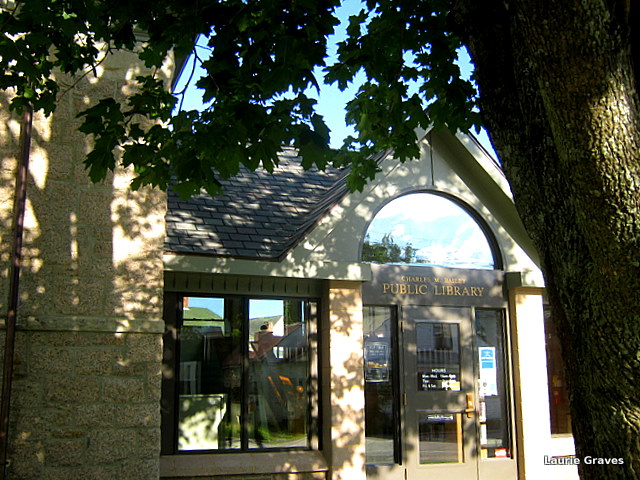
The entrance to our expanded library


Mediterranean Scrambled Eggs

The greens are still a-comin’, but we are going to turn our attention to another vegetable that can sometimes be such a nuisance that friends will run shrieking if they see you approaching with a bagful. Or a bushel full, as the case may be. This might be apocryphal, but I have heard heartbreaking stories of how these vegetables are just abandoned on the steps of family, friends, acquaintances, and even perfect strangers. Sometimes with a note, most times not.

I am, of course, referring to zucchini—or, courgettes as they are called across the pond. Right now, in Maine, they are little and trim, almost sweet looking, and this week they were innocently tucked at the bottom of my CSA bin from Farmer Kev. But before long, in the garden, these sweet little veggies will grow and grow and if left untended on the vine, become large enough to be used as a murder weapon.

And let’s be honest. When it comes to taste, zucchini is definitely the bland cousin of the vegetable world. (Perhaps that’s why they grow so large. To compensate for their muted flavor.) While peas, corn, tomatoes, and delicata squash make us rejoice, all too often zucchini makes us sigh.

Nevertheless, zucchini has its uses. Grated, it adds a nice texture to muffins or bread, and its mild flavor complements tomato dishes. Last but certainly not least, zucchini is very economical. As indicated above, sometimes you don’t even have to pay for it.

While the zucchini is still in its slender, innocent phase, I decided to take what business people might call a proactive approach and find ways to use those little darlings.

I wondered, what if you grate a small zucchini, add some garlic, sauté the mixture in a skillet for a couple of minutes, add eggs beaten with milk, and sprinkle with basil? Scramble the whole mixture, then cover with grated cheese. What would happen?

I’ll tell you what happens. You get a dish so tasty your Yankee husband not only says “Pretty darned good” but also adds “This would make an elegant dish for brunch.” Now, how many times have you ever heard the word “zucchini” paired with the word “elegant”?

Best of all, despite the chopping, this dish goes together fairly quickly, making it a perfect week-night supper. Add some homemade bread and some sliced cucumbers. Maybe even a white wine with a fresh taste. (Don’t even consider a Riesling.) Not only will you have made use of zucchini, but you will also have a delicious meal.

Note: Fresh basil is absolutely essential for this dish. If you don’t have some growing in your garden or in a pot, then spring for it at the grocery store or at a farmers’ market.

As with all dishes, get everything mise en place.


Sauté the grated zucchini and garlic in olive oil.


Add the basil and the beaten eggs.


IMG_0370
Scramble.


Sprinkle with grated cheese and cover.
Sprinkle with grated cheese and cover so that the cheese will melt.


Voilà! A dish so good you'll want to lick the plate.
Voilà! A dish so good you’ll want to lick the plate


Mediterranean Scrambled Eggs
Makes two hearty servings

Ingredients

  • 1 cup grated zucchini
  • 1 cup grated cheese (I used a sharp cheddar)
  • 2 tablespoons of minced basil
  • 1 clove of garlic, finely chopped
  • 4 large eggs beaten with 1 tablespoon of milk
  • 1 tablespoon of olive oil
  • Salt and pepper to taste

Directions

  1. On medium, heat olive oil in a skillet. Sauté the garlic and the zucchini for two or three minutes.
  2. Add the beaten eggs and the basil.
  3. Sprinkle with salt and pepper.
  4. Scramble away.
  5. When the eggs are done, sprinkle with grated cheese, cover, and turn off the heat. Let set until the cheese is melted.
  6. Serve and eat immediately.

Charting Your Own Little Territory

On Sunday, we had cocktails on the patio with Jim, an acquaintance who lives nearby. He’s a regular reader of this blog, and for quite a while, we’ve been wanting to  have him over for drinks and a chat.

We talked about many things, but I had to laugh when he noted that on my blog, I can get so much material from a walk down the road to the Narrows. This was an interesting coincidence  because lately I have been reflecting on my little territory, and how I map it with observation, words, and pictures.

But first things first: I am an extreme homebody. For me, home is best. When the weather is warm, my backyard is one of my favorite places to be. Even though we only own an acre of land, our home abuts a watershed for the Upper Narrows Pond, and this watershed comprises 2, 729 acres,  or 4.26 miles. This land is protected, closed for development, which means nobody can build on it. While we do have neighbors, we are essentially surrounded by woods. (I don’t call this place the little house in the big woods for nothing.)

The front yard, surrounded by trees


The backyard, even more surrounded

So my prime territory is my own yard, an acre that seems  much larger because of the watershed. Almost every day, with camera in hand, I patrol the yard. No matter the season, something is always going on, and it never gets old for me. From the budding trees to the blooming flowers to the falling leaves to the snow—and sometimes we are positively buried in it—it is a cycle that fascinates and delights me.

Flowers, flowers, flowers

Then there is the Narrows Pond Road. From my driveway, if I turn left, I will walk to the Upper and Lower Narrows, two bodies of water large enough to be considered lakes and lovely any time of year. The walk to the Narrows is a wooded walk, and through the trees I can see remnants of old stonewalls, a reminder that once upon a time, this land had been cleared of trees and was open farmland.

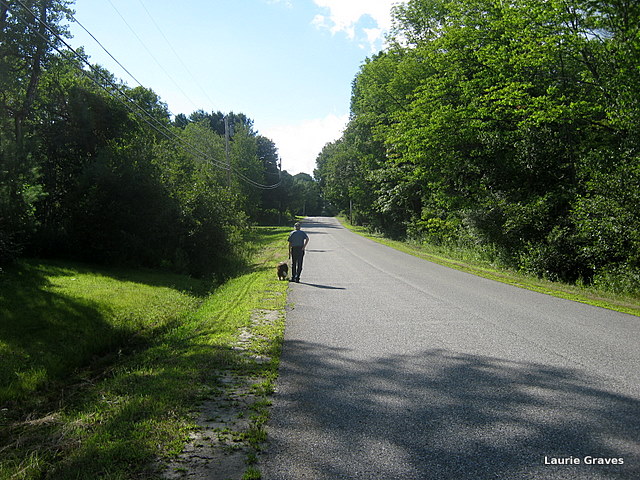
The road to the Narrows

If I turn right, I walk up to the fork, and there are still plenty of trees, but farther up the land is more open, with fields, houses, and a few apple trees leftover from when there were orchards on this road. There’s also a little swamp, quite near our house, and in the spring the peepers’ song is loud and beautiful.

The road to the fork
The road to the fork. The swamp is just beyond the clump of trees on the left.

From the Narrows to the fork it is about one-half mile, and this, combined with my acre yard, is my usual territory. Four days a week, I am home without a car, so it’s a good thing I am  fascinated and absorbed by the plants, the birds, the insects, the water, the fields, the sky, and the weather. I feel as though I could live here for a hundred years and never really know this acre, this half mile of road.

A wing found in the backyard

Sometimes, of course, I venture farther. Once or twice a week I go to the library in town, about a mile away. My husband and I go on five-mile bike rides. We go to potluck dinners, usually in town. Occasionally, we visit a friend in Brunswick or our daughter and son-in-law in Portland. Once in a while, we even visit our daughter in New York.

But mostly I stay home.

Always, it seems, qualifications are necessary, and so I will qualify. There is value in seeing and photographing areas far from home. The road calls to many people, and traveling can be broadening. As my mother might have said, it changes the mind. (French was her first language, and this is a literal translation from a French phase. I expect it really means that travel broadens the mind.)

But I also think there is value in charting your own little territory, observing what happens in your yard, on your road, in your town.  It seems to me that through this close mapping, a deep love can develop for the place that you live, whether it’s town, city, or country.

When you come to love a place and become intimate with it, then the chances are high that you will work to take care of it, to preserve it. Or, as in the case of Winthrop’s expanded library, even work to improve it.

And this can only be a good thing.


Starting the Weekend with Shakespeare

IMG_0263On Friday night, Clif and I went to the annual Friends of Bailey Library book sale. This was a special preview night—tickets cost $10 per person—and the actual sale was on Saturday. Clif and I are what might be called “frugal weirdos”—to borrow a term from the blog Frugalwoods, but we considered the $20 money well spent.

First and foremost, the money went to a very good cause. The Friends do so much to help the library. Thanks to the Friends, the children’s section of our library is a magical place filled with soaring wooden planes and giant stuffed animals. And this is just one example of the many things this group does for the library.

Second, and nearly as important, it was much less hectic to look at books on the preview night. In Maine, book sales are usually mobbed, and as I am claustrophobic, these sales are not always a pleasant experience. It is hard for me to look for books when I am hemmed in by people.

The preview sale was pleasantly full. There were people, many of whom I knew (this was another plus), but not so many that it was impossible to look at books.

Because we are frugal weirdos, Clif and I view book sales as an ideal place to shop for Christmas and birthday presents. We do have strict guidelines. Unless the book is rare or special in some way, it must be in mint condition. This brings us to another advantage of going to the preview sale—the books had not yet been picked over, and there were lots of good finds. We bought presents for five people, and even with the price of the tickets, we spent only $28.

Naturally, along with looking for presents for those we love, I did a teensy bit of looking for myself, and I am happy to report I hit pay dirt. I found A Year in the Life of William Shakespeare by James Shapiro.

Along with being a frugal weirdo, I am also a fool for Shakespeare and have been since seventh grade, when my English teacher had us read The Merchant of Venice. I can still remember how dazzled I was by the language. I couldn’t believe anyone could write so beautifully, and while there was much I didn’t understand, I understood enough to know I would be hooked on Shakespeare for life.

Accordingly, I have a collection of books about Shakespeare, and I am always glad to find another one to add to the shelf, especially when I get that book—a hard cover—for $1.  A Year in the Life is in very good condition, and the cover price is $27.95.

In the library’s new conference room, iced tea, lemonade, brownies, and cookies were served. As I drank iced tea and ate a brownie, I spread my books on one of the long conference tables so that I could decided which books to buy and which books to leave for someone else. People I knew came in to have refreshments, and naturally we chatted. Some people I didn’t know came in, and being a friendly introvert—yes, it is possible to be both—I chatted with some of them, too.

All in all, a terrific night. Next year, Clif and I will definitely be going to the book sale on preview night.

Lessons from My Garden

So far, in Maine, this summer has been nearly perfect. Warm and hot during the day, cool at night, and just enough rain for the plants and flowers to flourish. Oh, I could take nine months of this. I know. I live in Maine, where it is downright cold much of the year. Perhaps that’s why summer here is so sweet?

My front gardens, with their profusion of evening primroses, come into their own the end of June and the beginning of July, when everything is an exuberant burst of yellow. However, all good things must come to an end, and so it is with the evening primroses, which are nearly done blooming. There are other flowers to look forward to—black eyed Susans and daylilies—and the hostas and ferns hold everything together, but for the front yard, the peak is over.

It is now up to the hostas and ferns to hold everything together.

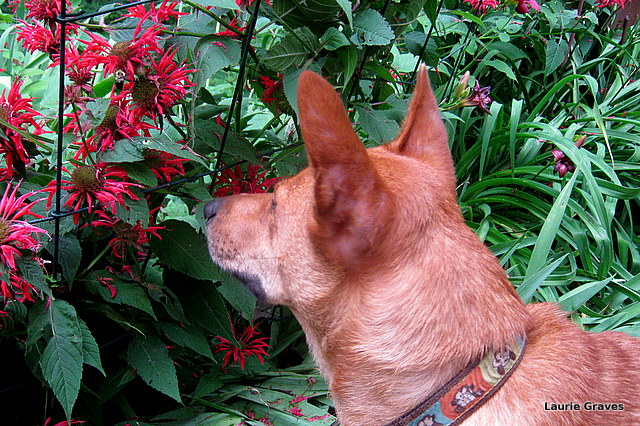
On the other hand, the back garden is just coming into its own. The Bee balm is in glorious red bloom—I can’t stop taking pictures of it—and soon there will be a profusion of especially lovely daylilies to join them. There will, of course, be more pictures.

The backyard coming into bloom.

I like to joke—well, maybe it’s not such a joke—that I have the worst yard in Winthrop in which to garden. There is shade galore, and much of it—especially in the front yard—is dry. Thirty years ago, we bought this house for other reasons—the price, the woods, the roominess despite its small size. It was our first house, and I hadn’t yet been bitten by the gardening bug.

However, after a couple of years here, I was bitten. Hard. I was young, I was strong, and I began digging like a fool. I planted willy-nilly, with little regard for the conditions.  Let’s just say that there was plenty of heartbreak and loss. What I wanted was a blooming cottage-style garden. My yard had other ideas, and I wasted a lot of time, energy, and money before I came to my senses. In retrospect, I realize that I should have put raised beds in the front, which would have helped with the dry shade.

But, as the saying goes, we grow too soon old and too late wise. The gardens are dug, and I don’t have the energy or the resources to replace them with raised beds.

I have finally followed the advice of a friend who is an accomplished gardener. “For God’s sake, Laurie, plant some hostas.” This I have done. They are thriving in the dry shade, and they look cool and elegant until the slugs munch them to ribbons. I’ve also planted ferns, which are lovely. But, oh, my heart aches for hollyhocks and roses.

In the backyard, I am happy to report that I learned from my mistakes in the front yard, and the large garden along the patio is indeed a raised bed. There are only six hours of sun in that garden, but I can grow irises, bee balm, and daylilies. Phlox does well, too.

This might sound a little woo-woo—to borrow from my friend Susan Poulin—but the garden has taught me lessons. That is, conditions are not always ideal.  We might want hollyhocks and roses, but instead we get evening primroses and hostas. Yet, in what we get, there can be creativity, value, and even beauty.

More photos from my mid-July garden.

A winged visitor.
A winged visitor
Another little guardian of the garden.
Oh, bee balm!
Oh, bee balm!
IMG_0139
Black and white against green.