All posts by Laurie Graves

I write about nature, food, the environment, home, family, community, and people.

Let It (Not) Snow

Today, on April 26—the anniversary of my mother-in-law’s birthday (1918) and the town of Winthrop’s incorporation (1771)—at 11:00 a.m., I looked out the window to my backyard. And what should I spy? Snow, snow, and snow. Enough to get my hair wet as I took a picture of the patio table. Enough to frost the herbs and trees.

Snow on the patio table and chairs


Snow on parsley
Snow on parsley


But not enough to stop the cavorting squirrels and their hanky panky. (The female squirrel certainly doesn’t make it easy for the male. You go, girl!)

The snow will not last long, and it will bring much needed moisture to what has so far been a dry spring. But still, snow in April is about as welcome as rain in January. Each in its own time.

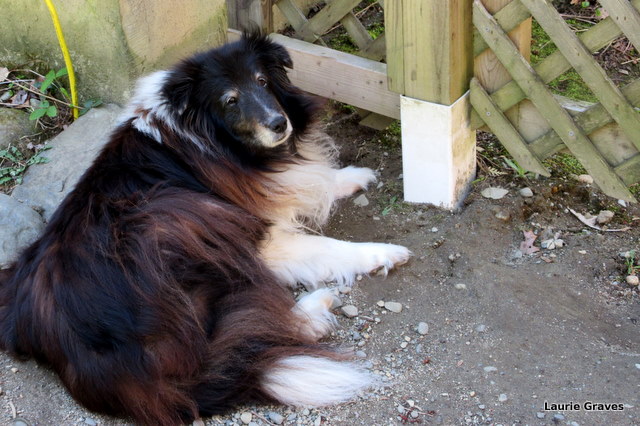
Liam, dog of the north


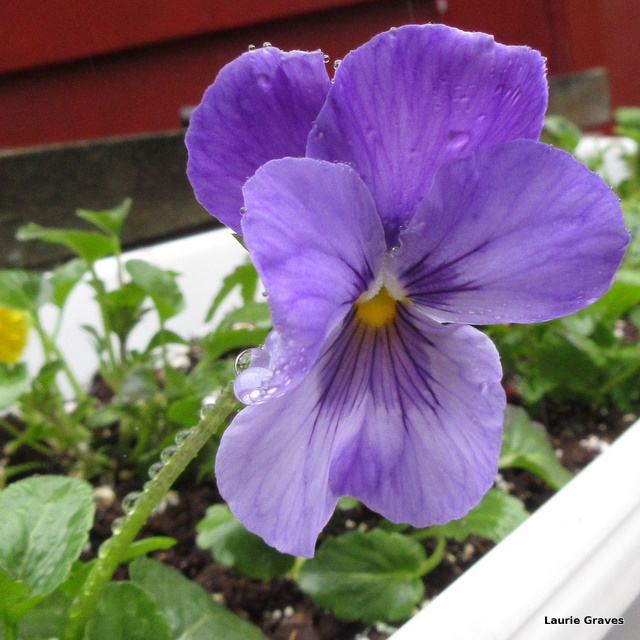
Poor little pansy
Poor little pansy


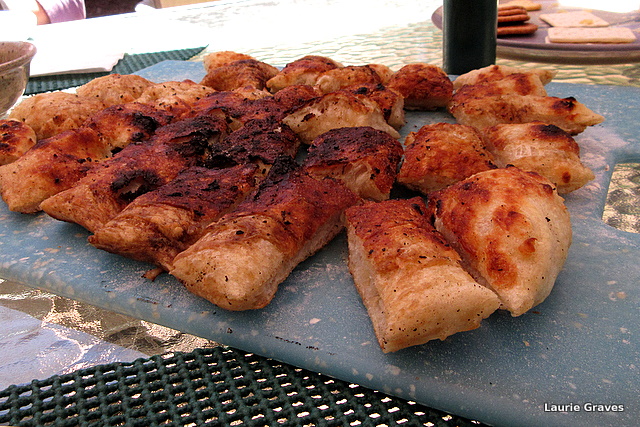
For supper, I’ll be making chickpea and chicken sausage soup as well as a batch of biscuits to go with it. As I eat the hot soup, I’ll be thinking, “Snow, snow, go away!”

Our front yard
Our front yard

Earth Day 2016: Time is Getting Short

Today is Earth Day, a special day not only for Earth but also for our family. April 22 is the birthday of our youngest daughter, Shannon. Happy birthday, Earth Day girl!

April 22 is also the anniversary of our friends Mary Jane and Vilis. It is my understanding—correct me if I’m wrong, Mary Jane—that they were married on the very first Earth Day in 1970. Happy anniversary to you, Mary Jane and Vilis!

IMG_1984
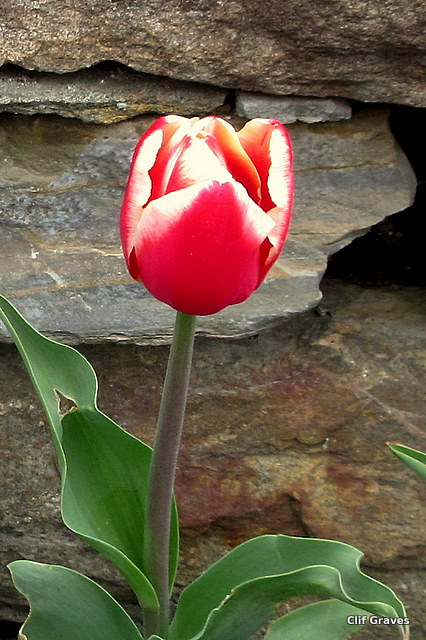
A birthday and anniversary flower


Here’s a brief history of Earth Day, taken from the history. com website: “Earth Day was the brainchild of Senator Gaylord Nelson of Wisconsin, a staunch environmentalist who hoped to provide unity to the grassroots environmental movement and increase ecological awareness. ‘The objective was to get a nationwide demonstration of concern for the environment so large that it would shake the political establishment out of its lethargy,’ Senator Nelson said, ‘and, finally, force this issue permanently onto the national political agenda.’ Earth Day indeed increased environmental awareness in America, and in July of that year the Environmental Protection Agency was established by special executive order to regulate and enforce national pollution legislation.”

Since Senator Nelson started Earth Day, there have been big improvements with cleaning up the environment, and I have seen them in central Maine, where I have lived most of my fifty-eight years. I grew up in Waterville, by the Kennebec River, and it was so dank and dirty that no one wanted to even dip his or her big toe in it. I suppose there must have been some hardy wildlife living in and by the river, but to my young eyes the Kennebec River in Waterville seemed to be an empty, foaming mass.

And now oh now there are eagles and ospery and ducks and other birds that live by the river. In Augusta, just down from Waterville, there are sturgeons, ancient-looking fish that appear to have time traveled from the Triassic. People go kayaking on the river, and they even dare to go fishing. In Hallowell, there’s a broad pier by the river and plenty of brightly colored chairs where people can relax and enjoy the water on a fine day.

IMG_1971
Last summer in Hallowell by the Kennebec River


But the dark shadow on the horizon, of course, is climate change, which has turned out to be a huge challenge for humans. Recently, on the radio, I heard an environmentalist say that when it comes to climate change, it is five minutes to midnight. And so it is. Every year Earth gets warmer, bringing us, among other things, droughts, floods, intense storms, dying coral reefs, and rising sea levels.

We are all in this together, and I hope we can all learn to work together to end our dependency on fossil fuels, to lower our carbon output, to stop the world from becoming even warmer.

That is the Earth Day message for now and probably for a very long time to come. And it is one we must carry with us throughout the year.

IMG_1993

Honoring Earth Week: Thursday—The Darling Buds of April and a Nearly Full Moon

Time was when I had both daffodils and tulips in my garden. In short order, the moles voles took care of the tulip bulbs—at the little house in the big woods, little rodents positively abound, even though we have always had cats. So that was that for tulips.

But the daffodils were another matter. Apparently, moles do not care for their bulbs, and for years and years the daffodils’ jaunty blooms brightened an otherwise drab spring garden. But then the bulbs petered out, as bulbs sometimes do, and I must shamefacedly admit that I did not replace them.

Who’s sorry now? I am, that’s for sure, especially after seeing the daffodil pictures on Jason’s wonderful blog Garden in a City. I have vowed to mend my lax ways and plant bulbs this fall so that next spring I can have cheerful yellow in my spring garden. In the meantime, I’ve spotted some daffodils in my neighbor’s garden up the road. Perhaps she’ll let me photograph them.

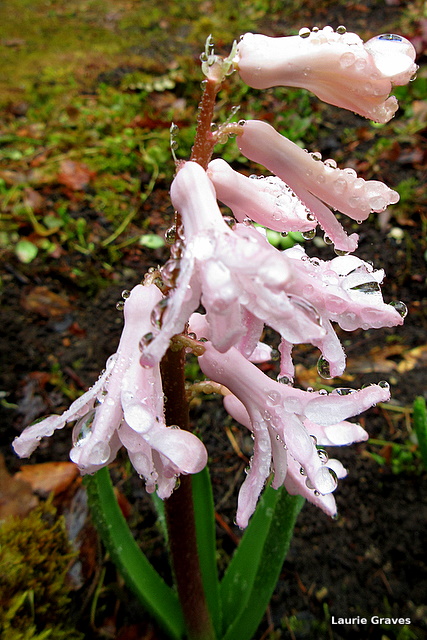
I do have hyacinths coming up, and their bulbs have proved remarkably sturdy. They do not spread much—hyacinths, so sweet and showy, seem to know their value and feel no need to elbow their way through the garden. Over thirty years ago, when we first moved to Winthrop, my mother-in-law bought some bulbs and randomly planted them in bunches throughout the garden. I still love how they pop up here and there, little spring presents to dazzle us with both looks and scent.

Right now, the darling buds are just beginning to form. After taking a picture of various plants, I noticed, for the first time, the little red tips of the leaves.

IMG_1956

“Do the red tips go away as the plant matures?” Clif asked when I showed him the picture.

“I don’t remember,” I answered sheepishly, and I promised to keep a better eye on them.

We have had many days of azure skies and sun. Naturally, there have been fire warnings, but these clear days can’t be beat for working in the yard, for raking and uncovering flower beds. We are making good progress, and in the next week or so I expect the gardens will be free of leaves and ready for wood ash, organic fertilizer, and compost.

Then comes the part I always look forward to—planting flowers in pots. How I love doing this, and I’m always sorry when the last flower is planted.

Tonight there will be a nearly full moon. Appropriately, the full moon—the pink moon—is tomorrow, on Earth Day. As the nights have been as clear as the days, the waxing moon fills the evening with a bright, luminous glow that would make a flash light unnecessary on a walk up our dark road.

IMG_1931

On a recent visit our daughter Dee asked, “Where are the street lights?”

My response. “Dee, you’ve been gone too long. We’ve never had them.”

And this is why the full moon is such a treat on our road. For a week each month, weather permitting, we can look out our windows at night and see the yard, the trees, and the road.

Addendum: Eliza Waters kindly pointed out that moles are insectivores, and it was probably voles that ate my tulip bulbs. Thanks for the correction, Eliza!


Honoring Earth Week: Tuesday—April Showers Bring…Pilgrims

Last night we had April showers, and today is a drippy day.

IMG_1902

While I was out taking pictures, I heard a nuthatch’s call, and I spotted the little creature on the roof.

IMG_1905

As I was walking around the yard, I thought of  silly little snippet  my daughters liked when they where young.

What do April showers bring?
Mayflowers!
And what do Mayflowers bring?
Pilgrims!

Ah, Pilgrims, those stern settlers of New England. To be fair, they had their good points. With their emphasis on individual choice merged with community, Pilgrims (aka Puritans) were the motivators for yearly town meetings, which to this day is the democratic and sometime contentious governing force in many small towns in Maine. With their desire to create a “Godly society through educated citizens,” Puritans established the school laws of 1642, which encouraged literacy and universal education.  In 1636, Harvard was founded, and in 1711, one of the first public libraries opened in Boston.

It cannot be denied that the Puritans were a bloody bunch in their early days, but no bloodier than any other group. Those were bloody times, both here and in England and Europe.

But now I must be blunt, and I apologize to readers who come from Puritan stock.  The worst thing about the Puritans was that they were party poopers extraordinaire. In fact, they waged a war against Christmas, and found the holiday to be a pagan “abomination” totally unsupported by Scripture. The Puritans referred to Christmas as “Foolstide,” and for a time it was illegal to celebrate Christmas in New England.

Did the Puritans stop with Christmas? They did not. According to Wikipedia, “In his award-winning book Creating the Commonwealth (1995) historian Stephen Innes writes that the Puritan calendar was one of the most leisure-less ever adopted by mankind with approximately 300 working days compared to the 240 typical of cultures from Ancient Rome to modern America. Days of rest in the New England calendar were few, Innes writes, and restricted to Sabbath, election day, Harvard commencement day, and periodic days of thanksgiving and humiliation. Non-Puritans in New England deplored the loss of the holidays enjoyed by the laboring classes in England.”

And May Day, that wild and wonderful celebration of fertility and spring and flowers? No, no, and no. (Nathaniel Hawthorne wrote about this in his short story “The May-Pole of Merry Mount.”)

After wandering around the wet yard and taking pictures and thinking about Pilgrims, I decided it was time to come in for breakfast and for my morning’s work on the computer.

But one last silly thought. In my mind’s eye, when the Pilgrims left England, I see the country collectively waving “Buh-Bye. And don’t let the door hit you on the way out.”

Honoring Earth Week: Monday, Old and New

Beech trees are not as magnificent as oaks nor as splendid as maples. But they have one thing going for them that neither oaks nor maples have and that would be leaves that last all through the winter. Beech leaves in winter are, of course, not green. Instead, they are pale, and they rustle and rattle when the wind blows.

IMG_1818

Beech leaves finally fall in the spring, but there are some that are still hanging from the trees in the woods behind our house. If you look closely in the above picture, you can see new buds forming on the branches. Soon the old leaves will fall to the ground to become part of the rich soil that nourishes the trees.

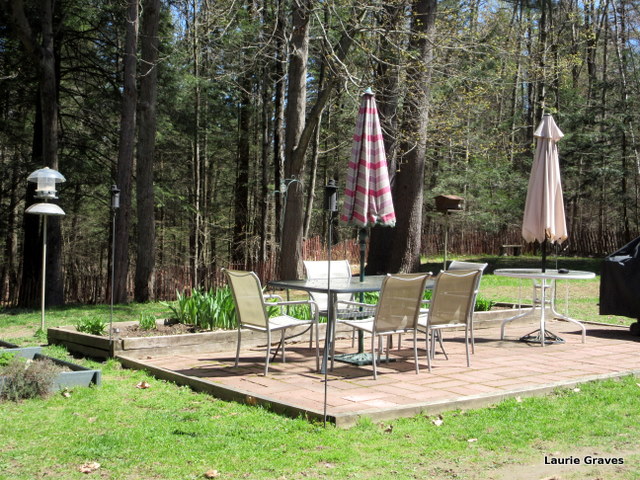
This next picture of our patio is not exactly of the natural world, but I couldn’t resist posting it. (Anyway, the beech leaves fulfilled my self-imposed requirement of each day posting a nature picture during Earth Week.)

IMG_1858

We have never had the patio entirely set up by Earth Week. Heck, some years there is still a line of snow in the backyard in mid-April. We usually aim to have everything out by mid-May, but yesterday the day was so fine—70°—that we couldn’t resist bringing up the big table, the rest of the chairs, and the citronella torches from down cellar.

From now until early fall, the patio will be our second living room, and although it is not of nature, it does put us in nature. As the trees in the picture indicates, the woods are not very far away, and when we sit on the patio, we see and hear many of the creatures who live there.

Yesterday, we were treated to a beautiful bird symphony. How the finches, cardinals, chickadees, tufted titmice, and nuthatches sang, their voices merging together to become a joyous song of spring. Their sweet song was punctuated by the percussion of the woodpeckers—Hairy, downy, pileated, and the most recent arrival to central Maine, the red-breasted woodpecker.

IMG_1854
A hairy woodpecker (I think!) taking time out from percussion to grab a bite to eat.


To borrow from Mozart, what a delight this is you cannot imagine. Or maybe you can. I suspect many readers of this blog love birds just as much as I do and listen eagerly for their song of spring.

Yesterday, after doing yard work, Clif and I celebrated by having drinks and nibbles on the patio. After a long winter of being inside, how good it was to be there, and we are looking forward to many more days and nights on the patio.

Come, spring, come.


Honoring Earth Week: Sunday, the Beginning

Today marks the beginning of Earth Week, a very special week for us as it culminates on April 22, Earth Day and also the birthday of our youngest daughter, Shannon. In honor of Earth week, each day I’ll be posting nature pictures taken either at the little house in the  big woods or in Winthrop, a town known for its beautiful lakes.

I will admit that mid-April in Maine is not its most photogenic time. Rather, we are on the cusp of true spring, where May kicks up her heels and blesses us with a landscape so dazzling we can hardly stand it.

Nevertheless, there are lovely albeit quiet moments to enjoy in Maine in April. Here are a few from our backyard.

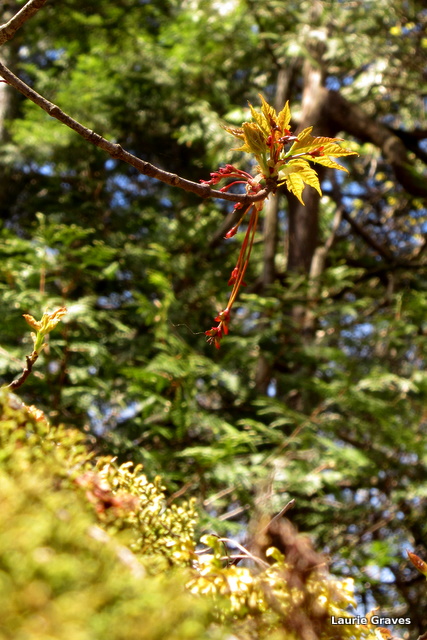
I just cannot resist taking pictures of the red buds on the maples. How I love them.

IMG_1813

I love the red buds even more when there is a bird or two among the branches.

IMG_1839

And, I was happy to find a tree spirit in the woods on the edge of our backyard.

IMG_1853

It hardly needs to be said that every day should be Earth Day. Where would we be without Earth to sustain us? However, setting aside special days to honor what we love is a long-standing tradition for humans.

So let us celebrate Earth Day with a happy, grateful heart. And maybe, just maybe, we can think of ways of living more lightly on this lovely, blue planet.

Stories Rippling Through Time

Yesterday was a sunny day with a clear blue sky.  Before going to a meeting at the library, I stopped to take pictures at the lovely old sliver of a cemetery in the middle of Winthrop.

IMG_1797

As to be expected, there were tree spirits in the cemetery, and I caught a picture of one.

IMG_1771

Then I turned my attention to four very old gravestones.

IMG_1793

I decided to focus on one of the smaller ones, which I expected would mark a child’s grave. In part, I was right, but the stone, in fact, marked the graves of two children, both with the name Susannah.

IMG_1801

The first Susannah died in 1771—when we were still a part of Britain—and she was five years old. The second Susannah died in 1784—we were then the United States of America—and she was twelve years old. If my math is correct, the second Susannah was born a year after the first Susannah died.

To modern parents, it is a very strange notion to use the name of a dead child for the next sibling of the same sex. Somehow, it seems morbid if not downright creepy. However, it is my understanding that this was fairly common practice in America in the 1700s when the child mortality rate was appallingly high.  Names, often ones that had been in the family, were reused if a child died.

Different sensibilities for different times, and that little gravestone marks the story of one family’s grief in losing not one but two Susannahs.  I understand that parents  in the 1700s were not unaccustomed to losing young children. Nevertheless, it is my belief that these parents grieved, too, even if a child’s death was all too common. To mourn is human, whatever the century.

Indeed, in the mid-1800s, a time when children still died at an alarming rate, Louis Pasteur would write in a letter that another one of his dear children had died of typhus. Three of Pasteur’s five children would die from this illness, which influenced his decision to study infectious diseases.

With all these morbid remembrances of lives ended too soon, you would think the Winthrop cemetery would be a grim place. But somehow, it isn’t. Like so many New England cemeteries, it is peaceful and serene, a place of beauty, even.

I especially love how snippets of stories, the human story, are told through the gravestones and remind us of how things were both different and the same back through the centuries.

The Summer Before the War by Helen Simonson

summerWhen Helen Simonson’s novel The Summer Before the War opens, it’s just another drowsy summer in 1914 in the coastal town of Rye in Sussex, England.  Snout, an unlikely but bright Latin student, is busy poaching rabbits and doing odd jobs to add to his growing pile of coins.  Agatha Kent, one of the pillars of the community, is enjoying the company of her two nephews, practical Hugh Grange, who is studying to be a doctor, and snobbish Daniel Bookham, a poet.  There are parties and teas to attend.

Except it’s not just another quiet summer in Rye. Agatha Kent has done something most unusual. She has persuaded the school board to hire a woman to be the new Latin teacher in the town’s school. Apparently, in England in 1914, men taught Latin, and The Summer Before the War begins with the arrival of Beatrice Nash to assume the position of Latin teacher.

Beatrice Nash is young, attractive, bright, an aspiring writer, progressive, and poor. In short, she is everything a heroine should be, and I was rooting for her right from the start. While Agatha Kent might be Beatrice’s champion, the mayor’s wife, Mrs. Fothergill, is Beatrice’s enemy and, of course, Agatha’s as well. During the course of the summer, Agatha and Mrs. Fothergill will work very hard to outmaneuver each other, with Beatrice often caught between the two women.

Much of the novel deals with Beatrice trying to make her way on her own—her father has recently died—in a town where her status is far from assured. With Agatha as Beatrice’s champion, the way is easier but certainly not easy for this bright, genteel but poor young woman who has never taught before and has much to learn.

For many novels, this would have been enough. As the story progresses, it is clear that Hugh and Beatrice are attracted to each other. Do we want them to get together? Of course we do. But there are complications. Hugh is committed to another woman, not quite engaged but heading in that direction. In the meantime, the repulsive Mr. Poot, the Mayor’s nephew, is angling for Beatrice.

But as the title suggests, this is the summer before the war, the Great War, as it is known, where so many young men lost their lives. Suddenly, the book’s tone takes a turn from pointed yet amusing to very serious. Many of the young men we have come to know in the book go off to war, and Helen Simonson has such a knack for vivid characters that I had a lump in my throat as they left Rye for the killing fields of France.

Readers, I must confess that one night I stayed up until 2 a.m. reading this book. Simonson, a terrific writer, skilfully weaves in many issues in this book that begins as a comedy of manners. Class, gender, poverty, sexuality, ambition, and literature are subjects that are explored in The Summer Before the War. Then, of course, there is war and its terrible toil.

Finally, as is the case with so many British writers, Simonson has a wonderful feel for the natural world, and there are many beautiful descriptions of Rye and the seaside. Indeed, the book opens with “The town of Rye rose from the flat marshes like an island, its tumbled pyramid of red-tiled roofs glowing in the slanting evening light. The high Sussex bluffs were a massive, unbroken line of shadow, from east to west, the fields breathed out the heat of the day, and the sea was a sheet of hammered pewter.”

This fine book will go on my wish list so that I can have it in my home library.