
Along with writing novels and pieces for my blog, I am an assistant editor for Résonance, which as the title of this piece indicates, is a Franco-American Literary Journal.
For readers unfamiliar with Franco-Americans, here is a brief history: from the mid-1800s to the 1930s, there was a huge migration—almost a million from Québec— of French Canadians to the United States. They came to farm and to work in the factories and forests and settled primarily in New England. On my mother’s side, my great-great grandparents, Prudent and Demerise Jacques, bought land in northern Maine and grew potatoes.
Many of the French Canadian immigrants were dark haired and had olive complexions. They all spoke French—indeed French was my mother’s first language—and by and large, they were Catholic. In short, they were foreigners and were looked upon with hostility by the dominant Yankee culture in New England. One newspaper described Franco-Americans as “a distinct alien race.”
In Maine in 1919, a law was passed outlawing French in public schools except during formal language classes. In the 1920s, the Ku Klux Klan was a huge presence in Maine, and they marched against the Franco-Americans.
It wasn’t until 1960 that the 1919 law was repealed, and by then the damage had been done. Franco-Amercians had effectively been silenced, forced to abandon French so that their children wouldn’t be punished at school. A Franco acquaintance, who was caught speaking French on the playground, told me how she had to stay after school and write “I will not speak French at school” on the chalkboard. Until the day my mother died, she maintained that she spoke “bad French.”
This silence extended to other areas of life. For the most part, Franco-Americans kept their heads down and worked hard, very hard, and were perhaps too passive, as one elder Franco-American put it. Outside of family circles, stories were seldom told. We were dubbed “The Quiet Presence,” a source of ridicule and jokes about how stupid we were. (Unfortunately, I have heard more than my fair share of dumb Frenchmen jokes.)
Then came my generation. We were sick of being quiet, of keeping our heads down, of feeling as though we were congenitally stupid. We have organized into groups celebrating our heritage, sometimes through performances. Slowly, slowly, books, articles, poetry, and essays have been written.
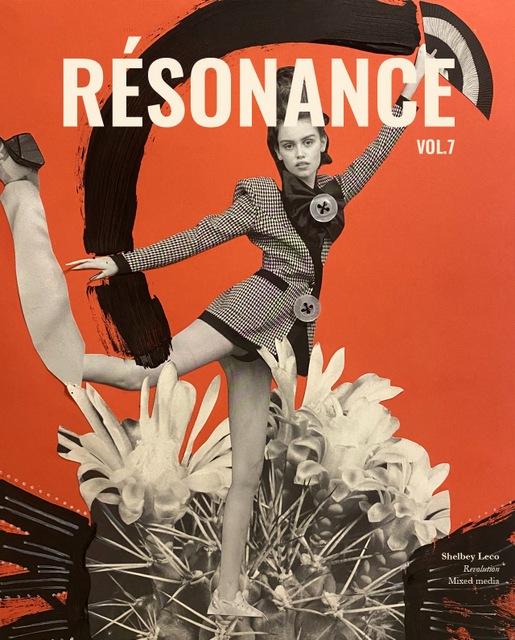
And under the auspices of the University of Maine at Orono, we have our very own journal, Résonance, which features “creative works by established and emerging writers, primarily by and/or about the Franco-American communities of the United States.” The newest issue, Volume 7, has just been published.
I help edit the creative non-fiction pieces. In this volume, there are a variety of essays, ranging from an account of the author’s ancestor arriving in Canada in 1662 to a humorous piece about a mouchoir (a handkerchief) to a reflection of nature and trauma to a reckoning of how French is spoken in Maine rather than in France.
In addition, there is artwork, poetry, fiction, and an interview with Susan Poulin, a Franco-American performer. If you have time, I hope you will check out Volume 7 of Résonance.
And for readers interested in submitting pieces to the journal, please check out the guidelines.
As we would say in French, à bientôt!
 Notes From the Hinterland
Wonderful mon amie! I will definitely check out Volume 7!
De rien! And perhaps think of submitting a piece? It sure could involve cooking and food. Anyway, just a thought.
I will give it some thought!
I took two years of French in Highschool, 50 years ago. They weren’t even consequtive years, but that’s another story. My husband and I traveled up the St. Lawrence one summer, and spent a few days in Quebec. I loved it. partly because I could pretend to be able to read the roadsigns. You know. Nord. Sud. Sortie. That sort of stuff. My husband was totally baffled and upset that he was driving but couldn’t read the signs. Sort of like having truck drivers in the states who can’t read or speak English. But that, also, is another story.
Lately, with things the way they are here I’ve dreamed of moving to Canada, maybe Quebec. Maybe some other small town along the St. Lawrence. My husband, of course, would be fully against that idea.
I am glad you have groups of people to support your heritage. I was wondering if the magazine would be in French, but I see it’s not. Is there a version that is?
I, too, have dreamed of moving to Canada in a reverse migration kind of way.
Most of the pieces in the journal are in English for a very sad reason: Most of my generation, which includes those who are working on the journal, don’t know French well enough to write a piece in that language. Sigh.
Félicitations, Laurie. Quelle enterprise importante. And how sad to have the historic languages of proud québécois and acadiens purposefully erased. Thank you for introducing me to this journal.
My pleasure! And thanks so much for the kind words.
I recently got an updated DNA result, and it traces 30% back to my French Canadian ancestors on my father’s side. They migrated from Quebec to Vermont to northern New York. I can only imagine how much you are enjoying this editing experience.
Oh, cool! Yes, a very rewarding project.
Such a wonderful thing to do and Journal to be involved with Laurie! The positive energies involved will be felt way back up the ancestral lines 💖✨️ xxx
Many, many thanks!
Very cool Laurie! I like the cover image.
Me, too! It clicked with me the moment I saw it.
This is very interesting! I live in NB and had no idea that this migration happened from Quebec to Maine. I hope your publication flourishes as we all can and should appreciate each other’s cultures and languages.
Interesting! It was a while ago, but it seems as though it should be common historical knowledge in Canada. Thanks for the kind words.
Interesting bit of a history lesson. Thanks.
Always glad to spread the word about something many people are unaware of.
Laurie, I had no idea! My mom was full Italian, and they, too, were shunned into speaking English and adopting English ways. Such a sad thing. I’m glad you’re able to help foster your French heritage through this publication. America is supposed to be a melting pot, and it seems to me we’re all better for the differences among us.
You are not alone. Franco-Amercians have been such a quiet presence that they became somewhat invisible. Yes, I know other ethnic groups such as the Italians had the same problem. As though knowing two languages is a terrible thing. Has anybody ever thought, “Dang, I’m sorry I know two languages. I wish I knew just one.”?
Astounded to read of the KKK presence! Thank you for widening my knowledge. Diversity and ones own culture is so important – when will we humans get that. Love the cover!
It’s a lesson humans are slow to learn. Tribalism certainly has its dark side. And even many people in the United States have no idea how big the KKK was in Maine. It’s thought of as a Southern problem. Nope. It was in the North, too. Thanks for your kind words!
How wonderful that your generation is reclaiming your heritage. I am so weary of the concept of “white” privilege, and what white/Anglo/Protestants have done to people not quite like them. Just looking at what your ancestors and native Americans (among many others) have had to endure is sickening and heartbreaking. The journal sounds like a rewarding project for you.
It is a rewarding project. The prejudice just doesn’t end.
Immigrants have always been treated poorly here, and it still is happening! What the ???!
As you know, we share the same heritage. My parents first language was French, but it was only spoken at home and among relatives. They could only socialize with ‘their own kind.’ Even my older Boomer sisters in the 50s were shunned by other parents who wouldn’t let their children play with ‘those Catholics!’
What the heck! It wasn’t just Maine, was it? So much prejudice. It makes me sad to think of your sisters being shunned.
Well, I learned something new today. More power to your editing elbow.
Many thanks! Always glad to spread the word. The quiet presence has gone on for far too long.
What a wonderful project to be involved with!
Laurie – I am dumbfounded . . . I may be a once-upon-a-time European immigrant to Australia but somehow, just somehow I should have heard of this. I had not. This is totally new . . . thank you for the information and I am so glad you are amongst those trying to correct the past being proud of your heritage . . .
Wow! Sounds great and I LOVE the cover! 🧡
Many thanks! I really like the cover, too.
So welcome! 🙂
Fascinating, Laurie! I am so glad to hear about this magazine and glad to think of repressed groups getting to a point of speaking up.
Thank you so much for bringing this into my awareness, Laurie! I only learned of my French Canadian heritage when I learned who my biological father was in 2019. Since then I’ve learned so much, but I’d never heard about the experiences you mention here until now! I will definitely check it out and will forward the link to my sister as well!
Wonderful that you have French Canadian history. David Vermette’s history, A Distinct Alien Race, gives a good overview of the discrimination and hardships Franco-Americans faced. An all too familiar story, unfortunately.
This has been a fascinating read and I have learned a lot!
Glad to be illuminating.
A fascinating story and a very welcome journal
Thanks so much, Derrick.
I’m curious. Does the journal also accept/include articles from Cajun culture? So many dynamics you describe are part of their history, and current attempts to reclaim the culture. In fact, there are students in Louisiana universities who are dedicated to interviewing French-speaking residents, and designing classes for teaching ‘Cajun French’ to high school students.
As for the KKK, it was active in Iowa in the 1920s, and their target their tended to be Catholics (or Republicans, since at that time their membership tended to align with the Democrat party). My mother remembered a cross burning, and in a bit of wonderful irony, I eventually learned that I grew up Methodist rather than Lutheran because the Klan couldn’t tell the difference between Catholics and Lutherans! I’ve thought about telling that story. This might be a good time in our nation’s history to do it.
Yes, the journal accepts articles from Cajun culture and any other Francophone culture in the United States.
The Klan, unfortunately, was active in many places in the United States. That would be a good story to tell, especially as Catholics could certainly tell the difference. 😉
I had no idea that the French language was actively suppressed anywhere in the US. Shocking. It’s good that publications such as Résonance are giving a voice to those who were silenced for so long.
Yup. Sigh. Thus leading my mother, and many other Maine Francos to think they spoke “bad French.” Instead of different French, much the way we speak English differently than you do.
I never heard French spoken in Maine, but we did a few times in Canada and it sounded very different from the “European French” I learned at school. But, as you say, it’s not “bad French”, just “different French”. And that’s the point about language, isn’t it – it continually evolves, often taking different routes in different geographical locations. Yes, US English is different in various ways from UK English, but even between me and Mrs P there are various little differences (I grew up in London, she grew up around 140 miles further north in Derbyshire). Our arguments about the correct way to pronounce the word “grass” are legendary…though I’m right, obviously!!!😂
Yes, yes! As a species, we excel at putting others down. But I love other accents. Long live the differences!
Laurie, I had no idea this was part of your history. I’m appalled. It would have been hard for your poor mom being raised under this cloud of untruths and restrictions on language and culture.
I also didn’t know you edited this publication. You’re a multi-faceted writer and editor. Do you have a favorite writing medium?
Thanks so much for the kind words! Yes, very hard for mother and all those who thought they spoke “bad French.”
Thanks for the kind words! I really don’t have a preference. I enjoy writing both fiction and nonfiction.
Goodness, I found this both fascinating and shocking to read. Like many other commenters here, I had no idea that these laws had been put in place…
It’s terrific to hear that initiatives such as the Résonance Literary Journal exist, giving these writers a platform for their work. How rewarding it must feel to be part of the editing team. Bravo, Laurie!
Yes, Maine’s history is not all sweetness and light. Finally Franco-Americans are speaking up.
Thank you for explaining the history Laurie. I knew you had French Canadian ancestry but not how discriminated against the immigrants were. I recently read a book in which a sentence hit me hard ‘Scapegoats are easier to find than solutions’. I am so glad that your generation decided to band together and speak out. That journal sounds a brilliant way to celebrate your culture loud and proud.
Many thanks for the kind words! It’s an old story, unfortunately, but one that hasn’t been fully acknowledged. My generation is trying to rectify that as we recognize that the previous generations were just trying to get by. No small thing with all that they faced.
I suspect that the first generation of immigrants don’t have energy spare to tackle the prejudice they face. It is only their children or grandchildren who feel sufficiently on top of how everything works to fight back.
This is some information. I shall check the journal in weekend.
Thanks, Rupali!
Thank you for sharing this interesting history, I had no idea. This must be a wonderful project to be a part of and to have the opportunity to share this with others. Looking forward to reading the latest volume of the journal.📖🙂
My pleasure! We shave even invisible for too long.
Thank you for the history lesson, Laurie. I am glad to see your people’s history brought to light, and a magazine dedicated to them.
My pleasure! So many people don’t know.