Three months of March

For most Mainers, March is the worst month of the year. After the long dark cold of December, January, and February, what we would like is a softening, some sign of spring. Instead, what we traditionally get is wet heavy snow, sometimes lots of it, followed by snowbanks packed with pebbles and dirt and then worst of all, at the end of the month, thick, dirty, oozing Mud. And, yes, I intended the capitalization. In March in Maine, Mud is a force of nature to be reckoned with. I have lost a shoe in the mud going out to the compost bin.

This winter, it feels as though we have had three months of March, with so little snow that some outside events in the area have been canceled. This February, we’ve had mud. The chickadees are singing their spring song, and friends have spotted red-wing black birds. Really? In February? So it seems.

Readers, fair warning: This does not look as though it’s going to be a good year for Snow-Gauge Clif. More about that next week.

Here is what our backyard looks like right now.

So many pine cones had dropped that I decided to go outside to gather them for kindling for our wood furnace down cellar.

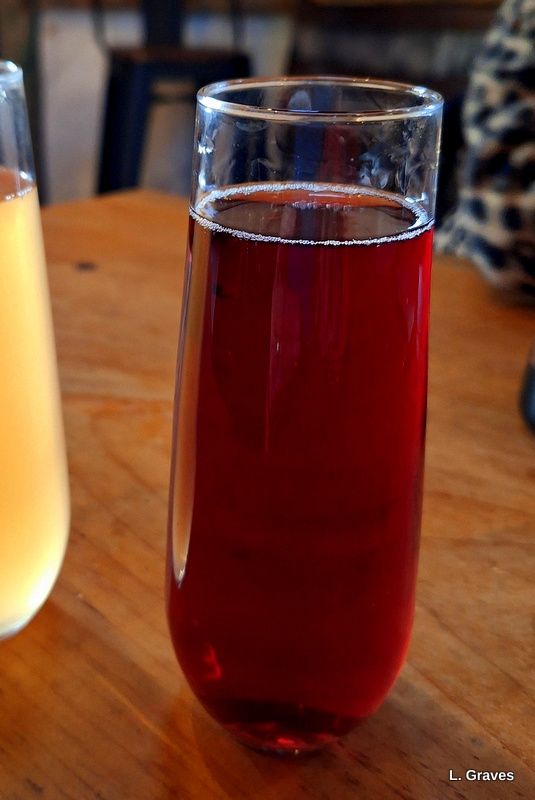
How to cap this odd month? With a trip to Absolem to meet friends for drinks. My drink, which is featured below, was a delicious blueberry cider.
What will March bring? We shall see.

Watching

Drive-Away Dolls
Directed by Ethan Coen

Ethan Coen is one half of the talented Coen brothers team—the other brother is Joel—and together they have made and directed terrific movies such as Fargo, No Country for Old Men, and The Big Lebowski.

Recently, they have parted ways creatively. Joel Coen would go on to direct a striking version of Macbeth. Ethan has given us Drive-Away Dolls, a stinker of film that leads me to conclude that Joel was the talented brother of the team, and whatever Ethan might have contributed was guided and controlled by his older brother.

The plot is a classic Coen brothers set-up and should have been fun: Two young women, an odd couple, decide to go on a road trip and hook-up with a company that allows them to drive a car for free to Florida. In the trunk is a brief case hidden with the spare tire, and it turns out the women were given the wrong car. A bickering pair of gangsters come after the women, and what mostly ensues is explicit sex, lame jokes, and a stupid denouement, which all come together to make the movie seem far longer than its 1 hour and 24 minutes runtime. However, in all fairness, I must add that some people at the cinema were laughing away at jokes we thought were lame. Even though the jokes left us cold, they tickled the funny  bones of other folks.

I decided to write about this movie for two reasons: One, to warn fans of the Coen brothers what they are going to get if they decide to go to Drive-Away Dolls and are expecting a quirky, snappy movie reminiscent of the brothers’ past films. And two, if readers do decide to go see this movie, I would be very interested in reading what you think about it. Did you love it or hate it?

I enjoy reading opposing views as much as I enjoy reading views that match mine. So do let me know what you think of the movie if you see it and have a chance to leave a comment.


A Haunting Tale

To a large degree, we are all here because of chance. If my mother had married another man, there would be no me. The same is true for my brother. Another daughter or another son, perhaps, but not the two of us with our exact genetic inheritance.

However, for my friend Ed Vigneault, the story of his existence is even more weighted by chance, a tragic, improbable tale that started sometime around 1815 in the waters off the Magdalen Islands, a small archipelago in the Gulf of Saint Lawrence. The archipelago is part of the province of Québec, and its French name is Îsles de-la-Madeleine. Population: 12,781.

According to Wikipedia, the territory once belonged to the Mi’kmaw Nation, and they named this cluster of islands Menquit, which means “battered by waves.” Later, it would be called Menagoesenog, or “battered by the surf. ” Both names give a vivid description of the rough waters that pound the Magdalen Islands, and through the years there have been over 400 shipwrecks. Some of the islanders are descendants of the survivors. And even though he isn’t an islander, this brings the story back to my friend Ed and the year 1815, long before Ed was born.

A ship from Europe, probably from the British Isles, was sailing to Canada. But before the ship reached port and was somewhere near the Magdalen Islands, a terrible storm blew in, a tempest. The ship was obviously in trouble, but the storm was so bad that none of the fisherman from the islands dared go out to rescue the passengers.

As the islanders feared, the shipped crashed against the rocks, throwing passengers into the ocean.  On a beach near Dune du Sud on the island Havre aux Maisons, bodies washed onto the sand. As the islanders searched for survivors, they found a heartbreaking sight: A  dead woman clutching a baby, who, incredible as it might seem, was alive. That baby was Ed’s great-great-grandmother, and a family—the Cummings—on Havre aux Maisons adopted her, naming the baby Sophie Peine. Because of her tragic beginning, Sophie was also known as “La Petite Misère,” which I’m sure needs no translation even for those who don’t speak French.

I first heard this story, told by Ed in broad outlines, at a gathering at a friend’s house, and I was immediately gripped by it. In my mind’s eye, I could see dead bodies—some face up, some face down—washed on a sandy beach. Waves break over them, pushing them farther up the beach and then rolling them back a little. With resignation, the islanders come to the beach, searching for survivors. Dead, dead, dead. Then they hear an infant cry and find baby Sophie in her dead mother’s arms. I think of the force of will it must have taken for that mother—Ed’s great-great-great grandmother—to hold on to that baby, to not let go as the ocean threw them toward the rocks and the sand. If the mother had loosened her grip just once, the baby would have been swept away to drown, and there would have been no Ed.

Knowing I was interested in hearing more, Ed and his wife Becky invited me over for tea one morning so he could fill in the details. He told me that when his niece and his sister started doing genealogy, she discovered the sad story of Sophie Peine. He spoke of how Sophie lived to be a woman and married a man named Bénoni Arseneau. They would have many children together, and eventually they moved to Natashquan, in the Province of Québec. The community is so remote that until 1996, it could only reached by either plane or boat. Ed’s great-grandmother would be born in  Natashquan, and it was in Natashquan, on dry land, that Sophie, La Petite Misère, died.

When he was done talking about his family, Ed brought out a small plastic container. Inside was sand, scooped from the beach on the island where Sophie and her mother washed up. On top of the sand was a little piece of driftwood.

Ed said, “I like to think this piece of wood came from the ship Sophie was on.”

I just nodded. Such a lovely thought that connects Ed to his great-great-grandmother, the improbable survivor of a storm that took so many lives, including the life her own mother.


A Year of Books

Last weekend we celebrated my son-in-law Mike’s birthday. Because they live in Massachusetts, Mike, our daughter Shannon, and the dogs came to Maine on Saturday to spend the night.

The day was astonishingly warm for early February in Maine.  When it comes to the weather nowadays, my thoughts always turn to my parents, who never would have imagined it could be so warm in midwinter. Such big changes.

Mike chose to go to Absolem Cider Company to celebrate his birthday. It is one of his favorite places in central Maine. It is one of mine, too.

Here we are, on the way to the barn at sunset. Note how shiny with mud the path is. It felt more like March than February.

However, inside all was cozy and dry. Soon we had our drinks, and it was cheers to the birthday boy.

Here is a picture of Mike and our daughter Shannon.

After our drinks, we went back home for presents, and this year, Clif and I had come up with something special for Mike—twelve books, one to be opened at the beginning of each month throughout the year.

I got the idea from my friend Doree, who had done this for her sister for Christmas and had written about it on Facebook. Immediately, I was smitten by the idea, and my thoughts turned to Mike and his birthday in February. Mike is an avid reader, and I knew he would be thrilled to get a book a month. Also, and this is sheer coincidence, of everyone in the family, Mike’s taste in books is most similar to mine, which made picking out books for him very easy.

Last Thursday, Clif and I wrapped and labeled the books. As we did so, I thought about how giving these gifts was a joy from beginning to end—choosing the books, deciding which books should go for which month, wrapping the books, and then seeing them laid out on our dining room table, small packages of delight waiting to be opened.

A closer look at February’s book.

And what was February’s book? Here is  New York, by the late great writer E.B. White, whom I mentioned in last week’s post.

It was so much fun to watch Mike inspect his books.

“This is amazing,” he said more than once.

Happy birthday, Mike, and happy reading!


Once More to the Lake

One summer, along about 1904, my father rented a camp on a lake in Maine and took us all there for the month of August. We all got ringworm from some kittens and had to rub Pond’s Extract on our arms and legs night and morning, and my father rolled over in a canoe with all his clothes on; but outside of that the vacation was a success and from then on none of us ever thought there was any place in the world like that lake in Maine.
—From “Once More to the Lake” by E.B. White

E.B. White (July 11, 1899 – October 1, 1985) is perhaps most famous for his beautiful children’s books—Charlotte’s Web, Stuart Little, and The Trumpet of the Swan. But he was also a brilliant essayist, writing for magazines such as The New Yorker and Harper’s Magazine. If you have never read any of his elegant essays, I encourage you to do so. One Man’s Meat is an excellent place to start.

“Once More to the Lake,” one of the pieces in One Man’s Meat, is an elegiac essay about returning to a favorite lake White and his family visited in his childhood in Belgrade, Maine, not far from where I live. White went in the summer, which is when most folks from away come to Maine lakes. Years later, White returned to the lake with his young son, and the essay is a reflection of how things both change and remain the same, how his son’s experience was a mirror of White’s own boyhood experience.

Yesterday, I had a once-more-to-the-lake moment. I live in a town in Maine with so many lakes and ponds that at times it feels as though Winthrop is an island. According to centralmaine.com, there are more than three dozen lakes and ponds in Winthrop, and some of those ponds are big enough to be considered lakes.

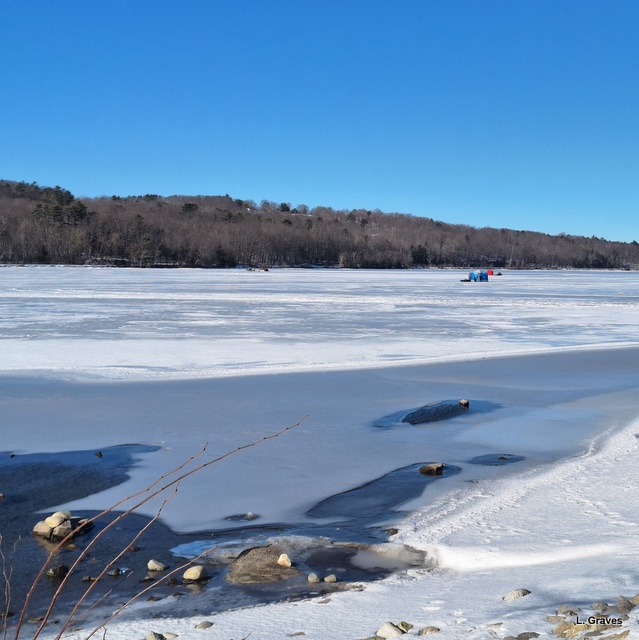
My lake of choice was Marancook, which sprawls between two towns, Winthrop and Readfield. Instead of going in the summer, I went on a fine February day, where the sky was a deep, impossible blue. Although I don’t like to walk on the ice anymore—my knees are too creaky for that—I still enjoy parking my car by the lake and admiring the cold view.

Clif took these pictures, and this last one caught his shadow.

However, here my story diverges from White’s essay about how the years dissolve change from one generation to the other. Although there is some ice on Marancook and a few ice fishing shacks, there is also a lot of open water. Usually, by February, the lake is pretty much frozen solid, and there are so many shacks on the lake that it looks like a colorful village has suddenly sprung up. On a fine day, when sound carries, you can here people talking and calling to each other.

Not so this winter, which has been warmer than average, when storms in December have brought rain and flood rather than blizzards. How much longer, I wonder, will people be able to go on the ice to set up their shacks?

I don’t know. And yesterday, while I still admired the lovely view, I had a shiver of apprehension, of change coming so rapidly that even a generation ago, when my parents were young, it would have been inconceivable to have open water on a Maine lake in February.