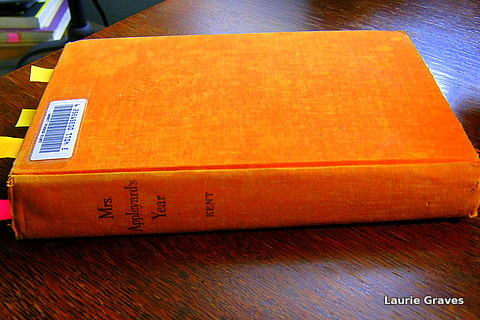
Book Review: Mrs. Appleyard’s Year

IMG_7685I follow a blog called Letters from a Hill Farm, and Nan, the author, writes a lot about the books she reads. Our tastes are fairly similar—we both love Miss Read—and when Nan suggests a book, I take note. Recently she recommended Mrs. Appleyard’s Year by Louise Andrews Kent, and as the title suggests, the book follows Mrs. Appleyard through the seasons—in  Massachusetts and on a farm in Vermont. I love books that do this, and immediately requested it through interlibrary loan, not paying much attention to when the book was written or anything else about it.

This inattention, along with the book’s unique voice, led to some merry confusion. In short, I thought I was reading a novel. Published in 1941, the book begins in January, and lists some of Mrs. Appleyard’s faults—impulsively buying antiques, “a fondness for looking up things in the dictionary during meals,” and telling the same story over and over.  But Mrs. Appleyard is philosophical about her faults. “Since she has had most of her defects for over half a century, she is well acquainted with them. Some of them, indeed, have become enjoyable simply because she has had them so long.”

With nary a plot in sight, next comes February, where Mrs. Appleyard notes she likes the month’s “uncertain temper.” The month brings illnesses that give the young Appleyards time to make homemade Valentines. In February, it is Mrs. Appleyard’s turn to host the Pinball and Scissors club. For this event, so much food is prepared that Mr. Appleyard compares the leftovers to the seven years of plenty in Biblical Egypt. Fortunately, Mr. Appleyard likes leftovers.

By now, I think I’ve made it quite clear that the book meanders, and this is true not only for the months but for time as well. Mrs. Appleyard’s Year moves between the present, when Mrs. Appleyard is in her fifties, and back to when her children were young. This book is so gently paced that it makes a Miss Read novel seem like a John le Carré story.

I almost gave up on Mrs. Appleyard’s Year, but then I came to March and “No matter how often she encounters this month, she doesn’t think she’ll live through it. Sometimes she doesn’t care whether she does.” And I was hooked. Anybody who felt that way about March—surely the longest and dreariest month of the year—deserved more of my time.

I also decided to do a little research about this book, and I discovered that Mrs. Appleyard’s Year really isn’t a novel at all. It’s more like a memoir, or semi-autobiographical fiction, told in third person and written in a wry, humorous tone that reminded me of James Thurber. Some of Kent’s descriptions were so funny that I laughed out loud, and when I read to Clif the episode of the revolving door at Christmas time, he laughed out loud, too.

I also found out that Kent’s pen name was Mrs. Appleyard, and she wrote cookbooks and food pieces for Vermont Life. Through interlibrary loan, I’ve already requested The Summer Kitchen. (Whatever would I do without interlibrary loan?)

Mrs. Appleyard’s Year is not great literature. There is no sex, violence, alcoholism, abuse, or dysfunction. The book is gentle and funny, yet well written and wise in its own way. While I certainly wouldn’t want to turn my back on darker literature—we need writers who examine humanity’s shadow side—I do wish there were contemporary writers like Louise Andrews Kent.

Readers, if you know of any, then please let me know.
A Creative Life

Lately I’ve been thinking about creativity and how it enriches and enhances everyday life. We can’t all become great artists. To do so requires a combination of talent, hard work, persistence, and—something we might hate to acknowledge—good luck. While chance might only favor the prepared mind, there is something to be said for being in the right place at the right time and having the right people pulling for you.

But I truly believe that most of us can live a creative life and that this is not the sole province of the enormously talented. As with many things, there is no one path to living a creative life, and vive la difference!

I feel extraordinarily lucky in knowing many, many people who live creative lives. In fact, I know so many that I really can’t list them all, but here are a few: John, a scrounge extraordinaire and a librarian who supplements his library’s tiny budget by scouring book sales and his town’s transfer station for books that he not only adds to the collection but also sells for additional income. There is Shari, who is so accomplished with knitting and needlework and who makes the loveliest pieces, often from scraps. There is Diane, a true green bean, who has made her old house snug and energy efficient. She also makes snappy jewelry from found objects.

I must add my son-in-law Mike who draws, paints, and takes pictures; my daughter Shannon who cooks the most wonderful meals; my daughter Dee and her keen intellect, which gives a creative edge to everything she does. My engineer friend Jim who can fix pretty much anything. My own husband, Clif, and his photographer’s eye, and  Farmer Kev, who grows food for so many people.

All right, I’ll stop. Apologies to friends and acquaintances who were left out. Kudos to all of you, especially those who do volunteer work. This, too, is a form of creativity that uses one of our most precious resources—time.

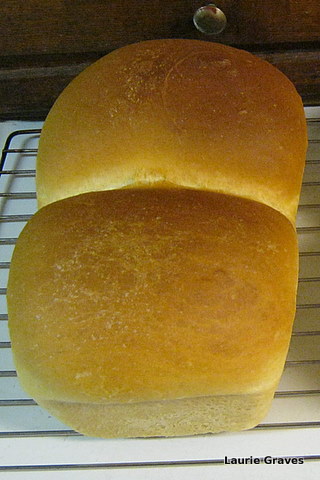
In my own life, I bake and cook, making pretty much all the bread that we eat.

IMG_7563

I’ve learned how to take pictures, something I never thought I’d be able to do. I’ve come late to photography, thus proving that even as you age, you can learn new things and expand what you do.

IMG_7674

And, of course, I write, five days a week, sometimes more, depending on what is happening. Writing is the center of my day, and without it, my life would feel out of whack. Words and story are definitely the thing for me.

By weaving creativity in with everyday life, we bring a spark that adds meaning to all that we do.  Creativity can also bring a much-needed attention to how we live. Can we create from things that would ordinarily be thrown out? Cook from scratch and thereby use less packaging? Scrounge useful items from the transfer station? Fix things when they are broken? In the end, a creative life is often a green life, and if there’s one thing we need people to do more, then it is to be as green as possible.

I’m going to end with a quotation from one of my favorite writers, Miss Read, who wrote stories about English village life. Here is her description of one of the characters—Mrs. Willet: “She can salt pork or beef, make jams, jellies, wines, and chutneys and pickles; she can bake pies…She makes rugs, curtains, and her own clothes. She can help a neighbour in childbirth…She is [a] good… gardener and sings in the choir…It is a creative life. There is something worthwhile to show for energy expended which engenders the desire to accomplish more. Small wonder that the Mrs. Willets of this world are happy, and deserve to be so.”

Small wonder, indeed.

Scenes from a Clean-Up

This is what the end of our driveway looked like yesterday afternoon.

IMG_7650

Naturally, it had to be cleared. Clif fetched Little Green and got to work.

IMG_7651

IMG_7652

IMG_7655

While Clif took care of the wall o’snow, I shoveled the various paths out back—much to the delight of the dog—as well as the steps and walkway out front. I also tackled the wall o’snow by the mailbox and cleared a space so that the mail carrier could deliver mail.

When we were done, I could appreciate all the beauty of this white stuff.

IMG_7656

IMG_7658

Yet again, after the clean-up, we felt we had earned our snack of buttered popcorn. Clif and I settled on the couch in the living room, and the dog, of course, settled beside us. After the snack, I took a short nap and woke up refreshed, ready to go to a library meeting.

Oh, the goings-on at the little house in the big woods.

And the Snow it Snoweth Every Day

Our tunnel of a driveway

I might be exaggerating. It hasn’t snowed every day, but it’s starting to feel that way. Clif and I are beginning to wonder where in the world we are going to put more snow. Our driveway is a tunnel, and backing out, I’m more than likely to hit a snow bank.  Fortunately, snow is soft, which means no damage is done.

We did have a break on Friday, when friends came over for minestrone soup, cornbread, and strawberry bars. We had many things to discuss, but we did manage to slide in some book talk, which always perks me up.

We had another break on Saturday, and Clif and I just piled on the activities while the weather was good. In the morning, we went to Railroad Square for Cinema Explorations, a winter film series. (Clif and I are on the planning committee.) We saw On the Way to School, a delightful but thought-provoking film about the long journey some children must make to get to school. Children from Kenya, Argentina, Morocco, and India were featured, and they traveled many, many miles, some by foot, some by horse, and one boy was even pushed several miles in a wheel chair. Sometimes the way was dangerous—elephants in Kenya, treacherous terrain in Morocco—and these children received blessings from their parents to get to school safely. The French director Pascal Plisson has worked for National Geographic, and the film’s gorgeous cinematography reflects this.

My friend Margy Burns Knight—an author, teacher, and former Peace Corps volunteer—led a discussion after the film, and when the official discussion was over, it spilled into the parking lot and then to Grand Central Café, where we had pizza. Even though the subject is serious, the tone of On the Way to School is as light as a Mozart aria. Nevertheless, we spent as much time talking about the film as we did watching it. Despite the film’s light tone, it means business.

After the movie, Clif and I came home to celebrate Mike’s birthday. We are of the firm conviction that every birthday, anniversary, holiday—you name it—should be celebrated. Celebrations add spice to life, and they don’t have to be elaborate or expensive to be fun. Our celebrations are always simple and at home, with meals cooked from scratch and small presents. There’s nothing big or showy about our celebrations, and we thoroughly enjoy them.

Mike’s birthday celebration was no different, and we stretched it out as we always do with appetizers—roasted pistachios and chickpeas as well as popcorn; followed by the main meal, homemade pizza—I did cheat and buy the dough; and dessert—ice cream cake.

It was a good thing we celebrated Mike’s birthday on Saturday because on Sunday, more snow came, and here it is on Monday, snowing yet again.

It just doesn’t have enough sense to stop.

Busy Day, Busy Weekend

IMG_7626Today, friends are coming over for lunch, and yesterday I made a big batch of minestrone soup using lots of Farmer Kev’s vegetables: yellow and green beans, yellow summer squash, garlic, and carrots.  The soup is warming in my trusty Crock-Pot as I write. I’ll be making corn bread to go with it.

This Saturday, we will be going to Cinema Explorations, the winter film series Clif and I helped organise for Railroad Square Cinema. In the afternoon, Mike, Shannon, and the dogs will be coming over to the little house in the big woods to celebrate Mike’s birthday.

A busy but fun weekend that will certainly perk up this housebound family.

Sherlock and Ms. Watson

Dear little Ms. Watson

Yesterday’s post was rather heavy, so today I thought I would turn to a lighter subject: our cats—Sherlock and Ms. Watson. A few days ago it occurred to me that while I frequently write about the dog and include many photos of him, I seldom write about the cats. It seemed only fair, then, to devote some time to them.

I suppose I should just come clean and admit I am more of a dog person than a cat person. I don’t dislike cats—far from it—but somehow I’m just more attuned to dogs. However, because we feed the birds, we have a mouse house. Several years ago, we tried going without cats, and we had a mouse invasion. Oh, the little creatures were all over the place—even in my office—and while I have nothing against mice, I do want them to stay outside. So we have cats, and they are a very effective mouse deterrent.

Sherlock and Ms. Watson are litter mates. (Clif, a fan of the quirky detective, named them.) I got Sherlock and Ms. Watson as kittens from the Humane Society in Augusta. Neither has a tail, and, yes, the cats were born that way. We get a surprising number of questions about this. I hope we don’t look like the kind of people who would chop off the tails of two kittens. Because we most certainly are not.  Sherlock has the stubbiest tail, and with its puff of fur it looks almost  like a rabbit’s tail. Ms. Watson’s tail is a little longer, and she is able to twitch it when she is irritated.

Unfortunately, she has ample cause to be irritated because Sherlock is not what you would call a nice cat. You might even call him a punk. Sherlock drives Ms. Watson away from choice spots, say, on top of the buffet, so that he can have the spot for himself. He bites her back hard enough to leave small marks. He periodically chases her through the house, and she hisses as she runs.

Since Ms. Watson is a timid cat, Sherlock’s aggression is a trial for her, and we intervene when we can. Fortunately, Sherlock is also rather lazy, content to nap much of the time and leave Ms. Watson alone.  However, when Sherlock gets too feisty, we put him on the porch, and especially when it’s cold, this calms him right down. Five minutes later we let Sherlock in, and he has lost the desire to pick on Ms. Watson.

Despite his bullying personality, I am fond of Sherlock. And Ms. Watson is a dear little cat who would like nothing better than to be in my lap when I’m on the couch.

But guess who has that spot?

Sherlock, the bruiser


Is It Decent?

IMG_7617As I wrote in a previous post, last weekend we visited our friend Diane, and one of the things we talked about was her work at her town’s local food pantry.  On Monday, I got an email from her telling me that because of the bad weather, only ten families came to the pantry. A normal Monday count is fifty families. Ten families out in bad weather to get food. Fifty families when the weather is good. And Diane lives in an affluent community that is not known for the number of people who need food assistance.

By a strange coincidence—it’s funny how often this happens—there was an editorial in last week’s Sunday Kennebec Journal about the greater Portland area and General Assistance. (Diane does not live in Portland.) The gist of the piece was that Portland’s General Assistance is not excessively generous and is, in fact, greatly needed. “Demand for General Assistance spiked in 2009, the first year of the worst recession in 80 years. The budget has climbed each year since then as the benefits of the recovery have been disproportionately distributed to the people at the high end of the income scale. That’s why in Portland you can see lines outside trendy restaurants and at the soup kitchen a few blocks away.”

That last sentence really caught my attention—the notion of two lines of people, one group waiting to get into a trendy and almost certainly expensive restaurant while another group waits in line for the soup kitchen. What kind of city, what kind of state, what kind of country do we have where there are two lines so far apart?

People, of course, are entitled to spend their money any way they want, but is it decent to flock to a trendy restaurant, where the meals are usually $25 or even higher, while so many people wait in the soup kitchen line? Before the Great Recession, I’m not sure if I would have asked this question. I am a foodie, and I love the idea of a vibrant food scene with good chefs and good restaurants. A happy day for me is going to an outdoor food fair—when the weather is good—and nibbling on food here and there. When times were better, Clif and I would occasionally go to a restaurant where the meals were expensive.

But the Great Recession has clarified a lot of things, one of them being the terrible inequality in this country. People are twisting themselves inside out to have a safe, comfortable place to live, enough fuel to stay warm, enough food to eat, education for their children, and in too many cases, health care. (Diane spoke of how some of the people who come to the food pantry have lost all their assets, including their homes, because of illness and lack of health insurance.)

It is human, I know, to be concerned with the circle of people closest to you. It is easy to forget that there are other less fortunate circles. It is easy to look away, to justify, to want to splurge. But again I ask the question: Is it decent?

Snow Sahara

It’s official. The snow is so deep in the backyard that the cellar windows are completely blocked, and when you look out, all you see is a white wall. As my daughter Shannon put it, we have gotten four feet of snow in one week. Surely that must be some kind of record for the most snow in the shortest amount of time. With all this snow, those who ski, snowshoe, or snowmobile must be pretty darned happy.

The view out the cellar window

It has also been very cold, which makes the snow light and subject to drifting. Even in our yard, which is surrounded by trees and thus shielded from the wind, the snow has been sculpted into huge mounds. On this sunny day, the blue-shadowed snow surrounds the little house in the big woods, and it reminds me of a desert, with shifting snow rather than shifting sand.

A desert of snow
A desert of snow

The next four days, the weather is supposed to be fairly decent, with perhaps just a bit of snow—four inches or so—to remind us that winter still has a grip on us.

With all the clean-up we must do, I can’t call winter restful. There’s nothing relaxing about hours of shoveling day after day. Still, despite the hard work, I am  dazzled by the beauty of this desert of snow I find myself in.

The window box, buried
Rolling snow
Rolling snow

Soon I will go out to do more shoveling. Soon I will refill the bird feeders that have been mobbed by hungry birds—finches, titmice, chickadees, woodpeckers, and blue jays. The mourning doves, crows, and squirrels hunt for fallen seed in the snow. After I fill the feeders, I will be sure to scatter seed for them, too. Little tunnels indicate other rodents gather seed beneath the feeders.

These creatures somehow survive the cold weather. Fluffy feathers, thick fur, underground burrows all help. But I am grateful for my own snug home and my well-stocked pantry and freezer, filled with so many good things.

Soup will soon be on the menu. Warm, nourishing, economical, exactly the right kind of meal when you are surrounded by a snow desert.

My trustee shovel, at the ready

The Little House in the Big Snow

The view from across the road

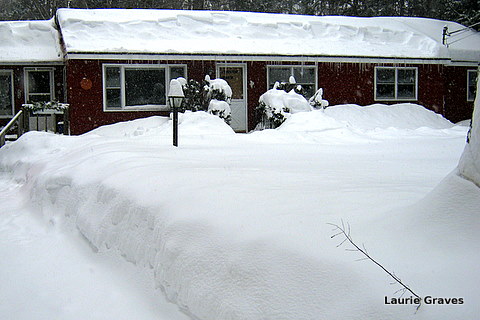
Yesterday, we visited our friend Diane, and upon returning and driving through the tunnel of snow that is now our driveway, my husband, Clif, observed, “You should call this the little house in the big snow.” Duly observed, and he couldn’t be more right.

I’m not sure if the pictures adequately show just how deep the snow is around our house, but in the shot below, it looks as though the snow is up to the windows. That’s because it is. While we don’t have the most snow ever—one winter the snow was up to the bottom of our outdoor lantern—it seems as though it’s the most snow we’ve gotten in the shortest amount of time—two feet of snow promptly followed by another foot of snow with yet another foot of snow predicted for today.

Snow up to the windows

And how cold it is. When I went outside to take pictures of our snow-bound house, the snow squeaked beneath my shoes, and I wasn’t suprised to learn that the temperature was still at zero degrees, even though it was midmorning.

So, more clearing of snow this afternoon. High winds are predicted to go along with the storm, which means we have to worry about our power going out. Clif is working at home today, and we’ll have our big meal at noon—a strata using Farmer Kev’s broccoli. That way, we’ll have plenty of time to do the dishes and clean the kitchen before the winds come.

Because of the weather, Clif and I have been pretty house-bound, and although we love our home,  there comes a point where we both feel a little stir crazy. How good it was, then, to visit our friend Diane. We had tea, a tasty bread made from exotic grains—can’t remember what they were—that gave a lovely carob flavor to the loaf. Best of all was the conversation. We talked about the burgeoning food movement in Maine—the increase in young farmers and co-ops. We talked about the number of people struggling to afford good food—Diane volunteers at her local soup kitchen and food pantry, and she has seen first hand how the Great Recession has affected people. She told us about a Japanese drumming concert she recently attended and how she met a man who was planning on opening a noodle shop on Munjoy Hill.

“Let’s all go when it opens,” I said. Clif and I rarely eat out anymore. With many places charging $10 for lunch, it’s become too expensive for us. But Clif and I are suckers for noodle shops—we found a great one in New York City once when we were visiting Dee—and noodles are usually very affordable.

When we left Diane’s house, a nearly-full moon was rising, framed by a neighbor’s roof and the bare branches of a large, dark tree. The sky was a deep blue, and how beautiful the winter sky was at twilight.

We stopped at Reny’s on the way home, and we got some wicked good deals, as we Mainers like to say.

All in all, a great way to cap off a delightful afternoon.

Now, onward to dinner and then clean-up.